Recovering from Chronic Stress: A Leader's Guide to Reclaiming Sovereignty
That constant, low-level hum of being ‘on.’ You know the feeling. It’s the relentless drive that fuels your success but leaves you utterly spent. For high-achieving leaders, this isn't just stress; it’s the fast track to a ‘Silent Collapse’—that critical moment where your internal systems can no longer sustain your external performance. You fear that if you slow down, even for a moment, everything you’ve painstakingly built will crumble. This isn't just about feeling tired; it’s a systemic breakdown.
Key Takeaways
The Silent Collapse: Chronic stress isn't just a feeling; it's a physiological state where your nervous system gets stuck in "survival mode," leading to burnout, brain fog, and a breakdown in your ability to recover.
The RAMS Framework: Lasting recovery requires a structured approach. The RAMS Method (Results, Attitude, Mastery, Systems) provides a practical framework to move from depleted survival mode to sustainable, embodied leadership.
Nervous System Sovereignty: The true goal isn't eliminating stress but building the capacity to handle pressure without losing yourself. This is nervous system sovereignty—the ability to lead from a place of grounded clarity and authentic power.
Recovering from chronic stress is the strategic process of reclaiming your energy, focus, and internal authority, enabling you to lead from a place of embodied power, not sheer willpower. It’s a recalibration of your entire operating system to handle modern pressures without self-destructing. This journey is not about abandoning your ambition, but upgrading your capacity to sustain it.
The Hidden Pattern: Why Your Body Keeps Score When Your Calendar Cannot
Your calendar is a masterpiece of precision. Every meeting and deadline is slotted into place, creating a perfect illusion of control. But while your schedule looks pristine, your body keeps a different ledger. It meticulously logs every missed meal, late night, and surge of adrenaline you summoned to hit one more target. It never forgets.
This growing gap between external performance and internal reality is where burnout takes root. The internal dialogue often sounds like, “If I stop performing, I’ll disappear.” That thought isn't just anxiety; it’s a deeply ingrained belief that keeps the burnout cycle spinning. Acknowledging that your physical symptoms are data points from a system under siege is the first step to recovering from chronic stress.
The Miscalibrated Internal Threat Detector
Think of your nervous system as your internal Threat Detector. Its job is simple: keep you safe. Faced with real danger, it triggers the "fight or flight" response, flooding you with cortisol and adrenaline. This is an ancient survival mechanism designed for short, intense bursts of stress.
The problem is, your Threat Detector can't distinguish between a charging tiger and a quarterly report. An urgent email, a looming deadline, a difficult conversation—it just registers "threat" and hits the big red button. Day after day, your system gets stuck in high-alert. Eventually, that sophisticated detector becomes miscalibrated. It starts seeing danger absolutely everywhere.

The Science of Being Stuck in Overdrive
This constant state of high alert is run by your Hypothalamic-Pituitary-Adrenal (HPA) axis. When it’s chronically switched on, the consequences ripple through your entire body.
High cortisol, the primary stress hormone, is useful for short-term survival. But when perpetually elevated, it becomes destructive. A 2021 study in the journal Endocrinology, Diabetes & Metabolism confirms that prolonged cortisol exposure can trigger systemic inflammation, impair immune function, and disrupt metabolic health. It’s critical to understand how to reduce cortisol levels naturally to begin reversing this damage.
This hormonal flood also directly rewires your brain. It impairs the prefrontal cortex—your center for executive functions like decision-making and emotional regulation. This is the neurobiological reason for that frustrating brain fog. We cover this in greater detail in our deep dive into your nervous system architecture.
From Acute Response to Chronic Condition
It’s crucial to understand the difference between a healthy stress response and the damaging state of chronic stress. One is a brilliant survival tool; the other is a fast track to what we call executive dysregulation.

This shift is where the real damage is done. Post-COVID data from the American Psychological Association highlights this tension: while 81% of adults rated their mental health as "good" or better in 2023, chronic illnesses among 35-44-year-olds surged from 48% in 2019 to 58%. There's a massive disconnect between how people think they feel and what their bodies endure.
The RAMS Method: A Practical Framework for Recovery
Knowing your body is keeping score is one thing; clearing that ledger is another. Recovering from chronic stress isn't a passive process. It’s an active, structured recalibration. You don’t need more theories; you need a practical framework built for the realities of high-performing leadership.
That framework is the RAMS Method.
RAMS stands for Results, Attitude, Mastery, and Systems. It is a comprehensive operating system designed to move you from depleted survival mode into sustainable, embodied leadership. It’s the bridge from knowing why you're exhausted to knowing how to rebuild from the ground up.
Redefining Your Results
The first pillar, Results, targets the engine of burnout: the relentless pursuit of external validation. You’ve likely measured success by metrics outside yourself—KPIs, revenue targets, promotions. This external focus trains your nervous system to believe your worth is conditional.
The RAMS Method flips that definition. We move from chasing external validation to cultivating internal sovereignty.
True success isn't measured by your capacity to endure more, but by your capacity to thrive within your limits. It’s generating powerful outcomes without sacrificing your well-being.
You start redefining your KPIs to include metrics your nervous system understands as safety and success:
Energy Levels: How much vitality do you have at the end of the day?
Quality of Focus: Can you drop into deep, uninterrupted work?
Emotional Regulation: Are you responding from calm clarity or reactive urgency?
Restorative Sleep: Are you waking up genuinely rested?
When these internal states become your benchmarks, you rewire the core programming that fuels burnout.
Shifting Your Core Attitude
The second pillar, Attitude, addresses the internal narratives that keep you stuck. For many leaders, the underlying belief is one of control and self-reliance at any cost: "I have to handle this all myself."
These beliefs directly command your physiology. Changing this isn’t about forced positivity. It’s a deliberate shift from a mindset of struggle to one of strategic recovery.
Move from Control to Influence: You can't control every outcome, but you can influence your response.
Embrace Compassionate Discipline: Treat yourself with the same strategic care you’d offer a top-performing team member.
View Rest as a Strategic Imperative: See rest and downtime as non-negotiable components of peak performance.
This attitudinal shift is the key that unlocks nervous system regulation. The mind must lead the way, creating the psychological safety your body needs.
Achieving Bodily Mastery
Mastery is the third pillar. This is where you build the tangible skills to regulate your nervous system in real-time. It’s about reclaiming control.
Key skills you develop here include:
Boundary Setting: Learning to say "no" as a clear declaration of your capacity.
Emotional Differentiation: The ability to identify, name, and process emotions without letting them overwhelm you.
Somatic Awareness: Learning to tune in to the subtle signals of your body—the knot in your stomach, the tension in your jaw—and responding before they escalate.
Developing these skills is like building muscle. For a deeper look into creating this internal stability, our guide on finding peace in the midst of chaos is a great place to start.
Building Sustainable Systems
Finally, Systems provide the structure to make your recovery sustainable. Willpower is a finite resource. You need intelligent systems that make recovery the default option.

These are not just "healthy habits." For a leader recovering from chronic stress, they are essential infrastructure. They reduce your cognitive load and give your body the consistent signals of safety it needs to finally exit survival mode.
The Return: Navigating Your Recovery Timeline
Recovering from chronic stress isn't a race. It's a gradual, often messy, return to yourself. This isn't about getting rid of stress; it’s about building the capacity to handle pressure without losing yourself in the storm.
Think of it in three core phases: Stabilize, Integrate, and Embody. Together, they represent your path back to nervous system sovereignty.
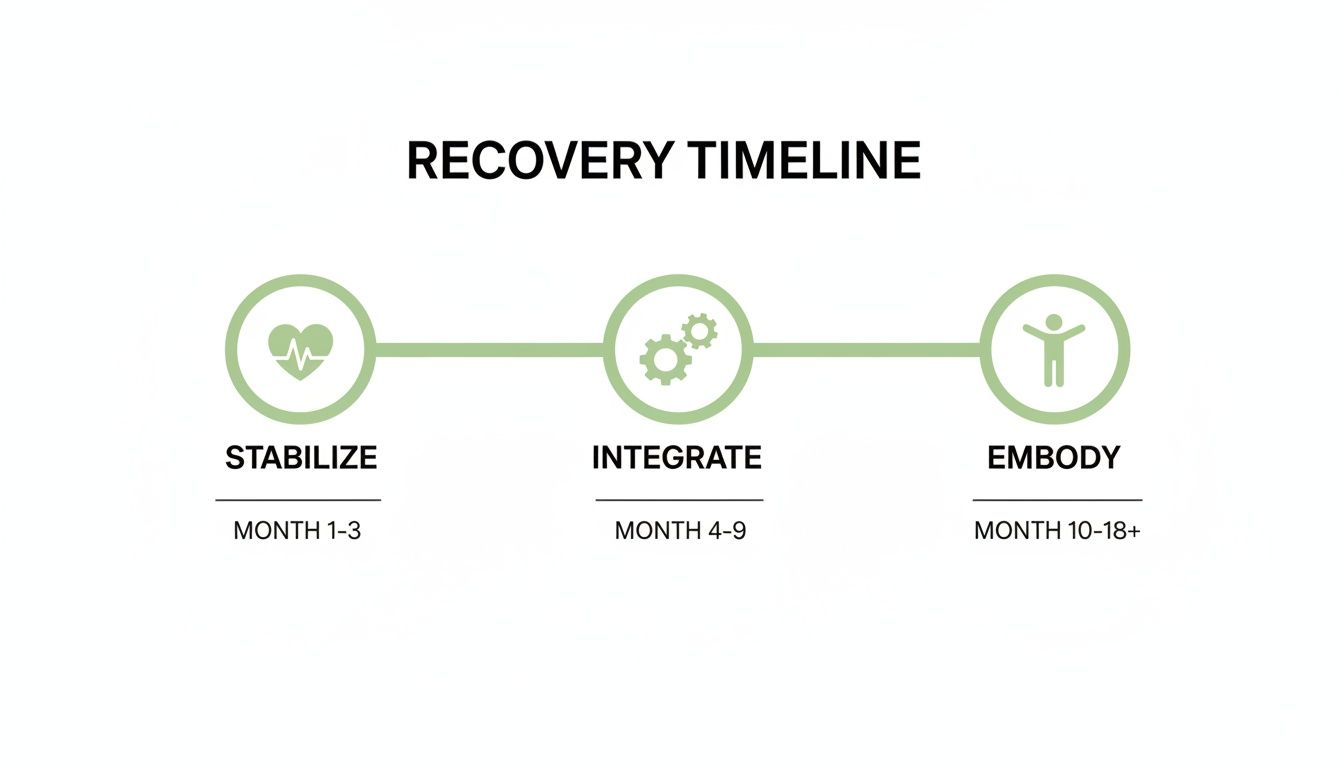
This visual shows that real recovery is a progressive build, starting with the basics and moving toward a fully embodied, grounded state.
Phase 1: Immediate Stabilization (The First 3 Months)
This first phase is pure triage. Your only mission is to stop the physiological bleeding. Performance takes a backseat to deep, intentional restoration. The focus is down-regulating your nervous system:
Prioritizing Sleep: A non-negotiable sleep routine is your most powerful tool.
Nutrient-Rich Fuel: Focus on whole foods that calm inflammation.
Gentle Movement: Think walking or stretching to release tension without adding stress.
The biggest hurdle here is recovery resistance. Your high-achieving brain will fight this slowdown. Learning the art of strategic rest and recovery is the most critical leadership skill you can develop right now.
Milestone: The main sign of progress is a shift in your physical state. You start waking up feeling more rested. Your energy is more stable.
Phase 2: Sustainable Integration (Months 3 to 6)
Once you have a baseline of stability, the deeper work begins. You move from consciously forcing new habits to building a life where they become natural.
Setting Firm Boundaries: You proactively design your schedule to protect your energy.
Emotional Co-regulation: You learn practical, in-the-moment tools to self-soothe.
Mindset Reframing: You actively challenge the old narrative that "your worth is your productivity."
The biggest challenge is impatience. You’ll feel better and be tempted to floor it back to your old pace. Resisting that urge is everything.
Phase 3: Embodied Leadership (Months 6 to 12+)
This final phase is about moving beyond "recovering" and into a state of nervous system sovereignty. The new habits are no longer things you do; they are part of who you are.
Intuitive Decision-Making: You start trusting your gut again.
Authentic Presence: The need to perform fades. You show up as your full self.
Sustainable Ambition: You pursue big goals in a way that energizes, not drains you.
Even at this stage, the journey requires vigilance. But there’s real hope. Research from the World Health Organization shows the body's remarkable capacity for healing, with many individuals recovering from severe stress conditions within a year when following structured support.
Returning to Nervous System Sovereignty
The end goal isn't just getting back to baseline. It's claiming something far more powerful: nervous system sovereignty. This is an active, embodied power—the capacity to lead from grounded clarity, fueled by energy that lasts.
Sovereignty is how you meet challenges without blowing out your internal circuits. It’s where ambition and well-being stop being at odds. This journey is a profound return to the most centered, potent, and effective version of yourself.
The Shift from Exhausted Achiever to Sovereign Leader
This process fundamentally rewires your relationship with success.
From External Validation to Internal Authority: Your sense of worth is anchored in your own embodied presence.
From Willpower to Strategic Energy Management: You operate from a full tank, using rest as a performance tool.
From Reactive Firefighting to Proactive Regulation: You respond to stress with skill, heading off overwhelm before it takes hold.
This is about trading the fragile identity of the ‘performer’ for the resilient identity of the ‘sovereign leader.’ One seeks approval; the other operates from deep self-trust.
Your Next Step Toward Embodied Leadership
Knowledge is just the starting block. Real change happens when insight translates into consistent action. As you begin, exploring actionable ways to regulate your nervous system can provide a toolkit of practical strategies.
You're at a decision point. This information can remain a concept, or it can be a catalyst. To get deeper into the practical tools, our comprehensive guide to nervous system regulation is your next logical stop.
For the leader ready to move from understanding to embodying this work, the first step is to get an honest lay of the land. Our diagnostic tool was designed for this. It will pinpoint where chronic stress is sabotaging your leadership and your life. It’s not a test. It’s a map—your personal guide to reclaiming your power.
Frequently Asked Questions
How do I know if I have chronic stress or just a demanding job?
A demanding job creates pressure; chronic stress dismantles your capacity to handle it. The key difference is recovery. Can you truly recharge, or does bone-deep exhaustion linger? Chronic stress shows up as persistent fatigue, brain fog, and a sense of detachment, even from wins. This is the 'Silent Collapse': your internal systems can no longer keep up with external demands.
Can I recover while still performing in my career?
Yes, emphatically. This recovery isn't about stepping away from ambition but changing how you fuel it. The RAMS Method was designed for this reality. It teaches you to perform with greater impact by eliminating the internal friction that drains your vitality. Recovery becomes your ultimate performance advantage.
How long does it realistically take to see results?
Recovery is a process. You'll often feel initial physiological relief—like better sleep or less anxiety—within the first few weeks. This is stabilization. The deeper, sustainable recovery that rewires long-held habits is a 6 to 12-month process. This timeline is a message of hope: meaningful, lasting change is achievable with a structured, compassionate path.
This journey from an exhausted achiever to a sovereign leader is the most important work you will ever do. To understand exactly where you're starting and get clarity on your personal recovery path, your next step is to take our diagnostic.