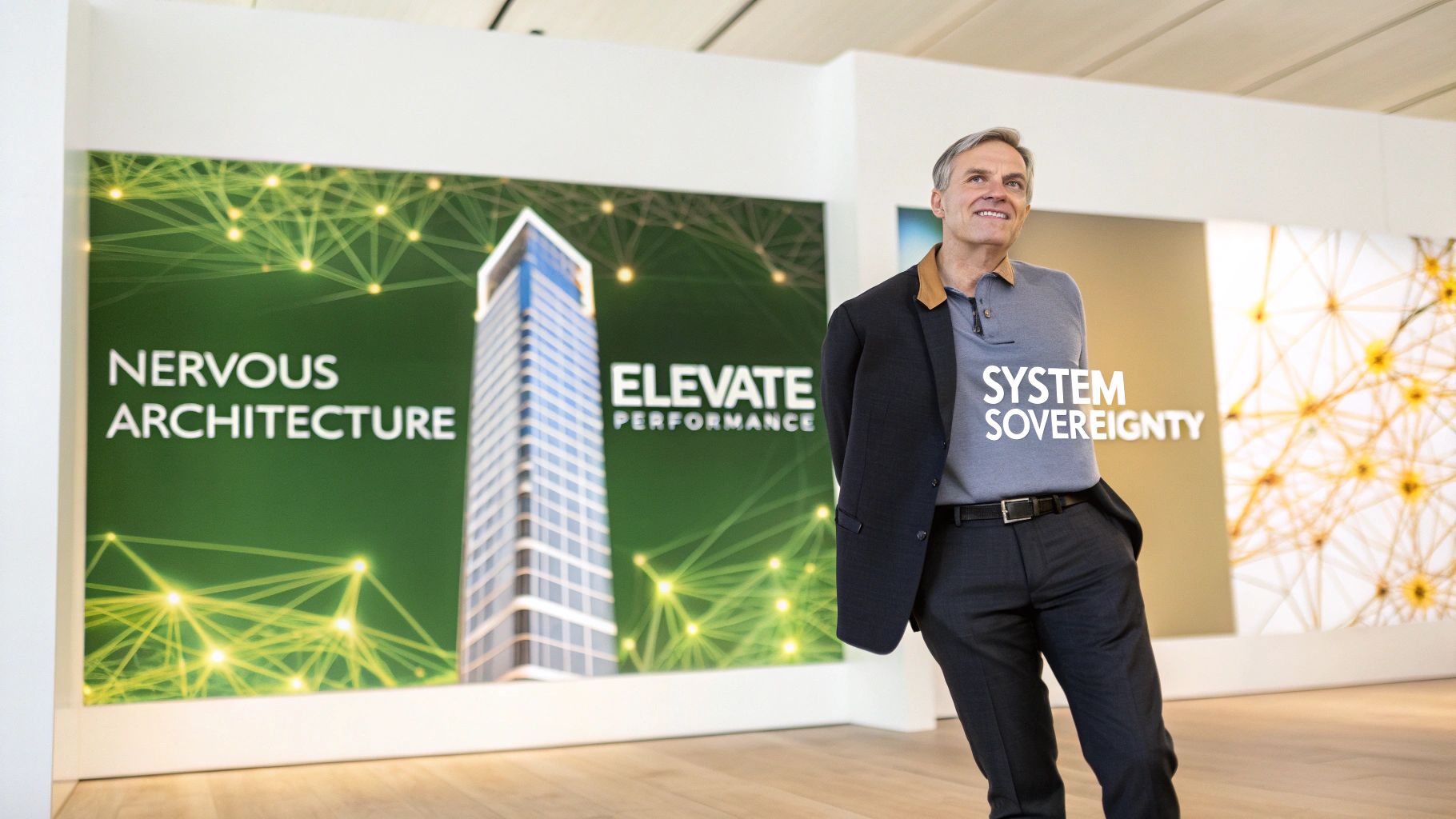
Nervous System Architecture: Your Blueprint for High Performance
You've hit every target and built an empire of success. So why does it feel more like depletion than victory? That constant, grinding exhaustion you can't seem to shake, no matter how much you achieve?
This is the Silent Collapse. It’s the exhausting reality where your relentless drive leads to a profound disconnection from yourself and your life. It’s the internal dialogue that says, “If I stop performing, I’ll disappear.” This shadow is the hidden cost of success.
Key Takeaways:
Your nervous system architecture is the invisible framework dictating how you handle stress, make decisions, and manage energy. An outdated architecture is the root of burnout.
High-achievers often operate in a chronic "Survival Mode," driven by the sympathetic nervous system, leading to reactivity and depletion. The goal is to shift to "Sovereign Mode," governed by the parasympathetic system, which enables presence and strategic vision.
Your internal architecture was built by your life experiences through a process called neuroplasticity. The same process allows you to intentionally rebuild it for sustainable performance.
The RAMS Method (Results, Attitude, Mastery, Systems) is a practical framework to reclaim your blueprint, shifting from an architecture of depletion to one of sovereign command.
Your Blueprint is Now Your Burden
What if the very operational blueprint that fueled your rise is now the source of your burnout? This internal "tax" on your achievement is often supercharged by unmanaged stress, revealing the hidden connection between stress and illness.
Your current nervous system architecture is the set of ingrained biological patterns you use to manage pressure. This internal wiring was likely built for survival, not sustainable leadership. This invisible framework, once your greatest asset, has become your most significant liability.
It’s time for a fundamental redesign.

Understanding Your Nervous System Architecture
Forget complex medical diagrams. Picture the foundational architecture of a skyscraper. You don't see the steel beams or the deep-set foundation holding it all together, but you know they dictate the building's capacity to withstand storms and bear immense weight.
Your nervous system architecture is that invisible framework. It’s your personal blueprint for processing stress, making decisions, and managing your energy.
This internal structure isn't static; it's an evolving system shaped by millions of years of evolution and a lifetime of your personal experiences. It's the biological hardware running your career and your entire life. Recognizing that an 'always-on' state isn't a badge of honor, it's a critical design flaw, is the first step. When this system is constantly pushed into overdrive, you don't just get tired; you burn out. If that sounds familiar, it might be time to learn how to recover from burnout.
The Two Core Divisions
Your internal skyscraper has two main structural divisions. Understanding their roles is the key to understanding why you feel the way you do.
The Central Nervous System (CNS): Your command center. Comprised of the brain and spinal cord, it processes information and sends directives to your body. When you're facing a high-stakes decision, your CNS is firing on all cylinders.
The Peripheral Nervous System (PNS): The intricate network of nerves branching out from the CNS. It acts as the communication grid, relaying sensory information back to command and carrying out its orders.
This diagram shows just how interconnected these systems are, forming a complete communication network from head to toe.
You can see the CNS as the core axis and the PNS branching out, a visual reminder of the vast reach of your body's internal wiring.
An Evolutionary Edge
Our nervous system is a marvel of evolution. While our brains are similar in size to other primates, their internal architecture is a different story.
Humans pack an astonishing 16 billion neurons into the cerebral cortex, the region responsible for executive function. This incredible density, which far outpaces the 6-7 billion found in chimpanzees, allows us to perform sophisticated problem-solving under immense pressure.
This advanced hardware gives you an incredible capacity for achievement. But here's the catch: without conscious management, its ancient survival programming can become a serious liability in the modern world. It’s what leads to the chronic stress patterns high-achievers know all too well. It’s this outdated wiring we must address to build a more sustainable model for leadership and for life.
Your Two Core Operating Modes: Survival vs. Sovereignty
Your nervous system constantly runs one of two core operating systems. Think of them as internal modes that dictate everything from your heart rate to your ability to think strategically. We call these Survival Mode and Sovereign Mode.
Most high-achievers are intimately familiar with Survival Mode. This is your default state when the sympathetic nervous system, your body’s gas pedal, is floored. It’s a state defined by reactivity, a constant low-humming need for control, and frantic sprints fueled by cortisol. It gets the job done. But it’s a direct flight to burnout.
Sovereign Mode, on the other hand, is governed by the parasympathetic nervous system, specifically the powerful vagus nerve. This is your internal braking system, the one that allows for recovery and regulation. This state is where presence, creativity, and strategic vision live. It’s the birthplace of sustainable, high-impact performance.
Survival vs. Sovereignty: A Leadership Breakdown
The chasm between these two states isn't just physiological; it's the difference between a leader who merely gets by and one who truly commands their world. One mode relentlessly burns through your resources; the other regenerates them.
For any high-performer, just recognizing which mode has become your default is the critical first step toward reclaiming your energy, impact, and sanity. It’s the beginning of a deliberate shift from an architecture of depletion to one of genuine sustainability.
To really grasp this, let's look at the foundational flow of your nervous system's architecture. This isn't abstract theory; it's the blueprint of how you experience every single moment.
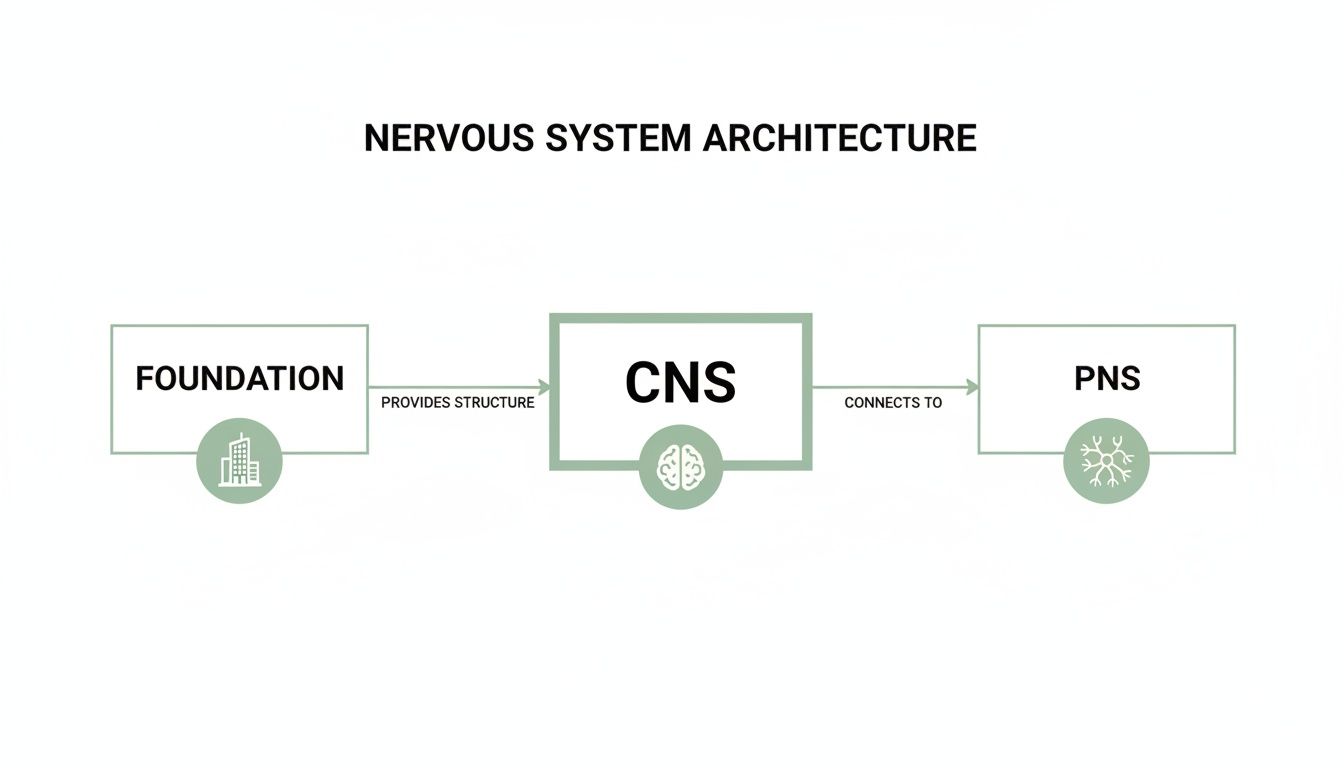
As you can see, your Central Nervous System (CNS) is the command center. It sends signals out through the Peripheral Nervous System (PNS), which then activates either your Survival (sympathetic) or Sovereign (parasympathetic) state. The choice between them dictates the quality of your leadership, your decisions, and your life.
To make this distinction crystal clear, we need to compare the tangible outcomes of operating from each mode. One builds a career on a fragile foundation of stress; the other builds a legacy on the bedrock of resilience. Cultivating the right internal state is non-negotiable, which is why resetting your mindset is such a critical piece of this work.
Leadership Comparison: Survival Mode vs. Sovereign Mode
This table isn't just data, it's a diagnostic tool. It contrasts the two primary operational states of your nervous system, highlighting their profound impact on leadership behaviors, decision-making, and long-term viability. As you read, ask yourself: which column feels more like my daily reality?

Seeing these two modes laid out side-by-side often triggers a powerful 'aha' moment. You start to see the patterns. You can finally put a name to the state you’ve been living in.
Recognizing your default state isn’t a judgment, it’s a diagnosis. It’s the essential starting point for intentionally redesigning your internal architecture for sovereignty.
How Your Internal Architecture Was Built
Your internal operating system wasn't installed overnight. It was built, layer by layer, over decades, shaped by every experience and high-pressure moment you’ve navigated. The brain’s core principle for this construction is neuroplasticity: your brain constantly changes and reorganizes itself based on what you do.
Think of your brain at birth as a dense, untamed forest. Your earliest experiences forged the first footpaths. Every time you repeated a behavior or thought pattern to cope with stress, that path got wider and clearer.
Over years of repetition, those footpaths became the superhighways you now travel automatically. Your system wasn't designed for the modern boardroom; it was meticulously engineered for survival based on the unique landscape of your life.
From Blueprint to Superhighways
The initial blueprint for your nervous system is laid down with staggering speed. The process kicks off just three weeks after fertilization, with neural stem cells multiplying at a peak rate of 250,000 neurons per minute. By birth, this foundational structure is packed with roughly 86 billion neurons.
But this is just the beginning. Your brain then goes through a critical refinement process called synaptic pruning. In childhood, it creates a massive surplus of connections, peaking at one quadrillion synapses, then strategically trims away the connections that are used less often.
This means your brain actively prunes away the pathways for calm and connection if your environment consistently demands vigilance and control. It's a ruthlessly efficient survival mechanism that reinforces whatever it believes you need most.
The Lasting Impact of Early Experiences
The experiences that guide this pruning process have a profound and lasting impact. These formative years create the deep-seated patterns that often run on autopilot in your adult life, especially under pressure. To truly grasp how these early events sculpt our internal operating systems, exploring resources on childhood trauma therapy can offer a powerful lens for understanding the path toward healing and resilience.
Here’s the critical insight: defaulting to a high-alert, survival-driven state isn't a personal failing or a character flaw. It is the logical outcome of a system built and reinforced by your specific life path.
Your internal architecture is simply running the most well-practiced programs it has.
But the most powerful truth of neuroplasticity is this: if your architecture was built, it can be intentionally rewired.
The RAMS Method for Reclaiming Your Blueprint
Knowing your internal architecture was built is the first crucial insight. Realizing you can renovate it is the game-changer. This is where we move from theory into direct, embodied action.
To reclaim your blueprint, you need a framework to intentionally reshape your nervous system architecture from a place of constant survival to one of sovereign command.
That framework is the RAMS Method. It’s a practical, four-part system I developed for high-achievers to systematically dismantle the patterns of burnout and build a foundation for leadership that lasts. Each part is a lever for intentional change, moving you from being a passenger in your own body to becoming the architect of your state.

The Four Pillars of the RAMS Method
The RAMS Method isn’t about piling more onto your already overflowing plate. It’s about replacing the inefficient, draining processes that got you here with elegant, energizing ones. It's built on four interconnected pillars that create profound, lasting shifts.
Results: This pillar upends the high-achiever’s definition of success. It shifts your focus from chasing external metrics to cultivating internal alignment and energetic sustainability. True results are measured by your capacity, not just your output.
Attitude: This is where we rewire the mindset that keeps you trapped in Survival Mode. We cultivate the mental frameworks that allow you to move from a reactive, control-based stance to a responsive, trust-based one.
Mastery: This is the most direct intervention for your nervous system. It’s a toolkit of embodied, somatic practices that give you the ability to consciously regulate your physiological state, downshifting from high alert to calm presence in minutes.
Systems: The final pillar is about building the external structures that protect your new internal state. This is the practical application of boundaries, routines, and environmental design that stop you from defaulting back into your old, exhausted patterns.
To go deeper into how these elements create a robust leadership model, you can explore a full explanation of the RAMS Method leadership framework and see how it applies to executive performance. This approach provides a clear path to rebuilding your internal world.
A Tangible Shift in 60 Seconds
The real power of this work lies in its immediate, felt impact. Let’s try a simple somatic exercise. This practice directly engages your Vagus nerve, the superhighway of your parasympathetic (Sovereign Mode) state.
The Embodied Reset Exercise:
Find Your Seat: Sit upright, feet flat on the floor. Uncross your legs and arms. Rest your hands gently on your thighs.
Lengthen Your Spine: Imagine a string gently pulling the crown of your head toward the ceiling. Let your shoulders soften down and away from your ears.
The Somatic Sigh: Take a slow, deep breath in through your nose, letting your belly expand. Then, release the breath with an audible, open-mouthed sigh. Make a "haaaaa" sound from deep in your throat. Repeat three times.
Notice the Shift: After the third sigh, sit in stillness. Close your eyes if comfortable. Notice the subtle changes. Is there more softness in your jaw? Less tension in your shoulders? Do you feel more grounded?
That subtle shift is a real, measurable change in your nervous system. It’s a micro-dose of Sovereign Mode. It’s proof that you have the power to change your nervous system architecture—one conscious breath at a time.
This is the foundation of Mastery.
The Return to Embodied Leadership
This path isn’t about eliminating pressure. Pressure is a constant for any leader worth their salt. The real game is about upgrading your capacity to meet that pressure with a regulated, resilient, and grounded nervous system.
This is the essence of embodied leadership. It's the shift from managing external chaos to commanding your internal world. Your "Silent Collapse" wasn't a failure; it was a necessary catalyst, your system’s final signal that the old architecture could no longer support the weight of your ambition. It forced an evolution.
Sovereignty as the New Foundation
True, sustainable power doesn't come from pushing harder. It comes from achieving nervous system sovereignty, the ability to choose your state, to access calm and clarity on demand, and to lead from a place of authentic presence. This is the bedrock of creativity, strategic insight, and lasting impact.
When you operate from this place, your decisions become sharper. Your communication resonates on a different level. Your very presence inspires trust, not anxiety. You stop leaking energy on internal battles and redirect it toward the vision you are here to build.
This return isn't about becoming a softer version of yourself. It is about becoming more potent, more discerning, and more aligned by mastering the very system that drives every action you take.
Your Next Step in Evolution
This process is a deliberate reclamation of your innate leadership capacity. It's about shedding the heavy armor of survival mode to finally step into the full power of your sovereign self.
For leaders ready to make this shift, the next step involves structured guidance. Exploring transformational leadership training is the logical continuation of this path, providing the tools and support to solidify this new way of being. This isn’t just another strategy to add to your toolkit; it's a return to the powerful, effective, and embodied leader you were always meant to be.
Questions on the Tip of Your Tongue
Even the most decisive leaders come to this process with questions. It's natural. Here are straight answers to the things you’re probably wondering about as you consider redesigning your internal operating system.
How Long Does This Actually Take?
Rewiring your nervous system is a practice, not a magic pill. While you can feel a genuine shift in your state from a single regulation exercise, lasting change is built over time. Neuroplasticity is a game of consistency.
The RAMS Method isn’t about disruptive overhauls. It’s designed to weave small, potent practices into the life you already lead. By integrating these moments of intentional regulation into your demanding schedule, you build new neural pathways through steady repetition.
Is This Realistic for a High-Stakes Environment?
Absolutely. This work is specifically for high-stakes worlds. Nervous system regulation isn't about becoming soft; it's about becoming ruthlessly effective and clear-headed when the pressure is on.
A regulated state is your ultimate competitive advantage. It sharpens your cognitive function, elevates your decision-making, and builds the kind of resilience that doesn’t fray at the edges. It’s the key to shifting out of reactive fire-fighting and into proactive, strategic leadership.
Sovereignty isn't about stepping back from the pressure; it's about developing the internal capacity to master it without being depleted by it.
I'm Already Successful. Why Do I Need This?
Many of us build incredible success by muscling through, overriding our body's signals with sheer willpower. That's a burnout model, not a sustainable leadership model. It works, but it has an expiration date.
This work is about making the critical shift from success at a cost to sustainable, embodied success. It gets to the heart of why so many accomplished leaders, despite all external validation, feel a deep, persistent sense of depletion.
It’s the difference between being a temporary high-performer and becoming a leader who can sustain that performance for a lifetime. This is the architecture of a legacy.
Are you ready to stop running on fumes and start leading from a place of deep energetic capacity and authentic power? At Baz Porter, we help high-achieving leaders like you rebuild their internal architecture for sustainable success and profound fulfillment. Learn more and begin your return to sovereignty at https://bazporter.com.
Where to go next
If any of this reads like your own reflection, the Silent Collapse Diagnostic™ is a quiet place to start. And if you want the deeper why beneath the work, read the Sovereign Manifesto.