The High Achiever's Guide to Rest and Recovery
Strategic rest and recovery isn't a luxury for elite leaders; it's a non-negotiable command performance for your nervous system. You've been treating adrenaline as a renewable resource, pushing past biological limits to secure results. But now, the system is flashing red. The deep, cellular exhaustion that no amount of coffee can touch is the first sign of a silent collapse. This isn't about weakness. It's about consciously rebuilding the physiological and psychological firepower you need for razor-sharp decision-making, innovation, and performance that actually lasts.
Key Takeaways
Burnout is a Business Liability: Ignoring rest and recovery isn't a personal failing; it's an economic crisis. Burnout and disengagement drain an estimated $8.8 trillion from the global economy annually.
The Adrenaline Economy is a Trap: High performers often operate in a state where stress hormones are the primary currency, leading to a state of executive dysregulation that cripples strategic thought and locks the nervous system in fight-or-flight.
Recovery Must Be Active, Not Passive: True rest is an intentional, physiological process of down-regulating your nervous system, not just the absence of work (like mindlessly scrolling social media).
The RAMS Framework is Your New OS: A sustainable system for performance requires shifting your approach to Results, Attitude, Mastery, and Systems to build a foundation of embodied leadership, not exhaustion.
The Hidden Cost of Constant Motion

You got to this level because of your relentless drive. That capacity to push past limits, to be "always on," is the very engine that built your career.
But that engine is sputtering. You feel it in the quiet moments—that profound disconnection. The clarity that once defined your leadership is now clouded by a persistent brain fog. Decisions feel heavier, your patience is shot, and the very passion that got you here feels like a distant memory.
Strategic rest and recovery is the intentional process of rebuilding your physiological and cognitive resources to prevent burnout and sustain high performance. It moves beyond passive non-work to actively down-regulate your nervous system, allowing you to operate from a place of capacity, not deficit.
The internal script is one I've heard a thousand times: "If I stop, everything falls apart. If I’m not performing, I'll disappear." That fear keeps you trapped on a hamster wheel of output, forcing you to ignore the warning signs your body is screaming at you.
You're running on a deep physiological deficit, treating adrenaline like it's a renewable resource. It's not. It’s a loan with compounding interest, and true rest and recovery is the only way to pay it back.
The problem isn't your work ethic. It's your operating system—an outdated program that equates rest with failure. This system ignores a fundamental biological truth: sustained peak performance is impossible without strategic recovery.
Think of your nervous system as a high-performance engine. You can redline it for a short time, but if you never pull into the pit for maintenance, it will seize up and fail. Intense cognitive and emotional output creates "microtears" in your focus and resilience. Without proper recovery, those small fissures cascade into a systemic breakdown known as executive dysregulation.
It’s time to reframe rest. It's not the absence of work, but the work itself—the essential, non-negotiable work of rebuilding your capacity to lead with power, clarity, and purpose.
The High Price of Hustle: Why Burnout Is a Business Metric
The relentless chase for success comes with an unspoken price: we trade our well-being for the next big achievement. Most leaders operate in what I call the ‘Adrenaline Economy’—a system where cortisol is the currency and exhaustion is the cost of doing business.
This isn't a sustainable model. When your body is constantly swimming in stress hormones, your nervous system gets locked into 'fight-or-flight' mode. This isn't a mindset problem you can "power through." It’s a biological state that dismantles your leadership tools. Strategic thinking is replaced by knee-jerk reactions. Creativity is choked by anxiety. Your ability to connect with your team is short-circuited by a nervous system wired for threat detection. For a deep dive into how stress causes fatigue, this resource is invaluable.
The Real-World Cost of Ignoring Recovery
The damage from neglecting rest and recovery doesn't stop with you. It ripples outward, impacting your team, your culture, and your bottom line.
This isn’t a hunch; it’s a global economic crisis. A stunning 48% of employees worldwide report feeling burned out, according to Gallup's State of the Global Workplace Report. This level of disengagement drains an estimated $8.8 trillion from the global economy every year.
That's 9% of global GDP.
That staggering number confirms a hard truth: burnout isn't a personal failing. It’s a massive business liability. It shows up in measurable ways in your organization.
Plummeting Team Productivity: A leader running on empty sets a frantic, unsustainable pace. This directly translates to lower output and sloppy work.
Sky-High Talent Turnover: Your best people will not stick around in a culture that treats exhaustion like a badge of honor.
Compromised Business Outcomes: Strategic blunders and poor judgment calls are the direct result of a tired mind.
Ignoring your own need for recovery isn't a sign of strength. It's a direct threat to the health of your organization and the very results you're working so hard to achieve.
Exhaustion is a critical business metric. It signals a breakdown in the most important system of all: you. True rest and recovery isn't a luxury; it's the strategic imperative that protects this asset.
The RAMS Framework: A New Operating System for Recovery
Knowing the cost of hustle culture is one thing. Doing something about it is another. What's needed is a new operating system for how you perform. The problem for most executives isn't a lack of effort—it’s the absence of a sustainable structure for that effort.
That’s where the RAMS Framework comes in. It is a blueprint to systematically shift you from exhaustion-driven output to embodied leadership.
RAMS stands for Results, Attitude, Mastery, and Systems. It’s a methodical approach I've developed to help leaders dismantle burnout patterns and rebuild their capacity for high performance on a foundation of genuine well-being. Each pillar targets a vulnerability that keeps high-achievers trapped.
This isn't just about feeling better. It's about leading better.
Redefining Your Results
The first pillar, Results, challenges the toxic belief that your value is tied to your output. The RAMS approach redefines a successful outcome as one achieved with clarity, strategic impact, and preserved energy. This means you learn to ruthlessly prioritize the few tasks that actually move the needle and eliminate the rest. It’s a powerful shift from being "busy" to being truly effective.
Adopting a Pro-Recovery Attitude
Next is Attitude. This is about the internal narrative that says rest is a sign of weakness. For most leaders I work with, this mindset is the single biggest barrier to effective rest and recovery. You must consciously adopt a new belief: recovery is a productive, non-negotiable act. It’s a strategic investment. The ability to find peace in the midst of chaos isn’t passive hope; it's an active practice rooted in the attitude that your well-being fuels your excellence.
Achieving Nervous System Mastery
The third pillar is Mastery. This is where we build real skills in nervous system regulation. The always-on grind leaves your nervous system chronically stuck in "fight-or-flight," which degrades your ability to think clearly. Mastery is about learning to intentionally shift your physiological state. It includes specific breathing techniques, mindfulness exercises, and somatic practices that actively down-regulate your stress response. You stop being reactive and start being centered.
Implementing Sustainable Systems
Finally, Systems provide the structure to lock all of this in. This pillar is about creating practical, repeatable routines that make rest and recovery an automatic part of your demanding schedule. This looks like:
Blocking recovery time directly in your calendar.
Establishing crystal-clear boundaries between work and personal life.
Implementing delegation workflows that protect your energy.
These systems are the guardrails that prevent you from defaulting back to old, unsustainable habits.
Hustle Culture vs. RAMS Recovery Model
What we're looking at here is a fundamental shift in the entire paradigm of performance—from an outdated, industrial-age model to a modern understanding of sustainable, brain-based leadership.

The difference is stark. One path leads to a dead end. The other opens up a career defined by sovereign, sustainable success. The RAMS Framework isn't just another recovery plan; it's a new paradigm for leadership.
Your Tactical Toolkit for Immediate Recovery
We've covered the RAMS framework. Now, let's get tactical. This is your in-the-trenches toolkit for calming your nervous system right when you need it most. This is about creating the physiological breathing room for real rest and recovery.
Forget hour-long meditations. These are micro-practices with macro-level impact, designed for an executive's schedule.
The RAMS framework itself gives us a map—moving from a leadership style fueled by exhaustion to one that's sustainable and embodied.
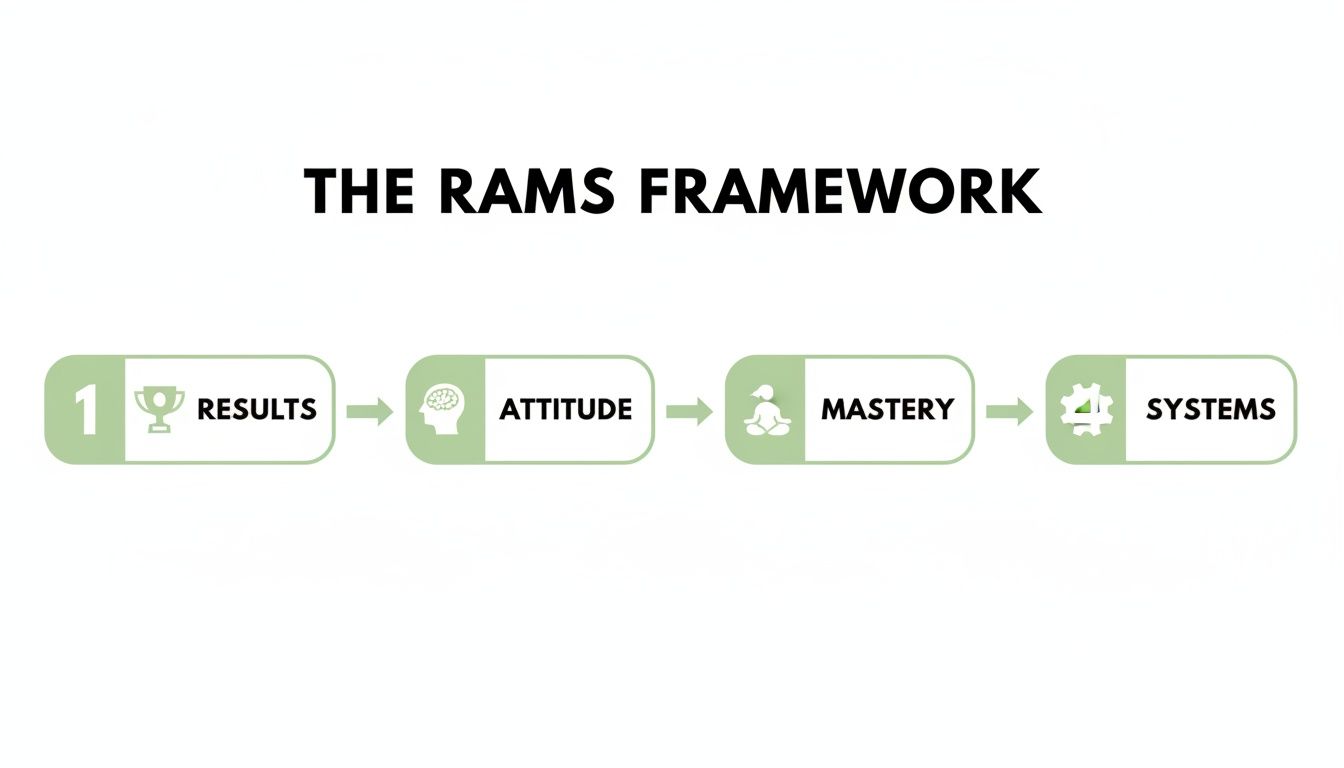
This process is a deliberate shift, and it starts with small, powerful actions.
The Physiological Sigh: Your 60-Second Reset Button
The pressure is mounting. You're about to walk into a critical meeting. Right there, you have a science-backed tool to instantly downshift your nervous system. It's called the Physiological Sigh.
How to do it: Take a deep inhale through your nose. Then, sneak in another short, sharp inhale. Now, let it all go with a long, slow exhale through your mouth.
Why it works: That double inhale pops open the tiny air sacs (alveoli) in your lungs, letting you offload carbon dioxide more efficiently. This sends a direct signal to your brainstem to slow your heart rate and pull you out of 'fight-or-flight' mode. Do this two or three times for an immediate shift.
This isn't just a breathing exercise; it's a direct intervention in your body's stress response. It’s one of the most potent tools for reclaiming your composure when stakes are high.
Strategic Time-Blocking for Deep Work and Actual Rest
Your calendar doesn't lie. It shows what you prioritize. If it's a solid wall of meetings, you've prioritized reaction over strategy. To get serious about rest and recovery, you must treat focus and rest like a board meeting.
Block out two non-negotiable types of time:
Deep Work Blocks: Schedule 90-minute blocks for tasks that demand full concentration. Notifications off. Let your team know you're offline.
Recovery Blocks: Schedule short, 15-minute breaks between meetings. Use this time to physically step away from your screen. Do a Physiological Sigh. Take a quick walk.
The Power of a Shutdown Ritual
The line between work and life has been obliterated. A "shutdown ritual" draws it back in, creating a clear psychological boundary that tells your brain the workday is over.
Your ritual doesn't need to be complicated. Consistency is key.
Quickly review your task list and plan for tomorrow.
Close every single work-related tab and application.
Say a specific phrase, like, "Work is done for the day."
Change your clothes or do a quick two-minute stretching routine.
This simple set of actions trains your brain to transition, stopping work stress from sabotaging your recovery. If disconnecting is a struggle, our guide on how to recover from burnout digs much deeper into these strategies.
Return to Yourself: Embodying Sustainable Leadership
Here’s the final and most critical piece: we have to stop treating rest and recovery like another set of tasks. The real objective is to move beyond just doing recovery and start being a leader who embodies sustainable performance.
This is where recovery becomes a permanent part of your leadership DNA.
It's not just a personal upgrade; it's a cultural one. When you, as a leader, model this behavior, you send a powerful signal to your entire organization. You set a new standard—one where well-being isn't a fluffy perk but the engine of high-impact results.
Becoming the New Standard
Your path becomes your influence. By strategically prioritizing your own rest, you give your team implicit permission to do the same. This creates a ripple effect, building a culture of psychological safety where people can bring their best work without sacrificing themselves.
You start to lead from genuine capacity, not from a deficit. Your decisions become sharper, your presence more grounded, your impact more profound.
True leadership isn't about having an endless supply of energy. It's about having the wisdom to know how and when to replenish it. This is the very core of embodied sovereignty.
This isn’t just about feeling better; it’s a strategic imperative. The World Health Organization found that workplace stress contributes to 12 billion working days lost every year globally to depression and anxiety. That loss equates to a staggering $1 trillion in productivity.
Your Path to Sovereignty
This final stage is about returning to yourself. It’s about reclaiming the parts of you sacrificed on the altar of achievement. By understanding your unique burnout signature, you can build a leadership style that is not only wildly successful but truly sustainable.
This is not a sale. This is a step toward "returning to yourself." Begin by understanding your own patterns of embodied sovereignty.
Common Questions About Executive Rest and Recovery
Even when you intellectually get the need for rest, I know there are deep-seated objections. It’s time we dismantle those barriers head-on.
How Can I Prioritize Rest When My Culture Expects Constant Availability?
You are the culture. You must lead from the front. Block out "Strategic Focus Time" or "Deep Work" in your public calendar. You're not taking a nap; you're preparing for your next big decision. Communicate your boundaries clearly. Frame this shift not as "time off" but as essential preparation that directly benefits the company's bottom line.
What Is the Real Difference Between Rest and Just Not Working?
This distinction is crucial. Simply "not working" can still mean your brain is burning fuel by worrying, planning, or ruminating. That’s passive non-work. True rest and recovery is an active process where you intentionally down-regulate your nervous system.
Active Rest: A 10-minute walk without your phone.
Passive Non-Work: Mindlessly scrolling through social media on the couch.
Active Rest: Getting lost in a hobby that puts you in a flow state.
Passive Non-Work: Doomscrolling through stressful news headlines.
The difference is intentionality. Active recovery is a strategic act that restores your cognitive battery.
I Feel Guilty When I’m Not Being Productive. How Do I Overcome That?
For most high-achievers, this guilt is a conditioned response. Reframe rest as the ultimate productivity tool, not its enemy. Think of it like a Formula 1 car—it's the pit stops that win the race. Start tracking your focus and energy levels on days you take intentional recovery versus days you don't. The data won't lie. You'll see undeniable proof that proper rest leads to higher-quality output.
If you're struggling to even see your own patterns, taking a diagnostic like this burnout assessment can provide the clarity you need. This is your first step toward building a leadership style that is not only wildly successful but truly sustainable.
Where to go next. If the pattern in this piece reads like your own, the Silent Collapse Diagnostic™ is a quiet place to begin. And if you want the deeper why beneath the work, read the Sovereign Manifesto.