Nervous System Regulation: A Guide for High-Achieving Leaders
You have the title, the track record, the team that delivers. From the outside, you are the picture of a leader who has it all under control. But inside, you're running an engine that has forgotten how to idle. It's the low-grade hum of anxiety that never powers down, the bone-deep exhaustion that no amount of coffee can touch. This is the silent collapse—that moment you realize your relentless drive has become a cage. The very traits that fueled your rise are now the source of your internal unraveling.
Key Takeaways
The Neuroscience of Executive Overdrive: Understand why the high-performance brain gets stuck in fight-or-flight and how it impacts your decisions, health, and leadership.
The Actionable RAMS™ Framework: Learn a proprietary method for nervous system regulation built on the four pillars of Results, Attitude, Mastery, and Systems.
Practical Regulation Techniques: Discover micro-practices you can use discreetly—in a board meeting or at your desk—to find immediate calm and clarity.
Shifting to Embodied Sovereignty: Move beyond managing stress to embodying a state of calm authority, creating a sustainable and impactful legacy.
Nervous system regulation is the biological process of managing stress responses to return your body to a state of calm and balance (homeostasis). For leaders, this is a core competency, enabling clear decision-making and sustainable performance by shifting the body out of a chronic fight-or-flight state.
This experience is more than "burnout." It’s a profound disconnect between your external achievements and your internal reality. Many leaders mistake this for a personal failing, but it's a classic case of Success Dysregulation—a predictable pattern where the nervous system adapts so well to constant pressure that it loses its natural ability to recover.
Your body is keeping a perfect score of every skipped lunch, late-night email, and high-pressure call. Nervous system regulation isn’t about adding another brutal task to your to-do list; it’s about learning to work with your biology to build a legacy that can actually last.
The Hidden Pattern - Why Your System Is Stuck in Overdrive
Think of your nervous system as the engine in a high-performance car. It’s built for speed and power. But what happens when that engine never gets to idle? What if the gas pedal is constantly floored? For high-achieving leaders, this isn't a metaphor. It’s a daily biological reality.
Your autonomic nervous system has two main gears.
Sympathetic Nervous System (The Gas Pedal): This triggers the "fight-or-flight" response. It pumps you full of adrenaline and cortisol to handle threats—whether a looming deadline or a contentious board meeting.
Parasympathetic Nervous System (The Brake): This is the "rest-and-digest" system. It slows your heart rate, promotes recovery, and brings you back to a state of calm.
In a regulated state, these systems are in a graceful dance. But for high-performers, that gas pedal gets stuck.
The Science of a Stuck System
The relentless pace of leadership sends a non-stop barrage of "threat" signals to your brain. Your body doesn’t know the difference between a predator and an overflowing inbox. The physiological response is nearly identical. This chronic activation keeps your sympathetic system in the driver’s seat, bathing your body in a chemical cocktail of stress hormones.
Cortisol: Chronically elevated cortisol disrupts sleep, clouds thinking, and can lead to weight gain.
Adrenaline: A constant drip of adrenaline leaves you with jitters, anxiety, and eventually, total exhaustion.
This state of constant hypervigilance isn't just a feeling; it's a physiological state. It's why you can't sleep even when you're exhausted. It's the source of that persistent, low-grade anxiety that no amount of success seems to quiet. The internal story of "If I stop performing, I'll disappear" becomes a self-fulfilling prophecy. Your body physically adapts to a state of perpetual motion, making stillness feel not just unproductive, but dangerous.
The brain fog, irritability, and difficulty focusing aren't character flaws. They are the predictable outcomes of a nervous system locked in overdrive. Getting a handle on your own nervous system architecture is the first, crucial step toward reclaiming control.
This is a global issue. According to a 2023 study published in The Lancet Neurology, neurological conditions are now the leading cause of ill health and disability worldwide. This points to a massive, collective struggle with nervous system regulation as our modern lifestyles outpace our biology's ability to cope. When your system is stuck, learning how to improve sleep quality naturally becomes foundational for recovery.
The RAMS Reframe - Your Toolkit For Regulation
Knowing why your nervous system is stuck is the diagnosis. Now for the prescription—a practical, structured path back to a regulated state. I developed the RAMS™ framework for leaders wrestling with this exact problem. It is a methodical approach standing for Results, Attitude, Mastery, and Systems. It’s designed to help you deconstruct the patterns that keep you stuck and build a new foundation for sustainable leadership.
This isn’t about piling more onto your plate. It’s about rewiring your operating system to achieve more with less internal friction.
R For Results: Redefining Your Metrics For Success
For high-achievers, "results" are an external game: quarterly targets, revenue growth. When these become the only metrics, your nervous system pays the price. The first step in nervous system regulation is to redefine what results mean, shifting to an integrated scoreboard that values both outer achievement and inner equilibrium.
From Burnout to Balance: Measure success by the quality of your focus, not the quantity of your hours. A regulated leader makes sharper choices in two hours than a dysregulated one can in ten.
From Reactivity to Responsiveness: Track the moments you consciously pause instead of reacting. Each one is a metric of nervous system mastery.
From Depletion to Energy: Your personal energy becomes a key performance indicator (KPI). Ending the week with enough in the tank for your family and yourself? That’s a win.
True success isn't withstanding constant pressure. It's the ability to return to calm amidst that pressure. That is the new benchmark for elite performance.
A For Attitude: Shifting From Control To Embodiment
Your attitude is the software running your mind. For many leaders, it’s built on perfectionism and a belief that you must control everything. This is a direct flight to dysregulation. The critical shift is from external control to internal embodiment. You can't control the market, but you can control your internal response to it.
Challenge the core stories fueling the overdrive state:
Let go of "productive anxiety": The belief that anxiety keeps you sharp is a myth. It’s a degenerative state that stifles creativity.
Embrace "good enough": The pursuit of perfection keeps your sympathetic system on permanent high alert. Replace it with excellence that allows for humanity.
Cultivate self-compassion: Treat yourself with the same supportive guidance you’d offer a valued team member.
This attitude adjustment is non-negotiable. Without it, any technique is just a temporary patch.
M For Mastery: Building Your Regulation Toolkit
Mastery is applying specific physiological techniques to actively shift your nervous system out of fight-or-flight. These are not "relaxation" exercises; they are direct biological interventions.
Think of these as micro-practices for high-stakes moments.
The Physiological Sigh: The fastest, evidence-based way to hit the brakes. Two quick inhales through the nose, followed by a long, slow exhale through the mouth. It offloads carbon dioxide and sends an "all clear" signal to your brain.
Somatic Grounding: When your mind races, bring your attention to your body. Feel your feet flat on the floor. Notice the weight of your body in your chair. This pulls your awareness out of future-tripping anxiety.
Orienting: Discreetly and slowly look around the room, softly naming five things you see. This engages the part of your brain that assesses for danger, reassuring it that there is no immediate threat.
Actively improving Heart Rate Variability (HRV) is a key part of this toolkit, as HRV is a prime indicator of your nervous system's resilience.
S For Systems: Designing A Regulated Life
Mastery gives you tools for the moment; Systems create an environment where you need them less often. Your current systems—or lack thereof—are contributing to your dysregulation.
The process is simple: relentless pressure triggers a biological state of overdrive.
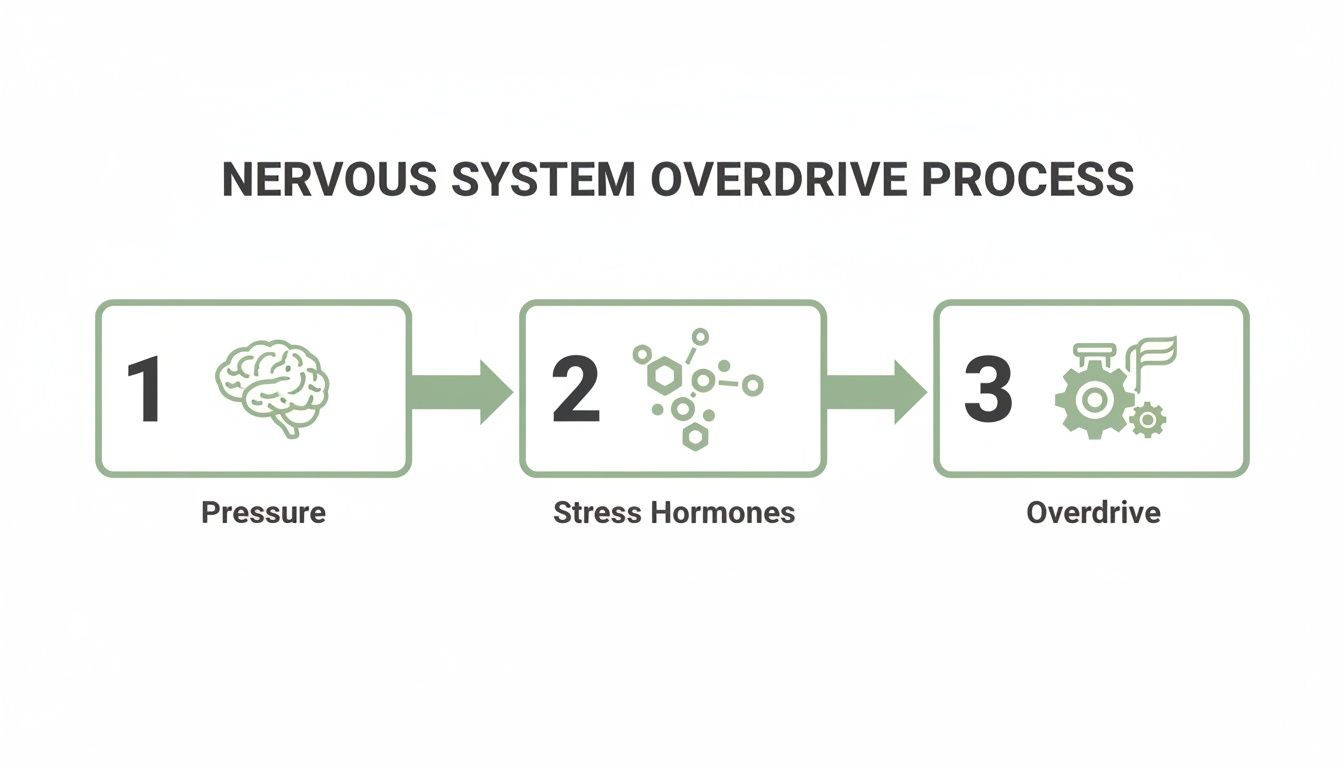
This flow shows that without intentional systems to buffer the pressure, the hormonal response is automatic and depleting.
Systems for regulation include:
Boundary Rituals: Create non-negotiable start and end times for your workday. A "shutdown complete" ritual, like closing your laptop and saying that phrase aloud, signals to your brain that it's time to switch off.
Scheduled Stillness: Block 15-minute "integration breaks" into your calendar between intense meetings. Use this time to walk, breathe, or do nothing.
Digital Hygiene: Implement a "no-fly zone" for screens for the first and last 60 minutes of your day to protect your nervous system.
Dysregulated vs. Regulated Leadership: A Practical Comparison
The difference between leading from reaction versus embodied calm shows up in every decision. The table below makes the contrast clear.

By implementing the RAMS framework, you rebuild your capacity for elite performance from a foundation of stability. It's the key to finding peace in the midst of chaos.
The Return - Putting Regulation Into Practice

Theory is the map; the real world is the territory. The true test of nervous system regulation is how you show up under fire. This is where we deploy frameworks as tactical, in-the-moment interventions. These are subtle, potent micro-practices you can use discreetly to shift your physiology and reclaim your executive presence.
Navigating High-Stakes Moments
Picture this: you’re five minutes from a critical presentation. Your heart is pounding. That’s your sympathetic nervous system hijacking your performance. You have a choice. Find a private space and execute a 60-second physiological sigh. Two sharp inhales through the nose, one long, slow exhale through the mouth. Repeat three times. This is a direct biological command that tells your brain the threat has passed.
Now, imagine you're in a tense negotiation. You feel defensiveness rising. Instead of matching their energy, deploy a grounding technique.
Subtle Somatic Anchor: Discreetly press your feet firmly into the floor. At the same time, gently press your thumb into the pad of your index finger. This simple physical sensation pulls your awareness out of the emotional storm and back into your body, keeping you centered.
These tiny actions are your circuit breakers. They interrupt the automatic stress response and create the space where your best leadership emerges.
"A CEO came to me completely overwhelmed by investor pressure. We drilled one practice: before every call, she spent two minutes holding a cold bottle of water, focusing on the sensation. This simple somatic anchor was enough to break her anxiety loop, allowing her to enter conversations from a place of grounded authority, not panic."
Baz Porter, RAMS™ Founder
Establishing Regulated Boundaries
One of the biggest drivers of chronic dysregulation is the erosion of boundaries. The "always-on" culture is a direct assault on a nervous system that requires rest. This is where the Systems pillar of the RAMS framework becomes your shield.
A female founder in our ecosystem was trapped in a cycle of weekend work creep. Her solution was a powerful "shutdown ritual."
Clear Communication: She informed her team she would be completely offline from 6 PM Friday to 9 AM Monday. No exceptions.
Physical Cue: At 6 PM on Friday, she would close her laptop, turn off her work phone, and say aloud, "Shutdown complete."
Protected Time: The weekend was then fiercely guarded for parasympathetic activities—nature, reading, and family.
Within two weeks, the "urgent" weekend requests vanished. She returned on Mondays refreshed and clear-headed. Setting firm boundaries is one of the most powerful acts of nervous system regulation. If this is a struggle, our guide on how to set boundaries at work provides a tactical starting point.
Applying these practices makes nervous system regulation a tangible, daily skill. It moves you from being a passenger in your own biology to being the pilot.
Reclaiming Your Nervous System Sovereignty
This work isn't about fixing something broken in you. Nothing is broken. Your nervous system has performed exactly as designed, adapting brilliantly to the relentless demands you’ve placed on it. You are not broken.
Reclaiming your nervous system sovereignty is the ultimate act of leadership. It’s a deliberate choice to shift from a life of unconscious reactions to one guided by conscious, embodied presence. This path is about returning to yourself. It's untangling your worth from your productivity and your value from your vigilance. When you operate from a regulated state, you stop making decisions from scarcity or fear. You lead from a wellspring of clarity, creativity, and authentic power.
The Foundation of a Sustainable Legacy
Your real legacy won't be measured by hours logged. It will be defined by the quality of your decisions and the impact you made from a place of centered strength. A dysregulated system can build an empire. But only a regulated one can build a sustainable legacy that doesn't demand your soul as payment.
This is the shift from fleeting success to true embodied sovereignty. It’s the understanding that real power isn’t controlling the world around you, but mastering the world within you.
The most powerful leaders are not the ones who can endure the most stress. They are the ones who can most skillfully return to a state of calm and lead from that grounded center, no matter the storm.
This isn’t a final destination. It is a daily practice, a moment-to-moment commitment to returning to the leader you were always meant to be. Your next move is an invitation to begin the path back to yourself.
Your Questions, Answered
Venturing into nervous system regulation can feel like learning a new language. For high-achievers, it can bring up valid questions and skepticism.
How Long Until I Actually Feel a Difference?
You can feel a change right now, but real change is gradual. A single physiological sigh can shift your state in 60 seconds. That’s an instant result. The deeper work—rewiring years of ingrained stress responses—takes longer. Most leaders report a noticeable, sustained shift in baseline stress, sleep, and decision clarity within four to six weeks of consistent practice.
Can I Do This Stuff Discreetly at Work?
Absolutely. These tools were designed for the boardroom, not the yoga mat.
Somatic Grounding: Discreetly press your feet into the floor during a tense meeting.
The 4-7-8 Breath: A silent breathing pattern (inhale 4, hold 7, exhale 8) you can do while on a tough call.
Orienting: Slowly let your eyes scan the top corners of the room. This is a primal cue to your brain that you're safe.
These are tactical interventions for professional environments.
Isn't "Nervous System Dysregulation" Just a Fancy Term for Burnout?
They are connected, but not the same. Burnout is the outcome; nervous system dysregulation is the underlying mechanism. Burnout is the state of complete exhaustion. Dysregulation is the chronic state of your nervous system being stuck in "fight-or-flight" that leads to that exhaustion. Addressing regulation isn't just a cure for burnout; it's the most effective preventative strategy.
How Can I Possibly Add This When I'm Already Drowning?
This is the most critical reframe. Nervous system regulation isn't another task; it's a tool that creates more time, focus, and energy. A dysregulated leader wastes enormous energy managing internal anxiety and making decisions from a foggy state. A regulated leader makes clearer, faster decisions, communicates more effectively, and is far more productive in less time.
You don't find time for regulation. You practice regulation to create more time. It’s the ultimate efficiency hack because it addresses the root cause of your energy drain.
The path to reclaiming your nervous system sovereignty is the most profound investment you can make. It’s not about becoming less of a high-performer; it’s about becoming a more sustainable, impactful, and embodied one.
Ready to move from a life run by stress to one led by your own centered authority?
Where to go next. If any of this reads like your own reflection, the Silent Collapse Diagnostic™ is a quiet place to start — a clear read on where your nervous system is most dysregulated. And if you want the deeper why beneath the work, read the Sovereign Manifesto.