Finding Peace in the Midst of Chaos: A Guide for High-Achieving Leaders

You walk into a tense meeting five minutes late because a crisis just landed on your desk. Your heart is pounding, your jaw is clenched, and a brutal internal monologue is on repeat: “If I stop performing, I’ll disappear.” This isn't just stress; it's a silent collapse, where the relentless noise of leadership dissolves your clarity right when you need it most.
Key Takeaways for Lasting Calm
Your Nervous System is Key: Peace isn't a mindset; it's a physiological state. Learn to regulate your nervous system with micro-rituals to regain control in seconds.
Chaos is Data: Reframe high-stress moments from personal threats into objective data points that reveal what systems or skills need your attention.
The RAMS Framework: Implement a structured approach—Results, Attitude, Mastery, Systems—to rebuild reactive fire-fighting into proactive leadership.
Boundaries are a Strategy: Protecting your energy with clear, well-communicated boundaries is a non-negotiable act of strategic leadership, not selfishness.
Finding peace in the midst of chaos isn't about eliminating external pressures; it is about cultivating nervous-system sovereignty. This guide provides a strategic framework to help you regulate your internal state and lead with clarity, even when the world around you is in turmoil.
The Hidden Pattern: Why Calm Feels Impossible
When you operate in a high-pressure environment, your brain literally rewires itself for survival. You become hypervigilant, constantly scanning for the next threat, deadline, or fire to put out. But that state of high alert comes at a cost. It silences creative confidence and shrinks your mental bandwidth until even simple choices feel monumental.
This is your brain on cortisol. Think of your nervous system like a high-performance engine constantly redlining. The amygdala—your brain's alarm system—is stuck in the "on" position, flooding your system with stress hormones. Meanwhile, the prefrontal cortex—your center for rational thought and strategy—gets sidelined.
This isn't a personal failing; it's physiology. This hijack is why you experience:
Racing thoughts that cloud routine decisions.
A knot of tension in your shoulders or a clenched jaw.
The inability to focus on one thing for more than a few minutes.
A feeling of being perpetually reactive, never proactive.
Chronic stress creates a vicious feedback loop: stress breeds more stress. To get a deeper sense of the toll this takes, it’s worth understanding the psychological impact of burnout and chronic stress.
And this isn't just happening in our offices. Global trends show we're all feeling it. According to the Institute for Economics & Peace, the world became less peaceful for the ninth time in the last ten years in 2023. Read the full research about modern conflicts on reliefweb.int. These larger societal ripples only amplify our personal stress.
If this is hitting close to home, our guide on overcoming burnout at work might be exactly what you need. Now, let’s explore how to break this cycle.
The RAMS Reframe: Your Operational System for Calm
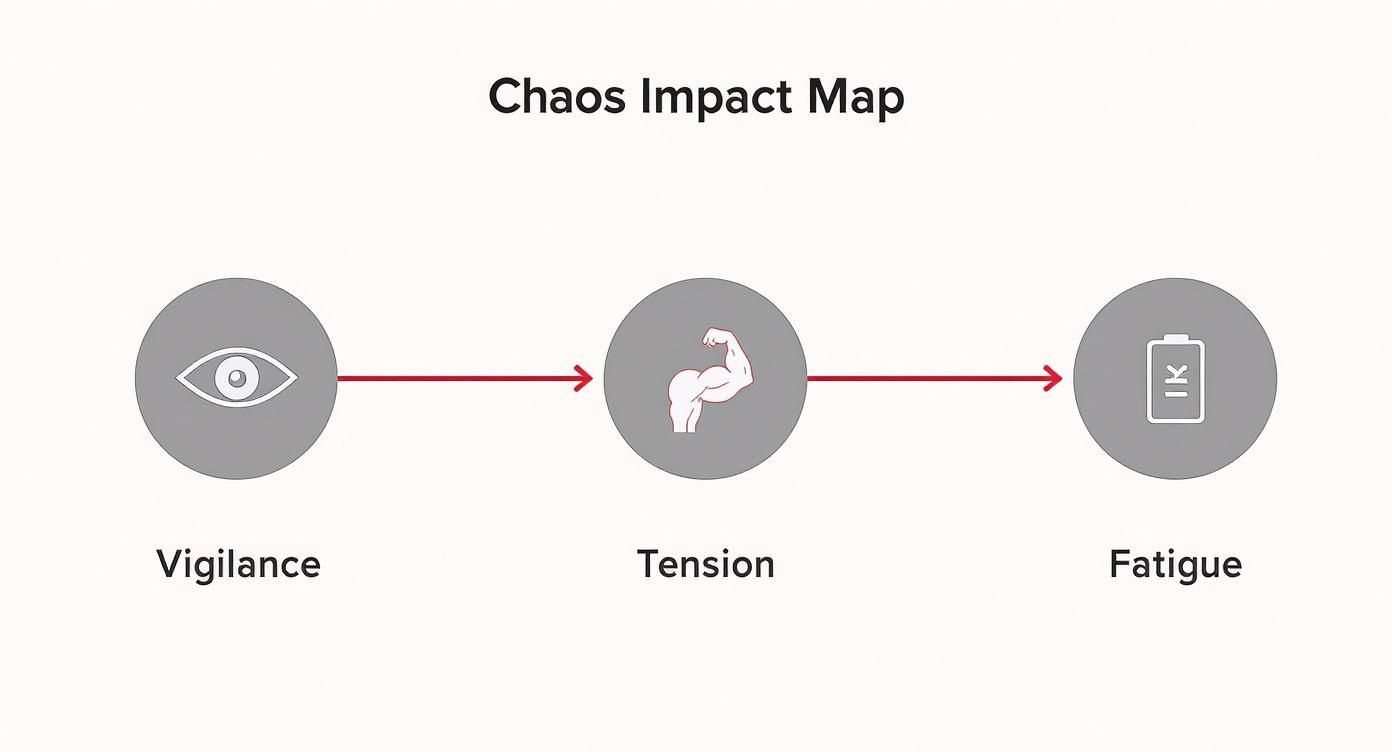
Breaking the cycle of chronic stress demands more than a wellness app. It requires a reliable operational model to navigate the storm. The RAMS framework is an integrated system designed not just to help you cope with chaos, but to rebuild it into strategic clarity.
Results: What Is the True Target?
First is Results. This forces you to cut through the noise and define the one critical outcome that matters most. When everything feels urgent, this singular focus becomes your north star, conserving mental energy and stopping the frantic multitasking that fuels overwhelm. It's about finding the single domino that, once tipped, makes everything else fall into place.
Attitude: How Are You Framing the Fight?
Next, Attitude. This is your internal operating system—the mindset you consciously choose. It's about deciding to see a challenge not as a personal threat, but as pure data. By deliberately reframing your perspective, you shift from a reactive, cortisol-fueled state to a proactive, strategic one, maintaining your leadership presence under fire.
Mastery: What Skills Do You Need to Sharpen?
Mastery is about targeted growth. It’s honestly identifying and honing the specific skills required to navigate the current challenge. Perhaps the chaos demands sharper negotiation skills, better delegation, or a deeper understanding of team dynamics. Focusing on skill development builds tangible confidence, replacing anxiety with a quiet sense of capability.
Systems: What Structures Will Automate Your Resilience?
Finally, Systems. These are the repeatable processes, routines, and boundaries that create a scaffold to support you, automating resilience and reducing decision fatigue. This covers everything from your non-negotiable morning ritual to your team’s communication protocols and your "end of day" shutdown routine. Strong systems free up your cognitive resources for high-level strategic thinking.
RAMS Framework: At a Glance

Each pillar reinforces the others, creating a powerful feedback loop. By implementing this structure, you’re building an internal system for thriving within chaos. You can learn more about how this framework outperforms traditional models in our deep dive on the RAMS Method coaching revolution.
Daily Grounding Practices: Regain Control in Seconds

Peace isn't found on a two-week vacation; it’s cultivated in the sixty seconds between back-to-back meetings. These science-backed tools are designed for the reality of your world.
Breathwork Sequences: A 60-second pattern to lower your heart rate before a high-stakes negotiation.
Micro Meditations: 3-minute focus pauses to reset mental clutter.
Expressive Journaling: A 2-minute "brain dump" to externalize nagging thoughts.
Mini Movement Breaks: 90-second stretches to dissolve tension building in your shoulders.
Breathwork To Reset In Sixty Seconds
When you feel frantic energy rising, this two-phase breathing cycle is your emergency brake.
Breathe in deeply through your nose for a count of six.
Hold that breath for just two counts.
Exhale slowly through your mouth for a count of eight.
Repeat this cycle for one full minute.
The magic is in making the exhale longer than the inhale. This activates the parasympathetic nervous system, telling your body it's safe.
Expressive Journaling To Clear Mental Clutter
When your mind feels like a browser with too many tabs open, grab a pen for a raw, two-minute data dump.
Scribble down every worry, task, or frustration. Use bullet points. No editing.
Quickly circle the top three stressors.
For each one, jot down a single sentence on how you can shift, delegate, or reframe it.
Close the journal. Let it go.
In a world where 2024 saw the highest number of active conflicts since World War II, the ability to cultivate inner calm is a necessity. Find more details in the conflict report from Vision of Humanity. For more practical strategies for staying mindful during difficult times, explore this resource.
Want to weave these resets into the very start of your day? Check out our five-day morning ritual guide to build a powerful foundation.
Setting Boundaries and Decision Tools
Finding peace requires fortifying your external world. Strong boundaries and sharp decision-making tools are your first line of defense—they protect your energy and focus from the constant barrage of demands. Without them, your mental bandwidth becomes a free-for-all.
Communicating Your Limits with Clarity
Effectively communicating a boundary is less about the word "no" and more about the clarity of your "yes." When you are clear on your priorities, turning down a request becomes an act of alignment.
State it simply. "I don't have the capacity for that right now" is powerful.
Offer an alternative (optional). Suggest another resource or person.
Hold your ground. Expect pushback. Stand firm without apology.
This is a core competency. Our guide on how to set boundaries at work provides practical scripts to start.
Triaging Requests with an Energy Audit
Not all tasks are created equal. Before saying yes, ask yourself:
Does this task align with my most important goals?
Does this genuinely require my unique skills?
On a scale of 1-10, how much will this task drain my energy?
A "yes" to one thing is always a "no" to something else. Make that choice consciously.
This structured thinking is critical. By reinforcing your external structures—your boundaries, your decision-making tools—you shield your inner calm and ensure every action aligns with what matters.
The Return: Real Leaders, Real Returns

These principles aren't theoretical. They are forged in the messy reality of leadership.
The Tech Founder and the Deadline Reorganization
Sarah, a tech founder, faced an impossible product launch deadline. Her team was fractured, and her internal monologue was brutal: "If this fails, it's all on me."
Using the RAMS framework, she clarified the only Result that mattered: shipping a stable product, not a perfect one. Her Attitude shifted from frantic problem-solver to calm systems analyst, seeing chaos as data revealing workflow flaws. This led to Mastery of delegation, strengthening her engineers. Finally, she built a new System: a daily 15-minute stand-up focused only on blockers.
The launch succeeded not because she worked harder, but because the framework restored order.
The Nonprofit Director and the Contentious Board
Maria, a nonprofit director, was navigating a deeply divided board where every meeting felt like a battle.
Instead of prepping defensive arguments, Maria started each day with a two-minute grounding ritual. Her calm presence began to subtly shift the room's dynamic. She then set a firm boundary: no personal attacks would be tolerated. This simple rule, enforced with quiet consistency, created psychological safety and shifted the focus back to the mission.
Maria’s tactical use of self-regulation and clear boundaries created peace in the midst of chaos. She didn't raise her voice; she raised the standard. Learn more about resilience building in our support for leaders guide.
Frequently Asked Questions
Why does staying calm feel impossible when the pressure never stops?
Under constant pressure, your brain rewires itself for survival. Cortisol keeps the amygdala — your alarm system — stuck in the "on" position, so you stay hypervigilant and reactive. That isn't a personal failing; it's physiology. Calm returns when you regulate the nervous system first, not when you simply try harder.
What's the fastest way to reset when frantic energy rises?
Use a two-phase breathing cycle as your emergency brake. Breathe in through your nose for a count of six, hold for two, then exhale slowly through your mouth for a count of eight. Repeat for one full minute. It signals your body that the threat has passed and pulls you out of the redline.
How do I set boundaries without feeling guilty?
A boundary is less about the word "no" and more about the clarity of your "yes." When you're clear on your priorities, declining a request becomes simple. Triage each ask with a quick energy audit — not every task carries the same weight — and protect the few that truly matter.
Can I find calm without escaping the chaos?
Yes. This isn't about escaping the storm; it's about commanding your own ship within it. Peace in the midst of chaos is a return to yourself — your innate clarity, focus, and steadiness — so the noise around you stops setting your internal state.
Where to go next
Ready to stop managing chaos and return to yourself? If any of this reads like your own reflection, the Silent Collapse Diagnostic™ is a quiet place to begin — a private, 60-minute conversation with Baz. And if you want the deeper why beneath the work, read the Sovereign Manifesto.