Leading Through Uncertainty: A Guide for the Overwhelmed Leader
The internal monologue runs on a loop. If I just work harder, I can steer this ship through the storm. If I stop performing, I’ll disappear. You're the high-achiever, the one who has always thrived on pressure, but suddenly the old playbook feels completely useless. The strategies that built your career are now accelerating your path to burnout.
This is the Silent Collapse. It’s that terrifying moment when the chaos of the external world collides with your own internal exhaustion, and the illusion of control you’ve worked so hard to maintain finally shatters. You feel it in the tension gripping your shoulders and the pit in your stomach when another crisis lands. Your leadership, once a source of strength, now feels like a compass made of glass—strong on the outside, but fracturing under real pressure, leaving you and your team lost.
Key Takeaways
Acknowledge the Biology of Burnout: Understand why your brain’s natural response to ambiguity fuels decision fatigue and how to regain control of your nervous system.
Adopt the RAMS Method: Learn a practical framework—Results, Attitude, Mastery, Systems—to build genuine resilience and lead from embodied confidence, not just authority.
Master Practical Tools: Get concrete communication scripts and strategies to create stability for your team, even when you don't have all the answers.
Achieve Nervous System Sovereignty: Move beyond temporary fixes to cultivate a regulated internal state—your single greatest asset in any crisis.
Leading through uncertainty isn’t about having a tighter grip; it's about building a better compass. It demands trading the addiction to rigid control for a deep investment in resilience and adaptive systems. The shift is from the pressure of having all the answers to the power of asking the right questions, turning volatility into a powerful opportunity for growth.
The Hidden Pattern—Why Your Brain Fights Uncertainty

If you feel constantly on edge, you’re not failing. You’re human. Your brain is a finely-tuned prediction machine, designed to find patterns and conserve energy. When hit with sustained ambiguity—market shifts, team restructures, global volatility—it registers one thing: threat.
This isn't a metaphor. That gnawing uncertainty kicks off a neurochemical cascade designed for short-term survival, not long-term strategic leadership. The problem is, that ancient programming is now working against you in the modern boardroom. It's like trying to navigate a complex spreadsheet with a caveman's club. The tool is powerful, but entirely wrong for the task at hand.
The Amygdala Hijack in the C-Suite
Deep inside your brain is the amygdala, your internal smoke detector. In a state of constant uncertainty, that alarm never turns off. This is the amygdala hijack. The constant "threat" floods your system with cortisol and adrenaline. These stress hormones are great for outrunning a predator but devastating for complex decision-making.
They effectively take your prefrontal cortex offline—the very part of your brain you rely on for:
Executive Function: Strategic planning and impulse control.
Emotional Regulation: Staying calm under pressure.
Creative Problem-Solving: Seeing new angles in chaos.
When your amygdala is driving, your leadership capacity shrinks. You become reactive, defaulting to rigid, black-and-white thinking because nuance feels dangerous.
The internal conversation flips from, "What are our options here?" to "What's the fastest way to make this awful feeling of threat go away?" This isn't a lapse in judgment; it's a predictable neurological response to an environment your brain thinks is hostile.
The Illusion of Control
The command-and-control model you mastered was built for a predictable world. Gripping the wheel tighter doesn’t help; it accelerates burnout and erodes trust. This relentless pursuit of certainty creates a system where admitting "I don't know" is seen as failure. The real cost isn't just exhaustion; it's the loss of creativity right when you need it most.
As noted by Amy Edmondson, a leading researcher at Harvard Business School, the absence of trust makes it impossible to build a supportive environment. Any effective leader today must understand the critical importance of cultivating psychological safety in the workplace to enable honest dialogue.
When your strategy is to project absolute certainty, your team stops bringing you problems. The lines of communication essential for navigating uncertainty go silent. You can read more about the dynamics between command and authority in leadership. This environment doesn’t just stifle growth; it sets the stage for a collective breakdown. For a much deeper look, check out our guide on your nervous system architecture in our detailed guide.
The RAMS Reframe—An Operating System for Resilience
Knowing your brain is in a tailspin is one thing. Building a new way to navigate it is another. It's time to swap your fragile, control-based playbook for something built for resilience.
This is where the RAMS Method comes in. It’s a complete re-architecture of your leadership operating system, designed to help you lead from a place of grounded, embodied power. RAMS stands for Results, Attitude, Mastery, and Systems. Each pillar confronts a specific vulnerability that uncertainty rips open.
1. Results: From Rigid Outcomes to Adaptive Progress
The first pillar, Results, targets the high-achiever’s Achilles' heel: our obsession with fixed outcomes. To lead through uncertainty, you must redefine winning.
Old Way: Chaining your emotional state to a single, predetermined goal.
RAMS Way: Celebrating adaptive progress. Did the team pivot intelligently with new information? Did we learn from an experiment that "failed"? These are the new wins. The game is no longer about the perfect plan; it's about taking the next best step with the information you have.
This moves you from brittleness to genuine agility, strengthening your team to respond to the world as it is.
2. Attitude: From Fear to Calibrated Confidence
Your internal state is a broadcast signal your team tunes into. The Attitude pillar is about intentionally cultivating the inner mindset required to be the steady hand in the storm. That default high-control attitude—fear in a business suit—is an energy drain. We replace it with:
Calibrated Confidence: Not blind optimism, but a deep trust in your team's ability to figure things out. It’s the internal anchor that says, "We don't have the answer, but we are capable of finding it."
Genuine Curiosity: Approaching setbacks with "Why did that happen?" instead of "Whose fault is this?" dismantles the defensiveness that suffocates innovation.
3. Mastery: From External Dominance to Internal Regulation
This is the core of embodied leadership. Mastery, in the RAMS framework, isn't about the market; it's about mastering your own biology. In volatile times, regulating your own nervous system is the ultimate leadership superpower.
Your capacity to remain calm and centered amidst chaos is your single greatest asset. It allows you to access your higher-order thinking and provide the "steady light" your team desperately needs.
Mastery is having practical, somatic tools to pull yourself out of a neurological hijack. This physiological control is the foundation on which every other leadership skill rests.
This diagram shows how uncertainty kicks off a predictable neurological chain reaction leading to burnout.
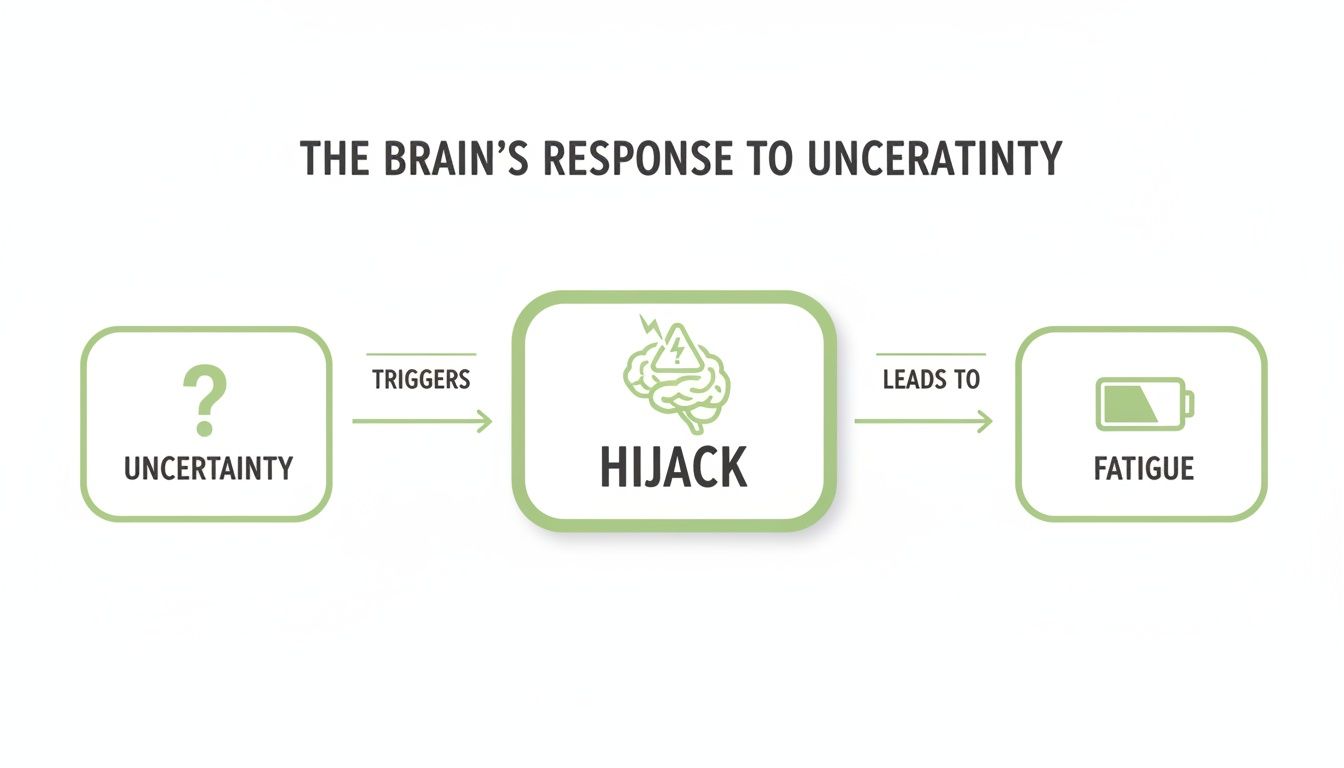
The RAMS method gives you the tools to break this cycle.
4. Systems: From Rigid Processes to Resilient Rhythms
Finally, Systems are the structures you build to create stability when everything else is in free fall. Willpower and individual heroics are finite resources. Resilient systems create a supportive scaffold for you and your team.
Personal Systems: Your non-negotiable routines that guard your energy—a 10-minute morning mindfulness practice, a hard stop at 6 PM, a weekly "deep work" day.
Team Systems: Predictable rhythms that build psychological safety—daily check-ins, transparent "here's what we know/don't know" updates, normalizing failure.
By putting robust systems in place, you free up everyone's energy to solve complex problems instead of just managing anxiety. For a complete breakdown, you can learn more about how the RAMS Method provides a revolutionary leadership framework in our detailed article.
The contrast between the old 'Control' paradigm and the strengthened 'RAMS' approach is stark.

Moving from left to right is a fundamental upgrade to your leadership identity—one that allows you to thrive in uncertainty, not just survive it.
Your Practical Toolkit for Leading with Confidence

The RAMS framework is the architecture. Now it's time for the tools. These are battle-tested tactics to put into play immediately.
Make the Good Enough Decision Now
The hunt for perfect data is a trap. The goal is to shift from chasing the perfect decision to making the best possible decision with the messy information you have. See every decision not as a final verdict, but as the next intelligent experiment.
Define 'Reversible' vs. 'Irreversible'. Most decisions are two-way doors, not one-way. This lowers the stakes.
Set a "Regret by" Date. Ask, "If we don't decide by Friday, what opportunity will we regret missing?" This creates productive urgency.
Act and Assess. Pull the trigger on the "good enough" decision, but immediately define how and when you'll measure its impact.
Communicate Change Without Causing Panic
When your team is anxious, silence is filled with worst-case scenarios. Ditch vague corporate speak and use a clear, repeatable script.
"I know there are a lot of questions. Here's what we know for certain... Here is what we are still figuring out... and here is my commitment to you on when and how I will provide the next update."
This formula works because it provides clarity, validates their uncertainty, and creates predictability.
The 5-Minute Embodied Reset
Right before a high-stakes meeting, your nervous system can get hijacked. You cannot lead effectively from that state. This discreet practice can bring you back into your body.
The Box Breathing Reset:
Find a quiet space.
Inhale slowly through your nose for a count of four.
Hold your breath for a count of four.
Exhale slowly through your mouth for a count of four.
Hold the exhale for a count of four.
Repeat for 2-3 minutes.
This technique directly influences your vagus nerve, sending a signal of safety to your brain. It breaks the panic loop, allowing you to re-engage from centered calm. This is fundamental to leading with confidence, as it grounds every action in a regulated state.
Build Psychological Safety When It Matters Most
Psychological safety is the essential operating system for an adaptive team. When people are too afraid to speak up, you lose access to the very information you need. Normalize and celebrate intelligent failure.
Safety-Destroying ResponseSafety-Building Response"Why did this happen? Who is responsible?""Thank you for bringing this to me. What did we learn?""We can't afford any more mistakes.""What support do you need to try a different approach?"Silence or visible frustration.Acknowledging the effort and encouraging the next attempt.
This deliberate shift turns mistakes from something to be hidden into data to be analyzed.
The Return—Achieving Nervous System Sovereignty
All the tactics in the world are temporary fixes if your internal world is on high alert. The real work is to stop managing chaos and start mastering your internal state. This is the ultimate competitive advantage: Nervous System Sovereignty.
For years, you've been conditioned to see leadership as an external performance. Project confidence. Have the answers. It's exhausting and disconnects you from yourself. Nervous System Sovereignty is leading from the inside out. It's the capacity to stay grounded and embodied when everything is spinning.
When you can regulate your own biology, you stop reacting to uncertainty and start responding with intention. Your presence becomes a stabilizing force.
This is where the real power is. It’s not in a better five-year plan; it’s in your ability to hold a steady internal state.
The Return to Yourself
At its core, leading through uncertainty is a path back to yourself. It’s about peeling back layers of conditioning that taught you to value control over connection, performance over presence.
When you achieve this sovereignty, you no longer need the external world to be predictable to feel internally stable. You source your security from within. This isn't just a leadership skill; it's a life-altering capacity. To go deeper, exploring resources on strengthened leadership can provide powerful frameworks that align with this path.
The strategies we've discussed are your starting point. The real work lies in the daily practice of returning to your body and regulating your internal state. For anyone ready to deepen this practice, explore the principles of nervous system regulation to build a solid foundation.
Leading through uncertainty isn't a problem to be solved. It’s an invitation to embody a new way of being—resilient, connected, and deeply sovereign. This is your next step, not toward another achievement, but back to yourself.
Your Questions Answered: Leading When the Path Isn't Clear
Navigating volatile environments always brings up tough questions. Here are direct answers to common challenges.
How Can I Project Confidence When I Feel Uncertain Myself?
Stop trying to project certainty. True confidence isn’t having all the answers. It’s cultivating a deep, unshakable trust in your ability—and your team's ability—to adapt. Practice calibrated confidence. Be honest about what’s up in the air, but remain anchored in your commitment to navigating the challenge.
Your primary role is not to have a perfect map but to be a reliable compass. Acknowledge the fog, but hold the direction steady. This builds far more trust than pretending the fog doesn’t exist.
What Is the First, Most Immediate Step to Regulating My Nervous System?
Your breath. It’s the simplest tool you have. For a quick intervention, use box breathing. Inhale for a count of four, hold for four, exhale for four, and hold for four. One minute of this can physically interrupt the stress response and bring your rational mind back online.
How Do I Keep My Team from Burning Out During a Prolonged Crisis?
Burnout is the result of sustained high effort without a sense of agency. While you can't make the pressure disappear, you can change how your team experiences it.
Focus on Progress, Not Just Outputs: Celebrate small, adaptive wins. Highlight iterative learning.
Create Predictable Rhythms: In chaos, predictability is a lifeline. Implement consistent communication cadences.
Model and Enforce Boundaries. Fiercely. Actively protect your team's time and energy by modeling your own downtime.
This shifts the environment from frantic reactivity to one of sustainable, resilient performance.
If you're ready to move beyond just surviving uncertainty and start leading with grounded, sovereign power, the path starts now. At Baz Porter, we help high-performing leaders architect a style that is both powerful and sustainable.
Explore how the RAMS Method can work for you at https://bazporter.com.
Where to go next. If any of this reads like your own reflection, the Silent Collapse Diagnostic™ is a quiet place to start — a private read on how close to the edge you really are. And if you want the deeper why beneath the work, read the Sovereign Manifesto.