
Leading With Confidence: The Executive Guide for Uncertain Times
You're standing at the helm, but the map is blank and a storm is brewing. On the outside, you project unwavering calm, the stable point in a hurricane of policy shifts, talent gaps, and market volatility. But inside, a silent collapse is underway. It’s that quiet, insidious voice whispering, "If I stop performing, if I show a single crack in the armor, everything I've built will fall apart." This exhausting performance isn't a rare occurrence; it's your daily reality, and the gap between the leader you're supposed to be and the person you are is becoming a chasm.
Key Takeaways
Your Nervous System is Your Compass: True confidence isn't about faking it. It's about regulating your nervous system to move from a reactive, threat-based state (fight-or-flight) to a calm, strategic one (rest-and-digest).
Redefine Your Wins with RAMS: The RAMS framework shifts your focus from fragile, external validation to a resilient, internal foundation built on redefined Results, a sovereign Attitude, embodied Mastery, and protective Systems.
Close the Perception Gap: Data shows a 75% increase in the gap between how leaders see themselves and how their teams see them. Closing this requires shifting from an all-knowing "expert" to a "facilitator" who builds trust through authentic collaboration.
Action Over Hesitation: Overcome leadership paralysis by implementing a structured 30-day action plan focused on small, consistent wins that build unstoppable momentum and genuine, embodied confidence.
Leading with confidence in uncertain times is not about having all the answers. It's about mastering your internal state so you can navigate external chaos with genuine authority, making clear, grounded decisions when the stakes are highest. This guide provides a physiological foundation to shift from merely projecting calm to truly embodying it.
The Hidden Pattern - Why Your Leadership Compass is Spinning
Ever have one of those days? One minute you're the strategic visionary, holding the entire company's future in your mind. The next, a minor hiccup from your team sends your entire nervous system into a tailspin. You feel completely reactive, and you have no idea why. This isn't a flaw in your character. It’s a biological response to the immense, sustained pressure of leadership.
This feeling of being perpetually off-kilter is the Miscalibrated Compass. Your internal guidance system, your nervous system, gets stuck scanning the horizon for the next inevitable threat instead of orienting toward your true north of intuition and clarity. It's not a conscious choice. It's your biology defaulting to its most primal survival state.
The Hijacking of Your Executive Brain
Under chronic stress, your body is swimming in cortisol and adrenaline. These hormones are fantastic for short-term crises but are destructive as a daily operating system. They effectively hijack your prefrontal cortex, the part of your brain that handles strategic thinking, emotional regulation, and complex problem-solving. Your feelings of overwhelm are not a moral failure; they are a physiological reality.
The problem is, traditional leadership models have failed us. A staggering 38% of global leaders flag policy uncertainty as a top priority, yet only 34% feel prepared to handle it. This data points to a critical disconnect: we've been taught to suppress the biological signals of stress, not work with them.
Leading with true confidence isn't about faking it until you make it. It’s about building a physiological foundation that allows you to make clear, grounded decisions when the stakes are highest.
Fight-or-Flight vs. Calm and Connected
True leadership confidence doesn't live in that hyper-vigilant state of fight-or-flight. It emerges from a place of physiological calm the parasympathetic "rest and digest" state. This is where your best thinking, your deepest wisdom, and your most inspiring leadership reside.
Feature
Threat Response (Fight-or-Flight)Strategic Response (Rest & Digest)Focus
Narrowed, threat-focused, short-term survivalBroad, opportunity-focused, long-term vision
Decision-Making Impulsive, reactive, prone to biasDeliberate, strategic, data-informed
Emotional State Anxiety, irritability, defensiveness Calm, curious, open, empathetic
Team Impact Creates anxiety, erodes trust, stifles innovation Fosters psychological safety, encourages collaboration
When your compass is spinning, you're stuck in that left column. The first step to recalibrating is to trade self-blame for curiosity. Learning how to be more self-aware is the bedrock of embodied, confident leadership. By recognizing the biological basis for your feelings, you reclaim your power.
ACT II: The RAMS Reframe - A Framework for Embodied Confidence
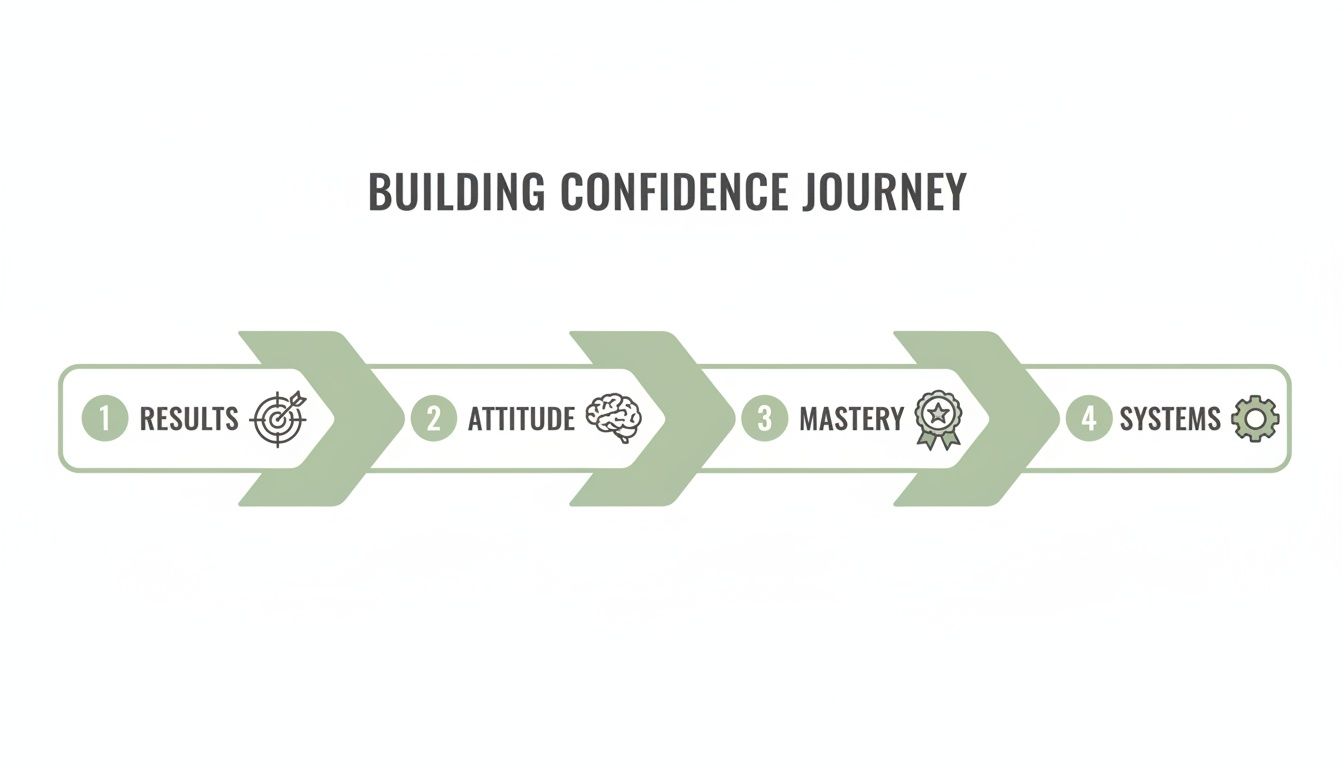
The journey from feeling constantly on edge to leading from a place of grounded authority requires more than willpower. It demands a practical blueprint for rewiring your internal state. The RAMS™ Method is that blueprint, a framework designed to build confidence from the inside out by shifting your relationship with four key pillars: Results, Attitude, Mastery, and Systems.

R is for Results Redefined
In leadership, results are typically quarterly reports and stock prices. Tethering your self-worth to these external metrics is a direct flight to burnout. Embodied confidence demands we redefine a "result" by shifting focus from external validation to internal alignment.
A redefined result is about your fidelity to your own process. Did you show up for that difficult conversation with integrity? Did you protect your team's focus by saying "no" to a non-essential request? When your metric for success becomes "Did I act in alignment with my values?" instead of "Did everyone like the outcome?", you reclaim your power.
Key Shift: Move from chasing external outcomes to measuring internal consistency. Your confidence becomes a product of your character, not your circumstances.
A is for an Attitude of Nervous System Sovereignty
Your attitude is the filter through which you experience every moment. For many high-achievers, the default is hyper-vigilance. To lead with confidence, you must cultivate an attitude of nervous system sovereignty, treating your internal state as your most important leadership asset.
This attitude is built through small, consistent practices:
The Three-Breath Pause: Before a high-stakes email or tense meeting, take three slow breaths to interrupt a cortisol surge.
The Physiological Sigh: Popularized by neuroscientists like Andrew Huberman, this double-inhale through the nose followed by a long exhale is one of the fastest ways to calm the nervous system.
Body Scan Check-Ins: Three times a day, take 30 seconds to notice where you're holding tension. Simply noticing begins to dissolve the pattern.
Adopting this attitude fundamentally changes your presence. For a deeper dive, exploring how to achieve unlocking mental clarity and confidence through neuroscience and hypnosis offers powerful insights.
M is for Mastery of Embodied Skills
Confidence isn't just a feeling; it’s a skillset. Mastery is about developing the tangible competencies of emotional regulation and boundary setting.
Emotional Regulation is the ability to feel an emotion without being hijacked by it. It’s not suppression. It’s creating space between a stimulus and your response. A powerful technique is to "name it to tame it," simply acknowledging the emotion internally: "Ah, that's defensiveness I'm feeling."
Boundary Setting is the external expression of internal self-respect. It's not a wall to keep people out; it's a line you draw so you can continue to show up sustainably.
Mastering these skills is a core component of effective transformational leadership training, as it shifts leaders from managing tasks to truly developing people, starting with themselves.
S is for Systems That Sustain Your Sovereignty
Your environment will always win over willpower alone. Systems are the personal and professional structures you intentionally design to protect your energy, focus, and confidence.
Personal Systems might include:
A Non-Negotiable Morning Routine: 15-30 minutes of grounding activity before touching your phone.
Scheduled "Thinking Time": 90-minute blocks in your calendar for deep, strategic work.
An Evening Wind-Down: A clear transition out of "work mode" to signal rest to your nervous system.
Professional Systems could involve:
Default Agendas for Meetings: Standardize structures to keep them focused and productive.
Clear Communication Protocols: Establish rules of engagement for your team (e.g., "No weekend emails unless it's a true emergency").
Weekly Energy Audits: Review your calendar. What energized you? What drained you? Redesign your next week based on this data.
These systems act as guardrails. They automate good decisions and create a supportive container for your confidence to flourish.
The Return - To Yourself and Your Team
Leading with confidence isn't about achieving a flawless state of being; it's about returning. Returning to your body when stress pulls you into your head. Returning to your values when external pressure tempts you to compromise. Returning to an authentic connection with your team when the performance of leadership feels isolating.
There’s a massive perception gap hollowing out trust from the inside. Recent data shows the chasm between how leaders rate their own skills and how their teams see them has exploded by 75% since 2019. This isn't just a small disconnect; it points to a serious drop in self-belief and a sign of widespread imposter syndrome at the highest levels. This is the space where trust erodes. You can see the full, sobering findings on this leadership confidence crisis.
Your First 30 Days: From Hesitation to Momentum
The goal for your first month is simple: build momentum with small, achievable actions rooted in the RAMS framework.
Week 1 (Systems): Pinpoint one major energy drain in your weekly schedule. Design a simple system to fight back, like creating a mandatory agenda template for a recurring meeting.
Week 2 (Attitude): Practice the Physiological Sigh twice a day. It takes five seconds and is a powerful tool for regulating your nervous system on the spot.
Week 3 (Mastery): Pick one low-stakes situation to practice setting a clear boundary. "I can't get to that right now, but I have a window at 2 PM."
Week 4 (Results): Review your wins based on internal alignment, not external outcomes. Did you protect your focus time? Did you honor the boundaries you set?
This initial phase proves that small, intentional shifts create significant results. To make these changes stick, it helps to understand proven strategies for making habits last.
Returning to Sovereignty
The ultimate source of confident leadership is reconnecting with your core values and intuition. When you feel that familiar whisper of self-doubt, it’s often a sign that imposter syndrome is distorting your perception. Learning how to overcome imposter syndrome is a critical step in aligning how you see yourself with your true capabilities.
Leading with confidence isn't about getting rid of uncertainty. That’s impossible. It’s about cultivating an internal state so grounded and resilient that uncertainty no longer throws you off balance. It just becomes another data point in your strategic landscape one you are fully equipped to handle. This is not a sale. This is a return to yourself.
Frequently Asked Questions
Stepping into this path of embodied leadership always brings up a few real-world questions. Here are some straight answers to the questions I hear most often from leaders making this shift.
How do I lead with confidence when my team is skeptical?
Of course, they're skeptical. They’re used to a different you. The key isn’t to declare the change; it’s to demonstrate it, consistently. In the next tense meeting, before you answer a tough question, take a silent, intentional breath. When your team sees you stay grounded under pressure, responding instead of reacting, their trust will build. Confidence is contagious, but it has to be real.
Your calm is a strategic asset. When your team sees you can hold your center in the middle of chaos, their skepticism turns to curiosity, and eventually, trust. Their nervous systems will literally co-regulate with yours.
What is the first step to regulating my nerves in a stressful meeting?
Get out of your head and into your body. When stress hits, your mind spins stories, but your body is always in the present moment. Before you say a word, press your feet firmly into the floor. Feel the solid ground under you. Take one deliberate, silent breath. This whole thing takes less than three seconds, is invisible to everyone else, and acts as an immediate circuit-breaker for the fight-or-flight surge. It brings your executive brain back online.
How long does it take to see real results?
You’ll feel small, internal shifts almost right away, likely within the first week. Noticing you’re a little less reactive or catching yourself before an emotional hijack, those are huge early wins. But for these changes to become your new default, for your team to really see and trust the change, give it about 90 days. That’s roughly how long it takes to carve out and solidify new neural pathways. Consistency beats intensity, every single time.
At Baz Porter, we guide accomplished women from high-functioning burnout to a place of embodied, sustainable leadership. If you're ready to stop performing and start leading with the kind of confidence that comes from within, the next step is to get clear on your unique patterns.
Take the Sovereign Leadership Diagnostic to begin your journey.