Command vs. Authority: The Hidden Reason High-Achieving Women Burn Out
"If I stop performing, I'll disappear."
It's the silent fear that fuels the relentless push. The whisper inside that says any pause, any moment of rest, means losing your footing entirely. This constant drive for command and authority is what got you here. But now, it feels less like a strategy and more like a cage. The very tactics that built your success are now the source of your bone-deep exhaustion—a silent collapse happening just beneath the glittering surface of your achievements.
Key Takeaways
Command vs. Authority: Command is an external force that drains your nervous system (think control, hierarchy). True authority is an internal state of being that regulates it and inspires commitment.
The Neuroscience of Leadership: Leading through command triggers a fight-or-flight response in you and your team, shutting down strategic thinking. Embodied authority creates psychological safety, fostering innovation and trust.
The Leadership Double Bind: Traditional leadership models force women into an unwinnable game: be assertive and you're "aggressive," be collaborative and you're "indecisive." This is a systemic trap, not a personal failing.
The RAMS™ Framework: Reclaim your power by redefining Results on your terms, mastering your physiological Attitude, honing your unique Mastery, and building sustainable Systems to protect your energy.
The fundamental difference between command and authority is this: Command is imposed through external force, while authority is earned through internal congruence. One dysregulates your nervous system, demanding constant vigilance and pushing you toward burnout. The other regulates it, creating sustainable influence from a place of grounded presence.
The Hidden Pattern: Why Your Drive is Draining You
The feeling that you're one missed deadline from becoming irrelevant is an all-too-common script for high-achieving women. It’s an exhausting cycle of proving your worth through sheer force of will. You’ve learned to mistake control for true influence. This entire approach, rooted in old-school command structures, is the leadership equivalent of holding your breath while running a marathon. It’s unsustainable.
You’ve mastered command—directing outcomes, managing variables, enforcing standards. But true authority isn't about forcing compliance; it's about inspiring commitment. It’s an internal state that naturally draws people in. This is the critical shift for sustainable leadership, the kind that doesn’t demand your soul as payment. For a deeper look, our guide on leadership coaching for women is a great place to start.
The Modern Leadership Crisis
This internal struggle reflects a wider crisis. The post-COVID world threw a harsh spotlight on broken leadership models. DDI’s 2023 Global Leadership Forecast revealed a staggering 17% drop in organizations claiming to have high-quality leaders, plummeting to just 40%. With hybrid work now a reality for 58% of leaders, engagement has nosedived. You can find more on these leadership statistics for 2023.
This isn't just a personal struggle; it’s the result of a systemic flaw. Moving from forced command to earned authority is the escape hatch from the burnout cycle. It’s about building an influence so authentic that your very presence aligns your team, making the constant, grinding effort unnecessary.
Distinguishing Forcing Command From Earning Authority
Let's be clear: command and authority are not the same. Not even close. Conflating them is the single biggest reason leaders burn out and their teams disengage.
Outdated leadership relies on what I call the Brittle Crown. This is leadership through force, hierarchy, and sheer will. It looks impressive, but it cracks under real pressure. It demands compliance, not commitment, and runs on a draining stress response.
True, sustainable leadership is built on Rooted Oak authority. It isn't demanded; it’s earned. It grows from self-trust, clarity, and embodied presence. It’s the kind of influence that doesn’t just weather storms—it becomes stronger because of them.
The Neuroscience of Brittle Crowns and Rooted Oaks
This isn't just metaphor; it's biology. When you lead from command—pushing, forcing, controlling—you light up your team's (and your own) threat-detection system. This spikes cortisol and fires up the amygdala, triggering a fight-or-flight response. The brain’s executive function, the prefrontal cortex, goes offline. Strategic thinking is replaced by a narrow focus on survival.
Embodied authority does the opposite. It engages the vagus nerve, our body's stress regulator. A grounded leader creates psychological safety. This allows their team’s higher-order brain networks to come online, fostering collaboration and innovation.
Command vs. Authority: A Leadership Breakdown
The differences are stark. One is a recipe for burnout; the other is the foundation for lasting impact.

The consequences of relying on brittle, command-style leadership are measurable.
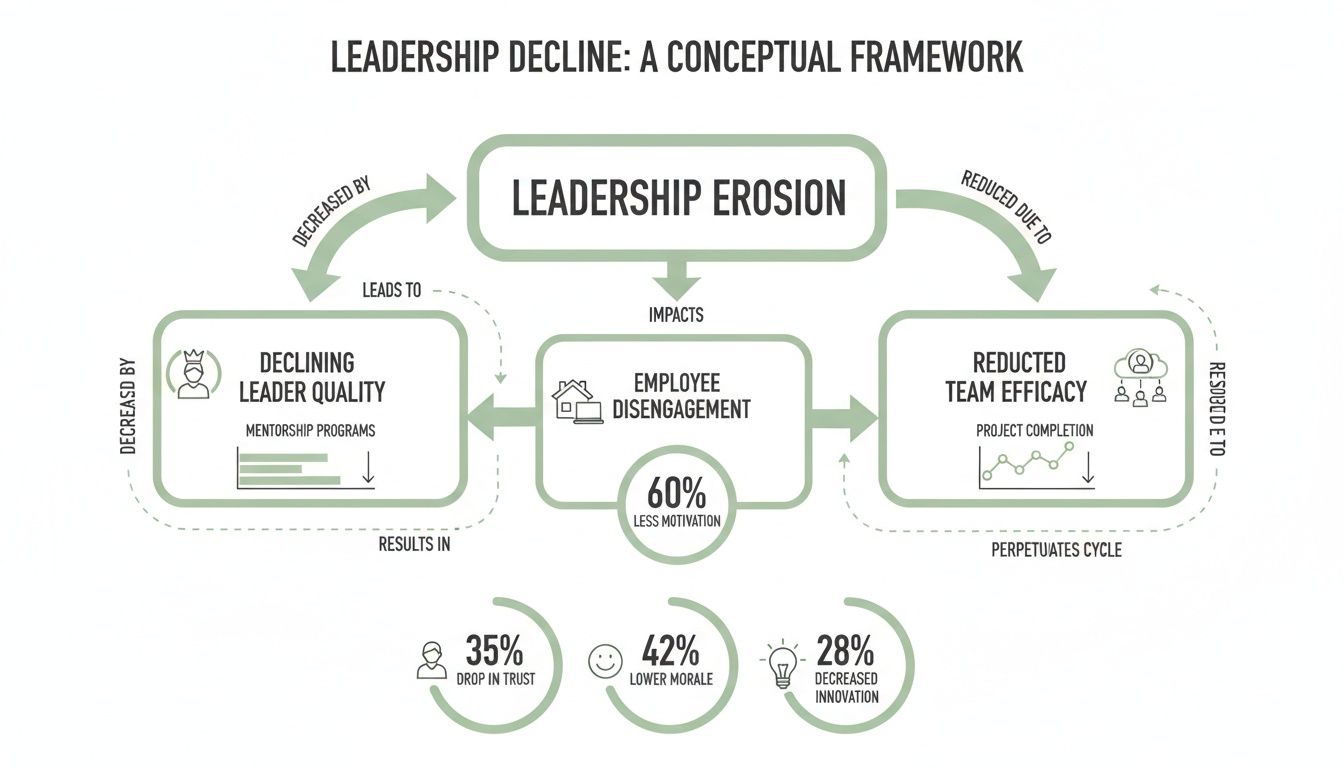
The data shows 58% of leaders in hybrid setups report lower team engagement. This isn't a failure of hybrid work; it's a failure of a leadership style that was never built to last. To cultivate an unshakeable presence that builds true authority, see our guide on developing executive presence.
The RAMS™ Reframe: Building Embodied Authority
Making the leap from command to authority demands a new operational blueprint. This is why I created the RAMS™ Method.
RAMS™ stands for Results, Attitude, Mastery, and Systems. It’s a framework for re-engineering how you generate influence and manage your energy. It's designed to pull you out of the hamster wheel of chasing external validation and plug you back into the true source of your power: yourself.
The Leadership Double Bind
Traditional corporate structures were not built with women in mind. They created a frustrating, unwinnable game known as the "double bind."
If you’re assertive and direct (commanding): You’re labeled as aggressive or abrasive.
If you’re collaborative and empathetic (lacking command): You’re seen as passive or indecisive.
This isn't a feeling; it's a systemic trap that forces you onto a tightrope, constantly self-monitoring. This keeps your nervous system in a chronic state of fight-or-flight. Your lived experience of feeling caught between "too much" and "not enough" is valid. It's the direct result of a system that equates forceful command with effective leadership—a definition that consistently penalizes women. Specialized female leadership development programs can be a powerful starting point for this crucial journey.
R is for Results Redefined
The first pillar, Results, tackles the high-achiever’s primary addiction: the hunt for external validation. RAMS™ reframes "Results" as internal alignment first, external achievement second. It starts by defining success on your terms, anchored to your core values. This forges an internal compass that makes you independent of outside praise or criticism.
When your actions align with this internal compass, the external results are more meaningful and sustainable. You stop chasing validation and start creating genuine value.
A leader operating from this space is unshakeable. Their value isn't tied to last quarter's numbers; it's rooted in an unwavering commitment to their own defined purpose.
A is for Attitude Grounded in Physiology
The second pillar, Attitude, is about mastering your own physiology. You can't project authority when your nervous system is screaming in a constant state of high alert. This pillar teaches science-backed techniques for nervous system regulation, like the Physiological Sigh. It teaches you to consciously shift from a reactive, sympathetic (fight-or-flight) state to a grounded, parasympathetic (rest-and-digest) one. This is the physiological bedrock of real executive presence.
When you can stay calm internally while chaos swirls externally, you project an aura of stability that is magnetic.
M is for Mastery of Your Unique Genius
The third pillar, Mastery, is about tearing up the generic leadership playbook and honing the skills that are uniquely yours. Mastery is the process of identifying, developing, and deploying your innate strengths—what I call your "zone of genius."
Instead of patching up perceived weaknesses to fit a corporate mold, you double down on what you do best. This not only makes you exponentially more effective but also builds unshakeable self-trust. When you lead from your zone of genius, you give everyone around you permission to do the same. This approach is further explored in understanding thought leadership marketing to build authority and influence.
S is for Systems That Sustain Your Energy
The final pillar, Systems, gets to the root cause of burnout: the belief that relentless personal effort is the only path to success. This pillar is about designing intelligent systems—both personal and professional—that create leverage and protect your energy.
Personal Systems: Routines for recovery, "do not disturb" blocks for deep work, non-negotiable time for movement.
Professional Systems: Mastering effective delegation, creating clear communication channels, building repeatable processes that empower your team.
By building robust systems, you stop being the engine and become the architect. Your role shifts from constant doing to strategic overseeing.
The Return: Reclaiming Your Leadership Legacy
The journey from forced command to earned authority isn't about adding another strategy. It's an act of returning. It’s a deliberate stripping away of the external pressures and outdated archetypes that have disconnected you from your most potent, authentic self. This is about reclaiming your nervous system from the constant threat-response that corporate culture demands.

True authority is the natural byproduct of self-mastery. It’s the quiet confidence that radiates from a leader who is fully aligned. This is how you build a legacy not just on what you achieved, but on how you led. It's creating an impact that is both powerful and sustainable, because it comes from a regulated, whole version of you. For leaders looking to amplify this impact, understanding how to build a reputation through platforms like podcasting is a powerful next step. Learn more about building an executive reputation through podcasting.
Your Return to Sovereignty
This path isn’t about becoming someone new. It is about remembering and reclaiming the powerful leader you already are. It’s building a foundation so solid that your presence alone inspires trust and commitment, making the old tools of force and control obsolete.
The shift from the brittle crown of command to the rooted oak of authority creates a ripple effect, transforming your team, your career, and your entire life. To explore this further, read our guide to defining your leadership legacy.
This is your invitation to step off the burnout treadmill. It’s a call to build a leadership that not only drives exceptional results but also deeply nourishes you. Your next step isn’t another push, but a guided return to yourself.
Book a diagnostic call to begin your transformation.
Your Questions, Answered
As leaders shift from brute-force command to embodied authority, important questions come up. Here are the most common ones I hear.
How Can I Build Authority Without Being Seen As Aggressive?
This is the key distinction. Aggression is about force and control, originating from a dysregulated nervous system. Authentic authority is rooted in a calm, clear assertion that comes from deep internal alignment. It's built through consistency, not intensity. When you lead from your core values (your redefined ‘Results’) and communicate from a place of physiological calm (your ‘Attitude’), your team experiences your conviction as stability, not a threat. Your strength becomes a source of psychological safety.
I Am Completely Burned Out. What Is The Very First Step?
If you’re running on fumes, the first step is to create space. Burnout is a physiological reality. Your only priority is recovery. Start with the smallest possible action to regulate your system. Commit to the Physiological Sigh technique (a double inhale through the nose, followed by a long exhale through the mouth) three times before your first meeting of the day. This simple practice, validated by neuroscientists like Dr. Andrew Huberman, is the fastest known way to voluntarily calm your body's stress response. It creates the biological foundation for every other change to stick.
How Does "Embodied Authority" Work With A Remote Team?
It’s even more critical in remote settings where non-verbal cues are lost. Embodied authority translates through the screen.
Clarity over Control: You create crystal-clear systems and communication channels so your team can operate with autonomy, reducing the need for micromanagement.
Intentional Presence: When you're on a video call, you are fully there. You're grounded and present. Your team feels that focus, building trust faster than any status update.
Trust by Default: You lead with trust, empowering your team to own their work. Your regulated presence makes it safe for them to take risks, innovate, and even fail without fear of reprisal.