Stop Being Heard, Start Being Felt: A Guide to Talking With Your Boss in 2026
The meeting is on your calendar, and the familiar dread begins its slow creep into your chest. Your stomach tightens. You rehearse lines in your head, planning the perfect, logical argument. But you know, deep down, that logic often isn't enough. You feel unheard, unseen, and exhausted by the effort of trying to make your boss understand.
This silent collapse—the gap between your brilliant insights and your ability to make them land—isn't a failure of intellect. It's a failure of connection. The truth is, to have a conversation that actually changes things, you must stop trying to be heard and learn how to be felt. This shift has nothing to do with memorizing a script. It begins and ends with mastering your own nervous system.
Key Takeaways:
Regulate Before You Communicate: Your nervous system's threat response (fight-or-flight) undermines your authority before you speak. Grounding yourself is the non-negotiable first step to influential communication.
Monetize Your Message: Stop talking about feelings and start talking about finances. Translate your needs (e.g., team burnout) into the language of business impact: cost of turnover, lost productivity, and risk to revenue.
Frame Your Ask as an Investment: Shift the dynamic from asking for a favor to presenting a high-return business opportunity. Your solution isn't an expense; it's an investment with a clear ROI.
Control the Narrative with a Pre-Read: A strategic one-page brief, sent before the meeting, anchors the discussion in facts and frames the problem on your terms, establishing your authority from the outset.
To talk with your boss effectively, you must first master the conversation inside yourself. Regulating your nervous system from a state of threat to one of grounded authority allows you to translate your team's needs into the language of business impact—risk, cost, and ROI—making your case not just heard, but impossible to ignore.
The Hidden Pattern: Why Your Logic Fails
You know that feeling. The meeting is on the calendar. For so many of the high-achieving women I work with, this is where the silent collapse begins.
The internal monologue kicks in: “What if they think I’m complaining? What if this backfires and they see me as difficult? If I stop performing, I’ll disappear.”
This isn't just pre-meeting jitters. It’s a primal threat response, hardwired into your biology. Your nervous system doesn’t know the difference between a condescending boss and a predator in the wild. The power dynamic triggers the same ancient fear of rejection, firing up your sympathetic nervous system. Your heart pounds, your breathing gets shallow, and your thoughts start racing. You are physiologically primed for fight, flight, or freeze—not a rational, influential discussion.
Imagine your nervous system is the operating system running in the background. If it's crashing, it doesn't matter how brilliant your software (your argument) is. It won't run. Trying to deliver a logical point when your body is screaming "DANGER!" is a losing game.
Shifting From Threat To Collaboration: The RAMS Reframe
The most critical conversation you'll have is the one that happens inside you first. You can't influence them if you can't regulate yourself. This is the core of the RAMS Method: Results, Attitude, Mastery, Systems. It starts with mastering your internal system.
The goal isn't to pretend the fear doesn't exist. It's to master your response to it. Real authority comes from a grounded presence, not a perfectly rehearsed speech.
This internal journey is a three-part process:
Signal: Acknowledge the stress signal (the knot in your stomach).
Regulate: Actively calm your nervous system.
Speak: Communicate from a place of grounded authority.

Speaking is the last step, the outcome of getting your internal state right. This is the bedrock of sovereign leadership. We break this down further in our guide on how to speak confidently at work. When you do this prep work, the entire game changes.
Prepare Your Case with Strategic Data Storytelling

Once you've grounded yourself, it’s time to build your case. But walking in armed with a spreadsheet of raw data is the fastest way to get dismissed. Data without a story is just noise. Leaders are moved by impact, not just information.
Your job is to transform numbers into a compelling narrative that demands attention. You shift from being seen as complaining about a problem to being the architect of a solution.
From Problem to Strategic Narrative
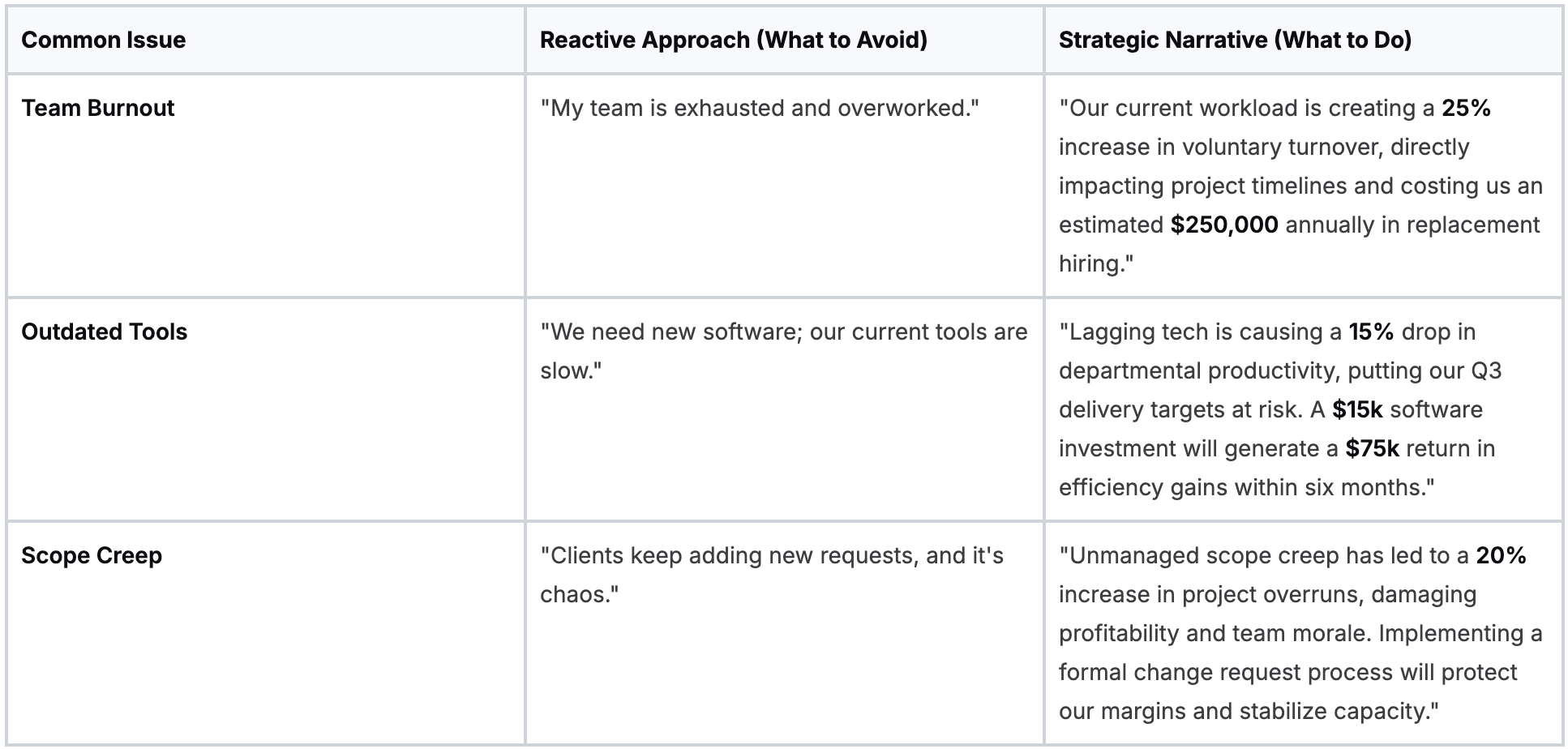
This table shows the shift. You’re not just presenting a problem; you're framing a strategic imperative. You’re moving the conversation from your team's pain to the business's bottom line.
Frame The Narrative Around Business Outcomes
Stop focusing on how tired your team is. Instead, frame the conversation around the metrics that keep your boss up at night: retention, productivity, and the financial bottom line.
A Harvard Business School study found that people remembered 20-30% more details when information was presented as a narrative versus just a list of stats. You’re not just sharing data; you’re making it memorable and urgent.
To build an undeniable case, connect your team’s reality to larger business metrics. This is your informational edge.
Quantify the Problem: Connect burnout to real dollars. Use industry averages for employee replacement costs—often 1.5-2x their annual salary—to put a shocking price tag on high turnover.
Benchmark Performance: How does your team’s productivity stack up against industry standards? Use this to highlight a performance gap.
Show the ROI of Your Solution: Frame your "ask" as a smart investment. Show exactly how it will reduce costs or boost productivity.
Mastering a few effective data visualization techniques for impactful reports can be a game-changer here. Your goal is to make it impossible for your boss to see the issue as anything other than a strategic business problem that needs an immediate solution. This is a cornerstone of powerful negotiation, detailed in our guide to the principles of negotiating.
Translate Your Needs into Business Impact

You've done the internal work. Now for the most critical part: translating what your team needs into the only language your boss truly speaks—the language of numbers, risk, and return on investment (ROI).
Leaders see every request through a financial filter. A vague plea for "more support" is easy to dismiss. But a meticulously crafted business case for a $50,000 investment to head off a guaranteed $300,000 revenue loss? That’s a conversation they can't afford to ignore. This is the art of monetizing your message.
Speak in Terms of Cost and Consequence
Calculate the cost of inaction. What is the real, financial damage being done by maintaining the status quo?
Cost of Turnover: Calculate the actual cost to replace people. Between recruitment fees, lost productivity, and training, you're looking at 1.5 to 2 times their annual salary. Put that number on the table.
Cost of Lost Productivity: Connect burnout directly to the bottom line. "Our outdated software adds five hours of manual data entry per employee, per week. That's costing us $125,000 a year in wasted payroll."
Cost of Risk: Pinpoint the ticking time bombs. Are you one burnt-out employee away from a missed contract deadline? Quantify that potential loss.
Research from Visier is clear: CEOs are laser-focused on the Total Cost of Workforce (TCOW) and are terrified of a potential 15% revenue dip from critical roles sitting empty. While 52% of executives are desperate for this cost-linked people data, most managers fail to provide it. Read the full research on how headcount data impacts CEOs to see how powerful this approach is. Be the one who delivers.
Frame Your "Ask" as a Strategic Investment
Once you've made the pain of the problem undeniable, you flip the script. Your solution is no longer an expense; it’s a high-return investment. You're not asking for a favor. You're presenting a lucrative business opportunity.
For women leaders, especially, this isn't just a useful tactic—it's a survival skill. Monetizing your message strips away subjectivity and anchors your request in the cold, hard logic of business.
Instead of asking for permission, you are presenting a strategic choice: "We can either continue losing $250k a year due to high turnover, or we can invest $50k in a retention program for a 400% ROI. Which option makes more sense for the business?"
This reframe is a masterclass in influencing outcomes without direct authority. You're moving the conversation away from your personal needs and toward shared business objectives. You are steering the company toward a more profitable, sustainable future.
Mastering The Art Of The Pre-Read Brief
The most critical part of a high-stakes conversation with your boss happens before you speak. It happens when you create a killer briefing document—a pre-read. This isn't just an agenda. This is about seizing control of the narrative.
A powerful pre-read anchors the discussion in undeniable facts and frames the story on your terms. For accomplished women who constantly face the "prove-it-again" bias, this isn't optional. It’s how you walk into the room as an authority, not a subordinate.
Storyboard Your Key Points
Your brief needs to tell a story. Don’t just present numbers; weave them into a narrative with context and weight.
Never just say turnover is high. That’s weak. Instead, frame it with a timeline and benchmark: *“Since 2025, our voluntary turnover has spiked by 28%, blowing past the industry's average of 19%.”* That single sentence establishes a trend, a performance gap, and urgency.
Use Strategic Visuals And Benchmarks
Ditch simplistic pie charts. It's time to get more sophisticated.
Waterfall Charts: These are gold for showing how a starting value is hit by positive and negative changes. Visually walk your boss through the cumulative financial drag of high turnover.
Benchmarking Data: Never present your numbers in a vacuum. A 2025 analysis found that women executives boost their influence by 25% when they benchmark performance. Frame your data against industry peers.
Instead of saying, "Our retention is down," hit them with this: “We are currently lagging 12% behind our tech industry peers in employee retention, which puts a potential $5M annual loss on the table.” Now you’re not just reporting a problem; you’re quantifying a multi-million-dollar risk.
To sharpen this skill, look at how top-tier consultants build effective meeting briefs. The principles they use—clarity, focus, and impact—are exactly what you need.
Your one-page brief is your opening argument. It should be so clear, concise, and compelling that your boss understands the core issue and its business impact before you even say a word.
Getting this right is a cornerstone of powerful executive communication. You can go deeper on this concept by building executive communication skills.
The Follow-Up That Cements Change

The meeting ends. The verbal agreement you just secured is fragile. A "great chat" without a documented follow-up is a fast track to disappointment and having the same conversation again in three months.
The follow-up is where you take control. It’s how you turn a fleeting moment of alignment into a concrete plan for action. This isn't about being pushy; it’s about professional clarity and refusing to let momentum die.
Why Writing It Down Is a Power Move
Documenting your conversation is a psychological power move. It drags vague ideas out of the ether and forces them into the real world as tangible commitments. It kills ambiguity. It signals professional respect and shows you are serious about executing the plan you built together.
Summarizing the conversation isn't just sending a memo. It's about codifying an agreement, building a foundation for accountability, and seizing control of the outcome.
The No-Nonsense Follow-Up Email
Send a follow-up email within 24 hours. It needs to do three things clearly:
State the Core Agreement: Reiterate the problem and the high-level understanding you reached. "Just to summarize, we agreed the team's productivity is down an estimated 15% because the software is outdated."
List the Action Items & Owners: This is where accountability is forged. "My understanding of the next steps is that you will look into the budget for new software, and I will research three viable options with ROI projections by EOD Friday."
Define the Timeline: Attach a specific date to every action. "We'll connect for a 15-minute sync next Tuesday to review my software options and make a decision."
This final step is what separates a frustrating conversation from a lasting change. You can explore how to build that muscle in our guide on how to follow through on commitments with integrity.
Your Toughest Questions, Answered
Even with perfect preparation, a high-stakes conversation is unpredictable. Here are the straight answers to the questions I hear most often.
What If My Boss Gets Defensive Or Emotional?
First, breathe. Their reaction is just data. It’s a reflection of their internal state, not a judgment on you. Your only job is to stay anchored in your own calm.
Don't get sucked into their emotional storm. Acknowledge what you're seeing without taking ownership of it: "I can see this is a difficult topic." Then, gently pivot back to the objective data and shared goals. Your regulated presence is your most powerful tool.
How Do I Talk About My Workload Without Sounding Like I'm Complaining?
Complaining is about your feelings. Strategic communication is about business impact. Frame the conversation around output, quality, and risk—not how "busy" you are.
Show them the consequences: "I've mapped our project pipeline against current capacity, and I've identified a bottleneck that's pushing our delivery dates out by 15%. This puts our Q3 revenue targets at risk."
Immediately follow with your proposed solution: suggest a reprioritization, make a data-backed case for a new hire, or outline a process improvement. You're not saying, "I have too much to do." You're saying, "I've identified a strategic threat, and I have a plan to neutralize it."
What If My Boss Agrees With Me, But Then Nothing Changes?
This is why the follow-up framework is not optional. A verbal "yes" without a documented action plan accomplishes nothing.
That follow-up email is your tool for accountability. It's a shared record of reality. If a week goes by with no action, you schedule a brief, 15-minute check-in: "Following up on the action items from our conversation on [Date]." This isn't nagging. This is professional persistence and a quiet display of leadership that’s impossible to ignore.
The work isn't about learning a better script. It's about returning to yourself—your grounded, sovereign power. This is the source of all true influence. At Baz Porter, we help accomplished women move from exhaustion-driven performance to embodied, sovereign leadership. If you're ready to stop having the same draining conversations and start creating real, lasting change, your journey back to yourself starts now.