
The Real Principles of Negotiating: A Guide for High-Achievers
You feel it in your chest, a tightening, a silent surrender. The handshake is firm, but the deal feels hollow. You’ve just accepted more responsibility, but the title and pay remain stubbornly fixed. You’ve swallowed your needs one more time, all in the name of keeping things smooth, of not rocking the boat.
This is the Silent Collapse. It's the quiet, draining negotiation high-performing leaders face every day, not in the boardroom, but within their own nervous systems. It’s the constant, grinding internal conflict between proving your worth and preserving your last ounce of energy. If you stop performing, you feel like you’ll disappear.
Key Takeaways
Negotiation is Internal First: True power comes from nervous system regulation. When you can maintain a state of "sovereign calm" instead of reacting from fight-or-flight, you reclaim your strategic mind and command the room.
The RAMS™ Framework is Your System: Move beyond tactics. Master negotiation through a repeatable system: define your Results, regulate your Attitude, build skill Mastery, and create a data-driven preparation System.
Data Replaces Drama: An undeniable business case, built on objective data (market benchmarks, ROI, industry trends), turns a hopeful request into a logical conclusion. Facts calm your nervous system and give you unshakeable leverage.
Traditional Advice Fails High Achievers: Generic advice to "be more aggressive" ignores the physiological reality of a hijacked nervous system and the societal double bind that penalizes assertive leaders. The solution isn't a new mask; it's a regulated internal state.
The most powerful principles of negotiating are internal, not external. It all starts with regulating your own physiological state before you even think about influencing someone else. When you can walk into a room from a place of grounded calm, not a fight-or-flight threat response, you reclaim your executive function and shift from pure reaction to conscious intention.
The Hidden Pattern Hijacking Your Power
You’ve mastered the external game. You command boardrooms and execute complex strategies. Yet, the most exhausting negotiation isn’t with a client; it's the one happening inside your own body. This internal battle is where your power bleeds out. Each time you say “yes” when every cell screams “no,” you trade a piece of your authority for a fleeting moment of perceived harmony.

This isn't a character flaw. It’s a predictable, physiological response. High-stakes negotiations don't just challenge your intellect; they directly threaten your nervous system. Your brain can't distinguish between a boardroom showdown and a predator in the wild. When your sense of safety or value is on the line, your amygdala hijacks your prefrontal cortex, the seat of strategic thought. You're flooded with cortisol, triggering a primal threat response.
The Threat Response Hijack
This isn't a failure of willpower; it's physiology. Your system defaults to one of three states: fight (becoming overly aggressive), flight (conceding too quickly), or freeze (going blank and being unable to articulate your thoughts).
When you’re in this state, your ability to think creatively and listen actively goes offline. You’re just trying to survive.
The Double Bind: Why Traditional Advice Fails High Achievers
For high-achieving leaders, this is amplified by a suffocating societal double bind. You’re conditioned to be collaborative, yet told to be assertive.
Too Aggressive: You risk being labeled "difficult" or "abrasive." Research confirms women face social backlash for self-advocating in ways men are praised for.
Too Accommodating: You risk being seen as a pushover, leaving value on the table and reinforcing the very biases you’re fighting.
This forces an exhausting calculation: Do I advocate for my worth, or do I protect my reputation? Generic advice to "push through" is useless when your entire physiological system is screaming "fall back." It ignores both the internal reality of your nervous system and the external reality of gendered power dynamics.
The path to mastering the principles of negotiating doesn't start with learning new lines; it starts with regulating your internal state so you can deliver the ones you already know with sovereign calm. Effective women leadership development programs must address these core physiological challenges, not just surface-level tactics.
The RAMS™ Reframe for Sovereign Negotiation
The cycle of burnout, concession, and resentment isn't your fault. The solution isn't a fake, aggressive mask or shrinking to keep the peace. The answer lies in building a new internal foundation, one that operates from sovereign calm, not survival-driven fear.
This is the purpose of the RAMS™ framework. It’s a systematic approach to mastering the principles of negotiating by grounding every external action in a regulated internal state. It stands on five pillars: Results, Attitude, Authenticity, Mastery, and Systems.
R - Results: Define Your Non-Negotiables
The first pillar is getting crystal clear on what a successful outcome looks like for you, long before you enter the room. This is deeper than a target number. It's about defining your absolute non-negotiables based on your value, contribution, and boundaries.
This isn't a wishlist. It's a declaration of worth, backed by data. What is the one outcome that will leave you energized and respected, not drained?
By defining your desired result first, you anchor the entire negotiation to your internal value, not the other party's opening offer. This flips the script from reactive defense to proactive direction.
Without this clarity, you become an easy target for pressure tactics and the urge to give in just to make the discomfort stop.
A - Attitude: Cultivate Sovereign Calm
Attitude is the cornerstone. This isn’t "positive thinking"; it’s your core physiological state. It is the active cultivation of sovereign calm, the tangible practice of regulating your nervous system so you can access your strategic mind when things get heated.
A dysregulated nervous system will sabotage the most prepared negotiator.
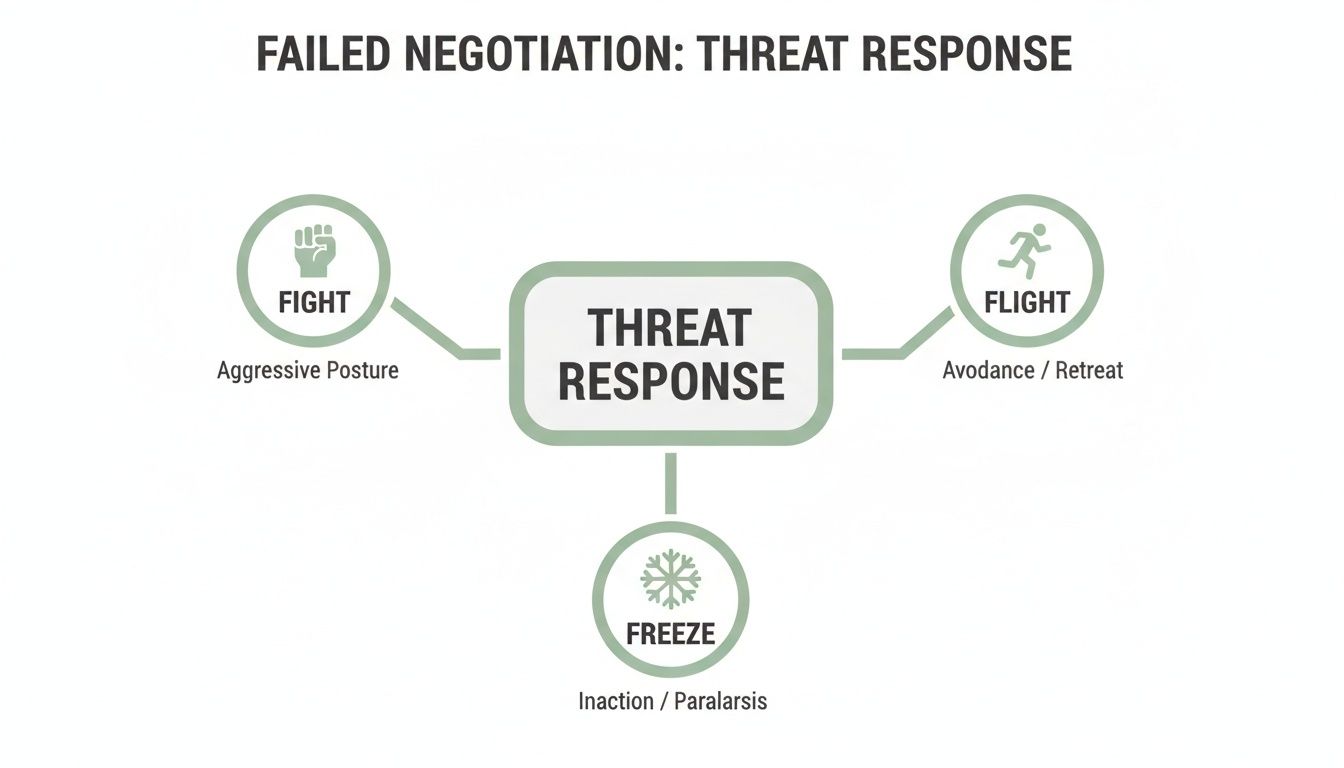
This visual shows how a hijacked nervous system forces you into primal, ineffective behaviors. By intentionally managing your internal state, you can choose a sovereign, powerful response instead. Sovereign calm allows you to listen without defensiveness, think creatively under pressure, and stay connected to your defined Results. It is your single greatest asset.
M - Mastery: Develop Core Competencies
With a clear Result and a regulated Attitude, you can focus on Mastery. This is about sharpening the skills that turn a confrontation into a collaborative conversation. Two are critical:
Active Listening: Hear what isn't being said. Listen to understand the other person's underlying interests and fears. When people feel heard, their defensiveness melts, opening the door for creative solutions.
Boundary Setting: Say "no" with grace and firmness. A well-articulated boundary is a sign of self-respect that commands respect. It communicates your value without ambiguity. This is crucial when dealing with the fear of being disliked.
S - Systems: Build Your Preparation Protocol
Finally, Systems provide the structure. A rock-solid preparation system turns fear into confidence. It’s how you replace emotional reactivity with data-driven conviction. Your repeatable protocol must include:
Data Collection: Gather objective proof like market salary benchmarks, company performance metrics, and industry precedents.
Interest Mapping: Identify your core interests and make an educated guess about theirs.
Option Brainstorming: Generate multiple potential solutions that could satisfy both sides.
BATNA Analysis: Define your Best Alternative to a Negotiated Agreement, your non-emotional walk-away point. This is the source of your true power.
This system automates excellence and ensures you walk in with an undeniable case built on facts.
The RAMS™ Framework In Action: A RAMS™ Return
Consider Sarah, a Senior Director doing C-suite level work without the title or pay. She was on the edge of burnout. Applying RAMS™, she:
Results: Defined her non-negotiable outcome: VP title and a 25% salary bump to match market data.
Attitude: Used breathing techniques to shift from anxiety to sovereign calm before the meeting.
Mastery: Actively listened to her boss's budget concerns, then proposed a phased increase tied to performance metrics, holding firm on the VP title boundary.
Systems: Built a business case with ROI data, industry salary benchmarks, and stakeholder testimonials.
The outcome? Sarah secured the VP title and a 22% salary increase. She walked away feeling powerful and respected, not resentful. She didn't "win"; she aligned the external reality with her internal value. For a deeper dive, explore the RAMS™ Method leadership framework.
Comparing Traditional Tactics And The RAMS™ Method
This table highlights the shift from reacting from threat to responding from sovereignty.

This isn't just a different set of tactics. It's a fundamentally different way of showing up. While these principles are key for negotiating for a promotion, they apply to any high-stakes conversation, including those covered in high-ticket sales training.
Act III: The Return to Nervous System Sovereignty
True power in any negotiation comes from the quiet confidence rooted in cold, hard facts. This is one of the most critical principles of negotiating. When you do the exhaustive, data-driven work upfront, you turn a hopeful request into an undeniable business case.
This is an act of self-respect. You systematically replace the fear that fuels your threat response with concrete data. When your nervous system is calm, your strategic mind can lead.

A rock-solid preparation system is your greatest asset. It provides the evidence you need to stand firmly in your value.
Building Your Undeniable Case
Your preparation protocol should focus on three areas:
Market Benchmarks: Collect current salary data for your role, industry, and location. This anchors your request in objective reality.
Company Performance Metrics: Quantify your contributions. How have your projects impacted revenue, reduced costs, or improved efficiency? Find the hard numbers.
Industry Trends: Is your skill set in high demand? What are competitors paying? This demonstrates your strategic value. This data-driven approach is a cornerstone of global deal-making; UNCTAD's global trade insights confirm its effectiveness.
Once you have the numbers, translate them into a compelling narrative. You’re not there to present a spreadsheet; you’re telling a clear story of your value. This is a core competency of strategic thinking for leaders.
Your data does more than support your argument, it regulates your internal state. With facts as your foundation, you're less likely to be swayed by emotional tactics. You can simply state the facts with sovereign calm.
Navigating Cultural Dynamics
On the global stage, culture is an invisible current. A direct approach that works in New York can backfire in Tokyo. Understanding cultural differences, as outlined in Harvard's research on unlocking cross-cultural negotiation differences from Harvard, is crucial. The key is to adapt your strategy without losing your core objectives. Preparation and cultural intelligence prevent disastrous missteps and build the trust every successful outcome requires.
Mastering negotiation isn't about winning an external battle. It's an inside-out job—a return to yourself. It’s standing so firmly in your value that you can communicate your needs with unshakable calm. True, lasting power comes from one place: nervous system sovereignty. When you can regulate your internal state, you can master any external conversation.
The real work begins by understanding your own patterns. What triggers your threat response? Where do you consistently give your power away? To walk this path, you must start by mastering confident conversations with yourself.
True negotiation mastery is the alignment of external outcomes with your internal worth. It’s the moment you stop asking for what you think you can get and start declaring what you know you deserve.
Your next conversation doesn't have to be a confrontation. It can be a confirmation of your value. Ready to understand your patterns and build a system that works for you?
Take the Sovereign Leader Diagnostic to identify your patterns and start your path back to yourself.
Burning Questions on Negotiation
Here are real-world answers grounded in the principle of negotiating from regulated strength.
"How Do I Negotiate When I Feel Powerless?"
True leverage isn't your title; it’s preparation and knowing your BATNA (Best Alternative to a Negotiated Agreement). When you know your absolute walk-away point, and have other viable options—you are never powerless. Focus on what you control: build an undeniable case with objective data and frame your proposals around their interests. Your clarity, preparation, and sovereign calm create a power that hierarchy cannot touch.
"What’s The Best Way To Handle An Aggressive Negotiator?"
An aggressive negotiator is a dysregulated one. Their goal is to trigger your threat response so you make concessions out of discomfort. Refuse to engage on their terms. Stay grounded in sovereign calm. Use active listening to disarm them ("It sounds like you feel very strongly about this"). Then, calmly redirect the conversation back to objective criteria and mutual interests. Your regulation is your shield.
"How Can I Practice This In Lower-Stakes Situations?"
Start small, today. Negotiate with your partner about dinner or discuss a deadline with a colleague. Use these moments to consciously practice identifying the underlying interests behind their positions. Most importantly, focus on regulating your own nervous system during these minor disagreements. Every time you notice you're getting activated and choose to stay calm and centered, you build the neurological capacity to do the same when the stakes are a hundred times higher.
Ready to stop reacting and start leading every negotiation with sovereign calm? At Baz Porter, we help you build the internal systems to achieve outcomes that reflect your true worth.
Where to go next
If the hardest negotiation you face is the one inside your own body, the Silent Collapse Diagnostic™ is a quiet place to see your own patterns. And if you want the deeper why beneath the work, read the Sovereign Manifesto.