
How to Influence Without Authority: Build Credibility and Lead with Impact
You see the path forward with perfect clarity. You know the vision. But when you try to rally the team, you hit a wall of polite nods and quiet resistance. You don't have the formal title to just make it happen.
This kicks off a familiar, gut-wrenching internal monologue: “If I can’t get them on board, this entire initiative will fail, and it will be my fault. If I stop performing, I'll disappear.” The pressure isn’t just about a project deadline; it’s about your identity as a capable leader. You're stuck in the gap between the immense responsibility you feel and the authority you lack—and that's exactly where self-doubt thrives. The fear is real: without direct reports, your brilliant ideas might remain just ideas, unheard and unexecuted.
Key Takeaways
Logic Fails, Connection Wins: Discover why data-driven arguments often trigger defensiveness and how building psychological safety is the true key to buy-in.
The Authentic Influence Framework: Learn a repeatable, four-pillar system to build credibility, map stakeholder motivations, earn trust, and frame your narrative for maximum impact.
Navigate Resistance Strategically: Get actionable scripts to handle pushback, build alliances with allies and neutrals, and neutralize detractors without escalating conflict.
Lead from Your Core: Shift from external tactics to internal grounding, understanding how self-regulation and true confidence create a natural authority no title can give you.
Influencing without authority is the art of creating genuine buy-in and collaboration when you can't rely on a formal title. It’s a leadership skill built on a foundation of credibility, strong relationships, and the ability to align your goals with the motivations of others.
The Hidden Pattern: Why Your Perfect, Logical Argument Just Fell Flat

You’ve done the work. The research is solid, the spreadsheet is flawless, and the data-driven argument you’ve built is completely irrefutable. And yet… you’re met with blank stares or even outright resistance.
It’s an incredibly frustrating experience, but it’s not a reflection of your competence. It’s a reflection of a fundamental truth: human beings are not wired to be persuaded by logic alone. When you lead with pure data, especially when it challenges someone’s beliefs, you can accidentally trigger their brain’s threat detection system. This isn't a conscious choice; it's a primal, protective mechanism. When people feel intellectually cornered, their nervous system flips into a defensive state, making them physiologically incapable of hearing your brilliant logic.
From Echo Chamber to Resonant Network
Think of traditional, top-down authority as an Echo Chamber. Ideas are pushed from the top and repeated down the chain of command. You might get compliance, but you rarely get genuine buy-in. The ideas just echo; they don’t actually land.
Now, imagine a Resonant Network. This is built on a foundation of psychological safety. In this network, ideas don’t just echo—they resonate. They’re absorbed and adopted because the people receiving them feel seen, heard, and respected. Your goal isn't just to be heard; it's to create resonance.
Influence is not about having the best argument. It’s about creating the best environment for that argument to be received.
And that environment is built on one thing: trust. Without it, your facts are just noise. When people trust you, they are neurologically primed to be open to your perspective. Their brain shifts from "protect and defend" to "connect and collaborate." For a deeper dive, explore our article on the clash between the head vs heart in leadership.
How to Build Psychological Safety
So, how do you create this receptive state? You stop selling your idea and start building psychological safety. This isn’t about being "nice." It’s about fostering an atmosphere where people feel safe enough to disagree without fearing punishment.
Lead with Genuine Curiosity: Before presenting your solution, ask questions. Understand their world—their challenges, their goals. This signals respect.
Acknowledge Their Expertise: Publicly and privately, recognize the skills others bring. This validates their contribution and lowers their defenses.
Share Your Own Vulnerability: Admitting you don't have all the answers or sharing a mistake is a powerful trust-builder. It humanizes you.
When you shift from winning the argument to building the relationship, the dynamic changes. This is the bedrock of learning how to influence without authority.
The RAMS Reframe: A Practical Framework for Authentic Influence

Knowing why your bulletproof logic gets ignored is half the battle. The solution isn’t about manipulation tactics. It's about a reliable, repeatable system for genuine influence—the kind that inspires people to want to follow your lead, no title required.
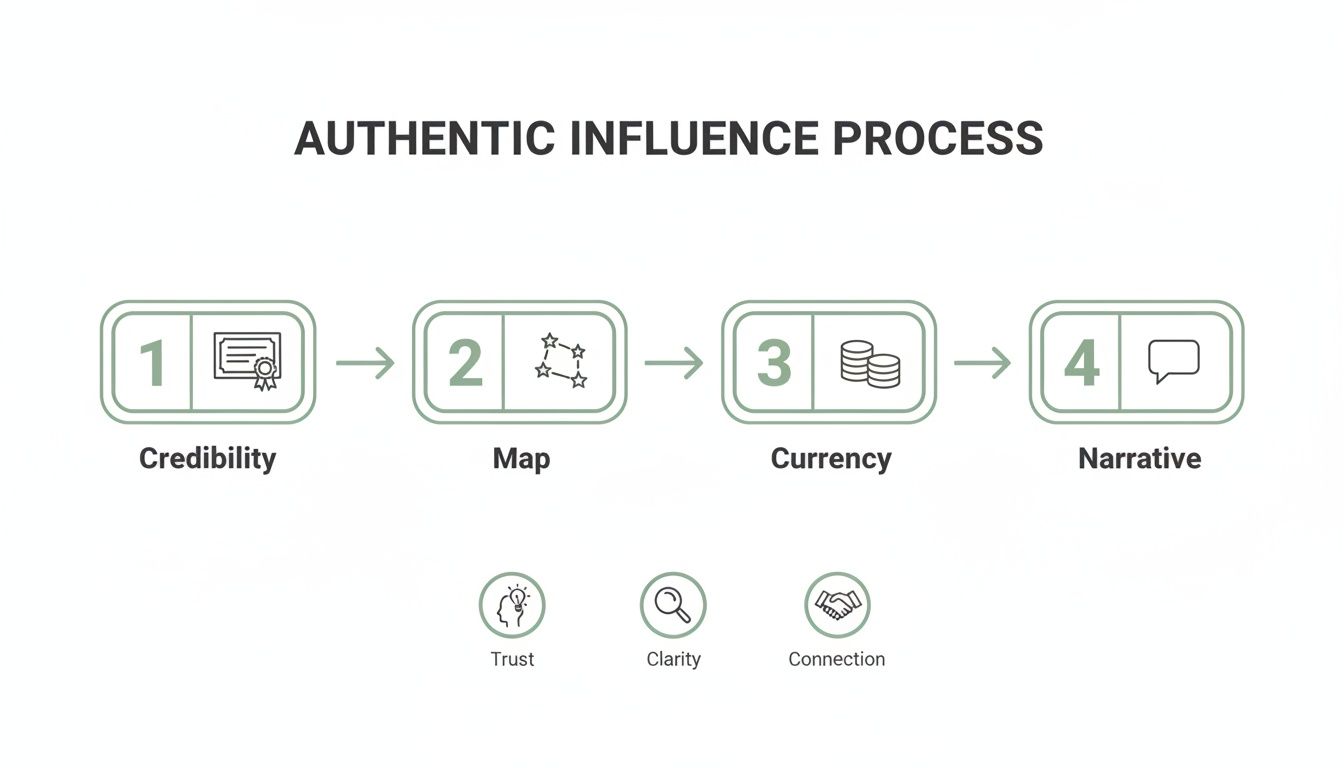
Real influence isn’t a dark art; it’s a skill. The four pillars below are your roadmap. They'll shift you from being the expert with good ideas to the trusted advisor whose insights are actively sought. This is the Results, Attitude, Mastery, and Systems (RAMS) approach applied to influence.
Pillar 1: Credibility (Mastery)
Before anyone listens, they have to trust your competence and character. Credibility is the bedrock of influence. It’s the quiet confidence you project that says, “I’ve got this, and you can count on my judgment.”
This is more than having the right answers. It's a track record of consistent excellence and showing you grasp the bigger picture. When you deliver on your promises, you build a reputation that walks into the room before you do.
To build this foundation, focus here:
Master Your Domain: Go deep. Become the go-to person for reliable information and thoughtful insights.
Deliver with Excellence: Make high-quality work your signature. Hit your deadlines. Follow through. Every time.
Speak with Integrity: Be honest and direct. When you screw up, own it. That vulnerability builds more trust than a facade of perfection.
A powerful way to solidify your expertise is through smart thought leadership marketing, a strategy that builds an external profile to reinforce your internal credibility.
Pillar 2: Mapping the Constellation (Systems)
Here’s a hard truth: you can't influence people you don't understand. Influential leaders stop seeing a rigid org chart. Instead, they see a dynamic constellation of individuals, each with their own motivations and goals. Your job is to map that constellation.
This means getting curious about what makes colleagues tick. Who are the actual decision-makers? Who are the informal influencers—the people others turn to, even without a fancy title?
Influence isn't about ramming your agenda through. It's about understanding everyone else's and finding where they intersect with yours.
To map your stakeholder constellation, start asking three critical questions about every key player:
What are their primary goals and pressures? Look at their KPIs. Frame your idea in a way that helps them win.
What's their preferred communication style? Do they want a deep-dive email? A quick summary on Slack? A face-to-face chat? Speaking their language is a game-changer.
Who do they trust? Identifying their key allies shows you how to build a broader coalition of support.
Pillar 3: Building Relational Currency (Attitude)
Think of every positive, helpful interaction as a deposit into a relational bank account. This "Relational Currency" is the trust and goodwill you build over time. When you need to make a withdrawal—by asking for support on a big project—you'll have the capital to do so.
We often get hyper-focused on tasks and forget that relationships are the channels through which all work gets done. This currency is built in small, consistent acts of support.
Here’s how to start making deposits today:
Offer Help Proactively: Don't wait to be asked. If you see a colleague drowning, offer a hand without expecting anything in return.
Give Credit Generously: When a project succeeds, be loud about the contributions of others. Highlighting their wins builds powerful alliances.
Listen to Understand, Not to Respond: Give people your full attention. Making someone feel truly heard is one of the fastest ways to build trust.
Organizational experts have found that influencing without authority can boost productivity by up to 30% on cross-functional teams. As companies moved to matrix structures, the reach of formal authority shrank by 50%, making persuasion the new currency.
Comparing Authority vs. Influence in Leadership
To thrive, we must move beyond the old command-and-control model. Here’s how the outdated, authority-driven approach compares to the sustainable, influence-driven leadership required today.

While authority can force short-term compliance, only influence builds the long-term commitment needed for breakthrough results. For more on building your professional standing, see our guide on how to gain respect at work.
Pillar 4: Framing the Narrative (Results)
This is the final piece. You can have rock-solid credibility, a perfect stakeholder map, and a vault of relational currency, but if you can’t frame your idea effectively, it will die.
Framing isn’t about spinning the truth. It's about presenting your vision in a way that connects to the motivations of your audience. It’s translating your "why" into their "what's in it for me."
To craft a narrative that lands, stop explaining what your idea is and start showing what it does for them.
A Practical Example
Let's say you want to bring in a new project management tool.
Poor Framing: "We should switch to this new software. It has better features and a cleaner interface." (Focuses on your preference.)
Powerful Framing (for an overworked peer): "I found a tool that could automate our weekly reports and save you three hours a week. Are you open to a quick 15-minute demo?" (Speaks to their pain point.)
Powerful Framing (for a budget-conscious manager): "I analyzed our workflow and found a bottleneck costing us about 10 hours of productivity a week. This tool has a strong ROI and could pay for itself in six months by freeing up the team for higher-value work." (Speaks their language: financial impact.)
The core idea is the same, but the narrative resonates with each listener’s world. This is the essence of influence and the core of what authentic leadership is.
Navigating Resistance and Building Alliances
Even with the best plan, influencing people is rarely a straight line. You will hit pushback. You will encounter skepticism and get tangled in office politics. This isn't a sign you've failed. It's the moment your real leadership begins.
Anticipating resistance isn’t about gearing up for a fight; it’s about preparing to meet friction with strategy and empathy. Your ability to handle these moments without getting defensive is what separates a fleeting win from lasting change.
Identify Allies, Neutrals, and Detractors
Before you build a movement, you must know the players. Not everyone will see your vision right away. The first step is to get a clear-eyed view of where everyone stands.
Allies: Your champions. They're already on your side or naturally inclined to support you.
Neutrals: The biggest group. They're not against you, but they aren't for you yet. They're busy, distracted, or haven't been given a compelling reason to care. This is your biggest opportunity.
Detractors: Those actively pushing back. Their resistance could come from a competing agenda, a fear of change, or a past negative experience.
Focus your energy on mobilizing allies and persuading neutrals. Trying to convert your most vocal detractors is often a draining, low-return effort. Instead, work to understand their objections. If you can address their concerns, you’ll likely win over the undecided middle.
For powerful strategies, learn how to navigate office politics without selling your soul.
Conversational Scripts for Tough Situations
When you get direct pushback, having the right words ready can de-escalate tension and reframe the conversation.
Scenario 1: You're told, "That’s not your decision to make."
This is a classic power play. Don't take the bait.
Your Response: "You're absolutely right, I'm not the final decision-maker. My goal is to bring a potential solution to the table that could help us hit [shared goal]. I wanted to bring the data to you first since you have the best perspective on this."
This response validates their position, sidesteps the power struggle, and pivots back to collaboration.
Scenario 2: A key executive has completely different priorities.
You have to connect your idea to their world, fast.
Your Response: "I know your top priority this quarter is [mention their known goal, e.g., reducing customer churn]. I have an idea that could directly support that by [explain the connection in one sentence]. Is now a good time for a two-minute overview?"
This shows you've done your homework, respect their time, and are there to help them win.
Proactively Building Your Coalition
Building alliances is something you do every day, not just when you need something. In a Harvard Business Review survey of 5,000 C-suite women, 82% said influence tactics were the key to navigating complex projects. They built legacies by treating everyone as a potential ally.
Influence is the art of building a powerful "we" around an idea that started with "I."
To build your coalition, weave these strategies into your week:
Share Knowledge Freely: When you see an article that could help a colleague, send it their way. It positions you as a valuable partner.
Amplify Others' Voices: In a meeting, when a colleague makes a great point, publicly credit them. "That's a brilliant idea, Sarah." This builds incredible goodwill.
Co-Create Solutions: Don't show up with a perfectly finished plan. Bring key people into the process early. Genuinely integrate their ideas. People will always fight for a world they helped create.
The Return: Leading Authentically from Your Core
All the strategies, frameworks, and scripts are powerful tools. But the real, unshakeable source of your influence isn't a tactic; it’s cultivated within you.
True, sustainable influence is an inside-out job. It radiates from a leader who is grounded, self-aware, and secure in their own value, independent of a title. This is the final, most critical shift: moving from doing influence to being influential.
When you operate from this core of authentic confidence, you generate a natural authority that people feel and instinctively respond to. It's the quiet power that comes from deep self-regulation and knowing your worth isn't tied to your last performance review. This is nervous-system sovereignty.
The Power of Self-Regulation
The most influential person in any room is almost always the most regulated one. When you can hold your center amidst chaos or pressure, you become a gravitational force.
People are drawn to that stability. Your calm presence creates the psychological safety for others to let their guard down and genuinely hear you. This is an active practice of managing your own nervous system so you can respond with intention rather than react from fear. A critical piece of this is developing your emotional intelligence.
Your capacity to influence others will never exceed your capacity to lead yourself. The external results you seek are a direct reflection of your internal state.
Embodying Authentic Leadership
Becoming a powerful influencer isn’t about adding more skills. It’s about stripping away the performance-driven armor you’ve been taught to wear. It’s about ending the exhausting cycle of burnout by leading in a way that aligns with who you actually are.
This path requires a commitment to understanding your core values. When you can articulate what truly matters to you, you can connect your vision to a deeper purpose. A great place to start is by defining what your professional values are.
This is the ultimate return. It’s a return to yourself—to a way of leading that feels less like a struggle and more like an expression of your deepest strengths. When you lead from this place, influence becomes the natural byproduct of your authentic presence.
Your Questions on Influence, Answered
You've got the framework. But theory is one thing; the messy reality of your day-to-day is another. Let's tackle the most common questions.
How Do I Start Building Influence When I Am New to a Role?
A new role is a golden opportunity. You have a clean slate. Your first mission isn't to prove how brilliant you are—it's to prove you're a listener and a learner.
Schedule brief, informal one-on-ones with key peers and stakeholders. Your goal is to understand their world. Try questions like:
"What's the biggest challenge you're wrestling with right now that I should understand?"
"From where you sit, what does a huge win for this team look like in the next six months?"
"Who are the people I absolutely need to connect with to get a real feel for how things get done around here?"
This simple act immediately starts building your Relational Currency. You're showing respect for their experience. From there, focus on nailing a few small, early wins and being relentlessly reliable. That's how you build credibility from the ground up.
What Is the Difference Between Influencing and Manipulating?
This is a critical distinction, and it all boils down to intent and transparency. The line can feel blurry, but the core difference is profound.
Influence seeks mutual benefit; manipulation seeks personal gain at others' expense.
Influence is an open-handed process. You lay out your case, connect it to shared goals, and respect the other person's autonomy to agree or disagree. It’s a collaborative effort to find the best path forward.
Manipulation operates in the shadows. It leans on hidden agendas, emotional ploys, or withholding key information. It's a short-term tactic that demolishes trust. If you feel you have to hide your real motives, you’ve crossed the line.
How Can I Influence My Manager When They Seem Resistant?
Influencing upward is its own art form. When a manager seems resistant, it's rarely about you. It’s almost always because they are focused on pressures and priorities you can't see.
Your first move is to stop pushing and start digging. Get curious. Find the root of their resistance. Is it a budget issue? A fear of risk? A competing priority from their boss?
Once you understand their world, you can reframe your pitch. Stop presenting your idea as something you want. Start positioning it as a solution to their problem.
For example, ditch: "I think we should invest in this new software."
Instead, try this:
"I know reducing project overruns is a huge focus for you this quarter. I've been looking into a tool that could potentially slash our revision time by 20%, which would directly help us hit that goal. Are you open to a 15-minute walkthrough of the numbers I pulled?"
This approach respects their authority, speaks their language (priorities), and positions you as a strategic partner. You’ve transformed a potential conflict into a problem-solving session. That’s the core of learning how to influence without authority.
Where to go next
At Baz Porter, we know true leadership has nothing to do with the title on your business card — it's about the authentic presence you command. If you're done performing and ready to return to yourself, the Silent Collapse Diagnostic™ is a quiet place to begin — a private, 60-minute conversation with Baz. And if you want the deeper why beneath the work, read the Sovereign Manifesto.