
Executive Communication Skills Training That Actually Works
You’re the most prepared person in the room. You’ve run the numbers, built the models, and have a clear answer for every question. Yet when you speak, the energy deflates. The idea that felt so powerful in your head lands with a quiet thud, lost in the noise. It feels like your expertise, the very thing that got you here, no longer guarantees you’ll be heard.
This is the silent collapse. It's that baffling, frustrating disconnect where your deep knowledge no longer translates into influence. You’re putting in more hours than ever, but your impact feels diluted. Your team looks disengaged, and a quiet anxiety creeps in, whispering that your leadership is becoming invisible. It’s a deeply unsettling feeling when you’ve built your entire career on being the expert.
Key Takeaways
It's a Nervous System Issue, Not a Skill Gap: Communication breakdowns under pressure are biological, not a personal failure. Stress hijacks your ability to connect, making traditional advice ineffective.
The Performance Paradox: The same drive that made you successful can create a state of hypervigilance, undermining your ability to communicate with authentic presence.
The RAMS Framework: A repeatable system (Results, Attitude, Mastery, Systems) to build communication skills from the inside out, starting with regulating your internal state.
Measure What Matters: The ROI of communication training is tangible and can be tracked through KPIs like employee engagement, project completion rates, and meeting efficiency.
What is Executive Communication Skills Training?
Executive communication skills training is a specialized program designed to move leaders beyond basic presentation skills. It focuses on translating complex ideas into clear, influential messages, especially in high-stakes situations. Unlike standard corporate training that offers surface-level tips, this approach addresses the core physiological and psychological drivers of effective communication, enabling leaders to command a room with authentic presence and drive tangible business results.
When Your Expertise No Longer Commands the Room
This isn't a sudden failure. It's a slow burn an erosion of presence. The disconnect often shows up in subtle, corrosive ways that are all too easy to brush off as just a "bad day" or a "tough crowd." But recognizing these patterns is the first step to reclaiming your influence.
See if any of these sound familiar:
You're being talked over in meetings. You start to make a critical point, only for someone to interrupt you or, worse, rephrase your idea five minutes later and get all the credit.
You're met with vacant stares. You lay out a data-rich, logical argument, but your audience’s eyes have glazed over. They’ve mentally checked out.
You lean on your credentials. You find yourself reminding people of your experience or qualifications to command respect, a sure sign that your presence alone isn't cutting it anymore.
Your team defaults to others. When a crisis hits, your direct reports go to other leaders for guidance. It's a clear, painful signal that their trust in your command has diminished.
The experience is isolating, but it's incredibly common. When your technical skills are no longer enough, understanding the value of specialized communication training for business leaders and executives becomes the critical next step to commanding the room again.

The Hidden Pattern: A Nervous System Issue, Not a Skill Gap
Here’s the insight that changes everything: this is rarely a knowledge problem. You haven't forgotten how to lead. What’s really happening is a physiological response to sustained, high-stakes pressure. It dysregulates your nervous system, pushing you into a state of "fight, flight, or freeze."
When your nervous system is hijacked by stress, your communication defaults to patterns of defense like aggression or withdrawal rather than connection and influence. Your intellect simply can't override your biology.
This biological reality is why all that well-meaning advice to "just be more confident" falls flat. Confidence isn't a mindset you can just switch on; it's an embodied state you feel from the ground up.
Reclaiming your influence requires more than memorizing new scripts or power poses. It demands a much deeper understanding of how to regulate your internal state to project authentic power. Learning how you physically show up is key, and it involves much more than just perfecting your posture—a concept we explore in our guide on developing executive presence. Before you can ever hope to command the room, you first have to command your own physiology.
Why Most Executive Communication Advice Doesn't Work
You’ve heard it all before. "Be more confident." "Speak up." "Take up space."
It’s the same hollow advice lobbed at high-achieving leaders who are just expected to command a room. But when you’re standing in front of the board or in a high-stakes negotiation, those tips completely vanish. It feels like a personal failure, but it’s not.
It's a biological reality. Your brilliant, strategic mind simply cannot win a fight against a dysregulated nervous system. When stress floods your body, your logic and reason your prefrontal cortex go offline. Your communication style defaults to primal survival patterns, not the polished executive presence you were aiming for.
This is the very trap that catches so many driven leaders. We call this the Performance Paradox.
The Performance Paradox: When Your Drive Works Against You
Your ambition has wired your nervous system to be on constant alert. You’re brilliant at spotting risks, anticipating problems, and planning for worst-case scenarios. This hypervigilance is a massive asset when you're analyzing a P&L statement, but it becomes a huge liability when your goal is to connect, influence, and inspire.
Under pressure, this threat-detection mode hijacks your ability to communicate. Instead of responding with measured authority, you react defensively. It’s like owning a Ferrari but filling the tank with low-grade fuel—the engine is powerful, but the performance is sputtering and inconsistent.
The internal monologue of a high-achiever is often relentless: "If I stop performing, I'll be exposed. If I make one mistake, I'll disappear." This constant pressure keeps the nervous system simmering in a state of fight-or-flight, making authentic, grounded communication feel almost impossible.
This is the biological reason why so much conventional advice feels completely disconnected from reality for leaders in high-stakes roles. For a deeper dive into these unique challenges, our guide on leadership training for women breaks it down even further.
The fallout from this isn't just personal it carries a staggering organizational cost. A shocking 86% of employees point to ineffective communication as the primary reason for workplace failures. These breakdowns are estimated to cost U.S. businesses a mind-boggling $1.2 trillion annually, a figure that underscores just how critical it is to get this right. You can see the full breakdown of these corporate training statistics on Edstellar.com.
Outdated Scripts vs. Embodied Presence
Most executive communication training is obsessed with the "what" and the "how." They give you scripts, templates, and a checklist of body language cues to memorize. This approach treats communication like a theatrical performance to be perfected, but it completely ignores the "who"—the actual human being delivering the message.
This is why it fails. It doesn't matter how great the script is if the actor is having a panic attack backstage.
The table below draws a sharp contrast between this outdated, superficial approach and a modern, embodied method that starts with the nervous system. This shift is essential for leaders who need to be resilient and influential, not just well-rehearsed.
Traditional vs. Embodied Communication Training
AttributeTraditional Training (The Flaw)Embodied Training (The Solution)
Primary Focus External performance and scriptsInternal state and nervous system regulation
Core Goal Sounding confidentBeing authentically present and grounded
Method Memorizing techniques and "power poses"Building physiological self-awareness
Under Pressure Scripts are forgotten; old patterns resurfaceLeader remains centered and adaptable
Long-Term Result Creates performance anxiety and burnoutFosters sustainable presence and resilience
To truly move the needle, you have to shift your focus inward. This isn't about learning more lines for the play; it's about rewiring the actor.
The entire goal of advanced executive communication skills training is to build what we call nervous-system sovereignty. This allows you to show up as your most powerful, authentic self—no matter what's happening around you. This is the only real foundation for true executive presence and lasting impact.
The RAMS Reframe: A Framework for Executive Influence
The solution isn't more tips or power poses. When you’re operating at this level, you don't need another tactic; you need a new operating system.
The problem isn't a lack of knowledge it's the massive disconnect between your internal state and your external expression. To bridge that gap, you need a structured approach that works with your biology, not against it.
This is where the RAMS™ framework comes in. It provides the foundation for sustainable executive influence, moving beyond superficial advice to create a repeatable model for communication that is authentic, grounded, and undeniably powerful.
RAMS stands for Results, Attitude, Mastery, and Systems. Each piece is designed to build on the last, creating an integrated system for showing up as the leader you actually are. This isn't about memorizing scripts; it's about mastering your internal and external environment so your expertise can finally land with the impact it deserves.
R is for Results: Defining Your Outcome with Radical Clarity
The first step in effective communication is to get ruthlessly clear on the desired outcome. Most leaders focus on what they want to say. Influential leaders focus on what they want the other person to do, think, or feel.
This isn’t just setting a goal. It’s reverse-engineering the interaction from the end state.
Before any meeting, email, or presentation, define the specific result you're aiming for. Is it to secure a $5 million budget approval? Is it to rally a fractured team around a single mission? Or is it to rebuild trust with a key stakeholder?
Without a clearly defined Result, your communication is just noise. It lacks direction and intent. Clarity of outcome is the anchor for every word you choose and every action you take.
Once that result is crystal clear, every other element of your communication strategy falls into place.
A is for Attitude: Regulating Your Internal State
This is the piece that traditional communication training misses. Attitude isn't about "being positive." It’s about the deliberate regulation of your nervous system to project an authentic, unshakable presence.
Your audience doesn't just hear your words; they feel your energy. If you walk in feeling anxious and defensive, your message will be received through that filter, no matter how confident your words sound.
Regulating your Attitude involves tangible, physiological practices. It means learning to recognize the subtle cues of your own nervous system activation the shallow breath, the tightened jaw. From there, you can use specific techniques to down-regulate and return to a state of grounded calm. This is the bedrock of what it means to find peace in the midst of chaos and lead from stability.
Somatic Awareness: The ability to notice physical sensations in your body that signal stress before they take over.
Breathwork Protocols: Simple, targeted breathing exercises to shift your state from fight-or-flight to rest-and-digest.
Mindset Reframing: Consciously shifting your internal narrative from threat ("What if I fail?") to purpose ("How can I serve this outcome?").
An executive with a regulated Attitude is unshakable. They are present, adaptable, and their calm confidence becomes contagious.
M is for Mastery: Honing the Craft of Communication
Once your Result is clear and your Attitude is grounded, then you can focus on Mastery. This is the practical, tactical side of communication the "how" of your delivery. It’s where we refine the mechanics of influence, but only after the internal foundation is solid.
Mastery is not adopting a persona. It's developing a toolkit that allows your authentic self to be expressed with maximum clarity and impact.
This includes key technical skills:
Vocal Dynamics: Learning to use pace, pitch, and pauses to command attention. A lower, steady tone, for instance, is scientifically proven to be perceived as more credible.
Embodied Presence: This goes far beyond "good posture." It’s how you occupy your space, use gestures intentionally, and make eye contact that connects.
Message Architecture: Structuring your message for maximum retention using storytelling, compelling data, and a powerful open and close.
Mastery turns your ideas into something that can be easily received, understood, and acted upon.
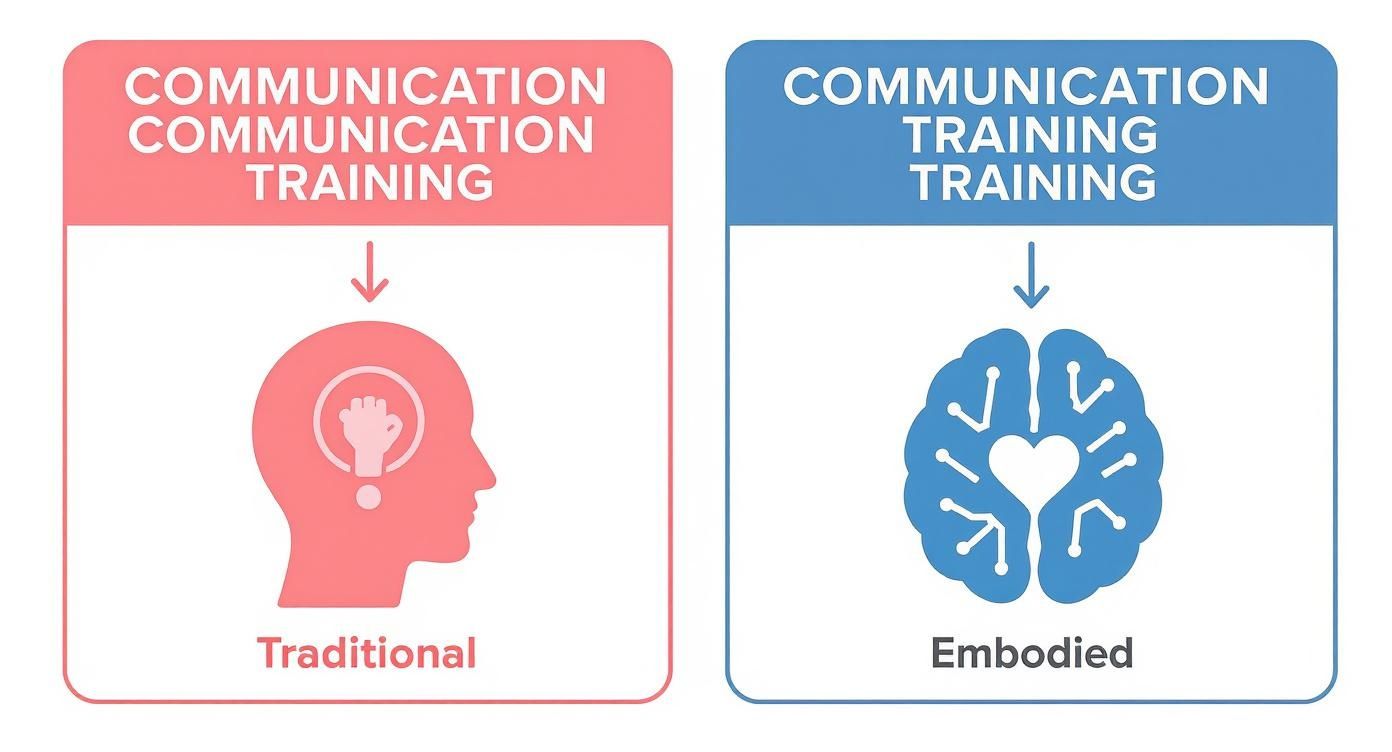
As you can see, old models focus solely on intellect and force. True executive presence integrates the heart and mind for authentic influence.
S is for Systems: Creating Repeatable Rituals for Influence
Finally, Systems ensure that powerful communication isn’t a one-time event but a consistent, reliable leadership practice. This is about building repeatable rituals that create alignment, drive accountability, and manage energy.
Influence isn’t built in a single speech; it’s cultivated through consistent, predictable patterns.
Effective systems might look like:
A Pre-Meeting Protocol: A five-minute routine to define your Result and regulate your Attitude before any high-stakes conversation.
A Weekly Alignment Cadence: A structured format for team check-ins that goes beyond status updates to focus on roadblocks and morale.
A Crisis Communication Framework: A pre-built system for how to communicate with clarity, empathy, and direction when uncertainty hits.
Systems remove the cognitive load of having to reinvent your communication strategy for every situation. They create a reliable structure that allows your best self to show up, even on your worst days.
How to Implement Your Communication Training
Knowing the RAMS framework is one thing. Embedding it into your leadership DNA is another. This is where theory hits the pavement. Turning these principles into a real-world curriculum requires intention and consistent practice.
Let's break down how you can start putting this training into action now. This isn't about piling more onto your plate; it's about refining how you show up to the work you're already doing.

Module 1: Mastering High-Stakes Conversations
Every leader has conversations where the stakes are incredibly high. This module is about preparing your internal state and external strategy for those moments.
First, pinpoint one high-stakes conversation you have coming up. It could be a budget negotiation, a difficult feedback session, or a critical board presentation.
Result (R): Write down the single, non-negotiable outcome you need. "Get approval for the $2M Q4 budget" is a clear Result. "Have a good meeting" is a hope.
Attitude (A): In the 10 minutes before, find a private space. Close your eyes and take five deep, slow breaths. The goal isn't to eliminate nerves it's to ground yourself.
Mastery (M): Role-play the first three sentences of the conversation out loud. This moves the plan from your head into muscle memory.
System (S): Create a one-page brief for every high-stakes meeting. Include your Result, key talking points, and anticipated objections. This is your repeatable ritual for success.
Module 2: Commanding Presence in Virtual Meetings
The virtual world makes it easy for communication to fall flat. Real presence on a video call isn't an accident; it’s engineered. This module helps you command attention even when you're not physically in the room.
The goal is to shift from passive participant to actively leading the energy of every virtual interaction.
Reflection Prompt:
"Before your next big Zoom call, ask yourself: What is the emotional tone I need to set in the first 60 seconds? Is it calm reassurance, focused urgency, or collaborative energy? Your intention dictates your presence."
To bring this to life, focus on mechanics. A powerful tool for this is using screen recording to create engaging training tutorials for yourself and your team. Record yourself speaking for two minutes, then watch it back. Analyze your vocal variety, body language, and where you might be losing your audience. It can be a cringeworthy but incredibly effective exercise.
Module 3: Your Personal Assessment Toolkit
You can't improve what you don't measure. A personal assessment toolkit makes your growth tangible, turning it from a vague idea into a trackable project.
Start with these three simple benchmarking tools:
The "Um" Count: For one week, notice how often you use filler words ("um," "ah," "like"). The simple act of noticing is the first step to cutting them out.
The Feedback Journal: After every significant meeting, take two minutes. Jot down answers to: "What went well?" and "What would I do differently next time?" This creates a powerful feedback loop.
The Energy Audit: At the end of each day, rate your physical and emotional energy on a scale of 1-10. This data reveals patterns between your communication demands and personal capacity.
Ongoing upskilling is essential. For those who want to accelerate the process with expert-led guidance, an intensive container makes all the difference. You can see how we approach this in our live training workshops.
The Return: Measuring the ROI of Your Communication Skills
How do you prove that better communication delivers results? In a data-driven world, connecting your investment in executive communication skills training to business outcomes is essential.
Effective communication is not a soft skill. It is a strategic asset with a measurable return on investment (ROI). The trick is to track the right key performance indicators (KPIs) that draw a direct line between your influence and the bottom line. This isn't guesswork. It’s connecting your actions to operational efficiency, team performance, and strategic wins.
This focus on training is a global priority. A 2025 global leadership development study found that 43% of organizations are implementing both internal and external programs. More importantly, 62% of these companies now rely on employee surveys to gauge effectiveness, proving the shift toward tangible evaluation.
Identifying Your Core KPIs
To quantify your ROI, define what success looks like in numbers. Pick a few core metrics that speak directly to your biggest challenges.
Here are a few specific KPIs you can start tracking:
Employee Engagement Scores: Keep a close eye on survey results after major announcements. A leader who communicates with clarity and conviction can directly boost morale and buy-in.
Project Completion Rates: Miscommunication is the number one cause of project delays. Monitor the percentage of projects that finish on time and on budget. As your communication improves, so will these numbers.
Meeting Efficiency: Calculate the average length and outcome of your key leadership meetings. Effective communication drives faster, more decisive action.
Qualitative Metrics That Matter
Not everything of value shows up on a spreadsheet. Qualitative data gives you the story behind the numbers, often revealing the most profound shifts.
The real return is often seen in the conversations that don't have to happen the avoided escalations, the resolved conflicts, and the clarity that prevents confusion before it starts. This is the invisible ROI of executive presence.
You can gather this data by paying attention to specific changes:
Speed of Decision-Making: How quickly does your team move from problem to solution? Faster, aligned decisions are a direct result of clear communication from the top.
Reduction in Team Conflict: Note how often interpersonal issues escalate. A leader who builds psychological safety through regulated communication will see a dramatic drop in team friction.
Quality of Feedback: Listen to how feedback is given. Are people more open, direct, and constructive? That's a clear sign of higher trust, which you actively cultivate.
By tracking both the hard numbers and the human shifts, you paint a complete picture of your growth. Our clients demonstrate this exact link between mastering communication and driving business success. You can see these results in our client success stories. This data strengthens your case to justify continued investment in your most valuable asset: your own leadership.
Got Questions About Executive Communication Training?
Investing in yourself is a big deal. It's smart to ask questions. Here are straight answers to the questions we hear most from executives ready to take this step.
How Is This Different from Standard Corporate Training?
Most corporate communication training is all about external performance. Think scripts, slide decks, and checklists. It's designed for the masses and falls apart under real-world pressure because it ignores the root cause: a dysregulated nervous system.
We start from the inside out.
Before we even think about your vocal tone or message structure, we work on regulating your internal state. This creates a solid foundation of authentic presence that makes every other skill stick. It's the difference between memorizing lines for a play and becoming a captivating actor.
How Quickly Can I Expect to See Results?
You’ll feel internal shifts almost immediately. The first modules, focusing on Attitude and Result clarity, give you tools for your next meeting. Many clients feel more grounded within the first week.
True mastery is a practice. Tangible business outcomes like higher team engagement or faster decision-making typically show up within 60 to 90 days of consistent application. This isn't a quick fix. It's building a lasting capability that compounds over time.
Is This Training Suitable for Introverted Leaders?
Absolutely. This work isn't about turning introverts into extroverts. It's about tapping into your natural, quiet authority without feeling inauthentic.
Many of the most powerful leaders are introverts. The RAMS framework frees you to leverage your inherent strengths like deep listening and thoughtful preparation while building the nervous system capacity to command a room on your own terms. The focus is on authentic influence, not manufactured charisma. We give you the tools to make your presence felt, not just your voice heard.
Where to go next
True leadership isn’t a performance. It’s a return to yourself. If any of this reads like your own reflection, the Silent Collapse Diagnostic™ is a quiet place to begin — a private, 60-minute conversation with Baz. And if you want the deeper why beneath the work, read the Sovereign Manifesto.