
How to Speak Confidently at Work and Finally Be Heard
You’ve done the work. You’ve prepared meticulously, you know the data inside and out, and you’ve earned your seat at the table. Then the moment comes to speak—and your heart pounds, your throat tightens, and the brilliant points you planned evaporate. Your own voice feels trapped. The internal battle is exhausting, a silent collapse happening in plain sight. This isn’t a fear of public speaking; it’s a gradual chipping away at your impact, felt in every meeting you leave wishing you’d said more.
Key Takeaways:
Understand the "Caged Voice": Recognize that the gap between what you want to say and what comes out is a biological threat response (fight-flight-freeze), not a personal failure.
Master the RAMS Framework: Learn a 4-part system (Results, Attitude, Mastery, Systems) to move from performance anxiety to embodied authority.
Regulate Your Nervous System: Use tangible techniques like Box Breathing and vocal resonance to manage the physical symptoms of anxiety before they hijack your executive brain.
Build Lasting Confidence in 30 Days: Follow a structured plan to turn conscious practice into an unconscious habit of confident communication.
The High-Achiever's Paradox: Feeling Unheard
To learn how to speak confidently at work, you must address the root physiological and psychological patterns that silence you. This means regulating your nervous system to control physical anxiety, reframing your internal monologue to project innate authority, and building repeatable systems for how you prepare and deliver your message. It’s about embodying confidence, not just faking it.
You have the intelligence, the drive, and the expertise to lead, but when it matters most, your own voice feels trapped. It’s a feeling that quietly tells you, "If I stop performing, I'll disappear." This isn't just about a fear of public speaking; it's a gradual erosion of your impact, felt in every meeting you leave wishing you’d said more.
The Caged Voice Phenomenon
I call this the 'Caged Voice'. It's the powerful, intelligent part of you silenced by years of social conditioning, perfectionism, and the immense pressure of corporate environments.
It shows up physically, leaving you to replay conversations for hours, analyzing every missed opportunity. You are not alone. It's an incredibly common battle for driven women feeling the weight of expectation. This feeling of being unheard isn’t just personal frustration—it’s a serious professional liability.
The internal battle is exhausting and, more often than not, completely invisible to everyone else. Many successful women find themselves in a silent crisis, appearing perfectly composed while feeling increasingly isolated and unheard in their leadership roles.
The stakes are high. A staggering 86% of workplace failures result directly from poor communication, according to a Salesforce study. For high-achieving women, this hits hard. When you hesitate, projects stall and opportunities are missed. In fact, a study cited by Forbes notes one in three employees estimates their inability to speak up has cost their organization at least $25,000.
To break free, you must focus on building a powerful personal brand that clearly articulates your value. By acknowledging this shared struggle, we can move past generic advice to a practical, science-backed solution that works.
Why Your Voice Falters Under Pressure: The Neuroscience of Silence
That maddening gap between what you know you’re capable of saying and what actually comes out in a high-stakes meeting isn't a personal failure. It’s biology. The hesitation, the blank mind, the shaky voice—these are predictable results of your nervous system doing exactly what it was designed to do: protect you from a perceived threat.
When your brain registers a threat—a critical boss, a dismissive colleague, the intense pressure of a boardroom—it doesn't distinguish between physical and social danger. Your amygdala, the brain's ancient smoke detector, sounds the alarm.
This triggers a cascade of physiological events you’ve felt a thousand times.

The Hijacking of Your Executive Brain
Once the alarm sounds, your body is flooded with stress hormones like cortisol and adrenaline. These prepare you for a primal response: fight, flight, or freeze. This survival mechanism is incredibly effective for escaping a predator but disastrous for delivering a nuanced project update.
This cortisol surge hijacks your prefrontal cortex—the sophisticated part of your brain responsible for executive functions. This is the very part you rely on for:
Logical Reasoning: Organizing thoughts into a coherent argument.
Complex Problem-Solving: Thinking on your feet to answer tough questions.
Language and Articulation: Accessing vocabulary and forming clear sentences.
When your prefrontal cortex goes "offline," you get the all-too-familiar symptoms of the Caged Voice. You stumble over words, forget a key statistic, or go completely blank.
You are not broken or unprepared. Your biology is prioritizing survival over eloquence. Understanding this is the first critical step to moving from a reactive state to a responsive one, giving you the power to consciously regulate your system instead of being controlled by it.
The Freeze Response in the Modern Workplace
For many high-achievers I work with, the default response isn't to fight (argue) or flee (leave). It's to freeze. This manifests as a sudden inability to speak, a feeling of being paralyzed, or the quiet internal decision to just "let it go."
This response is often compounded by past experiences where speaking up led to negative consequences, training your nervous system to associate using your voice with danger. Over time, this carves a deeply ingrained pattern that can make you feel like an imposter despite your expertise. If this resonates, explore our guide on how to overcome imposter syndrome at work.
The professional environment can pour gasoline on this fire. Poor communication is a direct driver of burnout, with 42% of professionals connecting it to increased stress. For leaders, the situation is even more acute, as a staggering 96% of employees report a strong desire for empathetic communication from their managers. In its absence, a high-stress, low-trust atmosphere makes it nearly impossible to speak with confidence.
By dropping the self-blame and recognizing the biological mechanics at play, you can stop fighting against your body and start working with it. The goal isn't to eliminate stress—it's to learn how to manage it and reclaim control of your executive brain when it matters most.
The RAMS Framework for Embodied Communication
Knowing why your voice shakes is one thing. Having a real strategy to stop it is another. This is where we stop diagnosing the problem and start building the solution. This is where you move from being a passenger in your own body to taking the driver's seat.
Generic advice like "just be more confident" is useless because it ignores the deep-seated physiological and psychological patterns in control. You need an integrated approach that tackles your mindset, physical presence, and strategic communication all at once.
That's precisely what the RAMS framework was designed for. I developed this system for high-achievers to shift from performance anxiety to embodied authority. It’s not about faking it. It's about building genuine confidence from the inside out, so the authority you feel internally finally matches the voice people hear externally.
The framework is built on four pillars: Results, Attitude, Mastery, and Systems. Let's unpack what that means for you.

Results: Define Your Objective
Confident communication isn’t about talking; it's about making something happen. The first pillar, Results, forces a crucial shift from a passive, hopeful mindset to one that is surgically precise. Before any meeting, answer one question with absolute clarity: What is the single, measurable result I need to walk out of this room with?
This isn't about what you want to say. It's about what you want to happen.
Vague Intention: "I want to share my project update."
Results-Driven Objective: "I need to secure a firm 'yes' for two additional engineers from the CTO by the end of this meeting."
This reframe anchors every word you say. It gives your communication a clear purpose and focuses your energy on that end state, leaving little room for self-doubt. When you know the target, your language becomes sharper and your presence gains direction.
Attitude: Project Innate Authority
Your internal monologue becomes your external reality. The Attitude pillar is about deliberately recalibrating your mindset from one that seeks approval to one that projects innate authority. Many high-performing women are conditioned to prioritize being collaborative and likable. These strengths become liabilities when they lead you to soften your message or seek consensus on things that are your call to make.
This is the critical mental shift: You are not in the room to ask for permission. You are there to provide a solution. Your expertise and track record have already earned you a seat at the table. Your job now is to own that space.
Consciously rewrite your internal script:
From: "I hope they like my idea."
To: "I have a solution that will solve this problem."
From: "What if I say the wrong thing?"
To: "What is the most direct way to communicate this value?"
This isn’t arrogance. It’s a quiet, unshakeable belief in the value you bring. This internal adjustment has an immediate, visible impact—steadier eye contact, a more grounded posture, a calmer vocal tone—before you’ve even said a word.
Mastery: Command Your Physical Instrument
Confidence isn't just a thought; it's a physical experience. The Mastery pillar gives you tangible techniques to command your voice, body, and breath—the very instruments of your communication. This is how you regulate the nervous system that used to hijack you.
Your voice is a tool. A voice that is lower-pitched and resonant is perceived as more authoritative. Under pressure, many women's voices rise in pitch or end with an upward inflection ("upspeak"), which subconsciously signals uncertainty.
Mastery involves simple, practical exercises:
Vocal Grounding: Practice humming or speaking from your diaphragm to find your natural, lower pitch. It’s about finding resonance, not forcing your voice down.
Pacing and Pausing: Use silence strategically. A deliberate pause before answering a tough question isn't a sign of weakness; it's a display of control. It gives your words weight.
Grounded Posture: This isn’t about an artificial "power pose." It’s about sitting or standing in a way that opens your diaphragm and signals presence through proper alignment.
By mastering these physical elements, you create a powerful biofeedback loop. Your body signals confidence to your brain, which helps calm your nervous system, allowing you to stay in control.
Systems: Create Repeatable Frameworks
Sustainable confidence is built through Systems. This final pillar is about creating repeatable structures for preparing, navigating, and following up on critical communications. It’s about removing guesswork so you can focus your mental energy where it counts. Think of systems as your defense against the chaos of high-stakes moments.
This includes building your own frameworks for:
Meeting Preparation: A checklist to define your result, anticipate objections, and script your opening and closing statements.
Managing Interruptions: Having pre-planned, respectful phrases ready to go when spoken over. "I appreciate that point, John, and I’d like to finish my thought," delivered calmly, is often all it takes.
Navigating Difficult Conversations: A structure for delivering tough feedback that is direct, empathetic, and outcome-focused.
When you have these systems, you dramatically reduce your cognitive load. You no longer invent a strategy on the fly; you simply execute the plan. To see how this fits into a larger picture, you can learn more about how the complete RAMS Method™ builds a revolutionary leadership framework.
These four pillars—Results, Attitude, Mastery, and Systems—work together to transform speaking confidently from a vague goal into a concrete, trainable skill set.
From Hesitation to Authority: A RAMS Transformation

As you can see, each challenge has a direct, actionable solution within the framework. It's about replacing reactive habits with intentional, practiced skills.
Practical Techniques for Voice, Body, and Breath
Theory is one thing; physical practice is another. This is where we translate neurological understanding into tangible skills. It’s how you reclaim command over your body’s stress response and use your physical presence as a tool for authority. Confident speaking isn’t about memorizing lines. It's about grounding yourself in your own body so your message can land with clarity and power.
Anchor Your Nervous System with Breath
Before you think about what you're going to say, you must regulate the system that will deliver the words. When your nervous system is in alarm, your breath becomes shallow, tensing your vocal cords. The result? That shaky, high-pitched voice. The solution is to anchor your breath before you enter the room.
Box Breathing for the Boardroom: This discreet technique can be done at your desk or in the restroom before a meeting. It works by directly stimulating the vagus nerve, which tells your brain to calm down.
Inhale slowly through your nose for a count of four.
Hold your breath for a count of four.
Exhale slowly through your mouth for a count of four.
Hold at the bottom of the exhale for a count of four.
Repeat this cycle four or five times. You are actively down-regulating your body’s stress response, creating a foundation of calm.
Find Your Vocal Resonance
Many high-performing women unintentionally undermine their authority with "upspeak"—ending statements with a rising inflection that sounds like a question. This habit, combined with a voice that gets higher under pressure, signals uncertainty. The goal is to find your natural, resonant pitch, located in your chest, not your throat.
The Vocal Resonance Hum: Close your mouth and gently hum, paying attention to where you feel the vibration. If it's in your nose or head, it’s too high. Aim to feel the vibration deep in your chest. This is your vocal "home base." Practice speaking from this place.
By grounding your voice in your diaphragm, you project more authority and reduce vocal strain. It feels and sounds more powerful because it is more physically supported. This is a core component of effective executive communication skills training.
Master Your Nonverbal Communication
Your body communicates long before you open your mouth. Research suggests nonverbal cues can account for a significant portion of a message's power. Mastering these physical mechanics is critical for leadership.
This isn't about striking a fake "power pose." It’s about cultivating a grounded, authentic presence.
Occupy Your Space: Sit or stand with your feet planted firmly on the floor. Avoid crossing your legs or arms in a way that makes you physically smaller. Distribute your weight evenly.
Use Purposeful Gestures: Instead of fidgeting, which signals nervous energy, use your hands to emphasize key points. Keep them in a neutral, relaxed position when not in use.
Maintain Steady Eye Contact: Your gaze directs energy. When speaking, make deliberate eye contact with different people in the room. When listening, maintain your gaze to show you are present and engaged.
Each technique creates a powerful feedback loop. Your body signals control to your brain, reinforcing the calm you established with your breathwork. This allows your resonant voice to emerge effortlessly.
For a broader perspective on enhancing your overall ability to express yourself effectively, consider exploring additional insights on improving verbal communication skills.
Your 30-Day Plan to Sustainable Confidence
Real confidence isn't a switch you flip; it’s a muscle you build through consistent, focused practice. This 30-day roadmap is designed with clear, weekly actions to help you finally own your voice.
Your Weekly Focus
Think of this as a progressive training plan. Each week, you'll layer on a new skill, building on the foundation you established the week before.
Week 1: We start with the foundation—your breath. You'll focus on daily breathwork and simple vocal warm-ups each morning to ground your nervous system.
Week 2: Now we add structure. This week is all about scripting key points for your upcoming meetings and presentations, giving your confidence a clear framework.
Week 3: Time to handle the unexpected. You’ll practice navigating interruptions gracefully using a few pre-planned, powerful phrases.
Week 4: Let's put it all together. You will consciously lead a low-stakes discussion to solidify your embodied presence and put your new skills to the test.
This structure is designed to let each new skill settle in, turning conscious effort into an unconscious habit. It’s about building true nervous-system sovereignty, not just faking it.
Weaving Confidence Into Your Day
The key to making this stick is building micro-habits that slot into your existing routines. Spend five minutes before opening your laptop doing a Box Breathing ritual or a chest resonance hum. It’s a tiny investment with a huge payoff.
I also recommend keeping a simple journal to track how you feel when you speak up. Note one small victory each day. This act of reflection accelerates the neural rewiring process.
For a deeper dive into the mental game behind this work, check out our guide on How To Reset Your Mindset. It’s the perfect companion piece for sustaining the right attitude.
Keeping the Momentum Going
Once you're in the groove, look for small pockets of time to reinforce the work. Embed a quick rehearsal into your lunch break or do a rapid vocal warm-up after a meeting. A quick posture check before you walk into a room can retrain your body for clarity under pressure. Set a timer for just three minutes. This keeps the practice focused and manageable. These brief, consistent actions accumulate into a confident habit that feels completely natural.
A Visual Timeline for Building Confidence
Here’s a look at how each phase builds on the last over the next month. It all starts with the breath, moves to posture, and culminates in a powerful, resonant voice.
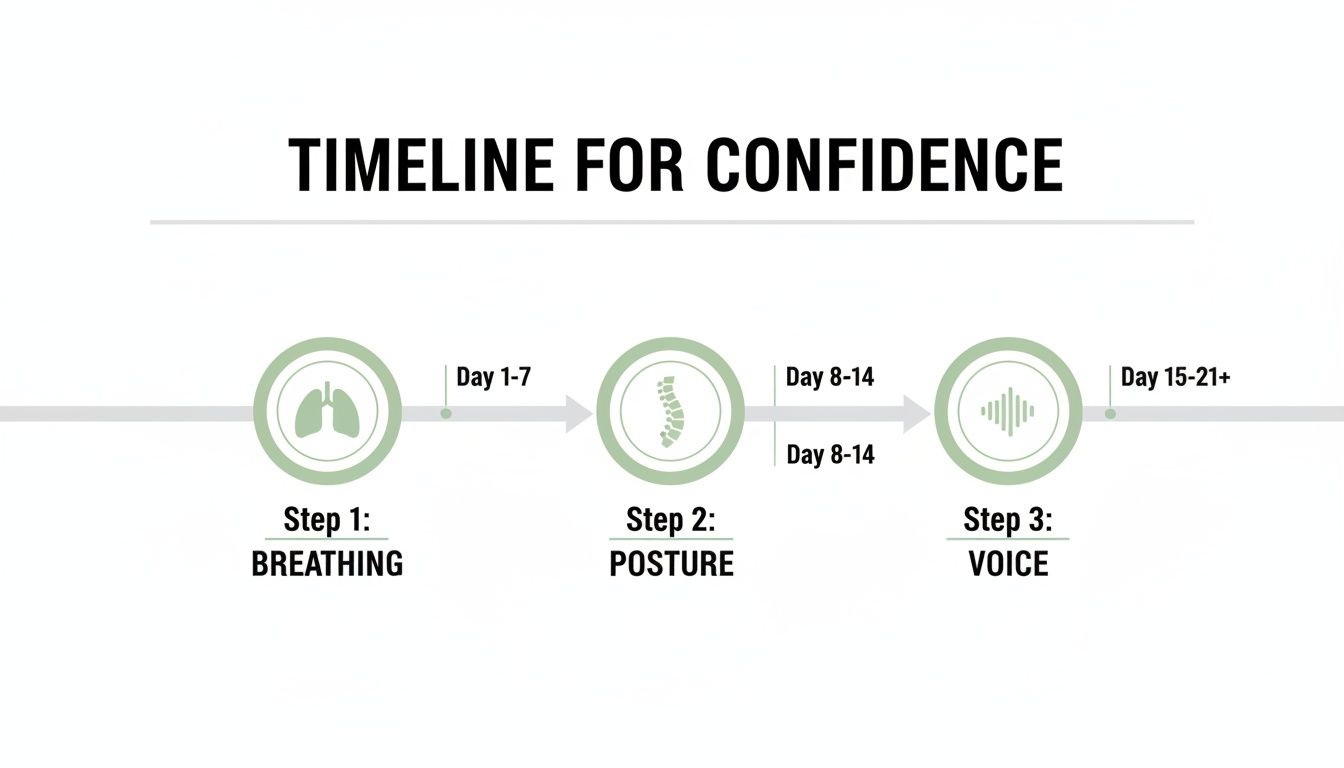
As you can see, it's a flow. Foundational breathwork supports a powerful posture, which in turn unlocks your vocal mastery. Steady practice in each area is what unlocks that deep, embodied confidence.
How to Know It's Working
You can't improve what you don't measure. Using simple metrics keeps your motivation high because seeing clear proof of your growth is the ultimate fuel.

This isn't about a perfect score. It's about having concrete data that proves real change is happening.
Consistent tracking transforms goals from abstract hopes into actionable milestones.
Making the Change Last
After Day 30, review your journal and metrics. Where did you see the most growth? What still feels shaky? Don't be afraid to repeat the 30-day cycle, focusing on areas that need more reinforcement. This is how you cement the pathways for automatic confidence.
For an extra boost, ask a trusted colleague to observe you in a meeting and give you candid feedback. A little accountability can be the spark that transforms dedicated practice into an unbreakable habit. Stay committed. You've got this.
Frequently Asked Questions
Even the best-laid plans meet reality. When you start putting these principles into practice, you’re bound to hit a few snags. Think of this section as your quick-reference guide for the most common hurdles. Here are straightforward, actionable answers to keep you grounded.
How do I handle being interrupted by male colleagues?
Getting cut off is jarring. It can feel disrespectful and instantly throws you off, kicking your threat response into high gear. The trick isn't to get aggressive or shrink away but to have a calm, practiced response ready. This is a direct application of the Systems pillar in RAMS.
Instead of letting it derail you, use a simple, firm phrase to reclaim your space, delivered without apology or anger.
"I appreciate that thought, and I want to finish what I was saying first."
"That’s a great point, and I’ll get to it right after I’ve finished this one."
Sometimes, holding up a hand in a gentle "pause" gesture and saying, "One moment," is incredibly effective.
Pair your words with grounded body language. Keep your feet planted and make brief eye contact with the person who interrupted. Then, immediately turn your attention back to the group and continue. This sends a clear, non-verbal signal: you’re in control.
What's the best way to calm my nerves before a big presentation?
Those minutes before you speak are critical. It's when your nervous system is most vulnerable to being hijacked. The goal isn't to crush your nerves—a little adrenaline is good—but to manage them so they serve you. This is a direct application of the Mastery pillar: learning to regulate your internal state on demand.
Create a simple, two-minute pre-game ritual.
Do a Physiological Sigh. This is one of the fastest ways to calm your nervous system. Inhale deeply through your nose. At the top of that breath, take another short sip of air. Then, let it all out with a long, slow exhale through your mouth. Do this two or three times. It’s a biological reset button.
Set a Clear Intention. Close your eyes for a moment and state your desired Result to yourself. Something like, "My intention is to clearly communicate the value of this project and get the green light for the next phase."
This one-two punch of physical regulation and mental focus pulls you out of anxiety and into a state of readiness.
I'm an introvert. Can I really be a powerful speaker?
Yes. Absolutely. Let’s dismantle this myth. Confident speaking isn’t about being the loudest person in the room. It’s about prepared authenticity. This mindset shift is at the heart of the Attitude pillar of RAMS.
Being an introvert gives you natural strengths that can make you an incredibly compelling communicator.
You're a Deep Preparer. Your tendency to think before you speak means you often have a more thought-out, nuanced perspective.
You're an Insightful Questioner. As a keen observer, you can ask questions that cut through the noise and guide a conversation to the real heart of the matter.
You Have a Calm Presence. A more reserved demeanor is often perceived as grounded, serious, and deeply authoritative. Your quiet confidence can be far more powerful than loud bluster.
Don't try to be someone you're not. Focus on meticulous preparation and deliver your message with quiet, unshakeable conviction. Your power isn’t in your volume; it's in your substance.
At Baz Porter, we know that true confidence isn't a performance you put on. It’s a return to the innate authority you already have. It is the path back to nervous system sovereignty.
If you're ready to stop feeling overlooked and start leading with the powerful, embodied presence that is authentically yours, it's time to return to yourself. Discover the system that helps high-achieving women move from burnout to sustainable, sovereign leadership.
Take the first step. Explore how we can work together at https://bazporter.com.