How to Build Executive Presence Without Burning Out
You've done everything right—crushed your targets, delivered incredible results, and proven your expertise time and again. Yet, when you walk into a high-stakes meeting, it feels like you're invisible. You watch as colleagues with half your track record command the room effortlessly while your ideas get glossed over, or worse, credited to someone else. That voice in your head screams, "My results should speak for themselves!" For high-achieving women, this belief isn't just a mindset—it's a career-limiting trap. The silent collapse begins when you realize your performance is no longer translating into influence, and you have no idea why.
Key Takeaways
Executive presence is physiological, not just psychological. It originates from a regulated nervous system, not faked confidence. Mastering your internal state is the foundation of external authority.
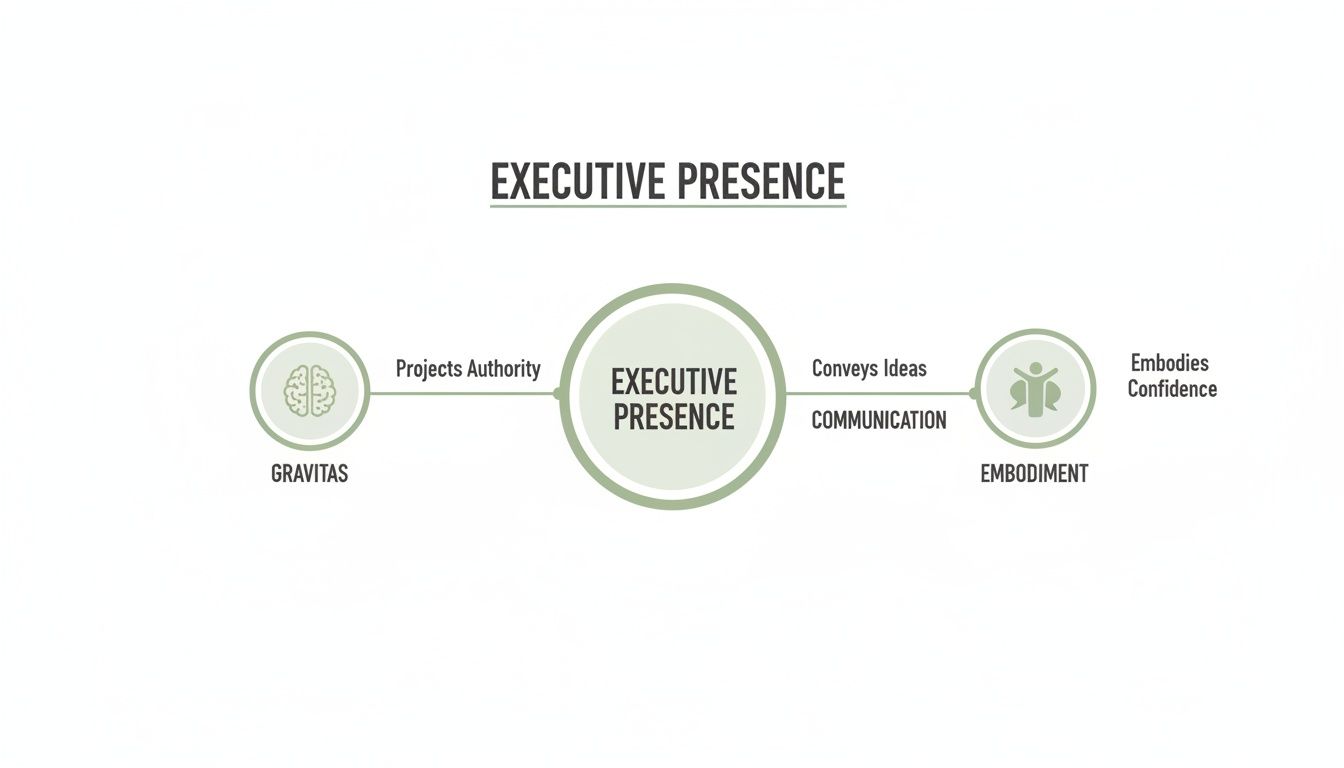
Presence is a trainable skill built on three pillars: Gravitas (internal composure), Communication (vocal and verbal clarity), and Embodiment (physical command of space).
Introverts can have powerful executive presence. It’s not about being the loudest person in the room; it’s about quiet confidence, deep listening, and intentional communication.
You can build presence without sacrificing authenticity. True presence is about removing the physiological static (stress responses) that obscures your natural authority, allowing the most regulated and clear version of yourself to lead.
What Is Executive Presence, and Why Does It Matter?
Executive presence is the ability to signal credibility, confidence, and authority through your physical and emotional state, making your expertise not just heard, but felt. It's the missing link between your proven capabilities and how your leadership is actually perceived. Influence isn't just about what you do; it's about how you are. It’s in your posture, your tone, and the energy you project long before you ever open your mouth.
The Hidden Pattern—Why Your Hard Work Isn't Enough
You’ve been conditioned to believe that the professional world is a meritocracy where the best work always wins. The crushing reality is that human decisions are swayed by perception, confidence, and the unspoken ability to inspire trust. This is the "Performance Trap," a cycle where you believe that if you just work harder, your value will finally be recognized. Instead, you're just accelerating toward burnout.
The constant pressure to perform kicks your nervous system into overdrive. This creates a subtle but perceptible tension that undermines you in high-stakes moments.
It can manifest as:
Vocal Strain: Your voice gets a little higher, a little shakier, especially when you’re challenged.
Constricted Body Language: You unconsciously make yourself smaller—crossing your arms, hunching your shoulders.
Reactive Communication: Instead of pausing, you jump in defensively or rush to fill any silence.
These signals are driven by a dysregulated nervous system, and they unintentionally broadcast uncertainty, even when you're the most knowledgeable person in the room. This isn't a personal failure; it's a physiological response. A landmark study from the Center for Talent Innovation revealed that executive presence accounts for 26% of what it takes to get promoted. Your technical skill alone won't get you to the next level. You must learn to regulate your internal state to project calm authority. You can learn more in our guide on how to influence without authority.

The RAMS Reframe—A Framework for Sovereign Presence
To escape the Performance Trap, you need a new operating system. True executive presence isn't a personality trait you're born with. It's a practice built on three distinct, actionable pillars: Gravitas, Communication, and Embodiment. These pillars are the core of the RAMS™ Method, which focuses on sustainable leadership from the inside out.
Pillar 1: Gravitas (The Foundation of Internal Authority)
Gravitas is your core. It's the unshakable self-assurance that comes not from ego, but from deep self-knowledge and a regulated nervous system. It’s the quiet confidence that holds steady when a project goes sideways or when you’re challenged—hard—in a boardroom. Before you can command a room, you must first command yourself. This starts with getting radically honest about your internal landscape. As the experts at the Women in STEM Network wisely point out, understanding yourself is the foundational pillar for authentic leadership.
Gravitas is the calm you project under pressure. It's the silent signal that you are in control of yourself, and therefore, capable of leading others. This quality is earned through internal work, not performance.
The difference between leading from a regulated versus a dysregulated state is night and day. One commands respect; the other creates chaos.

Building this skill requires understanding the deeper mechanics of your own internal operating system. You can learn about your nervous system architecture and see exactly how it shapes your leadership style.
Pillar 2: Communication (The Bridge to Influence)
Communication is how your internal gravitas becomes external influence. It’s the skillful articulation of your ideas, your vision, and your value. This pillar is about how you deliver your words. For a deeper dive, explore our resources on what is authentic leadership.
Key communication shifts include:
Vocal Power: Eliminate "upspeak"—the habit of ending statements with a rising inflection that makes them sound like questions. End statements with a firm, downward inflection to convey authority.
Message Clarity: Cut out filler words ("um," "like," "you know") and get straight to the point.
Strategic Silence: Use pauses to hold attention and create emphasis. A comfortable silence signals unshakable confidence.
To truly command respect, it's essential to keep refining these skills. This guide on How to Improve Communication Skills in the Workplace offers complementary advice.
Pillar 3: Embodiment (The Physical Expression of Leadership)
Embodiment is the final, crucial piece of the puzzle. It’s the non-verbal language of your body—your posture, your gestures, how you use the space around you. Long before you say a single word, your physical presence has already communicated your level of confidence. This isn't about faking "power poses"; it's about cultivating a physical presence that is an authentic reflection of your internal state.

Think about these scenarios:
In a Boardroom: Do you take up space at the table, sitting upright with materials organized? Or do you shrink, physically making yourself smaller?
During a Difficult Conversation: Do you maintain steady, open eye contact, signaling engagement? Or do you look away, communicating uncertainty?
When Presenting: Are your gestures purposeful and open? Or are they small, fidgety, and distracting?
Recent leadership development statistics on Exec.com reveal that with trust in managers plummeting and 77% of organizations reporting a leadership gap, developing these embodied skills is no longer optional.
The Return—Leading from Nervous System Sovereignty
The journey to building an unshakeable executive presence is the journey of returning to yourself. It’s about aligning your internal state with your external impact so your true authority can finally be recognized. It's a shift from performing for validation to leading from a place of grounded, sovereign power.
I once coached a senior VP in tech, we'll call her "Anna," who was technically brilliant but consistently overlooked. In meetings, she’d hunch over her laptop, speak rapidly, and physically shrink when challenged. We started with one ritual: before speaking, she would close her laptop, place both hands on the table, and take a single, deep breath.
The results were immediate. By taking up space, she was seen. By slowing her breathing, her voice became more resonant. Her colleagues started treating her not just as an expert, but as a leader. This wasn't about Anna becoming someone else. It was about allowing her physical presence to finally match the authority she had already earned. You can explore more of these core principles in our guide on Embodied Sovereignty or get more strategies in our guide on how to speak confidently at work.
Burning Questions About Executive Presence
It’s completely normal to have questions as you integrate these new ways of being. Here are the most common ones I get from the high-achieving women I work with.
How Can I Be Authentic While Building Executive Presence?
This is the question. So many women fear that building presence means putting on some stiff, unnatural corporate mask. That is the absolute opposite of what we do. Authenticity is the bedrock of powerful presence. The goal isn’t to change who you are. It's to strip away the physiological static—the frantic energy, the flicker of self-doubt—that keeps your natural authority from being seen. When you learn to regulate your internal state, you are becoming more yourself.
Your most authentic self is the regulated version of you. It's the you who is calm, clear, and fully in the room. That is the leader people instinctively trust.
Can Introverts Develop a Strong Executive Presence?
Absolutely. One of the biggest myths is that executive presence is just a synonym for extroversion. It's not about being the loudest person at the table. It’s about quiet confidence, deep listening, and speaking with intention. An introvert’s presence isn’t loud, but it’s incredibly potent. It’s felt through its depth, substance, and unwavering consistency.
How Long Does It Take to Build Executive Presence?
This is a practice, not a project with a finish line. But you can feel tangible shifts incredibly quickly. If you commit to a simple two-minute grounding exercise before every important call, your composure will improve almost immediately. The deeper, more lasting change—where these skills become your default setting—is a journey that unfolds over months of dedicated practice.
How Do I Know if It’s Working? How Do I Measure Progress?
You track progress by paying attention to the shifts in your environment and your own internal world.
Internal Metrics: Do you feel calmer before big presentations? When challenged, how quickly do you recover your center?
External Feedback: Are you being interrupted less? Are your ideas getting more traction? Are senior leaders actively seeking your opinion?
These are the qualitative shifts that tell you it’s working. When a senior stakeholder pulls you aside after a meeting to get your real take on an issue, you know your presence is landing.
The path to sovereign leadership is about returning to yourself. It's about aligning your internal state with your external impact so your true authority can finally be recognized. If you’re ready to stop performing and start leading from a place of grounded power, Baz Porter can guide you.
Explore the RAMS Method to discover how you can build a leadership style that is both powerful and sustainable.