Embodied Sovereignty: Real Power Without Performance
You're at the top of your game. The corner office, the industry awards, the flawless track record—from the outside, it’s a monument to success. But inside, a silent collapse is unfolding. A persistent, low-grade hum of anxiety never shuts off. Sleep is a brief intermission, not a recharge. Your first thought upon waking is an immediate wave of fresh pressure. You’re navigating a quiet crisis, feeling that if you stop performing for even a second, you’ll disappear. This isn't a personal failing. It’s the inevitable cost of leading from a place of chronic internal disconnect.
Key Takeaways:
Define Embodied Sovereignty: It’s the non-negotiable alignment of your inner world (nervous system, intuition) with your outer actions, moving beyond mere intellectual authority to a felt sense of self-trust.
Understand the "Sovereignty Debt": Constantly overriding your body's signals of fatigue and stress creates a physiological debt, leading to burnout, brain fog, and a dysregulated nervous system that hijacks executive function.
Implement the RAMS™ Method: A practical framework, Results, Attitude, Mastery, Systems, to reclaim your internal authority, regulate your nervous system, and build sustainable leadership from the inside out.
Link Sovereignty to Performance: A regulated nervous system creates psychological safety, which research shows directly unlocks team innovation, resilience, and engagement. Your wellbeing is a strategic asset.
The Hidden Cost of High Achievement
The corner office, the industry awards, the flawless track record, from the outside, your career looks like a monument to success. Inside, a very different story is unfolding. A silent collapse.
There’s a persistent, low-grade hum of anxiety that never quite shuts off. Sleep is a brief intermission, not a recharge, and your first thought upon waking is an immediate wave of fresh pressure. You’re navigating a silent crisis that few, if any, people around you could possibly understand.
Embodied sovereignty is the alignment of your inner world, your nervous system and core values, with your outer actions. It is the capacity to lead from a place of unshakable self-trust, not the exhausting treadmill of external validation, resolving the internal conflict that high achievement often creates.

This experience isn't a personal failing or a sign of weakness. It's the inevitable symptom of a leadership model built on a foundation of sand, the direct cost of prioritizing your intellectual authority over your body's deep, intrinsic wisdom.
The Internal Dialogue of the High-Performer
For many leaders I work with, the internal monologue is ruthless. It's a constant, unforgiving whisper that you cannot stop, you cannot slow down, and you absolutely cannot fail.
"If I stop performing, I'll disappear."
"I have to control every single outcome, or it will all fall apart."
"Rest is a luxury I haven't earned yet."
This constant internal battle is utterly exhausting. A crucial part of seeing this hidden cost is understanding man vs self conflict, a dynamic that details the deep internal struggles that sabotage our progress and peace. This conflict is the invisible engine driving countless leaders toward burnout, creating a profound chasm between their shiny external achievements and their desolate internal reality. I've written more about this exact phenomenon in my piece on the silent crisis facing successful women.
This disconnect is what I call the "Sovereignty Debt", the accumulated toll of overriding your body’s signals for the sake of performance. Each ignored ping of fatigue, each suppressed emotion, each time you push through when your body screams "no," you add to a deficit that will eventually come due.
This article isn’t about piling more strategies onto your already-full plate. It’s about introducing an entirely new paradigm: embodied sovereignty. This is your pathway back to a form of leadership where your power is sourced not from relentless, grinding effort, but from a place of deep internal alignment. It’s about learning to lead from a regulated nervous system, making your impact sustainable, authentic, and profoundly more effective, without sacrificing yourself in the process.
The Science: Why Your Body Is Your Greatest Strategic Asset
Let's be clear: embodied sovereignty isn't a wellness trend. It is the most grounded, tangible leadership skill you can build. This isn't about chasing calm in a meditation app. It’s the non-negotiable alignment of your inner world, your nervous system, your gut feelings, your core values, with your outer actions. It means your decisions and your very presence come from deep self-trust, not frantic reaction. Real authority radiates from a body that feels safe, grounded, and clear. This is the bedrock of true authentic leadership.
The Neuroscience of Sovereignty Debt
Your nervous system is a feedback machine. It sends signals all day long: the knot in your stomach before a big meeting, the tightness in your chest when a boundary is crossed. As high-achievers, we become masters at overriding these signals with intellect, caffeine, and willpower. Every time you say "yes" when your body screams "no," you make a withdrawal from your physiological bank account.
This isn't a metaphor; it's neurology. Living in chronic stress floods your system with cortisol. Your amygdala, the brain's smoke detector, gets stuck "on."
Your exhaustion, brain fog, and disconnection are not character flaws. They are the predictable physiological outcomes of a dysregulated nervous system. You've been running on an emergency override for so long that your body has forgotten how to power down.
This state directly hijacks your higher-level thinking. The prefrontal cortex, responsible for strategy and empathy, gets less blood flow. Your capacity for visionary leadership shrinks, replaced by short-term, survival-based reactivity.
From Intellectual Authority to Embodied Sovereignty
We were taught that leadership is an intellectual game. This model ignores the biological reality of what it takes to lead without burning out. Embodied sovereignty recognizes that your greatest strategic asset is a well-regulated nervous system. It’s the shift from thinking your way through problems to knowing the right path from a place of deep, internal coherence.
The table below contrasts the old way with this new paradigm.

This isn't about ditching intellect. It's about integrating your mind's brilliance with your body's wisdom. This is where you find sustainable power. Your body isn't a machine to be optimized; it is the seat of your leadership.
Self-Legitimation as a Strategic Asset
This internal alignment has a direct, measurable impact on your external authority. Research confirms a leader’s self-legitimation, how they embody their role and values, translates directly into real-world power.
When leaders actively assert and embody their legitimacy, it raises the internal expectations for their leadership. Teams get on board faster because the direction doesn’t just sound smart; it feels congruent. For a closer look at the data, you can read the full research on leadership self-legitimation. This validates what high-achieving leaders feel in their bones: when you own your authority on the inside, your ability to command a room amplifies tenfold.
From Survival Mode to Executive Function
The connection between your nervous system and leadership capacity is undeniable. When chronically stressed, you operate from your primitive brain, designed for survival.
Reactivity: You see threats everywhere, leading to impulsive decisions.
Tunnel Vision: Your focus narrows, making it impossible to see the bigger picture.
Reduced Empathy: Your ability to connect with your team plummets.
This is the neurological reality of burnout. If this hits close to home, our guide on how to recover from burnout offers critical next steps.
Embodied sovereignty is the practice of intentionally shifting your brain state. By regulating your nervous system, you bring your prefrontal cortex, the seat of executive function, back online.
This single shift unlocks the qualities of exceptional leadership: strategic foresight, creative problem-solving, and emotional intelligence. This internal work is the most critical investment you can make in your longevity and impact.
The RAMS Method™: Your Framework for Sovereignty
Understanding the neuroscience is one thing. Translating it into daily life is another. The path from a frantic, performative state to one of grounded power needs a clear, repeatable structure. This is why I developed the RAMS Method™—a framework to make embodied sovereignty an achievable, sustainable reality.
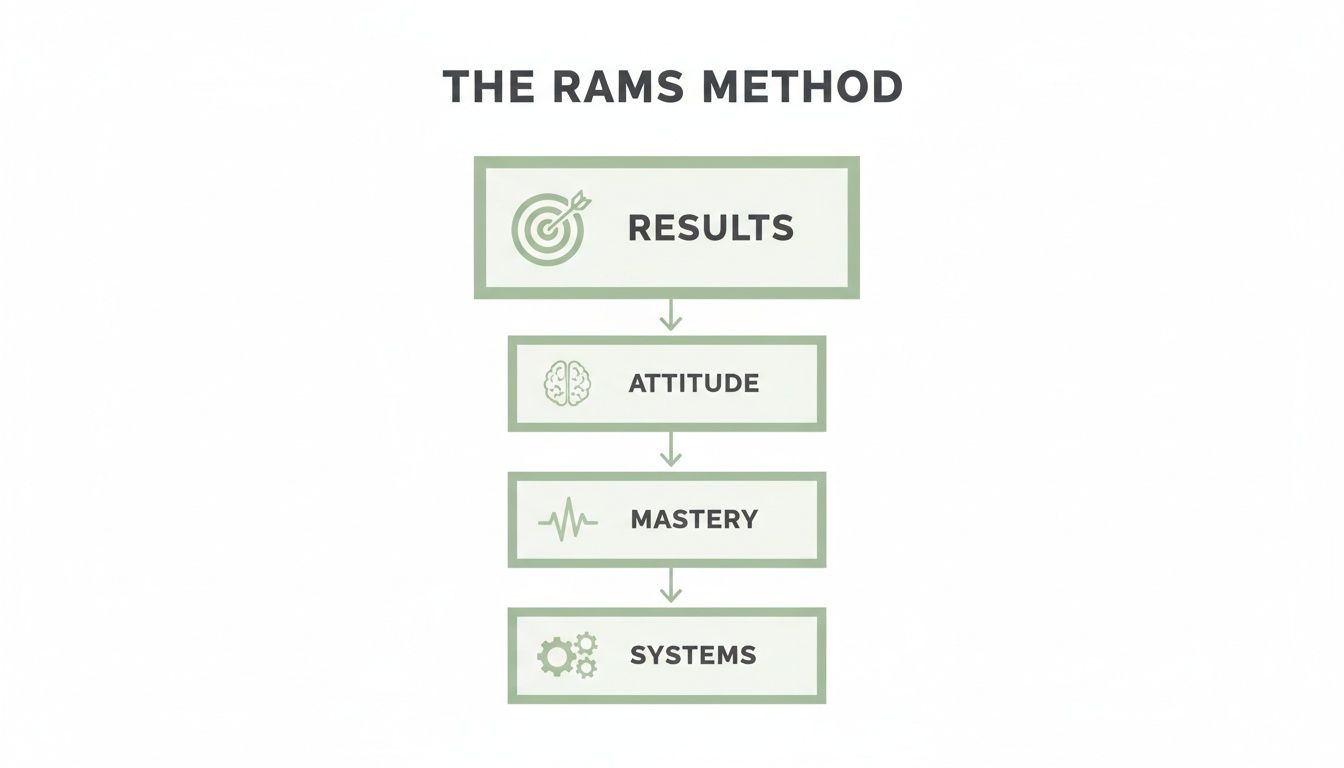
The RAMS Method™—Results, Attitude, Mastery, and Systems—is a practical blueprint for reclaiming your inner authority. It's about rewiring how you operate so your actions reflect your core self, not just a reaction to external demands.
Results Reimagined
In the high-achievement world, "Results" means external metrics. KPIs, revenue targets, the next promotion. Focusing on them exclusively drives Sovereignty Debt.
In the RAMS Method™, we redefine Results. A true result is an outcome in complete alignment with your sovereign values. It’s hitting goals in a way that feels as good as it looks.
This means asking different questions:
Instead of, "What do I need to achieve?" we ask, "How do I want to feel while achieving it?"
Instead of, "What will this look like to others?" we ask, "Is this action in integrity with my deepest values?"
Instead of, "Can I just push through?" we ask, "Is this sustainable for my nervous system?"
Success isn’t just the height of the mountain you climb, but the wholeness you maintain on the path.
Attitude: From Reactivity to Presence
Think of your Attitude as your internal operating system. For many leaders, that system is programmed for reactivity, constantly scanning for threats. That’s a survival mindset.
Embodied sovereignty demands an upgrade to an attitude of presence. It’s the ability to be with what is, right now, without being hijacked by yesterday’s regrets or tomorrow’s anxieties.
This shift in attitude is where you stop being a passenger in your own emotional vehicle and get in the driver's seat. You learn to respond from a place of grounded clarity rather than reacting from fear.
This isn't forced positivity. It's expanding your capacity to hold discomfort without losing your center.
Mastery: Regulating Your Nervous System
Mastery is the skillful, conscious regulation of your own nervous system. It's where we put the neuroscience into direct practice. It means learning to recognize your body's signals of dysregulation—the tight chest, shallow breathing, clenched jaw—and knowing how to guide yourself back to calm.
This is achieved through simple, repeatable somatic practices:
Breathwork: Using breathing patterns to activate your parasympathetic (rest-and-digest) system.
Somatic Awareness: Tuning into physical sensations to understand your body’s messages.
Movement: Using intentional movement to release stored tension.
This isn’t a one-time fix; it’s a daily practice. The more you practice, the more resilient your nervous system becomes. If you want to go deeper, you can explore our full guide on the RAMS Method.
Systems: Creating Structures for Sovereignty
Internal change must be supported by external structures. Systems are the personal and professional guardrails you design to protect your sovereignty. You cannot rely on willpower alone.
Sovereign systems are intentional choices:
Boundary Systems: Non-negotiables around time and energy. (e.g., No meetings before 10 a.m.)
Support Systems: A curated network of mentors and peers who champion this new way of leading.
Recovery Systems: Proactive, scheduled practices for rest, rather than waiting for collapse.
These systems automate choices that protect your energy. Data backs this up: a study of 20,000 leaders showed those practicing integrated leadership scored 24% higher on effectiveness metrics. This proves that embodied practices deliver real performance gains, as detailed in the WEF's analysis of integrated leadership's business advantages.
Together, these four pillars provide a comprehensive path back to yourself.
How Sovereignty Unlocks Innovation and Wellbeing
The path to reclaim your embodied sovereignty has a powerful, measurable ripple effect. When a leader shifts from chronic stress to grounded presence, they don't just change their own experience—they change the very air in the room. A sovereign leader, operating from a regulated nervous system, creates psychological safety. Your calm is contagious. It sends a non-verbal signal to your team that it’s safe to take risks, be vulnerable, and bring their most audacious ideas to the table.
This single shift moves your entire team out of survival mode and into genuine innovation.
The Business Case for Embodied Leadership
The link between a leader’s inner world and team performance is backed by data. Ethical, embodied leadership directly fuels the discretionary effort that drives groundbreaking work.
Recent peer-reviewed research confirms a significant, positive link between this leadership style and employees' "bootlegging" innovation behaviors, undirected, passionate problem-solving. The study found a direct effect size of β = 0.228 (p < 0.001).
Organizations led by people who model integrity and presence see far higher rates of voluntary creative solutions. You can discover more insights in the full study on leadership and innovation.
This proves a critical point: your commitment to your own wellbeing is not selfish. It is a direct investment in the creative capacity and resilience of your team. Your sovereignty becomes a strategic asset that unlocks human potential.
This is the ultimate return on investment. The most powerful thing you can do for your business is to come home to yourself.
Cultivating Wellbeing as a Performance Multiplier
Real wellbeing creates sustainable conditions for high performance. For leaders, this means recognizing nervous system regulation as a core business function.
This culture pays real dividends:
Reduced Attrition: People don't leave companies; they leave dysregulated managers. A calm leader builds loyalty.
Increased Engagement: When team members feel seen and supported, their ownership skyrockets.
Enhanced Resilience: A team guided by a sovereign individual is better equipped to handle setbacks.
For leaders looking to deepen their renewal, exploring things like dedicated chef services for wellness retreats can be a powerful support. These intentional acts are essential practices for maintaining the internal state required for impactful leadership. Your wellbeing isn't a distraction from your work; it is the source of your most influential contributions.
Your First Steps Back to Yourself
The path to embodied sovereignty isn't about adding another impossible goal to your to-do list. It’s about subtraction. It's unlearning the habits of self-abandonment and returning to the wisdom that already exists in your body. This return starts with small, intentional shifts that have an immediate impact on your nervous system. These practices are your anchors, simple tools to interrupt the frantic spiral and reconnect with your sovereign center.
Three Simple Practices to Begin Your Return
Consistency, not intensity, is the key. Pick one that resonates and commit to it for a few minutes each day. The real work is noticing the subtle shifts inside you without judgment.
The Three-Breath Reset: Your emergency brake for overwhelm. When you feel a surge of stress, pause. Place one hand on your heart, the other on your belly. Inhale through your nose for a count of four, feeling your belly expand. Hold. Then, exhale slowly through your mouth for a count of six. That longer exhale signals safety to your vagus nerve. Repeat three times. You’ve just actively down-regulated your nervous system.
Somatic Check-In: Set a silent alarm for three random times during your workday. When it goes off, stop and ask: "What am I feeling in my body right now?" Don't analyze or judge. Just notice. A knot in your stomach? Shoulders creeping up? A clenched jaw? This simple act, which we detail in our guide on how to be more self aware, rebuilds the connection between your mind and body. You're retraining yourself to listen.
Grounding Through Your Senses: When your mind is spinning, use your physical senses to pull yourself back to the present. Name five things you can see, four things you can feel (the chair under you), three things you can hear, two things you can smell, and one thing you can taste. This technique forces your brain out of its obsessive loops and into the reality of the here and now.
These practices are your first steps on the path back to yourself. They are a declaration that your internal state matters more than any external demand. They are the building blocks of a new way of leading and living—one rooted not in relentless effort, but in deep, embodied presence.
Your Questions About Embodied Sovereignty, Answered
Stepping into this work always brings up questions. It’s a new way of operating, and it’s smart to be curious. Here are the straight answers to the questions I hear most often from the leaders I work with.
How Is This Different from Mindfulness?
It's a great question, and the distinction is crucial. Think of mindfulness as the observation deck, it teaches you to notice your thoughts and feelings from a distance. Embodied sovereignty takes you down to the command center.
Mindfulness is awareness. Sovereignty is embodied agency.
It’s not just about noticing the knot in your stomach during a board meeting. It's about recognizing that knot as vital intelligence, trusting its message, and then acting on it, maybe by tabling a decision or directly addressing the point of tension. One is passive observation; the other is decisive, aligned action.
Can I Practice This and Still Be a Decisive Leader?
I hear this concern a lot, the fear that getting in touch with your body will make you "soft" or slow you down. The reality is the exact opposite.
What most people call indecision is actually just a civil war happening in their head, completely cut off from the powerful wisdom of the body. Embodied sovereignty doesn't mute your intellect; it gives it a powerful ally.
When your gut instinct, your emotional intelligence, and your analytical mind are all pointing in the same direction, your decisions become incredibly clear, potent, and fast. You stop second-guessing because the choice comes from a place of deep internal coherence. Real decisiveness isn't just a thought; it's a felt sense of knowing.
What Is the First Tangible Sign of Progress?
It won't be some massive, earth-shattering event. The very first sign is subtle, internal, and profoundly powerful: the pause.
You’ll find a split-second of space opening up between a trigger and your old, automatic reaction. That moment before you reflexively say "yes" to another project that will burn you out. The breath you take before firing back a defensive comment in a high-stakes negotiation.
In that tiny gap, a choice appears. And that choice is the first real, tangible proof that you are taking your sovereignty back.
Where to go next. If any of this reads like your own reflection, the Silent Collapse Diagnostic™ is a quiet place to start — a private way to see the pattern beneath the performance. And if you want the deeper why beneath the work, read the Sovereign Manifesto.