
What is Visionary Leadership: A Guide to Leading with Purpose and Impact
You’ve done everything right. The promotions, the growing team, the track record that proves you know exactly what you’re doing. So why does it feel so hollow? Instead of the fulfillment you expected, there’s a quiet but persistent exhaustion, a low-grade hum of burnout humming just beneath the surface. It’s like you fought your way to the top of the mountain, only to discover the view isn’t what you were promised.
This is the silent collapse of the high-achiever. It’s that brutal internal conflict between the relentless drive to keep performing and the sinking realization that this pace, this pressure, is utterly unsustainable. You’re caught in the paradox of crushing it on the outside while crumbling on the inside, constantly pushing forward while feeling completely disconnected from your own ‘why.’ The fear is real: if you stop, will you just disappear? But you know, deep down, this is costing you more than just your energy. It’s costing you yourself.
Key Takeaways
Definition & Distinction: Visionary leadership is the ability to articulate a compelling future that inspires deep commitment, setting it apart from styles focused on immediate team morale or process efficiency.
The Neuroscience of Inspiration: A powerful vision activates mirror neurons and releases oxytocin in your team, creating biological trust and a shared emotional state that tactical management cannot replicate.
The RAMS Framework: Sustainable visionary leadership is built from within using four pillars: Redefining Results on your own terms, cultivating a resilient Attitude, achieving embodied Mastery of your internal state, and designing Systems to protect your energy.
Beyond Dreams to Action: True visionary leaders are master strategists who build the teams and systems necessary to execute on their vision, as demonstrated by Ecosia’s success in planting over 200 million trees.
Defining Visionary Leadership For A New Era
So, let's get right to it: What is visionary leadership?
Visionary leadership is the ability to see a future that doesn’t exist yet and articulate it with such vivid clarity that others feel an irresistible pull to help build it. It’s about creating a shared reality so compelling that it moves beyond intellectual buy-in and sparks a fire deep within your team.
For the high-achieving woman trapped in the grind, this style is a radical departure from day-to-day tactical management. It’s the shift that transforms draining ambition into sustainable, energizing impact by finally aligning your powerful drive with your deepest personal values.
Distinguishing The Visionary Approach
While many leadership styles get the job done, they all operate from different playbooks. The visionary leader is relentlessly focused on an inspirational, long-term future. This is a world away from other common approaches that might prioritize immediate team morale, current processes, or nailing the next quarter's strategic plan.
Too often, those other styles lead to what I call "uninspired success"—a dead-end street where you’ve ticked all the boxes but feel completely empty. The diagram below shows exactly what that looks like.
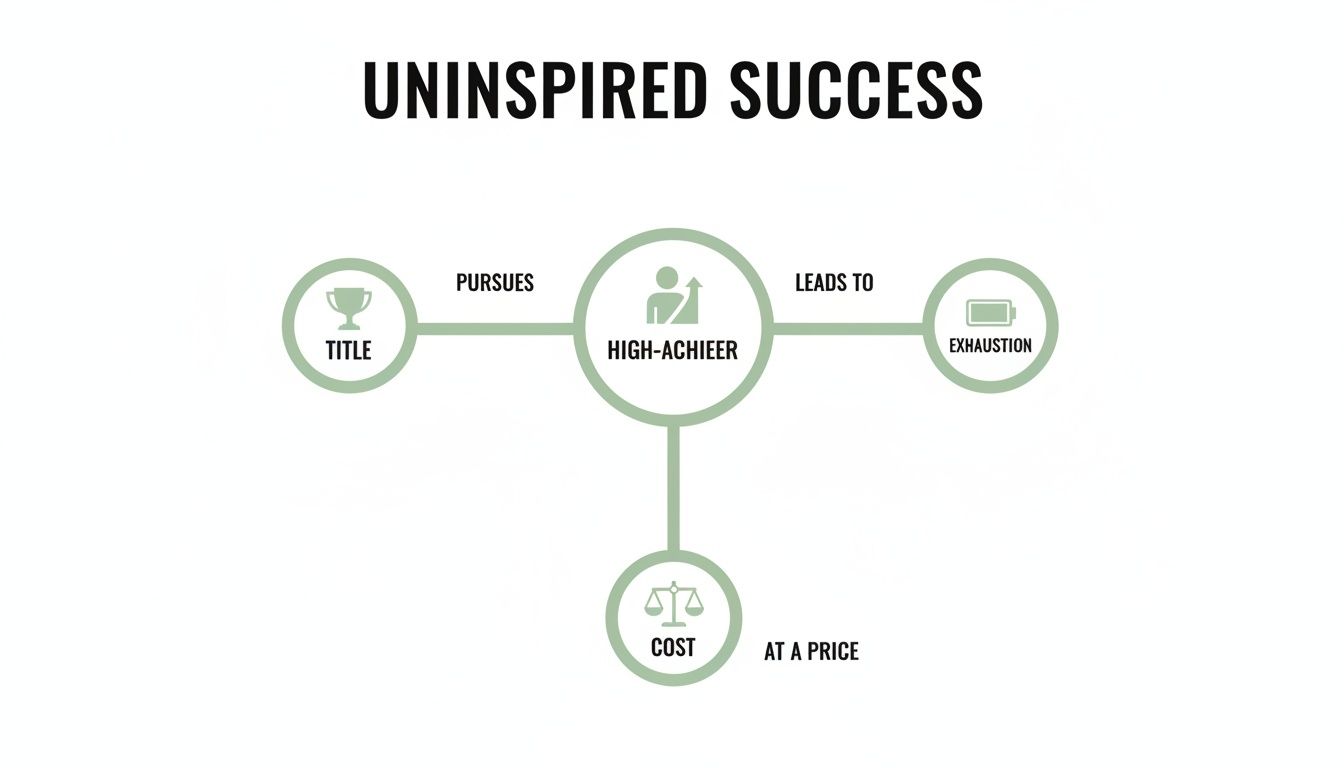
This map shows the hamster wheel so many leaders get stuck on: chasing titles and metrics at the expense of their own energy and fulfillment. Visionary leadership is the key to breaking this cycle, anchoring every single action to a future that actually means something.
Understanding these distinctions is everything. For instance, a charismatic leader can light up a room with their personality, but a visionary leader ignites an enduring belief in a mission that burns bright long after the meeting is over.
To make it even clearer, let’s break down how visionary leadership stacks apart from the rest.
Visionary Leadership vs Other Leadership Styles

Each of these styles has its place. But while a style like transformational leadership is fantastic for developing your people, the visionary provides the essential "why" that fuels all that effort in the first place. You can explore a deeper comparison in our guide on what is transformational leadership.
Ultimately, visionary leadership is about being the architect of the future, not just the manager of the present. It’s the game-changing shift from asking, "What do we do next?" to "What world do we want to create?"
The Neuroscience Behind A Compelling Vision

Ever wondered why a powerful vision feels so magnetic, almost electric? The answer isn’t hiding in a business textbook. It’s hardwired deep inside our own biology.
When a leader paints a future that truly connects on an emotional level, they aren't just sharing ideas—they're sparking a cascade of neurological responses inside their team. This goes way beyond simple motivation.
A compelling vision literally activates the brain’s mirror neurons. These are the specialized cells that fire not only when we do something but also when we watch someone else do it. As you describe a successful future, your team's brains start to experience that success as if it’s already happening. It’s an immediate, shared emotional state.
But this connection isn't just a fleeting feeling. It's chemical.
The Biology Of Trust And Motivation
An emotionally resonant vision also triggers the release of oxytocin, often nicknamed the "bonding hormone." This powerful neurochemical is the bedrock of trust, collaboration, and psychological safety. It’s the biological glue that turns a collection of individuals into a cohesive, deeply motivated unit.
When your vision gets the oxytocin flowing, it creates an undeniable sense of belonging and loyalty. This is precisely why purely tactical, data-driven leadership so often falls flat. It speaks to the intellect but completely ignores the nervous system.
Without this biological buy-in, you might get compliance, but you'll never get genuine commitment. You can dive deeper into how this all connects by exploring the core principles of your nervous system architecture.
A visionary leader acts as a lighthouse in a storm. While others are tossed by the chaotic waves of market shifts and internal politics, the lighthouse provides a steady, unwavering beam of light—a constant signal of hope and direction that guides everyone safely to shore.
This lighthouse effect is what truly separates visionary leaders from mere managers. When uncertainty is at its peak, a clear vision doesn't just offer a plan; it regulates the collective nervous system of the entire organization. It communicates safety, stability, and purpose precisely when the environment feels most threatening.
This is the hidden power of visionary leadership: it’s not about having all the answers. It’s about being the unwavering source of a future worth fighting for, forging a biological foundation for resilience and deep-seated motivation that no spreadsheet could ever hope to replicate.
The Five Core Traits Of A Visionary Leader
Knowing the definition of visionary leadership is one thing. Actually living it is another game entirely. For the high-achieving woman, this isn't about slapping on a new personality. It’s about awakening the powerful, innate qualities that have likely been buried under the constant pressure to just perform, to hit the next tactical target.
Visionary leadership is built on five core pillars. But don’t think of them as skills you just learn from a book; they are deep-seated traits you have to cultivate from within. They are the internal architecture you need to lead with real purpose and impact, turning that feeling of burnout into a genuine breakthrough.
Radical Foresight
This is more than just good planning; it’s the ability to see around corners. Radical foresight isn't about predicting the future with some mystical crystal ball. It’s about seeing the patterns no one else does, connecting seemingly unrelated ideas, and feeling the shifts in the market long before they become painfully obvious.
This requires a mind quiet enough to hear the whispers of what’s next, a mind that isn’t constantly drowning in the noise of daily fire-fighting.
Think of Whitney Wolfe Herd. She saw a future for online dating that put female safety and empowerment first. Bumble wasn’t just another app; it was a direct answer to a deep cultural need everyone else was ignoring. She didn't just see the next wave coming—she built the surfboard to ride it.
Unwavering Resilience
Let's be clear: a big, bold vision will always be met with resistance. The path is guaranteed to be littered with setbacks, failures, and moments of crushing self-doubt. Unwavering resilience is the capacity to take those hits without ever losing your core conviction.
It’s the quiet, internal strength to hold the vision steady when your own team is starting to wobble and the market is throwing a fit. Just imagine how many times critics told Oprah Winfrey her ideas were too niche, too personal, or simply wouldn’t work. Her resilience wasn't loud or aggressive; it was a deeply rooted belief in her purpose that just refused to break. This is one of the key things that separates visionary leadership from more fragile, reactive styles.
Compelling Communication
A vision that lives only inside your head is nothing more than a daydream. Compelling communication is the essential bridge between your inner world and the outside world. It’s the art of telling a story so powerful that it bypasses intellectual arguments and speaks directly to the heart.
This isn’t about using corporate jargon or having the slickest slide deck. It's about articulating the "why" with such raw clarity and passion that people feel an irresistible pull to join your cause. This single skill turns employees into evangelists and customers into a loyal community.
And the results are tangible. Research shows that vision-focused leaders achieve 35% higher success rates in firm growth. Their proactive environments also lead to 28% better performance.
Deep Empathy
If you want to truly inspire people, you have to understand them first. Deep empathy is the ability to connect with the core hopes, fears, and motivations of your team. It’s what allows you to frame your vision not as some top-down corporate mandate, but as a shared journey toward a future that benefits everyone involved.
This trait is absolutely critical for building the psychological safety that innovation demands. When people feel seen, heard, and genuinely understood, they become willing to take the kind of risks necessary to bring a bold vision to life.
Embodied Conviction
This is it. This is the most critical trait, the one that holds all the others together. Embodied conviction means you don’t just talk about the vision—you are the vision. Your actions, your decisions, and the very energy you bring into a room are in complete, unshakeable alignment with the future you are creating.
This is where your leadership becomes authentic and deeply trustworthy. Remember, people follow the leader long before they follow the plan. When you truly live your vision, it becomes undeniable. To dig deeper into this concept, check out our guide on what is authentic leadership. This complete alignment is the ultimate source of a visionary’s power.
Building Your Visionary Framework From Within

The traits of a visionary leader—that magnetic foresight, that unshakeable conviction—aren't abstract ideals you just decide to have one day. They are the direct result of a powerful internal operating system. Shifting from chronic burnout to a state of profound breakthrough requires a practical, repeatable framework. One that builds your leadership capacity from the inside out.
This is exactly where the RAMS method comes in. It’s not another theory to add to your bookshelf; it’s a tangible system for building the internal architecture required for embodied visionary leadership. It’s the bridge that carries you from being an exhausted high-performer to an energized, sovereign leader.
The RAMS framework is built on four interconnected pillars: Results, Attitude, Mastery, and Systems. Each one is engineered to systematically dismantle the patterns that lead to burnout and replace them with the structures that sustain a powerful, authentic vision.
Redefining Your Results
The very first move is to reclaim what success even means. For far too long, you’ve been chasing external metrics—targets, promotions, industry recognition. It's a chase that keeps you on a hamster wheel, running faster just to stay in the same place.
Embodied visionary leadership sparks to life the moment you define Results on your own terms. This means aligning your goals with your deepest values, not just the company’s Q4 targets. It's the radical shift from asking, "What am I expected to achieve?" to "What impact do I truly want to create?"
This redefinition is an act of sovereignty. It’s about creating a personal scorecard for a fulfilling life, where your professional achievements are just one piece of a much richer picture.
When your daily actions are tied to a result that genuinely energizes you, the work itself becomes regenerative, not draining.
Cultivating A Resilient Attitude
Your Attitude is your internal weather system. It dictates how you respond to the inevitable storms that come with leadership. The constant pressure to be "on" creates a state of hypervigilance, and that drains your mental and emotional reserves faster than anything.
Cultivating a visionary attitude is about building resilience at the nervous-system level. It’s about developing the capacity to stay centered amidst the chaos, to see a setback not as a personal failure but as crucial data. This is where unwavering conviction is born.
A resilient attitude lets you hold your vision steady, even when everything around you is turbulent. It’s that unshakable inner calm that inspires genuine confidence and trust in your team.
Achieving Embodied Mastery
Mastery, in this context, has nothing to do with being the smartest person in the room. It’s about mastering your own internal state and your communication. It means becoming fluent in the language of inspiration, telling stories that connect on a human level, and leading conversations that build true alignment, not just compliance.
It also means mastering your own energy. High-achievers are notorious for leaking energy through people-pleasing, over-committing, and sidestepping difficult conversations. Embodied mastery is about plugging those leaks and directing your energy with fierce intention. You can learn more about how this connects to high-level execution in our guide to strategic thinking for leaders.
Designing Sustainable Systems
Finally, Systems are the guardrails that protect your energy and focus. Let’s be clear: burnout is almost never a personal failing. It’s a systems failure. You’ve likely succeeded in spite of a total lack of systems designed to support your own well-being.
Creating sustainable systems means intentionally designing your work, your schedule, and your boundaries to prevent depletion before it even starts. This could look like non-negotiable deep-work blocks in your calendar or a structured delegation process that actually works. These systems create the space required for radical foresight and creative thinking to flourish. They are the structure that makes your vision not just possible, but inevitable.
How Visionary Leaders Shape The Future
Visionary leadership isn’t some lofty, abstract idea you read about in business books. It’s the raw, powerful force that actively creates the future. This is where a bold idea jumps off the whiteboard and starts to fundamentally reshape industries, communities, and sometimes, even the planet itself.
These leaders are more than just dreamers; they’re the architects of what’s next. They understand the grueling but essential journey required to truly turn vision into reality. They don't just have a great idea; they build entire movements around it by translating a compelling picture of the future into a series of strategic, executable steps. The vision gives everyone the "why," and their relentless focus on execution delivers the "how."
Vision In Action: The Ecosia Case Study
If you want to see this in action, just look at Ecosia. Here’s a search engine with a radical vision: to reforest the entire planet. The concept was as simple as it was profound—use the ad revenue generated from internet searches to fund massive tree-planting initiatives. This wasn't some tacked-on corporate social responsibility project; it was the very core of their business model, a perfect fusion of purpose and profit.
Ecosia's success is proof that a powerful vision becomes unstoppable when it’s welded to meticulous execution. The team planted over 200 million trees and expanded its reach to over 150 countries. They didn't just hope for the best; they built a model where every search, every click, and every dollar of ad revenue directly fueled the mission, leading to an incredible employee alignment of 90%. When vision is integrated and measured, it doesn't just survive—it thrives.
Vision without execution is a hallucination. Execution without vision is a nightmare.
This case study absolutely demolishes the myth that visionary leaders are just charismatic speakers with a good pitch. They are master strategists. They build the systems and inspire the high-performing teams needed to make the impossible happen.
By navigating immense challenges while staying anchored to a clear, compelling mission, these leaders build a legacy that matters. They prove that the greatest impact comes not just from seeing the future, but from having the courage and the discipline to build it, one decisive step at a time.
Reclaiming Your Leadership Sovereignty
This journey from an exhausted operator to an inspired visionary isn’t about faking it until you make it or slapping on some new leadership persona. It’s about coming home to yourself.
Developing visionary leadership is the ultimate act of reclaiming your nervous-system sovereignty. It’s about shifting from a state of constantly pushing, grinding, and reacting to one of powerful, purposeful alignment.
True leadership isn’t about managing tactics harder; it's about embodying a future so compelling that your actions naturally flow from your deepest purpose. To see how a clear, long-range vision drives tangible goals, just look at groundbreaking initiatives like Sam Altman's AI researcher vision.
This is the critical move toward embodied leadership—from management to genuine inspiration. It’s your invitation to finally escape the relentless cycle of burnout, regulate your own internal state, and build a unique visionary style that energizes you and everyone you lead. This isn't a sale; it's a return to you.
Your Questions About Visionary Leadership, Answered
Stepping into a more embodied, visionary leadership style is a powerful move. It’s also one that naturally brings up questions as you navigate the shift. Let's get straight to the most common ones that come up on this journey.
Can Visionary Leadership Actually Be Learned?
Absolutely. There's a persistent myth that visionary leaders are just born that way, but that couldn’t be further from the truth. While some personalities might lean into it more easily, visionary leadership is a set of skills and mindsets you can intentionally cultivate.
Think of it less as a rare, innate talent and more as a muscle you build. Skills like radical foresight and compelling communication can be developed. That’s why frameworks like the RAMS Method exist—to give you a structured path for building this capacity from the inside out, proving that anyone can learn to lead from a place of powerful, authentic vision.
What's The Real Difference Between Visionary and Charismatic Leadership?
This is a critical distinction, and it’s one that trips a lot of people up.
Charismatic leadership is all about the leader's personal charm and magnetic personality. It’s powerful, for sure, but that power is often tied directly to them. When they leave the room, the energy can fade.
Visionary leadership, on the other hand, is centered on the power of the idea itself. A visionary leader inspires a deep, unshakable commitment to a shared future, creating a motivation that lasts long after they’re gone. Charisma can certainly be a useful tool for a visionary, but the vision itself is the true, enduring source of power.
What's the Biggest Pitfall for New Visionary Leaders?
The single biggest mistake I see is a failure to cascade the vision effectively through every level of the organization.
It’s easy for a vision to feel potent and electric in the executive suite, only to lose all its energy and meaning by the time it reaches the front lines. Research involving over 1,400 employees confirms this, showing that the impact of this leadership style can seriously weaken at lower management levels if it isn’t intentionally nurtured. This piece on the challenges of cascading a vision is worth a read to understand just how easily this disconnect can happen.
A vision isn’t a one-and-done announcement. To maintain its power and create genuine alignment, it has to be communicated, reinforced, and lived out consistently, at every single level.
Reclaiming your leadership sovereignty is a journey of returning to yourself. At Baz Porter, we provide the framework for high-achieving women to transition from burnout to breakthrough, building a leadership style that is both powerful and sustainable. Discover the RAMS method and start your transformation today.
Where to go next
If any of this reads like your own reflection, the Silent Collapse Diagnostic™ is a quiet place to start. It is a private space to see what is really running underneath the work. And if you want the deeper why beneath it all, read the Sovereign Manifesto.