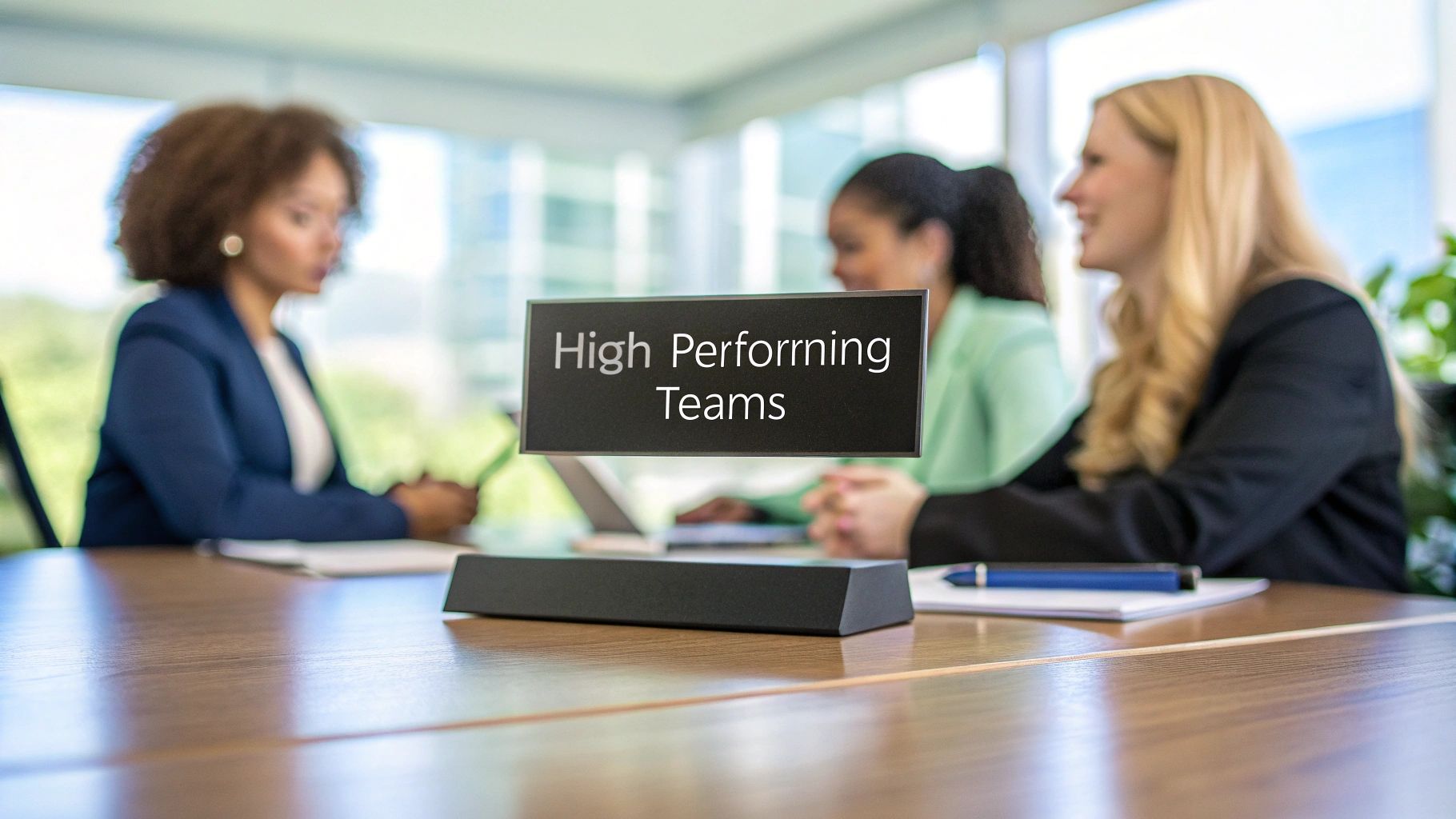
Building High Performing Teams Is An Inside Job. Here's How to Start.
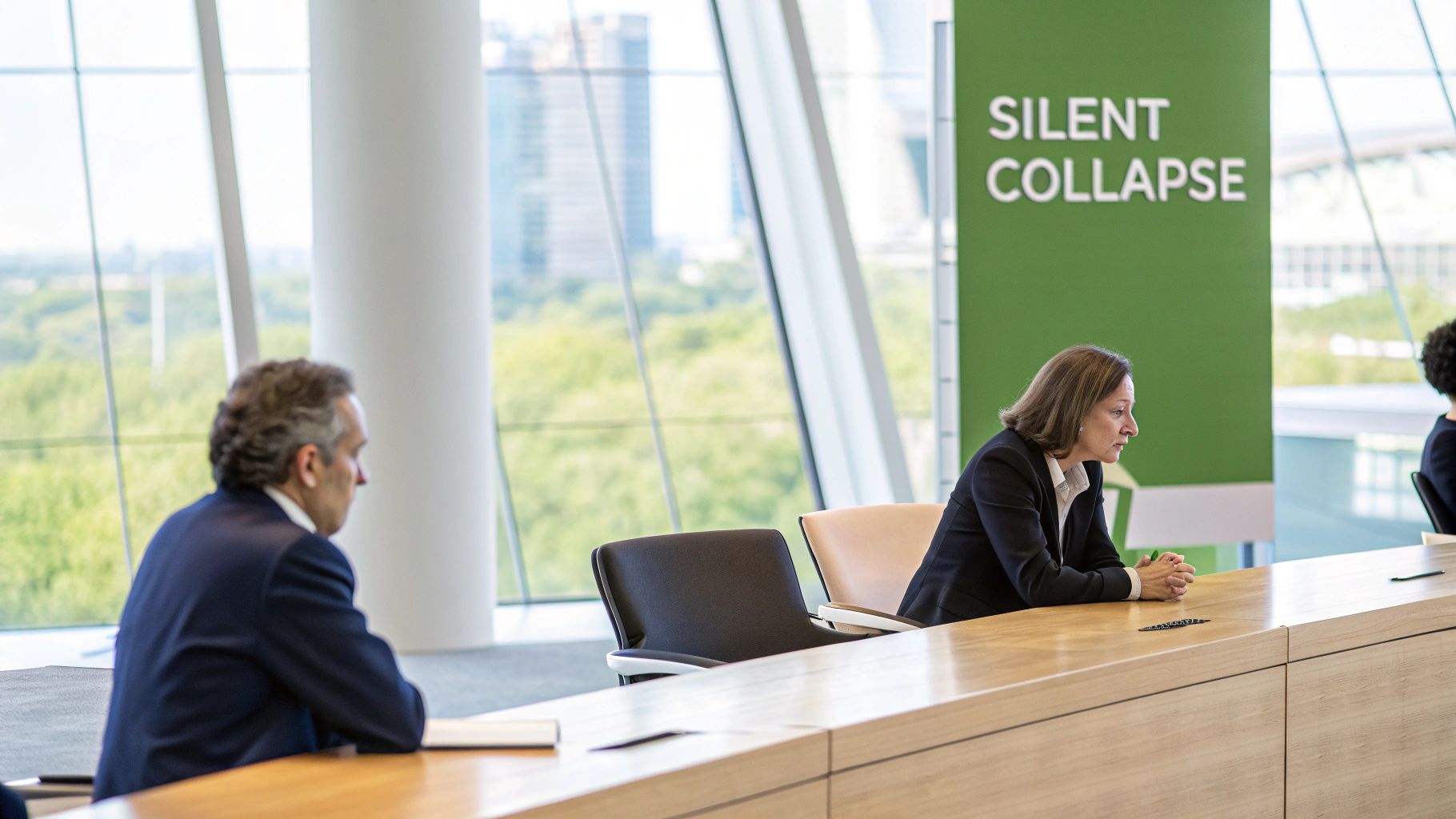
You did everything right. You hired the smartest people, gave them every resource, and pointed them toward a compelling mission. And yet, the team’s output doesn't match the sum of its brilliant parts. Meetings are thick with unspoken tension. Big projects crawl past deadlines. And a subtle fear of failure smothers any chance of real innovation. The internal dialogue is relentless: "Why isn't this working? I have an A-team, but we're getting C-level results." This frustrating gap between potential and performance is what I call the "Silent Collapse." It’s an unsustainable pressure that leads directly to self-doubt and, eventually, burnout.
Key Takeaways
Your Team Has an Operating System: High performance isn't about talent alone; it's about shifting your team's collective nervous system from a "Threat-Based" state (driven by fear and self-preservation) to a "Trust-Based" state (enabling innovation and collaboration).
The RAMS™ Framework is Your Blueprint: Systematically build a high-performing team by focusing on the interdependent pillars: razor-sharp Results, a resilient Attitude of psychological safety, pathways to individual Mastery, and frictionless Systems.
Systems Create Sovereignty: Implementing clear decision rhythms (daily, weekly, quarterly) and defining role clarity eliminates ambiguity, calms the collective nervous system, and frees up cognitive energy for high-impact work.
Your Presence Sets the Tone: A team’s performance is a direct reflection of its leader's internal state. Regulating your own nervous system is the most critical and often overlooked lever for creating a culture of trust and excellence.
The Definitive Answer to Building High Performing Teams
Building high performing teams requires a leader to architect a trust-based environment where psychological safety is the foundation. This is achieved by systematically implementing clear, co-created goals (Results), fostering a resilient mindset (Attitude), providing pathways for growth (Mastery), and establishing frictionless operational rhythms (Systems). Ultimately, a team's peak performance is a direct reflection of the leader's own nervous system sovereignty.
The Hidden Pattern Behind Your Team’s Dysfunction
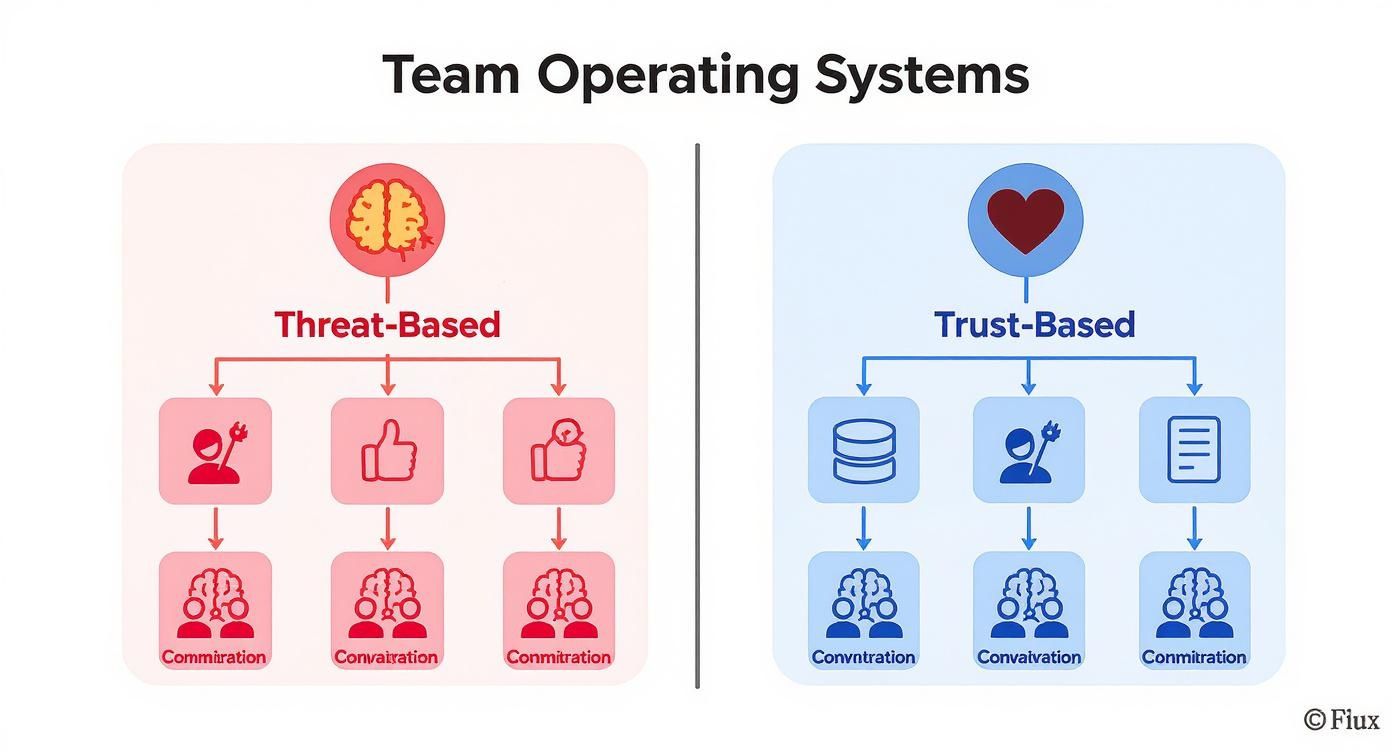
Why do even the sharpest, most credentialed teams fall spectacularly flat? The reason often has less to do with talent and more to do with something deeper: their collective nervous system. Every team operates on one of two fundamental settings. Think of it as a computer's background processing: it's either running a Threat-Based Operating System or a Trust-Based Operating System.
When a team is stuck in a threat-based state, you're dealing with a biological problem, not a personal one. Unclear expectations, unchecked micromanagement, or a subtle fear of judgment can trigger individual survival instincts. This neurological state, governed by the amygdala, effectively hijacks the prefrontal cortex—the very part of the brain you hired for its creativity and strategic horsepower. Simply put, your team members are biologically wired for self-preservation, not collective innovation.
The Myth of Raw Talent: Threat vs. Trust
The most common leadership mistake is believing that talent alone is the answer. Research shows team dynamics and psychological safety are far better predictors of performance than individual IQs. A Threat-Based OS is exhausting and inefficient, running on anxiety where people constantly scan for danger. This shows up as risk aversion, siloed communication, and a palpable lack of energy. You can feel it when no one speaks up or when accountability becomes a game of hot potato. For many leaders, this pattern of disengagement signals their team is feeling chronically unmotivated at work.
A Trust-Based system, on the other hand, creates relational calm. It’s built on psychological safety, which allows the collective nervous system to settle. When the brain perceives safety, it grants access to higher-order thinking where collective intelligence flourishes.
Key Takeaway: Team dysfunction is not a character flaw. It's a predictable biological response to a threatening environment. Your primary job is to shift the team's operating system from threat to trust, unlocking the cognitive capacity that’s already there.
The Neurological Cost of Disengagement
The tangible business impact between these two states is staggering. When teams are disengaged—a key symptom of a threat-based environment—performance plummets. Gallup's extensive meta-analysis of over 183,000 teams provides hard proof. Teams in the top quartile for engagement were 18% more productive in sales, 14% more productive in production, and a remarkable 23% more profitable overall. These figures prove that management practices fostering trust are direct drivers of your bottom line.
The difference lies in how you, as the leader, shape the environment. Here’s how the two systems show up in daily operations:
Team DynamicThreat-Based System (Survival Mode)Trust-Based System (Performance Mode)
Communication Filtered, cautious, and often political. Information is hoarded. Open, direct, and transparent. Information flows freely.
Feedback Avoided or delivered defensively. It's seen as an attack.Actively sought and given constructively. It's seen as a gift.
Risk-Taking Stifled. Failure is feared and punished, leading to inaction. Encouraged. Failure is framed as a learning opportunity.
Accountability Focused on blame and finger-pointing.Focused on shared ownership and problem-solving.
Moving your team from the left column to the right is the core work of elite leadership. Digging into the principles of what is inclusive leadership is a powerful first step in fostering the trust that true performance is built on.
The RAMS™ Reframe to Unlock Your Team’s Potential
Knowing the science is one thing. Building the team is another. Moving from a threat-based mindset to one built on trust requires a clear, repeatable blueprint. This is why I developed the RAMS™ Framework. It’s a practical, actionable system for engineering a team that thrives under pressure and sustains peak performance. RAMS™ is an architecture built on five interdependent pillars: Results, Attitude, Authenticity, Mastery, and Systems. Each one directly addresses a core part of your team's DNA, shifting them from friction into flow.
R is for Results
Everything starts here. If your team isn’t crystal clear on what “winning” looks like, they’ll fragment. The Results pillar is about defining outcomes with such razor-sharp precision that they become the team's unwavering north star. This goes beyond setting quarterly KPIs; it’s about creating a shared language around success.
Define "Done": What does a finished project look like in tangible, measurable terms?
Communicate the "Why": Connect every objective back to the bigger picture—the company’s mission and the client’s success.
Establish Clear Metrics: Use a handful of leading indicators that predict success, not just lagging ones that report on past failures.
When the destination is clear, alignment happens organically.
A is for Attitude
The Attitude pillar is the heart of this framework. This is where we cultivate psychological safety and a resilient, growth-oriented mindset. A global survey from Dale Carnegie revealed that only 30% of teams are actually considered high-performing. A key differentiator? Goal clarity was a factor—85% of elite teams had well-defined objectives. But 81% also practiced daily communication and 74% had access to robust training. You can dig into the specifics in the full Dale Carnegie report.
This pillar is about engineering an environment where people feel safe to:
Speak Up: Share a dissenting opinion without fear of being shut down.
Take Smart Risks: Experiment and fail forward, knowing failure is a learning opportunity.
Be Vulnerable: Ask for help and admit mistakes.
Cultivating this attitude isn’t about cheesy exercises. It’s about you, the leader, consistently modeling these behaviors.
M is for Mastery
Top performers are wired for growth. The Mastery pillar is about creating deliberate pathways for individual skill development. Stagnation is the silent killer of motivation. When people see a clear future, their commitment soars.
Clear Career Pathways: Show people what the next level looks like and the skills needed to get there.
Personalized Development Plans: Map out strengths to amplify and gaps to close.
Peer-to-Peer Coaching: Create opportunities for team members to teach and learn from each other.
Mastery creates a powerful feedback loop: as individuals sharpen their skills, the team's collective capability expands.
S is for Systems
Finally, Systems are the operational rhythms that hold everything together. These are the communication protocols and decision-making cadences that strip out ambiguity. Great systems make high performance the path of least resistance.
Your team’s performance will never exceed the quality of its systems. Robust systems create predictability, which calms the collective nervous system and frees up mental energy for high-impact work.
Designing effective systems includes:
Decision Rhythms: A clear cadence for daily, weekly, and quarterly meetings.
Communication Protocols: Defining which channels are used for what.
Role Definition Documents: A single source of truth for responsibilities.
For a deeper look at this process, check out our guide on creating systems that empower teams and free your time.
How RAMS™ Contrasts With Old-School Leadership
Conventional leadership is often rooted in control. The RAMS™ framework flips that model, focusing instead on shared strength and shared ownership.
Team Dynamic Conventional Control-Based ApproachThe RAMS™ Framework Approach
Clarity Goals are set at the top and cascaded down.
Results: A crystal-clear vision of "done" is co-created and owned by the team.
Safety Vulnerability is seen as a weakness; mistakes are punished.
Attitude: A safe environment where risks and authentic feedback are encouraged.
Growth Development is a generic, once-a-year HR process.
Mastery: Personalized growth paths are central to the team’s operating model.
Operations Processes are rigid and bureaucratic.
Systems: Agile, clear rhythms that reduce cognitive load and enable flow.
One approach manages resources; the other unleashes human potential.
The Return to Nervous System Sovereignty
Frameworks and systems are essential, but they are only half of the equation. The final, most critical element is the one looking back at you in the mirror. Your team’s performance is a direct reflection of your own internal state.
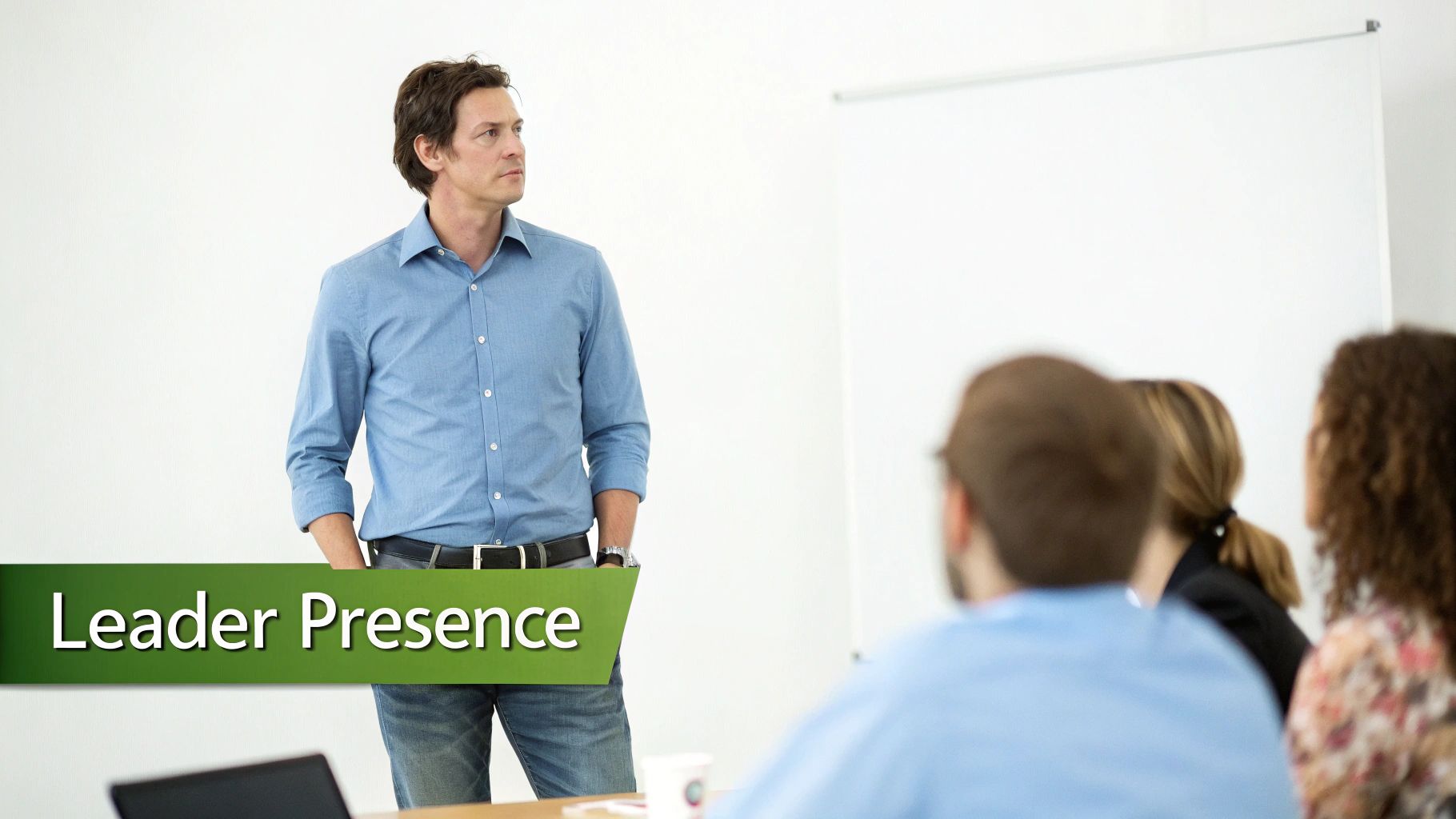
This isn’t an abstract concept; it's a neurological reality. The collective nervous system of your team will always attune to yours. When you lead from a place of calm, clarity, and centeredness—what I call nervous system sovereignty—you create an environment where people feel safe enough to bring their A-game. A leader caught in a cycle of stress and reactivity will unintentionally broadcast that same chaotic energy.
The Leader as the System’s Thermostat
Think of yourself as the thermostat for your team's psychological climate. Your presence dictates whether the room feels safe or threatening. This is about leading not just from your intellect, but from a place of deep internal alignment.
The ultimate goal isn't just a high-performing team; it's for you to lead from a place of authenticity and power, where an exceptional team is the natural result.
This is the shift from managing tactics to embodying presence. For any leader serious about sustaining peak performance, continuous development in Mastering Leadership Style in Business Management isn't just helpful—it's indispensable. A high-performing team is, ultimately, an inside job. It starts with regulating your own nervous system so you can become a stabilizing force. When you lead from this centered place, you don't just build a better team—you build a more resilient and powerful version of yourself. The team's success becomes the undeniable evidence of your own return.
Your Toughest Questions, Answered
Here are the most common questions that come up when leaders start putting these principles into practice.
How Do You Turn Around a Toxic or Underperforming Team?
Your first move is to re-establish psychological safety. Stop the bleeding. As the leader, you must model the vulnerability you want to see. Acknowledge the team's struggles and own your part in them.
Once you’ve cracked the door open, bring in two pillars for stability:
Clarity on Results: Define the top 1-2 priorities for the next 30 days and strip away everything else.
Predictable Systems: Introduce a simple rhythm, like a daily 15-minute huddle. Its predictability calms the collective nervous system and rebuilds trust through consistency.
Only then can you address deeper issues.
What Is the Single Most Critical Factor for Team Performance?
It's psychological safety. It is the soil from which everything else grows—or withers. You can have a team of geniuses, but if they don't feel safe enough to take risks, admit mistakes, or challenge your ideas, you will never unlock their true potential.
Psychological safety isn't some "soft skill." It's a hard requirement for elite performance. It’s the prerequisite for the brutal honesty, healthy conflict, and shared accountability that define truly great teams.
Without safety, your team operates from a threat state. With it, you flip the switch to a trust-based operating system. For those who want to go deeper, this comprehensive guide on how to build high performing teams offers powerful insights.
How Long Does This Actually Take?
This isn’t an overnight fix, but it happens in two phases.
1. The Atmospheric Shift (Weeks 1-4)
Within the first month, you’ll feel a change. Introducing clear Results and consistent Systems immediately lowers anxiety. Meetings get sharper. Communication feels less like a minefield.
2. The Performance Shift (1-2 Quarters)
Real, measurable jumps in performance metrics typically show up within one to two business quarters. This is how long it takes for new rhythms to become ingrained habits. As the team internalizes the framework, you’ll see a sustained lift in execution speed, quality, and proactive problem-solving.
Where to go next. If building a resilient team starts with regulating your own inner state, the Silent Collapse Diagnostic™ is a quiet place to start — an honest look at what is really driving how you lead. And if you want the deeper why beneath the work, read the Sovereign Manifesto.