Strategic Thinking for Leaders: How to Escape the Busyness Trap
You’re drowning in the urgent. Your calendar is a wall of back-to-back meetings, your inbox is an endless tide of demands, and you spend your days putting out operational fires instead of shaping the future you were hired to build. You got here because of your vision, but now you feel more like a firefighter than an architect. The internal dialogue is relentless: “If I stop performing, I’ll disappear.” This isn’t just feeling busy; it’s a silent collapse, where the very drive that made you successful is now the cage keeping you from your most important work.
Key Takeaways
Busyness is a biological trap: Your brain is addicted to the dopamine hits from completing small, urgent tasks, creating a "Cognitive Treadmill" that neurologically sabotages long-term strategic thought.
The RAMS Framework is your escape route: Move from reaction to intention using a four-part system: defining clear Results, cultivating a curious Attitude, honing analytical Mastery, and building protective Systems.
Strategy is a daily practice, not an annual event: Integrate small, consistent rituals like the "90-Minute Strategy Block" and "Horizon Scans" to build the mental muscle for foresight.
The real goal is sovereignty: Effective strategic thinking is not just about business outcomes; it's about reclaiming control over your nervous system, your energy, and your professional authority.
Strategic thinking for leaders is the disciplined art of overriding your brain's preference for immediate tasks to deliberately anticipate threats, seize opportunities, and rally your team around a future that doesn't yet exist. It is the conscious shift from being the primary doer to becoming the chief architect of a system where the right work gets done by the right people, freeing you to operate at your highest value.
The Hidden Pattern: Why Your Brain is Addicted to Busyness

It feels completely backward, doesn't it? You know, intellectually, that high-level strategic thinking is your most valuable work. Yet carving out the actual time for it feels like trying to build a dam with a teaspoon.
Let's be clear: this isn't a failure of your discipline or willpower. It’s a direct conflict with your own biology.
Your brain is, first and foremost, a survival machine. It's fine-tuned to respond to immediate rewards. Every time you clear your inbox, squash a logistical problem, or answer an "urgent" Slack message, your brain gets a tiny hit of dopamine. Each checked box is a little biological cookie.
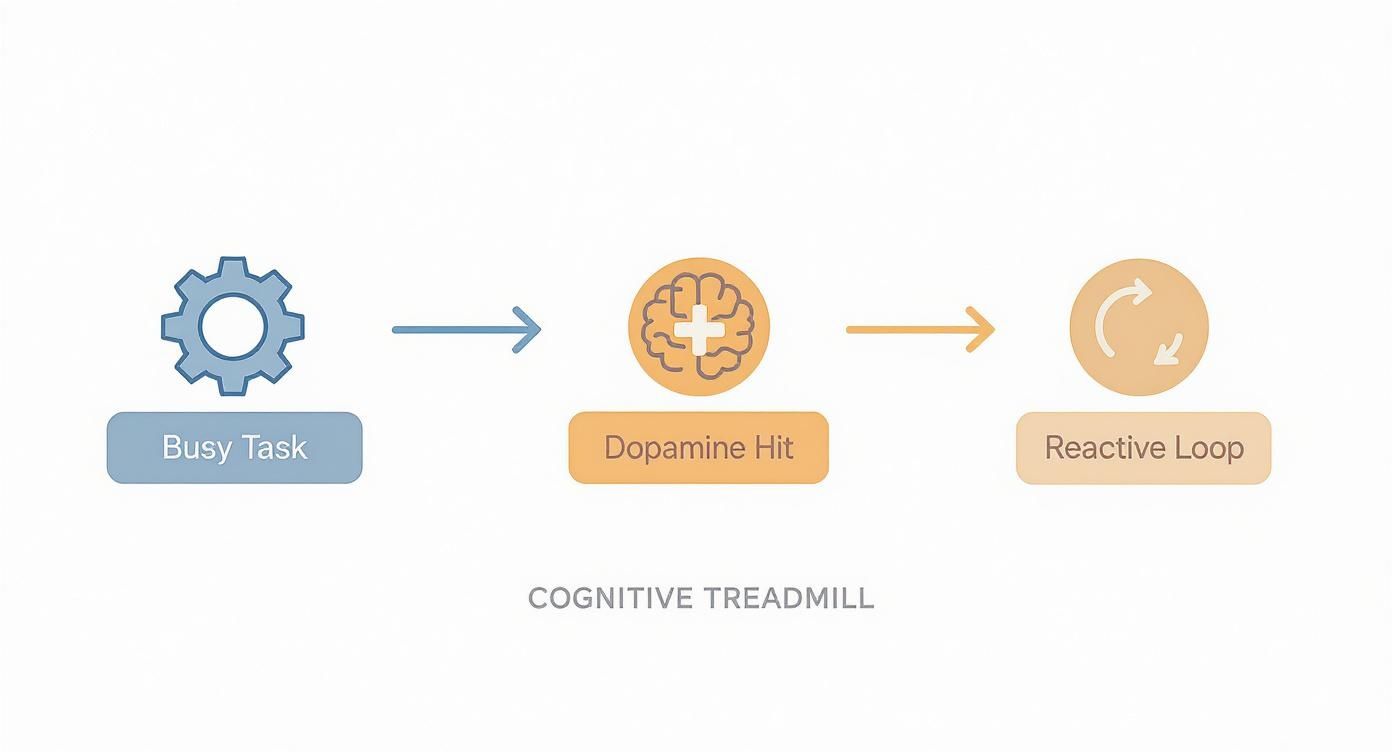
This creates an incredibly powerful feedback loop. Your brain quickly learns that "being busy" feels good, even when the tasks are trivial. I call this the Cognitive Treadmill: a relentless cycle where you run faster and faster on operational tasks, rewarded by fleeting chemical hits, all while making zero strategic progress. It’s an addiction to the immediate, and it keeps you stuck.
The Tyranny of the Urgent
This biological pull makes engaging in abstract, long-term thinking feel almost impossible. Strategy doesn't offer an instant dopamine reward. Its payoff is distant and demands immense cognitive energy. So, by default, your brain shoves that deep work into the "non-essential" category.
Living in this constant state of reaction keeps your nervous system on a low-grade alert. This makes it even harder to access the calm, creative prefrontal cortex—the part of your brain where true strategic breakthroughs actually happen. You become neurologically wired for reactivity, not foresight. This is often the real reason you might feel completely unmotivated at work despite external success. The constant churn is utterly exhausting.
The great paradox is that the very brain wiring that helps you execute flawlessly on a dozen small tasks actively sabotages your ability to perform the one task that truly matters: shaping the future.
This internal battle has massive real-world consequences. While 85% of leaders agree that strategic thinking is crucial, a study from the Harvard Business Review found a staggering 97% of them spend less than one day a month on it. This directly tanks performance. The data confirms what you feel in your gut: the relentless pressure for short-term results is squeezing the life out of long-term vision. You can read more about these powerful leadership findings and their impact.
Understanding this neurological pattern is the first real step toward changing it. You are not fighting a character flaw. You are working against a deeply ingrained biological default. The goal is to consciously override it.
The RAMS Reframe: An Operating System for Strategic Leadership
To consciously step off the Cognitive Treadmill, you need more than good intentions. You need a system. The RAMS Framework is that system. It’s a clean, actionable model I developed with leaders like you to shift from a state of constant reaction to one of intentional direction. It stands for Results, Attitude, Mastery, and Systems—four interconnected pillars that restore your strategic capacity and professional sovereignty.
This isn’t just another abstract theory. It is a practical blueprint for rewiring your approach, protecting your cognitive energy, and ensuring your daily actions connect to your long-term vision.
R Is For Results: Defining What Truly Matters
The first pillar, Results, forces you to cut through the noise. It’s about defining the outcomes that actually move the needle. Leaders stuck on the Cognitive Treadmill measure progress by volume: emails sent, meetings attended. This is a trap.
Strategic leadership starts with a ruthless focus on impact over effort. You stop asking, "What do I need to do today?" and start asking: "What are the one to three critical outcomes that, if we achieve them this quarter, will create the most significant long-term value?"
From Tactical Metrics to Strategic Outcomes: A tactical metric is "clear 100 support tickets." A strategic outcome is "reduce ticket volume by 30% by fixing the root cause of the top three issues."
From Vague Goals to Specific Impact: "Improve team morale" is a wish. "Increase our employee Net Promoter Score (eNPS) by 15 points" is a result.
This is the first, most crucial step in breaking the addiction to busyness. The simple but powerful loop below is what keeps so many talented leaders trapped.
A Is For Attitude: Cultivating Foresight And Curiosity
Your mindset dictates your altitude. The Attitude pillar is about cultivating the internal state necessary for strategic thought. A leader in reactive mode has a narrowed perspective, optimized for threat detection, not opportunity creation.
A truly strategic attitude is defined by two core qualities:
Intentional Curiosity: Instead of accepting surface-level information, you constantly ask probing questions. "Why are we doing it this way?" "What assumptions are we making that might be flat-out wrong?"
Calculated Detachment: Create cognitive space between an event and your response. When a crisis hits, the tactical leader jumps in. The strategic leader pauses, assesses the second- and third-order consequences, and then acts with intention.
M Is For Mastery: Honing Your Analytical Skills
Once you have the right attitude, you need the right tools. Mastery refers to the specific, practical skills that underpin sharp strategic analysis. This isn't innate genius; it's disciplined practice.
Systems Thinking: The ability to see the organization as an interconnected whole, where a decision in one department creates ripples everywhere else. A systems thinker maps these connections before acting.
Scenario Planning: Instead of trying to predict the future, you imagine several plausible futures. What if our main competitor gets acquired? What if new technology makes our product obsolete? This builds resilience and agility.
Information Synthesis: A strategic leader doesn't just consume information; they synthesize it. They can take a market report, customer feedback, and internal data and weave them into a coherent story that reveals a hidden opportunity or an emerging threat.
S Is For Systems: Building Your Strategic Fortress
The final and most crucial pillar is Systems. This is where you build the structures—both personal and organizational—that protect your time and energy for deep work. Without robust systems, good intentions get crushed by daily demands.
Personal Systems: This includes non-negotiable "Strategy Blocks" in your calendar—90-minute, firewalled sessions for deep thinking. It means designing a delegation framework that frees your team to own outcomes, not just tasks.
Organizational Systems: This involves structuring meetings to be strategic, not just informational. For instance, dedicating the first 15 minutes of a leadership meeting to discussing one external trend and its potential impact.
These systems act as your fortress against the tyranny of the urgent. The entire RAMS framework is a detailed methodology designed to install these systems directly into your leadership practice.
Shifting from Tactical Management to Strategic Leadership
To make this crystal clear, let's look at the contrast between the reactive behaviors of a leader stuck on the Cognitive Treadmill and the intentional actions of one applying the RAMS framework.
Focus AreaTactical Mindset (The Cognitive Treadmill)Strategic Mindset (RAMS Framework)
Time Allocation Calendar is reactive, filled with others' prioritiesCalendar is proactive, with protected blocks for deep work
Problem Solving Addresses immediate symptoms; puts out firesSeeks to understand and solve root causes
Decision Making Based on gut feel and immediate dataBased on trend analysis, scenario planning, and long-term impact
Team Management Delegates tasks and micromanages processDelegates outcomes and strengthens ownership
Focus Internal operations and daily performance metricsExternal trends, competitive landscape, and future opportunities
Communication Focused on updates, status reports, and immediate issuesFocused on vision, context, and asking "what if" questions
By systematically implementing Results, Attitude, Mastery, and Systems, you are engineering an entirely new operating model for your leadership—one that builds sustainable impact and restores your control.
The Return: How to Integrate Strategic Thinking Into Your Daily Work

Knowing the theory is one thing. Putting it into practice when your calendar is bursting is another. The real shift happens when you translate strategic leadership from an idea into small, repeatable actions.
This isn't about adding more to your plate. It’s about replacing low-value, reactive habits with high-impact rituals that carve out mental space.
Start Your Day with a Horizon Scan
Before your inbox dictates your priorities, take ten minutes. This isn't meditation—it's strategic reconnaissance.
Scan one or two trusted industry publications. The goal isn’t to absorb every word, but to hunt for patterns. What shifted overnight? What whispers of a new trend are getting louder? This simple ritual flips your brain from reactive mode ("what fires need fighting?") to proactive mode ("what does this new information mean for us?").
Mandate the 90-Minute Strategy Block
This is the most critical system you can build. Block a 90-minute session in your calendar every single week. Label it "Strategy Block" and protect it like your most important client meeting. No calls, no emails, no Slack. This is your protected time to work on one specific strategic question.
Week 1: "What's the single biggest bottleneck holding my team back?"
Week 2: "If we were starting this company from scratch today, what would we do differently?"
Week 3: "Which of our core assumptions about our customers might be dangerously outdated?"
This block is the engine of your strategic practice. It’s the single most powerful way to find peace in the midst of chaos by creating an intentional space for clarity.
Elevate Your Team Meetings
Most team meetings are operational black holes. Change this with one simple rule. Dedicate the first 15 minutes of every leadership meeting to one strategic conversation. No operational talk allowed.
"What's one thing happening in the outside world that should be scaring us?"
"Describe our ideal customer five years from now. How is she different from our customer today?"
"What's a 'sacred cow' process in our department that we should eliminate?"
This practice trains your entire team to lift their gaze. Over time, you'll find it helps everyone improve decision-making for better outcomes across the board.
A leader's job isn't to have all the strategic answers. It's to create the environment where the best strategic questions can be asked and explored.
From Burnout to Sovereignty: The Return to Yourself
The pursuit of strategic thinking isn't just about hitting quarterly numbers. The real goal is reclaiming your professional sovereignty.
This path is designed to pull you out of the chaotic, reactive state that keeps your nervous system in a constant fight-or-flight response. True leadership isn't about managing chaos more efficiently. It’s about designing a system where chaos no longer dictates your agenda, your energy, or your focus.
This shift is a return to yourself. By carving out intentional space for deep thought, you stop just reacting to the world. Instead, you start co-creating your future with intention. This often requires a fundamental strategic reset, a conscious decision to operate from foresight rather than firefighting. It's a commitment to resetting your mindset to align with your deepest values.
The demand for this kind of evolved leadership is only getting louder. A 2024 global study from Harvard Business Publishing found that nearly 70% of professionals believe leaders must develop more diverse skill sets to navigate today's complexity. The message is clear: advanced strategic capabilities are no longer optional. You can explore the full findings on evolving leadership needs.
Strategic thinking isn't just a professional tool; it's a pathway back to your own authority. It's the mechanism through which you stop letting your role run you and start running your role with clarity, purpose, and power.
This path from burnout to sovereignty is the ultimate return on investment. It restores your energy, sharpens your focus, and solidifies your legacy as a true visionary leader.
Your Burning Questions About Strategic Thinking
Even with the best intentions, making the leap to strategic leadership can feel impossible. Let's tackle the most common questions from leaders ready to bridge that gap.
“How do I find time for strategy when my calendar is already a nightmare?”
This is the number one hurdle. The answer is counterintuitive: You don't find the time. You make it.
This is about strategic substitution. Pull up your calendar. Find one recurring, low-impact meeting—that status update that could have been an email—and kill it. In its place, schedule a non-negotiable 60-minute "Strategy Block."
That initial twitch of discomfort is your brain’s "Cognitive Treadmill" trying to pull you back into the familiar grind. When you consistently swap busywork for deep work, you're not just clearing your calendar. You're re-engineering your role from operational firefighter to strategic architect.
“What’s the real difference between strategic thinking and strategic planning?”
This is a critical distinction. We use the terms interchangeably, but they are fundamentally different.
Strategic thinking is the messy, creative, ongoing mindset. It's the constant scanning of the horizon, connecting disparate dots, and questioning core assumptions. It’s a way of being.
Strategic planning is the structured, periodic event. It’s the formal process of forging those messy insights into a documented plan with goals, timelines, and metrics. It’s a moment of doing.
Strategic thinking is the fuel; strategic planning is the engine. A brilliant plan built without deep, continuous strategic thought is just a beautiful document destined to collect dust.
“How can I get my team to think more strategically?”
Your team’s ability to think strategically is a direct reflection of your leadership. You can't just command them to "be more strategic." You must create the environment where strategic thought can thrive.
It all starts with how you delegate. Stop delegating tasks. Start delegating outcomes.
Instead of: "Please create a new social media campaign for our Q3 product launch."
Try this: "Our goal is to increase market share with Gen Z by 10% this quarter. From your perspective, what’s the most powerful way we can use social media to make that happen?"
That simple reframe forces your team to own the "why" behind the "what." It hands them the problem, not just the process. Then, use your team meetings to model curiosity. Ask powerful, open-ended questions: "What's one core assumption we're making about our customers that might be dead wrong?"
When you consistently delegate outcomes and ask better questions, your team will transform from efficient task-doers into a collective of strategic problem-solvers.
Where to go next. If the pattern in this piece reads like your own, the Silent Collapse Diagnostic™ is a quiet place to begin. And if you want the deeper why beneath the work, read the Sovereign Manifesto.