What Is a High-Strung Personality? The Executive Cost
You’re answering emails with your jaw locked.
You’re reviewing work at night because your body won’t stand down. You call it standards. Your team calls it intensity. Your family feels the edge before you say a word.
You’re not dramatic. You’re overclocked.
The high-strung leader lives in permanent readiness. Every delay feels loaded. Every mistake feels expensive. Every silence gets scanned for threat. You still perform. That’s why nobody sees the failure building underneath.
This is the setup for Silent Collapse™. Outward results stay intact while the internal system starts stripping gears. If your private thought is, “If I stop driving this, everything slips,” you’re already in it.
Table of Contents
The Unseen Cost of Constant Vigilance
You wake up alert, not rested.
Coffee isn’t a ritual. It’s reinforcement. Your eyes hit the screen before your feet settle. A delayed reply irritates you. A vague message drains bandwidth. A minor error feels like incoming fire.

You don’t look unstable. You look competent. That’s the trap. The body tension gets misread as discipline. The chest pressure gets renamed ambition. The constant scanning gets mistaken for leadership.
If you want a plain physiological frame, this resource on understanding high cortisol for sports enthusiasts helps explain why a body held in constant activation starts paying a price.
The pattern also overlaps with what I describe in overcoming burnout at work. The collapse doesn’t begin when output drops. It begins when vigilance becomes your default setting.
Key Takeaways for the High-Performing Leader
A high-strung personality isn’t just temperament. It’s an operating system built around tension, speed, and preemptive control. That system can produce results while eroding authority.
What looks like drive often hides Silent Collapse™. The leader still performs, but the internal cost rises. Irritability, overchecking, urgency, and emotional friction are not badges. They’re warnings.
Sovereignty requires redesign, not coping. You don’t fix a high-strung state with surface tactics. You rebuild the structure through RAMS Framework™ principles: Results, Attitude, Mastery, and Systems.
Your body keeps the score your calendar ignores. If your work style runs on bracing, your personal life and decision quality will absorb the damage. Even practical lifestyle pieces like effective weight loss for professionals point to the same truth. A strained system leaks into everything.
High performance without internal command isn’t strength. It’s dependency on stress.
Defining the High-Strung Operating System
What is a high strung personality? It’s a pattern of heightened emotional sensitivity, tension, and stress reactivity that keeps a person in constant readiness. In practical terms, it’s a survival-based operating system that scans for threat, accelerates urgency, and burns energy to preserve control.
That’s the clean answer. The harder answer is this. A high-strung personality often works well enough to get rewarded. That’s why leaders protect it long after it stops serving them.
This isn’t a character flaw. It’s an outdated internal protocol. It was built for protection, not Sovereign Leadership™.
The problem is cost. This system consumes attention, distorts interpretation, and punishes stillness. It turns ordinary leadership friction into internal alarm. If that description lands, read my piece on nervous system architecture. The issue isn’t effort. The issue is design.
The Hidden Pattern From Trait to System Failure
A high-strung personality sits close to neuroticism in psychological research. That matters because it moves this conversation out of vague self-help language and into observable patterns.

The trait is real, but the cost is operational
The basic profile is clear. Heightened emotional sensitivity. Tension. Pronenness to stress. That sounds abstract until it starts shaping how you lead, relate, and recover.
A landmark study in the Journal of Health and Social Behavior examined MIDUS data and assessed neuroticism partly through whether people saw themselves as tense or “high strung.” People with high neuroticism scores had 34% more frequent negative interactions with relatives and friends and received 15.8% less social support than those with low scores (Journal of Health and Social Behavior study).
That finding matters because the high performer usually assumes the problem is private. It isn’t. The internal state leaks into the network around them. Tone sharpens. Patience thins. Support erodes.
The nervous system you refuse to examine will rewrite your relationships for you.
This is why I reject the soft definition of high-strung as “just intense.” Intensity doesn’t explain chronic interpersonal drag. System strain does.
This is how Silent Collapse™ forms
Think of a high-performance engine held in the red zone. It still moves fast. It still sounds powerful. But redline isn’t a steady-state operating condition. It’s a warning.
The same thing happens in leadership. You keep producing. You keep managing. You keep solving. But your body stays in mobilization. Your mind starts treating inconvenience as threat. Your relationships absorb the static.
The result is Silent Collapse™. External competence stays visible. Internal capacity keeps degrading.
Three signs usually show first:
Threat inflation
Neutral events feel loaded. A delayed text, unclear brief, or team mistake triggers disproportionate activation.Support rejection
You want help, but you don’t trust it. Delegation feels risky. Rest feels irresponsible. Receiving care feels inefficient.Identity fusion
Your value gets tied to control, speed, and output. If those wobble, self-worth wobbles with them.
This is why the solution can’t be “manage stress better.” That advice is weak. A high-strung executive doesn’t need a softer to-do list. They need a redesigned command structure.
If this pattern feels familiar, the deeper issue is often executive dysregulation. The body isn’t misbehaving. It’s executing a strategy that has outlived its usefulness.
Silent Collapse™ is what happens when visible success hides invisible depletion.
The RAMS Framework Re-Architecting Your Internal State
A high-strung system doesn’t respond to slogans. It responds to architecture.
That’s why I use the RAMS Framework™. Results. Attitude. Mastery. Systems. Not as inspiration. As reconstruction.

A high-strung personality also overlaps with Type A behavior. Perfectionism, competitiveness, and urgency don’t just exhaust attention. In the verified data, Type A individuals showed a 2.2 times higher risk of coronary heart disease, and 68% report impostor syndrome in the 2023 McKinsey Women in the Workplace material referenced here (McKinsey Women in the Workplace).
That combination is toxic for executives. You push harder because doubt stays active. You stay urgent because stopping feels dangerous. You become effective and internally unstable at the same time.
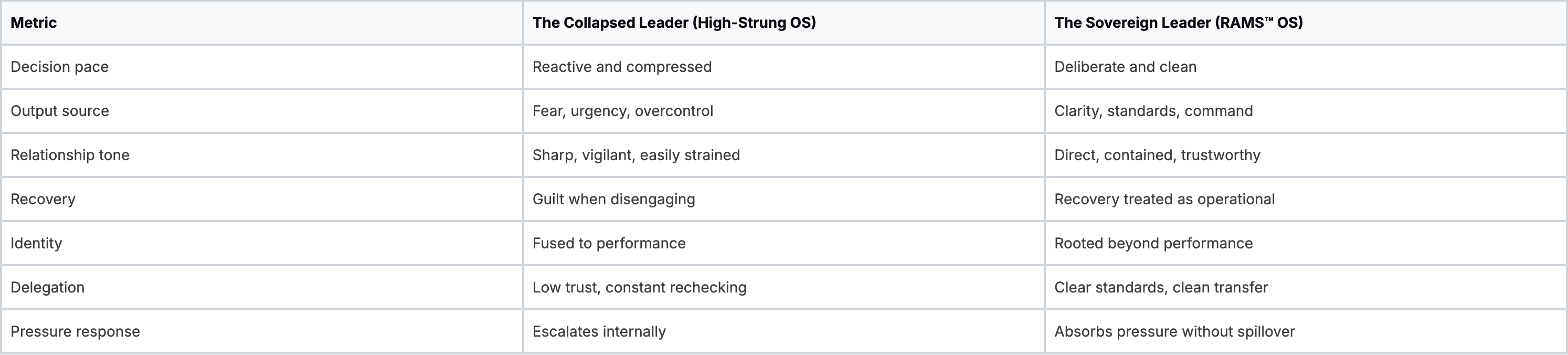
Leadership Operating System Collapsed vs Sovereign
Results stop being your identity prosthetic
The first correction is brutal. Results are not proof of safety. They’re outcomes.
The high-strung leader uses output as a stabilizer. More done means less felt. More control means less exposure. That works until it doesn’t.
You need to separate performance from self-preservation. If your result metric includes “I can rest once this is handled,” your system is already lying to you. There is always another target. Another revision. Another threat cue.
Use this discipline:
Define the actual result.
Strip out ego-preservation tasks.
Identify where urgency is performative, not necessary.
Stop using completion to negotiate inner worth.
That shift sounds simple. It isn’t. High performers often defend overwork because it kept them relevant. But relevance purchased through strain is unstable.
Operational rule: If the task is carrying your identity, the task is already contaminated.
A founder I worked with had strong revenue, clean market authority, and a private compulsion to recheck every key deliverable. Nobody questioned the results. Everyone felt the tension. The work issue wasn’t quality. It was identity dependence. Once that dependence was exposed, the workload became manageable because the false stakes were removed.
Attitude is your internal command system
Attitude in RAMS Framework™ isn’t positive thinking. It’s the governing narrative beneath your behavior.
The high-strung script usually encompasses such thoughts: “If I don’t hold the line, standards fall.” “If I step back, people disappoint me.” “If I’m not tense, I’ll become weak.”
Those beliefs create constant mobilization. They also feel intelligent because they were reinforced by past success.
You have to challenge them like a field commander reviewing a compromised map. Ask three questions:
Is this belief current?
Many beliefs were formed in environments that rewarded hypervigilance.Is this belief accurate?
Urgency often masks distrust, not necessity.Is this belief expensive?
If it costs sleep, patience, and relational safety, it isn’t wisdom.
A high-strung personality often confuses tension with seriousness. That confusion is lethal. Serious leaders don’t need internal chaos to execute.
If you need a practical entry point for this internal shift, start with how to reset your mindset. But don’t treat mindset as decoration. It’s command infrastructure.
Mastery means command under pressure
Most leaders are skilled. Few are sovereign.
Skill means you can perform a task. Mastery means you can stay regulated while performing it. That difference decides whether pressure sharpens you or dismantles you.
In the verified data, the Mastery pillar is tied to cognitive restructuring and biofeedback aimed at reducing irritability and perceived urgency. That matters because a high-strung executive doesn’t just need insight. They need retraining.
Mastery includes:
State recognition
Know the bodily signatures of activation before behavior deteriorates.Interrupt discipline
Stop sending the message, making the call, or correcting the team from a loaded state.Pressure containment
Learn to hold intensity without exporting it into every room.
Many leaders resist, preferring tactical fixes. They want a script, a planner, or a better protocol. Those matter, but they fail if the operator remains dysregulated.
Skill gets results. Mastery keeps the operator intact.
The high-strung personality usually has competence in excess and self-command in deficit. That’s why the outer machine keeps moving while the inner system frays.
Systems protect capacity before pressure hits
Systems are the architecture of return. Not productivity tricks. Protective design.
A regulated leader does not rely on willpower for everything. They reduce avoidable load. They create standards others can follow. They narrow decision clutter. They build structures that preserve executive function under pressure.
A few essential points:
Decision lanes
Not every issue deserves executive cognition. Create hard boundaries on what reaches you.Communication rules
If every message can become urgent, your team is training your nervous system into reactivity.Review cadence
Stop random checking. Inspect on schedule. Lead by standard, not compulsion.Recovery architecture
If rest depends on guilt negotiations, rest never occurs cleanly.
Systems expose a hard truth. What you call “being high-strung” is often unsupported complexity plus unchallenged control addiction.
The return doesn’t come from becoming softer. It comes from becoming harder to destabilize.
Take the next logical step. Take the Silent Collapse Diagnostic.
The Return to Nervous System Sovereignty
Sovereign Leadership™ is not calm for its own sake. It’s stable command.
You still handle pressure. You still make hard calls. You still carry weight. The difference is that your body no longer treats every demand like a threat to survival. You stop bleeding energy into imagined emergencies.

A regulated system feels unfamiliar at first. Less noise. Less inner rehearsal. Fewer compulsive checks. More clean attention. More authority with less force.
That state isn’t indulgence. It’s operational superiority. Even broader clinical resources, like Cedar Hill Behavioral Health's guide, reinforce the basic truth that stress management changes how people function. My standard is stricter. You’re not aiming for relief. You’re aiming for command.
If you’re ready for that shift, study the mechanics of nervous system regulation. Then make a decision. Keep feeding the high-strung system, or replace it.
Frequently Asked Questions
Is being high-strung the same as being driven
No. Drive can be clean. High-strung behavior is drive contaminated by chronic tension, threat scanning, and control dependency. One builds authority. The other drains it.
Can a high-strung personality help someone succeed
Yes. It often fuels precision, urgency, and visible reliability. That’s why people defend it. The cost appears later in relationships, recovery, and emotional stability.
How do I know if this is Silent Collapse™ and not ordinary stress
Ordinary stress passes. Silent Collapse™ becomes your baseline. You stay productive while feeling internally braced, emotionally thin, and unable to disengage without guilt.
Is a high-strung personality a permanent trait
No. The pattern can be strongly conditioned, but it isn’t fate. Traits have expression. Systems can be rebuilt. That’s the difference between resignation and design.
What’s the first thing to change
Stop romanticizing your tension. If your body is always loaded, your leadership system is compromised. Name the pattern. Then rebuild the architecture behind it.
Baz Porter is a leadership architect for high-achieving executives and founders facing Silent Collapse™ beneath visible success. British military veteran. Two-time international bestselling author. Founder, The Prestige Architect™. Host, Rise From The Ashes podcast, C-Suite Network. Boulder, Colorado. If you’re done performing strength while your internal system degrades, Apply to Work With Baz. You can also continue your reading inside the Sovereign Leadership Resource Hub.