Ditching Burnout: How to Reset Your Mindset for Good
That relentless drive that got you here? It’s the same one that’s now quietly dismantling you from the inside out. You’re the engine that never stops, the one holding it all together. But the success that once fueled you now feels hollow, creating a quiet disconnection from the very life you’ve worked so hard to build.
This is the beginning of the silent collapse. It’s not a single event; it's a slow erosion of energy, a creeping exhaustion that no amount of sleep can fix. The internal dialogue insists, “If I stop performing, I’ll disappear.” This isn’t a failure of ambition; it’s a biological tipping point. Acknowledging this is the first, most critical step in learning how to reset your mindset.
Key Takeaways
The Silent Collapse: High-achievers often mistake the symptoms of burnout (decision fatigue, emotional numbness, chronic irritability) for the “cost of success,” leading to a dangerous cycle of depletion.
The Autopilot Brain: Chronic stress hijacks your brain, over-activating the amygdala (threat detector) and shutting down the prefrontal cortex (rational thought). This makes a mindset reset a biological challenge, not just a mental one.
The RAMS™ Framework: A true reset requires a four-part system: Redefining Results, shifting your Attitude from control to trust, gaining Mastery over your nervous system, and building sustainable Systems.
Sovereignty as the Goal: The ultimate aim isn't just to feel better but to reclaim nervous-system sovereignty—the ability to consciously govern your internal state and lead from a place of authentic power, not anxious control.
The Silent Collapse Most High-Achievers Ignore
Resetting your mindset isn't about slapping on a layer of positive thinking. It’s about getting under the hood and rewiring your nervous system's entire response to stress. This work involves carving out new neural pathways through consistent, intentional practices that pull you out of a reactive, fight-or-flight existence and into one of conscious choice and sovereignty.
You're the engine that never stops. You push through deadlines and shoulder responsibilities while the rest of the world sleeps. But lately, the returns on that relentless effort feel… off.

It doesn't arrive with a bang. It shows up in subtle, insidious ways that are easy to dismiss as just the "cost of success."
The Real Symptoms Hiding in Plain Sight
You might not even recognize these feelings as burnout. Instead, you've accepted them as the new, unwelcome price of admission for playing at a high level. It's a dangerous normalization of depletion.
Decision Fatigue: Making even simple choices feels monumental. Your brain, once sharp and decisive, is now so overwhelmed by the constant demand for judgment that you find yourself paralyzed by the smallest decisions.
A Disconnected Feeling: You hit a major goal, close a huge deal, or receive incredible praise, yet you feel… nothing. The pride and satisfaction you expected are replaced by a flat, empty sensation, as if you're watching someone else’s highlight reel.
Chronic Low-Level Irritability: Small inconveniences trigger disproportionate frustration. Your patience is worn tissue-paper thin, and you find yourself snapping at colleagues or loved ones, which only fuels a vicious cycle of guilt and more stress.
This experience is profoundly isolating. Your trusted strategies pushing harder, sleeping less, ignoring your body’s signals, have stopped working. In fact, they’ve become the very source of the problem.
Many high-achievers balancing immense professional and personal loads, experience this unique and draining form of depletion. Understanding the specific pressures of working mother burnout can shed more light on these interconnected challenges.
The Neuroscience Behind A Mindset Stuck On Autopilot
That feeling of being stuck on a hamster wheel, constantly reacting and on edge? It isn't some personal failing or a lack of willpower. It's a completely predictable neurobiological response to chronic stress. Your brain's ancient survival wiring has essentially hijacked its more evolved, rational side. You're living in a state of high alert, and your biology is calling the shots.
Just "thinking positive" is like bringing a paper shield to a gunfight; a genuine reset means retraining your entire nervous system from the ground up.

The Over-Functioning Amygdala: Your Brain's Alarm System
Think of your amygdala as your brain’s hyper-vigilant smoke detector. It’s designed for one job: to keep you safe by spotting threats fast. When you’re a high-achiever juggling immense pressure, this system gets a serious workout.
Every looming deadline, every critical email, every high-stakes presentation gets flagged as a threat. The problem? Your amygdala can't tell the difference between a saber-toothed tiger and a performance review. It just sounds the alarm, unleashing a flood of stress hormones like cortisol and adrenaline.
In short bursts, this is a brilliant survival mechanism. But when it's happening day after day, your smoke detector basically gets stuck in the "on" position.
This is the core of a stuck mindset: your nervous system becomes conditioned to exist in a state of survival, not creation or strategy. Your body is physically bracing for impact, even when you're just sitting at your desk.
The Hijacked Prefrontal Cortex
When your amygdala is screaming "DANGER!", it effectively hijacks the resources that should be going to your prefrontal cortex (PFC). The PFC is your brain's CEO, the part responsible for rational thought, long-term planning, and emotional regulation.
Under chronic stress, blood flow and neural activity are literally diverted away from the PFC toward the more primitive, reactive parts of the brain. This biological resource shift has very real consequences:
Rigid Thinking: Your ability to see nuance or consider alternatives plummets. Your brain defaults to what it knows is safe.
Emotional Reactivity: Without the PFC's calming influence, your emotional responses become completely disproportionate. A minor setback feels like a catastrophe.
Impaired Decision-Making: You start relying on short-term fixes and gut reactions instead of deliberate, strategic choices.
This neurological state creates a vicious cycle. The more you operate from a place of reactivity, the stronger those neural pathways become. That feeling of being on autopilot is literal, your brain is running old survival programs because it lacks the energy for anything new. Learning how to recover from burnout is the active process of reversing this hijack.
Reclaiming Your Brain's Resources
The only way to reset your mindset is to start disrupting these automatic patterns. The first step is often developing self-awareness as a tool for change to even notice these patterns are running.
The link between our physical habits and our mental states is undeniable. According to research published in the Journal of Affective Disorders, adults sleeping less than 6 hours a night have up to 2.0 times higher odds of elevated psychological distress. Similarly, a meta-analysis in The Lancet Psychiatry found that insufficient physical activity is associated with a 20–30% higher prevalence of depressive symptoms. The data is clear: your body is a key entry point to rewiring your brain.
Introducing The RAMS™ Method For A Full System Reset
Knowing the science behind why you’re stuck is one thing. It's proof you’re not broken. But awareness alone doesn't flip the switch. You can't just "think positive" your way out of burnout, especially not when you're a high-achiever with everything on the line.
This is where the RAMS™ Method comes in.
This isn’t another flimsy set of mindset hacks. It’s a ground-up rebuild. We're talking about rewiring your nervous system and completely redefining your relationship with success, control, and yourself. The method is the bridge from knowing what’s wrong to embodying the solution.
Think of each component as a pillar. If you neglect one, the whole structure gets wobbly. But when you build them together, you create a rock-solid foundation for a new way of leading and living.
R Is For Results Redefined
The first pillar takes a hard look at the very definition of success that drove you into the ground. For most high-achievers, "results" are all about external validation: hitting revenue targets, landing the promotion, getting industry awards. This chase for outside approval is a massive source of chronic stress.
Redefining Results is about shifting your focus from the outcomes you can't fully control to the inputs you absolutely can. It's about detaching your self-worth from the scoreboard and tying it back to the integrity of your effort.
This isn’t about lowering your standards. It's about raising them to include your own well-being in the equation.
A key insight of the RAMS™ method is this: True success is measured by sustainability, not just intensity. Can you maintain your energy, health, and sense of self while pursuing ambitious goals? That becomes the new metric.
A Is For Attitude From Control To Trust
Right now, your attitude is likely one of hyper-vigilance. You're trying to manage every last detail, anticipate every possible risk, and force outcomes through sheer will. This constant state of trying to micromanage the universe is neurologically exhausting. It keeps your brain's alarm system, the amygdala, on high alert 24/7.
The shift in Attitude is from a clenched fist of control to an open palm of trust. It means trusting your team. Trusting the process. And most critically, trusting yourself to handle whatever comes your way without orchestrating every variable.
This frees up an incredible amount of mental and emotional energy. This is what sovereign leadership feels like.
M Is For Mastery Of Your Nervous System
This is the most hands-on pillar of the method. Mastery here isn't about dominating your industry; it’s about gaining sovereignty over your own internal state. You cannot think your way out of a physiological stress response. You have to learn to regulate it from the body up.
Mastery involves tangible, physical practices that send safety signals to your nervous system. These are neurobiological tools.
Breathwork: Simple, structured breathing exercises can instantly shift you from the sympathetic (fight-or-flight) state to the parasympathetic (rest-and-digest) one.
Somatic Awareness: You'll learn to notice the quiet whispers of stress in your body—a clenched jaw, shallow breath, a tight chest, long before they escalate into a reactive storm.
Strategic Disconnection: Deliberately scheduling short, non-stimulating breaks into your day allows your nervous system to down-regulate and recover.
These tools give you a manual override for your brain's stuck alarm system.
S Is For Systems For Sustainability
Finally, willpower alone isn't going to cut it. You need to build Systems that support your new mindset and stop you from sliding back into old patterns. A system is any structure, routine, or boundary that automates the behavior you want, so you're not constantly draining your finite willpower.
These systems are the guardrails that protect your energy and focus. They are the architecture of a burnout-proof life.
Boundary Systems: Non-negotiable rules for your time, like "no-meeting Fridays" or a hard stop at 6 PM every day.
Delegation Systems: A clear process for identifying what can and should be handed off, freeing you to focus on your unique genius.
Recovery Systems: Proactively scheduling rest into your calendar with the same importance as a board meeting.
These systems aren't about restriction; they're about creating the conditions for freedom and sustained high performance. You can find a deeper dive into these components in our guide on the RAMS Method as a revolutionary leadership framework.
Integrating Results, Attitude, Mastery, and Systems gives you a complete, holistic approach for resetting your mindset. It’s a full system reboot, designed for the leader who is ready to perform at the highest level—without paying the ultimate price.
To really see the change in action, it helps to compare the old way of thinking with the new framework. This table breaks down the mental shift required to move from a state of burnout to one of sovereign leadership.
Shifting From A Fixed Mindset To A RAMS™ Mindset

This table isn't just a summary; it's a diagnostic tool. As you look at the "Trap" column, notice which statements resonate the most. That's your starting point. The "Reset" column isn't a destination you arrive at overnight, but a new direction you commit to, one day at a time.
Your 66-Day Action Plan To Embody Real Change
Knowing is not the same as doing. All the mindset theory in the world is just noise until you put it into practice and feel the shift in your own body. The RAMS™ Method isn't about collecting interesting ideas; it's about fundamentally rewiring your daily experience from the inside out.
This is a process of strategic replacement swapping out the draining, autopilot habits for intentional practices that actually restore your energy and solidify this new way of operating.
Why 66 Days Is The Magic Number For A Mindset Reset
You’re not just changing your mind; you're carving new neural pathways. That takes consistent, repeated effort. A landmark study from the European Journal of Social Psychology found that the median time to form a new automatic habit is 66 days. Think about that. For about two months, you're laying the tracks before the new behavior starts feeling like second nature.
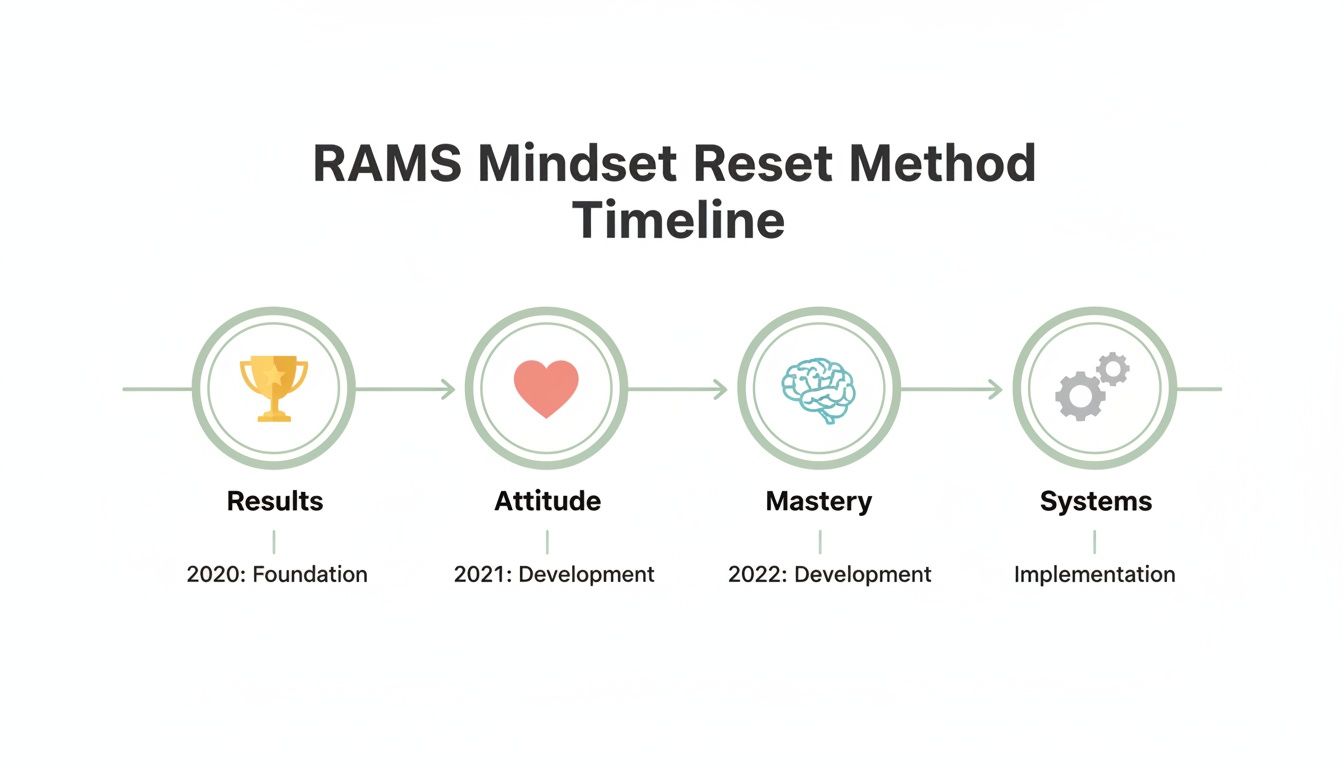
The timeline below maps out how each phase of RAMS™ builds on the last, creating a compounding effect that leads to a full system reset.
Your Integration Plan: Daily, Weekly, and Monthly Rhythms
This plan is built for integration, not overwhelm. The goal is consistency over intensity. Start by picking just one or two practices from each category.
Daily Practices (The Non-Negotiables)
These are small, 5-15 minute actions that ground you in the RAMS™ principles every single day.
Morning Nervous System Check-In (Mastery): Before your phone gets its hands on you, take 3 minutes. Close your eyes, place a hand on your chest, and just notice your internal state. Is your breathing shallow? Is your jaw clenched? This simple act of noticing is the first step toward self-regulation.
Define Your One 'Result' (Results): Ditch the sprawling to-do list. Instead, identify the single most important input you will own today. This isn't "close the deal," it's "make the three critical calls." It immediately reframes success as something you directly control.
End-of-Day 'Trust' Acknowledgment (Attitude): Before you shut down your computer, write down one thing you chose to trust today. Maybe you trusted a team member to handle a task without micromanaging, or you trusted yourself to navigate a tough conversation.
Weekly Practices (The Strategic Review)
These actions require a bit more time and are all about reviewing and course-correcting your week.
The RAMS™ Review (All Pillars): Block 30 minutes in your calendar on Friday afternoon. No exceptions. Ask yourself:
Results: Did my actions this week align with my redefined metrics of success?
Attitude: Where did I default to control? Where did I practice trust?
Mastery: When did I feel most regulated? When was I most reactive?
Systems: Did my systems support me, or was I running on willpower?
System Audit (Systems): Pinpoint one friction point from the past week where a system would have saved your sanity. Was it scheduling chaos? A recurring task you could automate or delegate? Design a simple system to solve it.
Monthly Practices (The Deep Dive)
This is where you zoom out for bigger-picture reflection and integration.
Sovereignty Assessment (All Pillars): Review your journal or notes from the past month. On a scale of 1-10, how sovereign did you feel? That is, how much did you feel you were in conscious control of your internal state? What patterns emerge?
Boundary Reinforcement (Systems): Look at your calendar for the coming month. Where are your boundaries already looking weak? Proactively block out "white space" or "thinking time" to protect your energy before the month even begins.
For leaders whose action plan includes a physical component, learning how to reframe your mindset when starting a fitness journey can be an incredibly powerful way to embody this change.
Case Study: A Client's Path From Burnout To Integration
Let’s make this real. Sarah, a COO at a fast-growing tech firm, came to me in a state of classic silent collapse. She was celebrated for "getting things done," but behind closed doors, she was exhausted, irritable, and felt completely disconnected from her own success.
Her 66-day plan focused on a few key, high-leverage practices:
Her Daily Practice: A 5-minute box breathing exercise (Mastery) every single day before her first meeting to calm her amygdala.
Her Weekly Practice: A mandatory 30-minute review of her "trust ledger" (Attitude), where she tracked every task she successfully delegated without interfering.
Her Monthly Practice: Redefining her team's KPIs to include wellness metrics (Results & Systems), shifting the entire culture from "hustle at all costs" to sustainable performance.
Around day 40, something clicked. Sarah realized she hadn’t felt that familiar Sunday night dread in weeks. By day 66, her team was reporting higher engagement, and she was leaving the office at 5:30 PM feeling energized, not drained.
She hadn't lowered her standards; she had simply created the conditions for her to meet them without self-destructing. That is the power of a concrete plan.
Returning To Sovereignty: The Real Goal Of A Mindset Reset
We’ve dismantled the old programming and laid out a new blueprint with the RAMS™ Method. But now I want you to zoom out and look at the big picture.
Learning how to reset your mindset was never just about being more productive or feeling less stressed. Those are just the positive side effects of a much deeper shift.
The real endgame here is reclaiming your nervous-system sovereignty.
This is the ultimate return path. It’s about coming back home to yourself after years of operating from a place of external expectation, relentless pressure, and that deep-seated belief that your worth is tied to what you produce.
Sovereignty is your ability to consciously choose your response, to govern your internal state regardless of the chaos spinning around you. It’s leading from a place of authentic power, not anxious control.
The Real Shifts To Expect
This path redefines the very fabric of your leadership, and your life. It’s a deliberate move away from the brittle, exhausting patterns of high-achievement burnout and into a more resilient, integrated way of being.
Here are the core shifts that I see happen again and again when leaders commit to this work:
From Reactive to Responsive: You stop being a puppet to your amygdala’s constant alarm bells. Instead of getting triggered by every perceived threat, you learn to pause, regulate your system, and respond with clarity.
From Control to Creation: Think about the immense energy you spend trying to manage every single outcome. We liberate that energy, shifting you from a defensive posture of preventing failure to an offensive one of creating new possibilities.
From Depletion to Vitality: You finally learn that rest isn't a reward; it’s a non-negotiable component of high performance. Your energy becomes a resource you manage strategically, not a debt you’re constantly trying to pay back.
This isn't about becoming a different person. It's about peeling back the layers of conditioning and chronic stress that have been obscuring the powerful, centered leader you already are.
Your pursuit of Leadership Sovereignty Mastery is the most critical work you can undertake. This is your return to yourself. And from that place, your impact becomes truly limitless.
Your Questions About Mindset Resets, Answered
Committing to a full system reset is a big decision. It’s normal for practical questions to pop up as you start using the RAMS™ framework. This isn't about a blind leap of faith; it's about building real, sustainable change. Let’s tackle the most common questions.
How quickly can I actually expect to see changes?
You'll likely feel small but immediate shifts within the first week. Using a Mastery tool like a 3-minute breathing exercise can instantly dial down physiological stress, giving you tangible relief. But the deeper, automatic changes, where your default response becomes calm instead of reactive, that takes time. We're rebuilding neural pathways. Remember the 66-day principle for habit formation? Lasting change comes from consistency, not intensity.
What should I do if I feel resistance to the new habits?
Resistance is not a sign of failure. It's a sign that the work is real. Your brain is wired to love familiar pathways, even if they lead to burnout. When you feel that internal friction, try this:
Get curious, not critical. Ask, "What is this resistance trying to protect me from?"
Make the habit ridiculously small. If a 10-minute meditation feels impossible, do one minute. The goal is to show up.
Acknowledge the discomfort. Simply say to yourself, "This feels hard right now because it's new, and that's okay."
How is the RAMS™ Method different from just "positive thinking"?
This is a crucial distinction. Positive thinking is like slapping a coat of paint over a crumbling wall. It asks you to ignore the very real stress signals your body is sending you.
The core difference is this: Positive thinking tries to change your thoughts. The RAMS™ Method changes your physiological state first, which then makes a new quality of thought possible.
You simply cannot think your way out of a body that's locked in a stress response. By focusing on regulating your nervous system (Mastery) and creating supportive structures (Systems), you create the biological conditions for a genuinely new mindset to emerge and stick.
If you're not sure where your biggest energy drains are, a diagnostic is a powerful first step. Pinpoint your personal starting point with our Burnout Breakthrough Assessment. It's about working with your biology, not fighting against it.
Where to go next
If any of this reads like your own reflection, the Silent Collapse Diagnostic™ is a quiet place to start. And if you want the deeper why beneath the work, read the Sovereign Manifesto.