The Confidence Gap Book: Why It Doesn’t Create Real Leadership
You nailed the project. You shattered the sales record. You earned the seat at the table you fought so hard for. But instead of feeling powerful, you’re ambushed by a quiet, gnawing voice. The one whispering, “You don’t belong here. It was a fluke. When will they find you out?”
That feeling—that silent, internal collapse after a huge win—isn't a personal failing. It’s a documented phenomenon, a symptom of a deeper problem that reading The Confidence Gap book alone will not solve. You're trying to fix a nervous system problem with an intellectual solution, and it’s a battle you will keep losing.
Key Takeaways
The Hidden Science: The confidence gap is not just in your head; it’s rooted in biology (hormones like testosterone vs. estrogen) and decades of societal conditioning that hardwires women for caution and men for action.
Competence vs. Confidence: Your stacked resume and track record of success will never be enough to create genuine confidence. The article explains why piling on more qualifications is a trap that keeps you stuck.
The RAMS Reframe: True confidence isn't about 'faking it.' It's built from the inside out using a practical framework (Results, Attitude, Mastery, Systems) that regulates your nervous system and redefines success on your own terms.
The Return to Self: The ultimate goal is not to perform confidence but to achieve nervous-system sovereignty—an unshakeable internal state that makes authentic leadership your default, not a daily struggle.
The Definitive Answer: Does Reading The Confidence Gap Book Build Confidence?
Reading The Confidence Gap book is an excellent first step for diagnosing why you feel a disconnect between your competence and your self-belief. However, the book primarily explains the problem; it does not provide a sufficient framework for building the deep, embodied confidence required for sustained leadership. True confidence is not built through intellectual understanding but through nervous system regulation and consistent, courageous action.
Understanding The Hidden Science Behind Self-Doubt

That feeling of hesitation—the one that stops you from speaking up in a meeting or going for a promotion—isn't random. It’s not a personal failure. It’s the predictable result of biology and conditioning, acting like an invisible anchor that keeps even the most driven women tethered to caution while their male counterparts often sail right ahead.
To break free, you first have to understand the anchor's weight. This isn't a battle of willpower; it’s a matter of wiring. The science reveals fundamental differences in how male and female brains are primed for risk, action, and social connection. When you amplify those differences with a lifetime of societal expectations, you get the exact confidence gap we're fighting to close.
The Biological Blueprint for Caution
Let's cut straight to the science. At a biological level, hormones are running a script in the background, shaping our default responses to every challenge and opportunity.
Consider that men operate with 10-fold higher levels of testosterone, a hormone that doesn't just build muscle—it fuels ego and drives a higher tolerance for risk. This stands in stark contrast to the effects of estrogen, which promotes bonding and collaborative instincts, often curbing the kind of single-minded assertiveness seen in men. This hormonal landscape naturally primes men for action and women for contemplation and connection.
This isn't just a theory; it's a globally documented pattern. An enormous eight-year study by Wiebke Bleidorn at UC Davis analyzed 985,000 men and women across 48 countries. The findings were staggering: a universal disparity in self-belief that cuts across every culture. The confidence gap isn't a local issue; it's a global phenomenon with deep biological roots.
This biological predisposition doesn't mean women are incapable of taking risks. It means the neurological path to action is often paved with more internal checkpoints, detailed analysis, and a heightened awareness of potential consequences.
Societal Pressure and The Perfectionism Trap
Biology is just the first layer. Society then comes in and hardens this natural caution into a debilitating cycle of perfectionism and over-thinking. Think about it. From a young age, girls are praised for being meticulous, collaborative, and coloring inside the lines. Boys, on the other hand, are often encouraged to be bold, to try and fail, to just go for it.
This decades-long conditioning carves out entirely different neural pathways:
For Women: It builds a neurological superhighway for self-critique, consensus-building, and the overwhelming need to ensure every single detail is perfect before making a move.
For Men: It creates a more direct, lower-friction pathway from an idea straight to action, with a much higher tolerance for imperfection along the way.
The result? A female leader who feels she must be 120% qualified before she even considers raising her hand, while her male colleague confidently leaps at the same opportunity feeling just 60% ready. This isn't a character flaw; it's a trained response etched into your brain's wiring.
The constant mental gymnastics of over-preparation, second-guessing, and seeking validation are neurologically taxing. They drain the very energy you need for bold, decisive leadership. You can learn more about how to start rewiring these patterns in our guide on self-directed neuroplasticity.
Validating this internal experience is the critical first step. That feeling of being "stuck" is a logical, predictable outcome of your biology meeting your biography. It's real, it's scientific, and most importantly, it can be changed.
Why Competence Is Not the Same as Confidence
You have the degrees. The certifications. The track record of undeniable wins. You’ve built an impeccable resume, a fortress of qualifications. Yet, in the moment that matters—the one where you need to claim your space or seize a game-changing opportunity—you hesitate. A wave of doubt washes over you, and the moment is lost.
This is the frustrating paradox at the heart of The Confidence Gap. It’s a vast and maddening chasm that separates what you can do from what you believe you can do. For so many high-performing women, you are objectively, undeniably qualified, yet you’re haunted by the feeling of being an imposter.
You've been sold a lie. The myth that "one more credential" will finally unlock unshakable self-belief is one of the most damaging traps holding powerful women back. It keeps you in a never-ending cycle of preparation—always learning, but never fully acting.
The Great Underestimation
The research doesn't lie. Study after study, much of it discussed around The Confidence Gap book, points to a glaring disparity. Women consistently underestimate their abilities, while men are far more likely to overestimate theirs. This isn't about arrogance versus humility; it's a deeply conditioned response.
This pattern creates a dangerous feedback loop: women wait to feel 100% ready, holding back until they've checked every box. Meanwhile, men leap at opportunities when they feel just 60% ready. The people who advance are the ones who act, not necessarily the ones who are most competent.
This is a critical insight. Your problem isn't a lack of skill. The real issue is the broken connection between your proven competence and your internal self-concept. You’re trying to fix an emotional, neurological problem with a logical solution—piling on more qualifications—and it will not work. To learn more about projecting the authority you've already earned, explore our guide on developing executive presence.
Competence Focus vs. Confidence Action
This table breaks down the two mindsets. One keeps you stuck in the gap, and the other builds the bridge to get you across it.
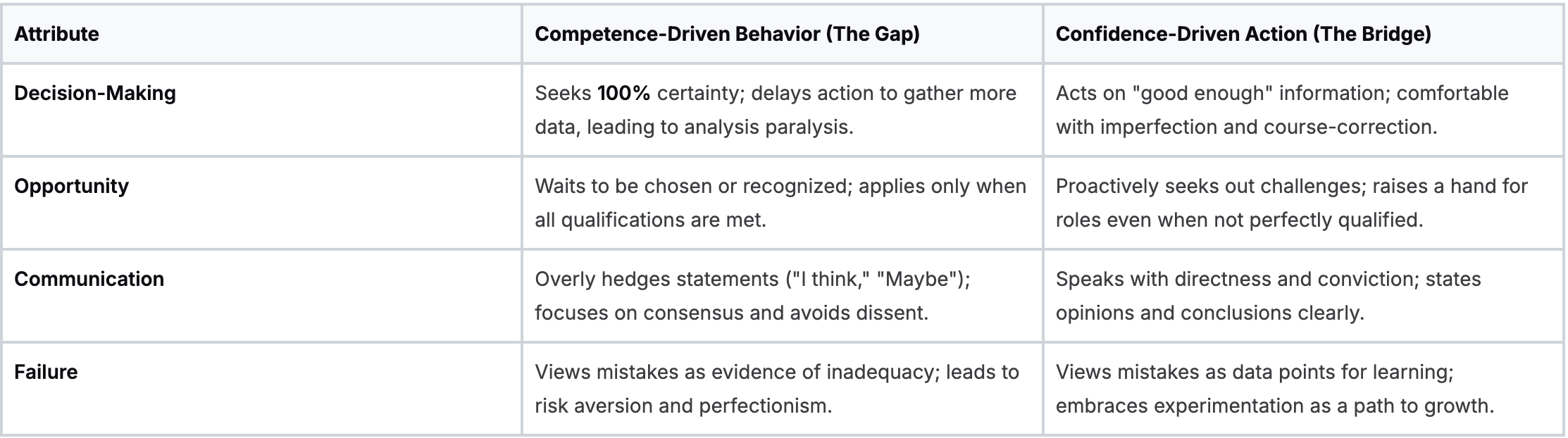
Seeing it laid out this way is often a harsh wake-up-call. The behaviors that feel safe—gathering more data, waiting for permission, avoiding mistakes—are the very things holding you back. Shifting from a competence-driven mindset to one of confident action isn't about faking it; it's about learning to trust the expertise you already possess.
How The Confidence Gap Sabotages Your Career Growth

The concepts in The Confidence Gap aren't just interesting theories; they're the invisible tripwires causing real-world damage to your career. This gap is the silent saboteur that stalls promotions, shrinks your earning potential, and quietly bleeds the energy from even the most brilliant women. It’s the inner critic that whispers for you to play small when you were born to lead.
These individual moments of self-censorship aren't isolated. They weave together into a pattern of missed opportunities that puts a hard ceiling on your career trajectory.
The Financial Toll of Self-Doubt
Let's get brutally honest: the confidence gap has a measurable, and frankly infuriating, impact on your bank account. That hesitation is a direct throughline to the gender pay gap that stubbornly persists.
The research is damning. One statistic that jumps off the page is that men initiate salary negotiations four times more often than women. But it gets worse. When women do negotiate, they ask for 30% less money than their male counterparts. This has nothing to do with competence. As UC Berkeley psychologist Cameron Anderson proved, confidence matters as much as competence, a truth that gets written into payroll checks every single month.
The Direct Path from Hesitation to Burnout
Beyond the money, the confidence gap wages a war of attrition on your most vital resource: your energy. It creates a straight line from self-doubt directly to burnout. That constant, nagging feeling that you have to over-prepare—that you must work twice as hard and know twice as much just to justify your position—is utterly exhausting.
This isn't a sustainable way to operate. It’s a survival mechanism, not a success strategy.
The Over-Preparation Trap: You pour hours into mastering every last detail, leaving zero room for error, while male colleagues move forward with confidence and 80% of the information.
Decision Paralysis: The sheer mental load of second-guessing every move drains the cognitive fuel you need for high-level, strategic thinking.
The Stress of the Imposter: Living with the chronic stress of feeling like a fraud is a heavy tax on your nervous system, leading to real physical and emotional exhaustion.
This isn’t just "working hard." It’s a vicious cycle born from a lack of innate confidence, and it’s the fastest way to extinguish your leadership fire.
Recognizing these patterns is the first step toward dismantling them. Getting support from a career coach can help you navigate your career path with confidence and break the cycle. Once you see the machine, you can learn how to advance your career based on your actual capabilities, not the limitations your self-doubt has created.
Building Authentic Confidence with The RAMS Framework
Knowing you have a confidence gap is one thing. Actually closing it is another. Reading a book like The Confidence Gap won't magically solve the problem. Real, unshakable confidence isn't about 'faking it'; it’s about building a new internal foundation where self-belief becomes your default state.
This is where we shift from diagnosis to action. The RAMS Framework—Results, Attitude, Mastery, and Systems—is the blueprint for constructing genuine confidence from the inside out. It's the bridge across the chasm between what you know you can do and what you feel you can do.
Redefining Your Relationship with Results
The first pillar, Results, isn't about piling on more achievements. It's a radical shift—redefining success based on internal metrics you control. The focus moves from, "What did they think of my presentation?" to, "Did I show up with courage and integrity?"
When you measure success by your own courageous actions—speaking up, taking a calculated risk, holding a boundary—you create a new feedback loop. This loop builds self-trust, regardless of external outcomes.
This is the destructive cycle that hesitation—a classic symptom of the confidence gap—creates.

As you can see, one moment of self-doubt can trigger a devastating cascade, leading from missed opportunities right into total burnout. The RAMS framework is engineered to break this cycle at its source.
Governing Your Attitude Through Nervous System Regulation
In the RAMS model, Attitude isn't about positive affirmations. It’s about learning to regulate your nervous system to manage self-doubt. True confidence isn't the absence of fear; it's the ability to act right alongside it.
This involves tangible, physical practices that pull your body out of a "threat" state (fight, flight, or freeze) and into a state of grounded presence. You can’t think your way out of a physiological fear response. You have to regulate it.
Owning Your Mastery Beyond Credentials
The third pillar is Mastery. It’s not about collecting more certifications. It's about deeply and unapologetically owning your unique genius—that specific cocktail of skills, experiences, and perspectives that only you bring to the table.
Instead of asking, "Am I qualified enough?" the question becomes, "What is my unique contribution here?" This shifts your focus from proving you belong to understanding what you are uniquely positioned to deliver.
Mastery isn’t knowing everything. It’s having profound clarity on your core strengths and operating from that zone with complete conviction.
Creating Systems to Reduce Anxiety
Finally, Systems are the scaffolding that supports confident action. They are the repeatable structures that cut down on decision fatigue and ambient anxiety. When you have reliable systems for your work, health, and recovery, you free up immense mental bandwidth.
For a leader, this might look like:
A system for ruthlessly delegating low-impact tasks.
A non-negotiable weekly block for strategic, deep work.
A structured morning routine to ground your nervous system.
Systems automate discipline. They make confident action the path of least resistance. To see exactly how this works, you can explore our full breakdown of the RAMS Method and its revolutionary approach to leadership.
The table below contrasts the theoretical advice you might get from The Confidence Gap book with the practical, embodied approach of the RAMS framework.
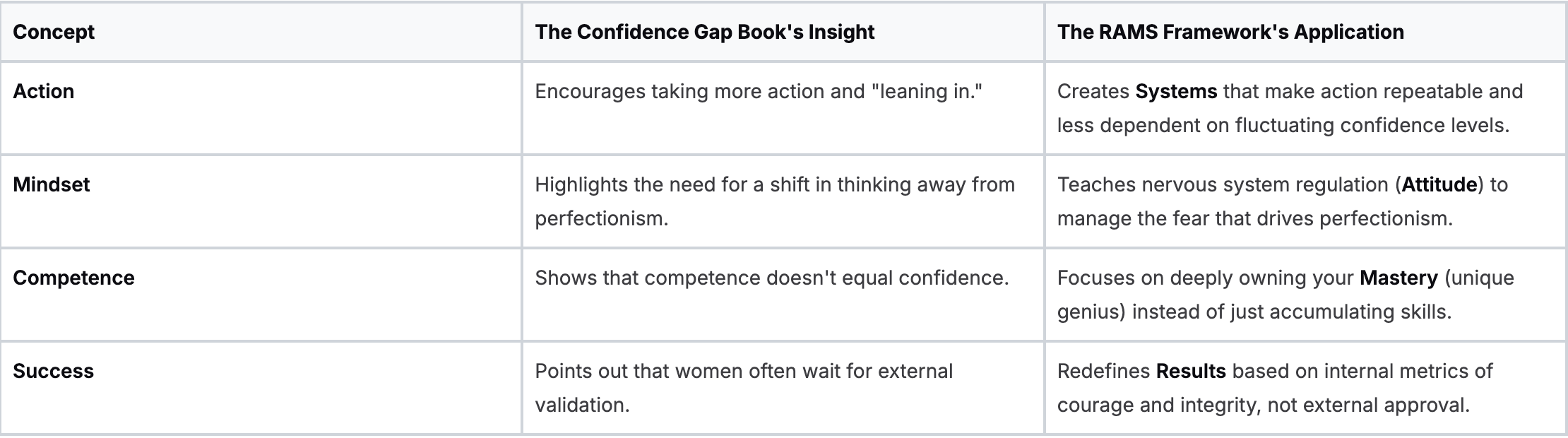
Ultimately, building this kind of authentic self-assurance is a holistic process. A vital piece of this journey is learning how to build real confidence and strengthen your social skills in every interaction. The RAMS framework provides the structure to turn these powerful insights into a lived reality, helping you construct a foundation of self-trust that is unshakable because you built it yourself.
Leading from a Place of Authentic Self-Trust
Moving from simply *knowing* about *The Confidence Gap* to actually closing it for good demands more than intellectual understanding. It’s a powerful, non-negotiable return to *yourself*. The goal was never to perform a louder, more convincing imitation of confidence. It’s to cultivate **nervous-system sovereignty**—that quiet, unshakeable internal knowing that only comes from deep alignment and unwavering self-trust.
This is the final, most crucial reframe. Real confidence isn’t an external performance; it’s an internal state of being.
It’s the calm that washes over you when you finally stop looking for outside validation and start operating from your core. It's the unshakable foundation you build when you apply a framework like Baz Porter’s RAMS Method, which systematically pulls your focus from the noise of outward approval to the power of your inner authority.
This is the path that takes you beyond the book’s diagnosis and into a sustainable, daily leadership practice. You stop battling the symptoms of the confidence gap and start embodying the solution.
Your return to self is not a one-time event but a continuous practice of choosing authentic power over performative strength. It's the most critical investment a leader can make.
This is the very essence of embodied leadership. It's about taking back your energy, trusting your gut instincts, and leading from a place of grounded, centered presence. The next step isn't just another business decision; it’s a profound investment in your Return to Self.
Frequently Asked Questions About The Confidence Gap
Once you start digging into the reality of The Confidence Gap, a lot of questions naturally come up. It's a concept that can feel both deeply personal and frustratingly universal.
Let's cut through the noise and tackle some of the big ones head-on.
Is The Confidence Gap A Real Phenomenon?
It’s not just real—it’s a global, measurable reality. This isn’t about feelings or a simple lack of self-esteem. The confidence gap is a well-documented pattern, confirmed by decades of research.
The work by Katty Kay and Claire Shipman was a breakthrough, but the evidence goes even further. A massive, eight-year study covering nearly one million people across 48 countries proved this isn't some Western cultural quirk. It's a universal issue.
This gap shows up as a consistent disparity where high-performing women, despite having equal or even superior skills, systematically report lower self-confidence than their male counterparts. It’s the product of deep societal conditioning and even biological wiring, creating a tangible deficit in self-belief that directly sabotages careers and leadership potential.
How Is This Different From Just Leaning In?
"Leaning in" was a great starting point, but it put the cart before the horse. It’s all about taking external actions—demanding the seat at the table, speaking up, acting more assertive. While those actions are necessary, the advice often falls flat because it completely ignores the internal battle that makes those actions feel terrifying or fake.
This is where building a robust internal framework like RAMS comes in. It goes so much deeper. It’s about learning to regulate your nervous system so you can actually handle the intense fear and self-doubt that surge when you do try to lean in.
We focus on creating a foundation of internal stability and self-trust first. When you have that, confident external actions become the natural result of who you are, not some exhausting performance you have to put on every day.
Can Confidence Be Learned Or Is It A Personality Trait?
This is probably the most critical distinction to grasp, and the research in The Confidence Gap makes it crystal clear. Confidence is absolutely not a fixed personality trait you’re either born with or you’re not. It is a skill that can be systematically developed.
Confidence is built through action, risk-taking, and resilience in the face of failure. It grows from the evidence of your own courage, not from an innate sense of certainty.
Think of it like a muscle. You don't get strong by thinking about lifting weights; you get strong by lifting them, failing, and lifting again. Confidence works the same way. It requires specific, repeatable practices—managing your internal state, shifting your mindset, and taking one small, courageous action after another.
Ready to stop just reading about the gap and start building the bridge to real, authentic leadership? At Baz Porter, we give you the exact framework to turn this knowledge into your lived reality.
Take the first step and discover your leadership archetype today.