Rewire Your Brain: A Guide to Self-Directed Neuroplasticity
You’ve built an empire. You are the architect of your own success, a high-achieving leader who has meticulously crafted a career others envy. From the outside, you have it all: the title, the influence, the financial freedom. But inside, a silent collapse is underway. The internal monologue is a brutal, relentless loop: “I built all of this, but I’m completely hollowed out. How much longer can I keep this up before it all shatters?” This isn’t the fear of failure. It's the crushing, isolating weight of your own success.
Key Insights
Your Brain Isn't Fixed: You possess the innate ability to consciously reshape your brain's physical structure and function through focused attention and practice. This is the core of self-directed neuroplasticity.
Burnout is Neurological, Not a Moral Failing: Chronic stress rewires your brain for hypervigilance, degrading performance and well-being. This is a predictable biological response, not a personal weakness.
The RAMS Method is a Practical Blueprint: Lasting change requires a systematic approach. The Results, Attitude, Mastery, and Systems (RAMS) framework provides a repeatable structure for turning neuroscience into tangible leadership outcomes.
Nervous System Sovereignty is the Goal: The ultimate aim is not just to reduce stress but to reclaim command over your internal state, allowing you to lead with grounded presence and strategic calm, regardless of external pressure.
The Hidden Cost of High Achievement

The external trophies of success often mask a deep internal bankruptcy. You’re running on fumes, bone-deep tired, and haunted by a creeping sense of disconnection—from your team, your family, and the person you used to be. The constant, grinding pressure is quietly rewiring your entire nervous system for a permanent state of high-alert, making genuine rest, creativity, or joy feel physically impossible.
Self-directed neuroplasticity is the discipline of intentionally using your thoughts, focus, and actions to physically change the structure and function of your brain. It moves you from being a passive recipient of stress-induced neural patterns to becoming the active architect of your own cognitive and emotional resilience.
The Unsustainable Price of Peak Performance
This state of being is a silent epidemic among the most accomplished leaders I work with. The very perfectionism and relentless drive that got you to the top now form the bars of your own cage. Every victory feels hollow, instantly erased by the pressure of the next impossible target.
Emotional Flatlining: Your emotional range has narrowed to a persistent, gray numbness. You don’t feel the soaring highs of a win or the sting of a loss—just a dull, heavy exhaustion.
Cognitive Fog: Your decision-making, once your sharpest weapon, now feels like wading through mud. Your mind, once a steel trap, now struggles to grasp focus.
Physical Depletion: Chronic fatigue, mysterious aches, and a compromised immune system have become your new normal. Your body is keeping a score you’re trying desperately to ignore.
The most dangerous place for a leader isn’t failure. It's succeeding in a way that hollows you out, a victory that costs you your vitality, your presence, and your connection to what actually matters.
Beyond the 'Hustle Harder' Mantra
Let's be direct. The conventional advice to "hustle harder" or book a spa day is insulting. You mastered the hustle; it's what built your empire. And a weekend getaway isn't going to fix neural patterns grooved into your brain over years of over-performance.
The problem isn't your work ethic. The problem is that your entire operating system has been programmed for a battle that is costing you the war for your own well-being. If this feels familiar, you can read more about the hidden cost of success and the pervasive feeling of being "never enough."
This burnout cycle is not a personal failing. It’s a biological, predictable response to a leadership model that demands endless output without any system for real recovery. The way out isn't by doing more, but by fundamentally rewiring the very foundation of how you operate. It’s time to stop managing the symptoms and start the real work of reclaiming your internal command through self-directed neuroplasticity.
You Can Intentionally Rewire Your Brain
That internal state of being utterly spent—of being frayed, “on” 24/7, and disconnected from your own life—is not a life sentence. It’s not some fixed, unchangeable part of your identity as a leader.
It is the direct result of neural grooves carved into your brain over years of high-stakes, high-pressure performance. These pathways were often formed unconsciously. The empowering truth is, what was built can be rebuilt. The most powerful concept in modern neuroscience is that your brain isn't static hardware. You have the innate capacity to consciously reshape its physical structure and function. This is the essence of self-directed neuroplasticity.
Think of it as the ultimate act of leadership: taking the helm of your own cognitive and emotional landscape. You stop being a passenger in your own mind and become the executive director of your brain's operating system.
From Default Mode to Deliberate Design
For most high-achievers, the brain operates in a default, reactive state. This is the brain hardwired for survival, constantly scanning for threats, and prioritizing short-term wins over your long-term vitality. It's the root cause of burnout.
Self-directed neuroplasticity offers the pathway to a deliberately designed brain—one wired for embodied presence, strategic calm, and authentic power. It’s the shift from simply reacting to the world to actively creating your world from the inside out. Of course, the first step is often admitting why you might resist change in the first place. But once you do, you unlock the power of focused intention.
Your thoughts, feelings, and behaviors are not just fleeting experiences; they are the chisels that sculpt the architecture of your brain. Every repeated pattern of thought or action either strengthens an old, unhelpful neural pathway or forges a new, more effective one.
This isn’t just a motivational platitude; it's a biological reality. A 2025 study in the Journal of Integrative Neuroscience showed just how powerfully effortful attention triggers real, measurable changes.
Researchers found that just 8-12 weeks of daily 20-minute sessions focusing on sustained mental effort led to a 15-20% boost in prefrontal cortex activation—the part of your brain directly linked to better decision-making under fire. This process specifically helps break the task-specific rigidity that plagues 68% of female C-suite executives who report chronic fatigue. You can explore the full research on how attention boosts prefrontal cortex activation to see the science for yourself.
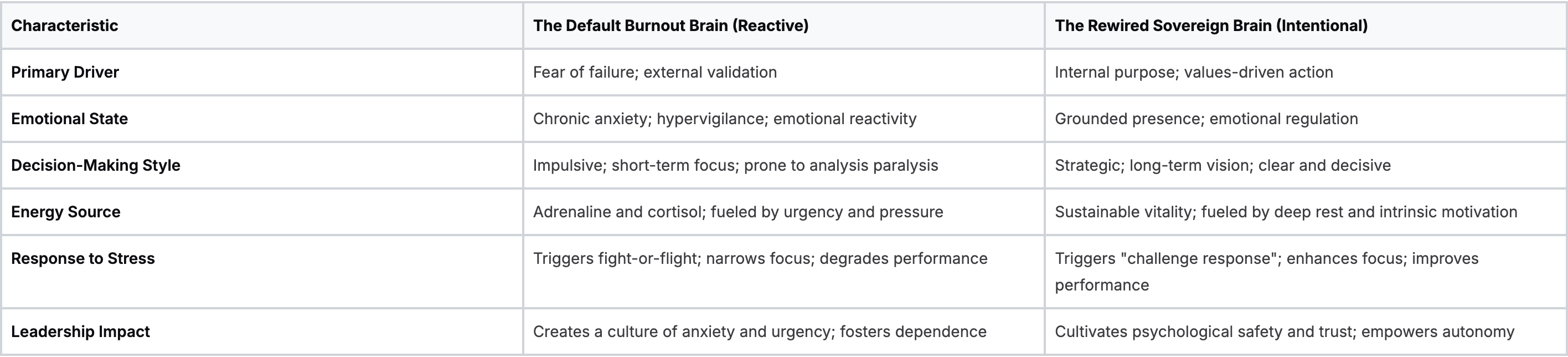
To truly grasp the power of this shift, let’s compare the default brain wiring of a high-achiever on the verge of burnout with the intentionally rewired brain of a sovereign leader. The difference isn't about raw capability; it's about the underlying operating system that runs the show.
This isn’t about judging where you are now. It’s about creating a map. It shows you your current location and, more importantly, it illuminates the powerful new destination you have the ability to reach.
Understanding The Science of Brain Change
If you want to intentionally change your brain, you have to know the rules of the game. Self-directed neuroplasticity isn't a wellness trend; it’s a hardwired biological process. Once you understand how it works, you stop being a passenger in your own mind and become the architect of your reality.
The foundational rule is surprisingly simple. It was first proposed by neuropsychologist Donald Hebb in 1949 and is now a cornerstone of modern neuroscience.
Hebb's Law: Neurons that fire together, wire together.
Every time you repeat a thought, a feeling, or an action, you’re strengthening the connection between the brain cells responsible for it. Think of it this way: a single thought is like walking across a grassy field once, leaving only a faint trace. But repeat that same thought thousands of times? That's like driving a truck over the same path, carving deep, permanent ruts that become your brain's default highway.
This is exactly why your habits—both good and bad—feel so automatic. It’s not about willpower; it’s pure neurology. Your brain is a ruthlessly efficient machine that will always take the path of least resistance, which is always the most well-traveled neural road.
Attention Is Your Scalpel
If your brain is a massive network of pathways, then your focused attention is the surgical scalpel you use to reshape it. Where you place your attention literally determines which neurons fire. By consciously and repeatedly directing your focus, you get to choose which circuits to reinforce and which ones to let wither away from disuse.
Consider the difference between key brain regions when you’re operating in a high-stress leadership role:
The Prefrontal Cortex (PFC): This is your brain’s CEO. It handles strategic planning, emotional regulation, and impulse control. But under chronic stress, blood flow is literally rerouted away from the PFC.
The Amygdala: This is your brain’s alarm system, firing up the fight-or-flight response. When you’re constantly stressed, the amygdala becomes overactive and hypersensitive, trapping you in a feedback loop of anxiety and reactivity.
Self-directed neuroplasticity is the practice of using focused attention to deliberately calm the amygdala and bring your PFC back online. This isn't just a mental trick; it’s the physical act of redirecting your brain's resources. To dig deeper into the specific mechanisms behind this, you can explore the scientific basis of affirmations.
The Biology of Building a Better Brain
Forging new neural pathways is a biological process supported by a critical protein called Brain-Derived Neurotrophic Factor (BDNF). You can think of BDNF as "Miracle-Gro" for your brain cells. It helps existing neurons survive while encouraging the growth and development of new ones.
When you engage in focused learning, new experiences, or even intense physical exercise, you trigger a release of BDNF. This is your brain’s natural fertilizer, nourishing the new connections you’re trying to build and making the rewiring process faster and more durable.
But chronic stress is the enemy of BDNF. It actively degrades the very substance your brain needs to grow and repair itself. An integrative review in Neuropsychopharmacology found that chronic stress can slash BDNF expression by up to 30% in the hippocampus and PFC. But here's the good news: the research also showed that targeted interventions restored synapse formation in 75% of models, and self-directed techniques cut rumination—a massive energy drain for high-performers—by 35%.
This science confirms a vital truth: you are not broken. Your brain is simply adapting to its environment. By changing your internal focus and external habits, you can reverse the damage and actively cultivate a brain built for resilience and sovereign leadership. To do this right, you first have to understand your current nervous system architecture.
The RAMS Method: Your Blueprint for Brain Rewiring
Knowing the science of self-directed neuroplasticity is one thing. Actually using it to change your life is another beast entirely. The gap between intellectual understanding and real-world results is where most leaders get stuck. They read the books and listen to the podcasts, but they lack a repeatable method to make it happen amidst the chaos of their daily lives.
This is the exact reason I built the RAMS Method. It’s not just theory; it’s a systematic, actionable framework designed to turn the science of neuroplasticity into tangible outcomes. It’s the bridge that moves you from simply knowing about your brain to actively taking the controls. The RAMS Method is built on four interdependent pillars: Results, Attitude, Mastery, and Systems. If you neglect one, the whole structure collapses.
Pillar 1: Results (The Target)
First, Results. This is about defining your “why” with surgical precision. Think of your brain as a hyper-efficient resource manager. If you don't give it a clear, compelling, and emotionally charged target, it has no idea where to point its energy. Vague goals like “I want to be less stressed” are neurologically useless.
A powerful Result sounds like this: “I will remain calm, centered, and strategic during high-stakes board meetings, even when challenged, so I can lead my team with presence and clarity.” This specific destination gives your brain a concrete blueprint to start wiring toward.
Your brain cannot build a neural pathway to a destination you haven’t defined. Clarity isn't a preference; it's a neurological prerequisite for change.
Pillar 2: Attitude (The Fuel)
The Attitude pillar is about creating the internal state that allows neuroplasticity to happen. You cannot rewire your brain from a place of self-criticism, frustration, or impatience. Those emotions flood your system with cortisol, a hormone that actively blocks the growth of new neural connections. The right attitude for brain change is one of curiosity, self-compassion, and gritty persistence. It’s about seeing setbacks not as failures, but as valuable data. This shift from judgment to curiosity is a non-negotiable part of self-directed neuroplasticity.
Pillar 3: Mastery (The Skills)
Mastery is the "how-to" of neuroplasticity. This is where you get your hands dirty with the specific, repeatable practices that physically forge new neural circuits. It’s where you put Hebb's Law—"neurons that fire together, wire together"—into deliberate, conscious action. These are micro-practices you weave into the fabric of your day.
Mindful Transitioning: Taking 60 seconds for a breathwork reset between back-to-back meetings to clear your nervous system.
Somatic Awareness: Briefly checking in with the physical sensations in your body during a tense email exchange to interrupt a reactive pattern.
Intentional Focus Blocks: Practicing single-tasking for 25 minutes straight to strengthen the prefrontal cortex's grip on your attention.

It’s a simple but powerful sequence. Your deliberate attention is the scalpel, consistent practice is the work, and the BDNF that gets released is the biological superglue that makes the change stick.
Pillar 4: Systems (The Scaffolding)
Finally, the Systems pillar. This is all about engineering your external environment and daily routines to support your new neural wiring. Your brain is a product of its environment. Trying to change your internal world while your external world is constantly screaming at you to stay the same is a losing battle. Systems are the guardrails you install to make your desired changes the path of least resistance.
Environmental Design: Turning off all phone notifications during deep work blocks to stop triggering your amygdala.
Social Scaffolding: Intentionally connecting with a community of peers who are also committed to this kind of intentional growth.
Accountability Structures: Working with a coach to provide the pressure and support needed to stick with your Mastery practices.
When your systems are dialed in, your new brain wiring becomes the default, not the exception. You can see a complete breakdown of how these pillars lock together in our deep dive on the RAMS Method, a leadership framework for executives.
RAMS Method: Practical Application for Brain Rewiring
To pull this all together, the table below shows how each part of the RAMS Method translates into a direct, practical action for rewiring your brain. This isn't abstract theory; this is your starting roadmap.
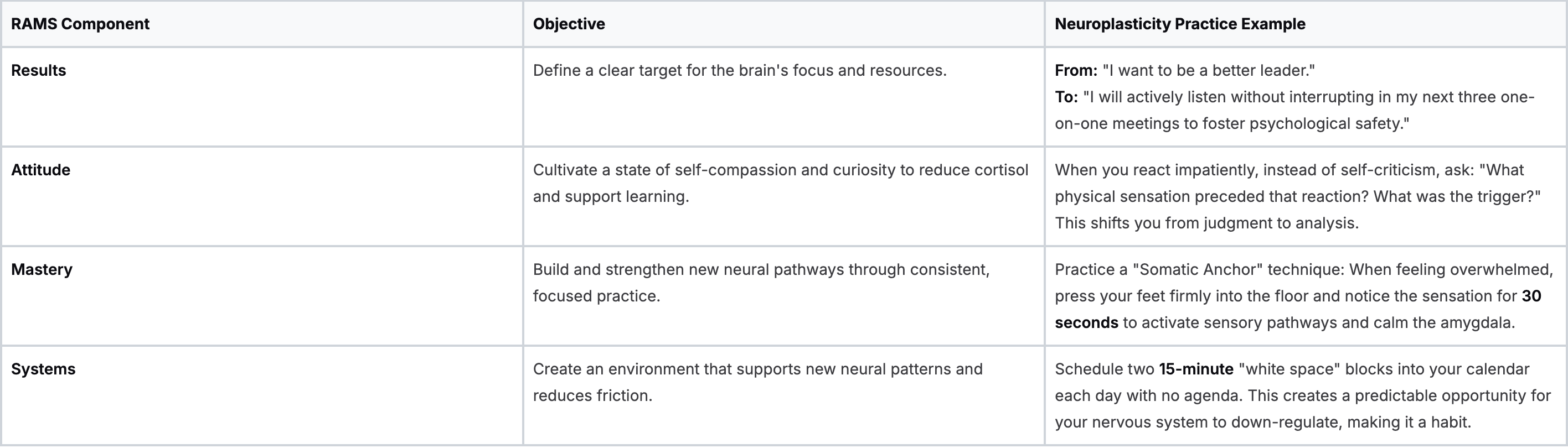
The RAMS Method delivers the structure required to break free from a reactive, burnout-driven existence and step into a life of intentional, sovereign leadership.
Real-World Applications for Executive Leaders

Theory is useless until it’s battle-tested in the unforgiving world of executive leadership. Inside the RAMS ecosystem, we don't just talk about rewiring the brain; we see leaders use these tools to completely overhaul their impact.
I worked with a tech founder, a brilliant woman whose company was scaling at lightning speed. The problem? Her internal monologue was a vicious imposter syndrome loop: “If I’m not perfect, it’s all over.” Every win felt like a lucky break. She didn’t just "think positive." Instead, using the RAMS Method, she began the intentional work of rewiring. She deployed specific Mastery practices to short-circuit the physiological panic that hijacked her in meetings and built Systems to train her nervous system for calm.
The result? Within three months, she wasn’t just surviving her board meetings; she was leading them from a place of grounded, authentic power. She had physically rewired her brain to associate high-pressure situations with calm authority, not existential dread.
Sharpening Decision-Making Under Pressure
Another client, a CEO in portfolio management, had a reactive pattern that was costing her firm millions. When challenged in high-stakes negotiations, she would either concede too quickly or become overly aggressive—a textbook amygdala hijack.
Her work was all about rewiring that reactive loop. Through targeted attention-training practices, she learned how to create a micro-second pause between a trigger and her response. That tiny gap was everything. It was just enough time for her prefrontal cortex to stay online, giving her access to strategy instead of a primal fight-or-flight reaction.
This is the essence of nervous system sovereignty: the ability to consciously choose your response, regardless of the external pressure. It is the ultimate competitive advantage in leadership.
Accelerating Burnout Recovery
Hard science confirms what we see in the field. One recent study showed that targeted cognitive training could reconfigure brain networks for 12-15% efficiency gains. This isn't a "nice-to-have." For women in tech, who already face a 40% higher burnout risk, these interventions are critical for survival.
By deliberately optimizing neural pathways, leaders can slash the recovery time from chronic stress. If you feel like you're running on fumes, you’ll find actionable strategies in this blueprint to end executive burnout. The research further shows intensive training can profoundly reorganize brain function—dive into the details of the neuroscience study to see the proof for yourself. These stories are the predictable outcomes of applying self-directed neuroplasticity with a proven method.
Reclaiming Your Nervous System Sovereignty
We’ve covered the science, the frameworks, and the real-world applications of self-directed neuroplasticity. But let's be clear: this isn't about collecting interesting facts or mastering a new mental trick. This is about a fundamental return to yourself.
This is the final frontier of leadership—moving beyond managing external empires to claiming absolute ownership of your internal world. It’s a conscious decision to stop being a product of your circumstances and start architecting the internal state that creates your reality. This is nervous system sovereignty.
From Reaction to Reclamation
For years, maybe decades, your nervous system has been shaped by the punishing demands of high achievement. It learned to run on high alert, trading vitality for productivity. This was a survival strategy that got you here.
But now, you face a choice. You can continue down that path of depletion, or you can begin the work of reclamation. Self-directed neuroplasticity is the tool for this work. It is the process of deliberately choosing which neural pathways to reinforce and which to finally let go of.
This journey isn't about 'fixing' a flaw. It's about 'returning' to your most authentic and powerful self—the leader who operates from a place of grounded presence, not anxious urgency.
Your Path Back to You
This process starts with a brutally honest look at where you are right now. You can't chart a course to a new destination without knowing your precise starting point. What are the specific neural patterns holding you captive in a cycle of burnout and disconnection?
This is why the only logical next step is assessment. It's about creating a clear, unvarnished map of your current nervous system architecture. This isn't just data; it's the blueprint for your reclamation. You can learn more about this foundational concept and what it means to lead from a place of embodied sovereignty in our guide.
Once you have that map, the deliberate work of rewiring can begin. You can start building the neural foundation for a new kind of leadership—one that is sustainable, authentic, and profoundly powerful.
This is your invitation to stop managing your exhaustion and start architecting your sovereignty. Take the first step by diagnosing your unique neural patterns. Then, let's have a conversation about building your path back to the leader you were always meant to be.
A Few Questions You Might Be Asking
As you start to explore the world of self-directed neuroplasticity, it's natural for some practical questions to come up. Let's tackle a few of the most common ones I hear from leaders.
How Long Until I See Results?
While rewiring your brain is a long-term commitment, you can feel subtle shifts very quickly. Many leaders I work with report a new sense of calm or sharper awareness within the first few weeks of consistent practice. But creating deep, lasting structural change—the kind that truly sticks—takes time. Research consistently points to 8-12 weeks of dedicated, daily practice as the tipping point where measurable changes in brain activity and structure become evident.
Can This Practice Help With Severe Burnout?
Absolutely. Self-directed neuroplasticity is a foundational tool for building the neural resilience needed to not only recover from burnout but also prevent it from recurring. It gets to the root of the issue by training your nervous system to step out of that chronic state of high alert. However, it is crucial to understand that this is a supportive practice—it's not a replacement for professional medical treatment. If you are experiencing severe burnout, this method should be part of a larger strategy in conjunction with guidance from a qualified healthcare provider.
Is This Just Positive Thinking?
No. This is a common misconception. Positive thinking is a passive wish for things to be different. Self-directed neuroplasticity is an active, intentional process that demands specific, targeted behaviors. It’s not about ignoring challenges. It’s about using scientifically validated practices to physically alter your brain’s structure and function in response to those challenges. The changes aren't just in your mindset—they are biological and measurable.
Ready to move beyond theory and begin the real work of rewiring your leadership? The journey with Baz Porter starts with a single, decisive step.
Book a call today to begin your path to sovereign leadership.