How Developing Executive Presence Stops You From Being Overlooked
You’ve done everything right. You’ve hit every target, mastered every technical skill, and delivered flawless work, time and time again. Yet when the promotion list is posted, your name isn’t on it. You’re left wondering, what am I missing? The internal monologue starts: "If I just present more data, they'll see my value. If I just work harder, they'll have to notice." This is the silent collapse—the moment you realize your brilliant contributions are failing to translate into perceived leadership potential.
Key Takeaways
Presence is an Embodied State: True executive presence isn't a performance. It's an internal state of grounded composure broadcast directly from your nervous system, not a mask you wear.
Competence Isn't Enough: Hard work alone will keep you stuck as a high-performer. Presence is the missing link that translates your competence into perceived influence and strategic value.
It's a Skill, Not a Gift: Over 98% of leaders actively develop their presence. It's a trainable skill built on rewiring your internal state, not an innate personality trait.
The RAMS Method is a Practical Framework: You can systematically build presence by focusing on Impact-driven Results, a regulated Attitude, communicated Mastery, and sustainable Systems.
The Hidden Pattern: Why Your Hard Work Is Being Overlooked
You spend hours preparing for every meeting, ensuring every detail is perfect. You’ve anticipated every question and have the data to back it all up. But when you speak, it feels like your voice just disappears into the room. Decision-makers nod politely, but you can see their attention drifting to someone who commands the space with an authority that seems to come naturally. This cycle of over-performing to prove your worth is a painful, common reality. It's like being a world-class engine in a car with no transmission—all that power is generated, but none of it ever reaches the wheels.
Developing executive presence is about building that transmission. It's the tangible quality that communicates your credibility, confidence, and composure before you even open your meticulously prepared slide deck, ensuring your hard work doesn't just get done—it gets seen, valued, and respected.

The Science Behind Your Leadership Signal
Your ability to project true presence is tied directly to your autonomic nervous system. When you feel a threat—a high-stakes board meeting, a skeptical client, your own inner critic—your body kicks into a stress response. Cortisol floods your system, tightening your throat, making your breathing shallow, and putting your brain into survival mode. You're cut off from the parts you need for strategic thinking and connection.
Developing executive presence is the practice of rewiring this exact response. It's about consciously shifting from a state of chronic stress to one of calm, grounded power. This is how you learn to lead from a place of internal stability, not a desperate need for external validation.
This internal shift is the only foundation for genuine influence. It gets to the heart of the conflict so many high-achieving leaders I work with face: trying to project confidence on the outside while fighting a hurricane of inadequacy on the inside. This feeling of being constantly overlooked often connects to deeper patterns, like imposter syndrome. In fact, many high-performers grapple with this, and we've explored how to overcome imposter syndrome at work in another guide.
The Three Pillars of Embodied Presence
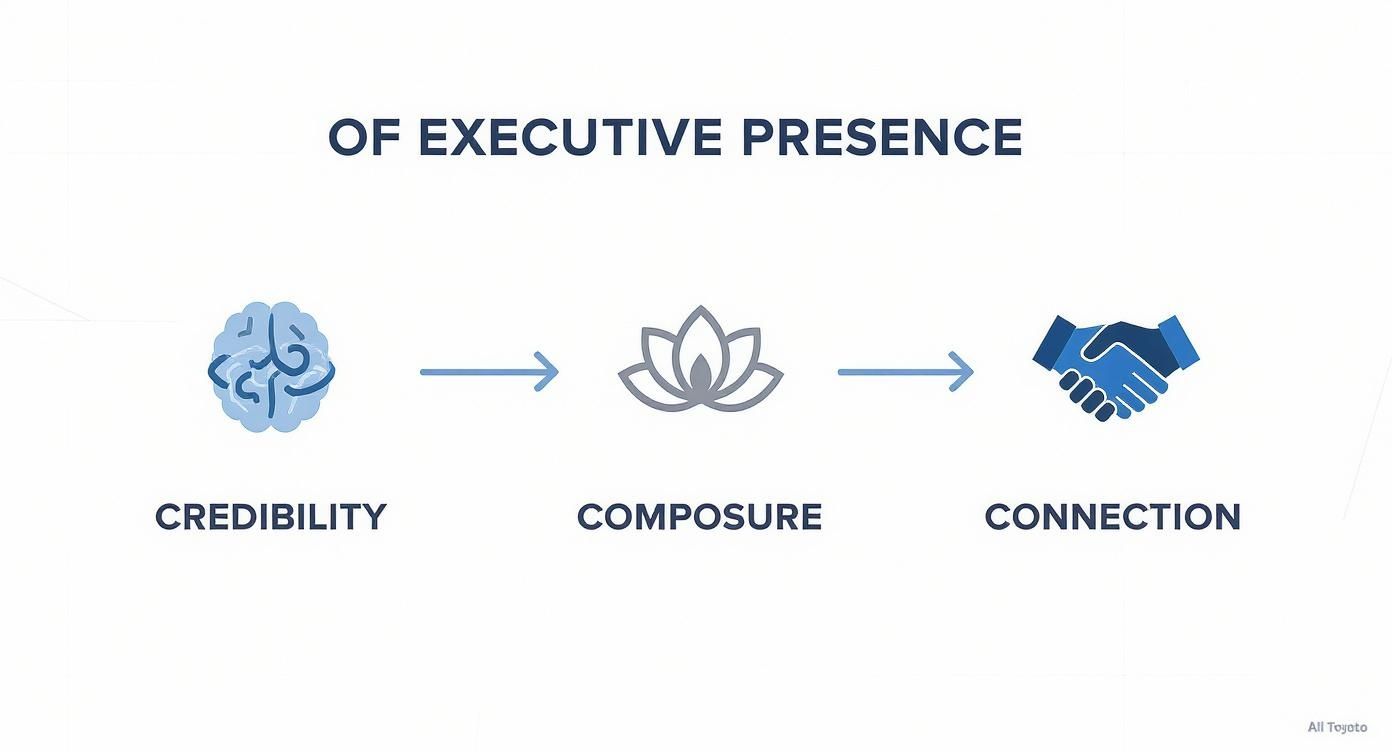
To make this practical, we can break executive presence down into three core pillars. It’s critical we move beyond superficial definitions and get to what these pillars actually mean from an embodied, nervous-system-aware perspective.
PillarConventional Definition (The Myth)Embodied Reality (The RAMS Approach)
Gravitas Being serious, formal, and having "weight." Often misinterpreted as being unapproachable or overly stern. An internal state of grounded composure. It's the ability to remain centered and regulated under pressure, communicating stability to those around you.
Communication Speaking perfectly, using big words, and having a powerful presentation voice. Focuses solely on delivery and polish.
Authentic connection through regulated expression. It's about listening deeply, speaking from your core, and aligning your words with your non-verbal cues.
Appearance Wearing the right suit or having the perfect haircut. It’s an external checklist focused on conforming to a corporate ideal.
Congruence and self-respect. It’s about presenting yourself in a way that feels aligned with your identity and signals that you take yourself and your role seriously.
Understanding this distinction is everything. One path leads to performance and inevitable burnout. The other leads to sustainable, real leadership. You can learn more about how this connects to a deeper sense of self by exploring our guide on what is authentic leadership.
Executive presence is often mistaken for an innate quality, but it's a skill you can learn. For a deeper look at what this takes, it's worth understanding how to develop executive presence to elevate leadership. The most powerful truth is that presence isn’t reserved for a select few. Research confirms that 98% of leaders must actively develop executive presence; they simply weren't born with it. That statistic should feel liberating—it reframes presence from some elusive gift into a skill that can be built.
A Practical Framework for Building Presence: The RAMS Reframe
The path to developing real executive presence isn't about faking confidence. It's about fundamentally rewiring your internal state to project the authority you’ve already earned. This calls for a practical, repeatable system—one that gets you out of theory and into daily, embodied practice.
This is where the RAMS Method comes in. It’s a framework for building leadership from the inside out, tackling the core elements that forge an undeniable presence.
Results: Defining Your Impact, Not Your Activity
First, we shift how you define "Results." For most high-achievers, results are a glorified to-do list: projects done, reports sent, targets hit. But that perspective keeps you stuck as a doer, not a leader.
True executive presence is born from defining your results by their impact. Instead of saying, "I launched the marketing campaign," a leader with presence says, "I drove a 15% increase in market share by capturing a new customer segment." See the difference? The focus shifts from the activity to the outcome. This reframe is critical. It changes how you talk about your work in performance reviews and board meetings. You start communicating strategic value, not just operational efficiency.
Attitude: Cultivating Emotional Regulation
Your Attitude is the foundation of your presence. It’s your ability to stay composed on the inside when everything is chaotic on the outside. This isn't about bottling up emotions; it’s about regulating them so you can respond with intention instead of reacting from stress. A powerful leader cultivates a mindset of radical ownership. When a project goes south, an embodied leader asks, "What was my part in this, and what system can we build to ensure it doesn't happen again?" That kind of attitude demonstrates stability and accountability. It signals you are a grounding force, not another source of chaos.
Mastery: Communicating Your Expertise with Gravitas
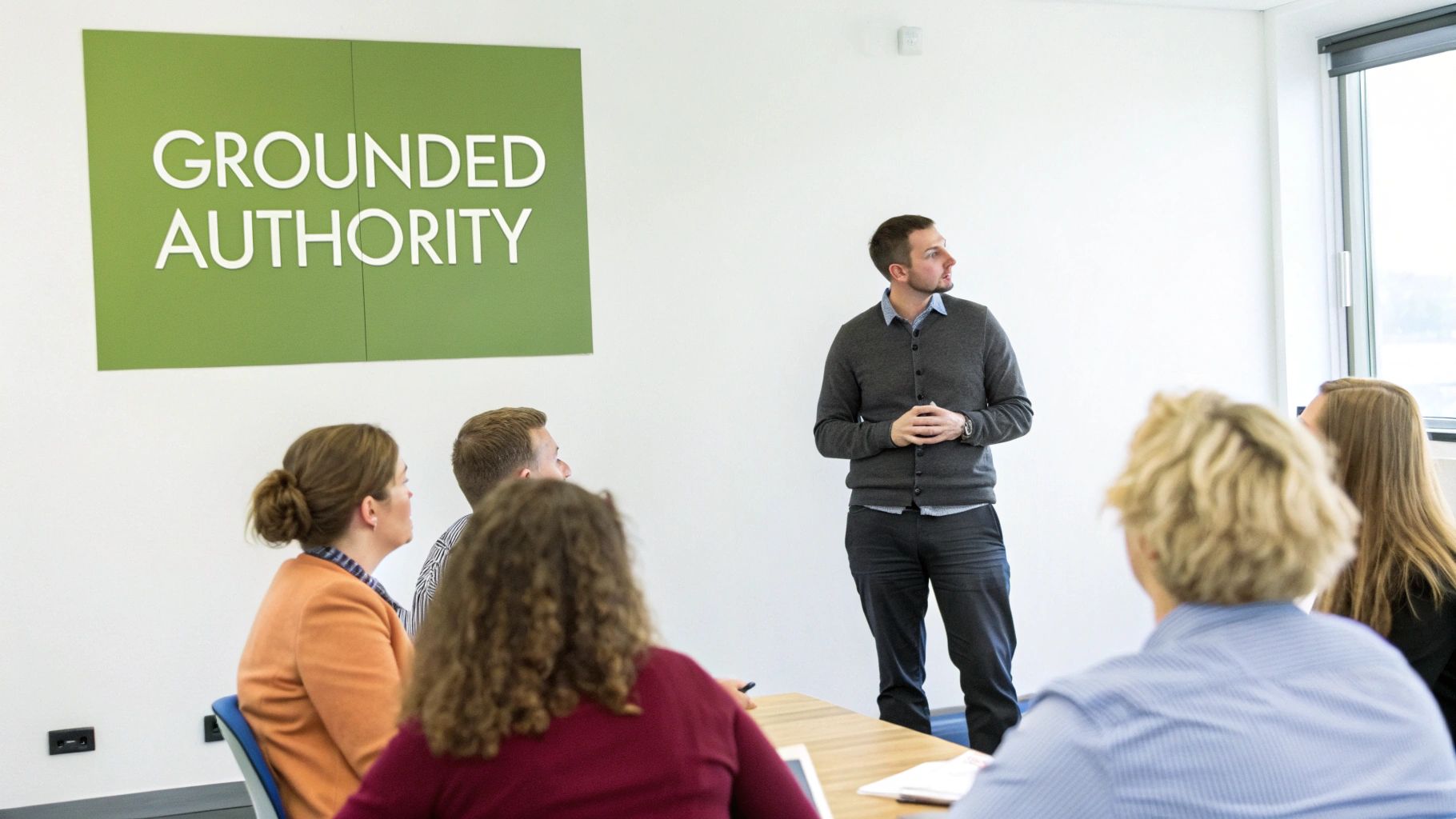
You are already an expert in your field. Mastery, in the context of presence, is about closing the gap between your deep knowledge and your ability to communicate it with gravitas. It’s about making sure your expertise lands with influence.
This comes down to practical skills, like mastering your vocal tonality. I once worked with a director who, despite being brilliant, struggled to hold the board's attention. We put daily vocal resonance drills into her routine. Within weeks, her voice carried a new weight. Her ideas, once easily glossed over, were now met with genuine consideration. She didn't change what she was saying—but by changing how she said it, she rebuilt her perceived authority. A huge piece of this is also learning how to become a thought leader and grow your influence, which is vital for any leader's visibility.
Systems: Creating Structures for Sustainable Presence
Finally, we have Systems. These are the structures you build to support your presence and—crucially—prevent the burnout that will destroy it. Presence that relies on sheer willpower is not sustainable.
Think about a VP who was notorious for micromanaging her team—a classic symptom of an overwhelmed nervous system. We helped her implement better operational systems: clearer project charters, automated check-ins, and well-defined roles. She created space. Suddenly, she no longer needed to control every detail because the system itself provided stability. Her presence shifted from anxious and controlling to trusting and strengthening. This is what effective systems do: they regulate the environment so you can regulate yourself.
These four pillars—Results, Attitude, Mastery, and Systems—are all deeply interconnected. Your attitude affects how you communicate your mastery, and strong systems give you the breathing room to focus on impactful results.
The business impact here is significant. Organizations with solid leadership programs see a 25% jump in business performance and are 2.3 times more likely to hit their financial goals. Putting this work off has real costs. Each part of the RAMS framework is a practical, actionable step toward embodied leadership. If you want to go deeper on this, check out our detailed guide explaining the RAMS Method and its revolutionary approach to leadership.
Mastering the Non-Verbal Language of Leadership
Your strategic brilliance can get completely lost if your body is sending the wrong signals. Long before you say a word, your posture, gaze, and how you carry yourself have already told a story about your authority. Mastering this non-verbal language isn’t about faking it. It's about deep alignment—making sure your physical self reflects the power you hold inside.
Finding Your Command Voice
Your voice is a powerful instrument of influence. A voice that gets high-pitched under pressure or sounds rushed can instantly sabotage your message. Developing a command voice means learning to speak from your core.
Try this simple exercise:
Breathe from your diaphragm. Place a hand on your stomach. Breathe in deeply through your nose, feeling your hand rise. Exhale slowly.
Find your natural pitch. On your next exhale, make a low, humming "Mmm" sound. Notice the vibration in your chest. That resonance is your grounded, natural pitch.
Play with your pace. Record yourself reading a paragraph aloud. Listen back. Now, record it again, consciously pausing at commas and taking a full breath at the end of each sentence. Intentional pacing adds weight to your words.
Your vocal tone says more about your internal state than your words ever will. A calm, resonant voice signals a regulated nervous system, which inherently builds trust.
Adopting a Grounded Posture
Your posture is the most immediate broadcast of your presence. Slumped shoulders or a tense stance can scream anxiety. A grounded posture communicates stability and confidence. This isn’t about a "power stance." It’s about a centered, relaxed alignment.
Think of your body in three key points:
Feet: Stand with your feet hip-width apart. Feel your weight distributed evenly. This physical grounding helps regulate your nervous system.
Spine: Imagine a string gently pulling the crown of your head toward the ceiling. Let your shoulders relax down and back.
Core: Gently engage your core muscles. This creates a stable center and prevents nervous fidgeting.
This stance says you are present, stable, and ready. If you want to dive deeper into projecting this kind of self-assurance, we have a complete guide that can help you lead with confidence.
Wielding an Intentional Gaze
Eye contact is a potent tool. Averting your gaze can read as unconfident, while an unbroken stare can feel intimidating. An intentional gaze is about using eye contact to create connection.
In one-on-one conversations, hold eye contact for 4-5 seconds at a time. Then, briefly glance away to a neutral point before re-engaging. This rhythm feels connected, not confrontational. When speaking to a group, resist scanning the room. Instead, connect with one person for a full sentence or thought, then move your gaze to someone else. This makes each person feel seen.
By consciously practicing these skills, you replace unconscious habits with intentional presence.
Shifting from Unconscious Habits to Intentional Presence
Non-Verbal CueLow-Presence Signal (Unconscious Habit)High-Presence Signal (Embodied Practice) Impact on Perception Voice High-pitched, rushed, quiet, upward inflectionResonant, measured pace, grounded, downward inflectionSignals authority, calmness, and certainty PostureSlumped, rigid, fidgeting, closed offAligned, relaxed, grounded, openCommunicates stability, confidence, and approachability GazeAverted, darting, overly intense stareDirect, sustained, warm, inclusiveBuilds trust, connection, and credibility
The Return: Sustaining Your Presence for the Long Haul
This work isn't about mastering a performance. It's the deep, ongoing practice of reclaiming your authentic leadership—one rooted in your own internal stability, not the constant search for external validation. This is how you stop feeling invisible and start becoming an embodied, influential leader for the rest of your career. The goal is to move from doing presence to being present. That's the difference between temporarily commanding a room and permanently embodying your authority.
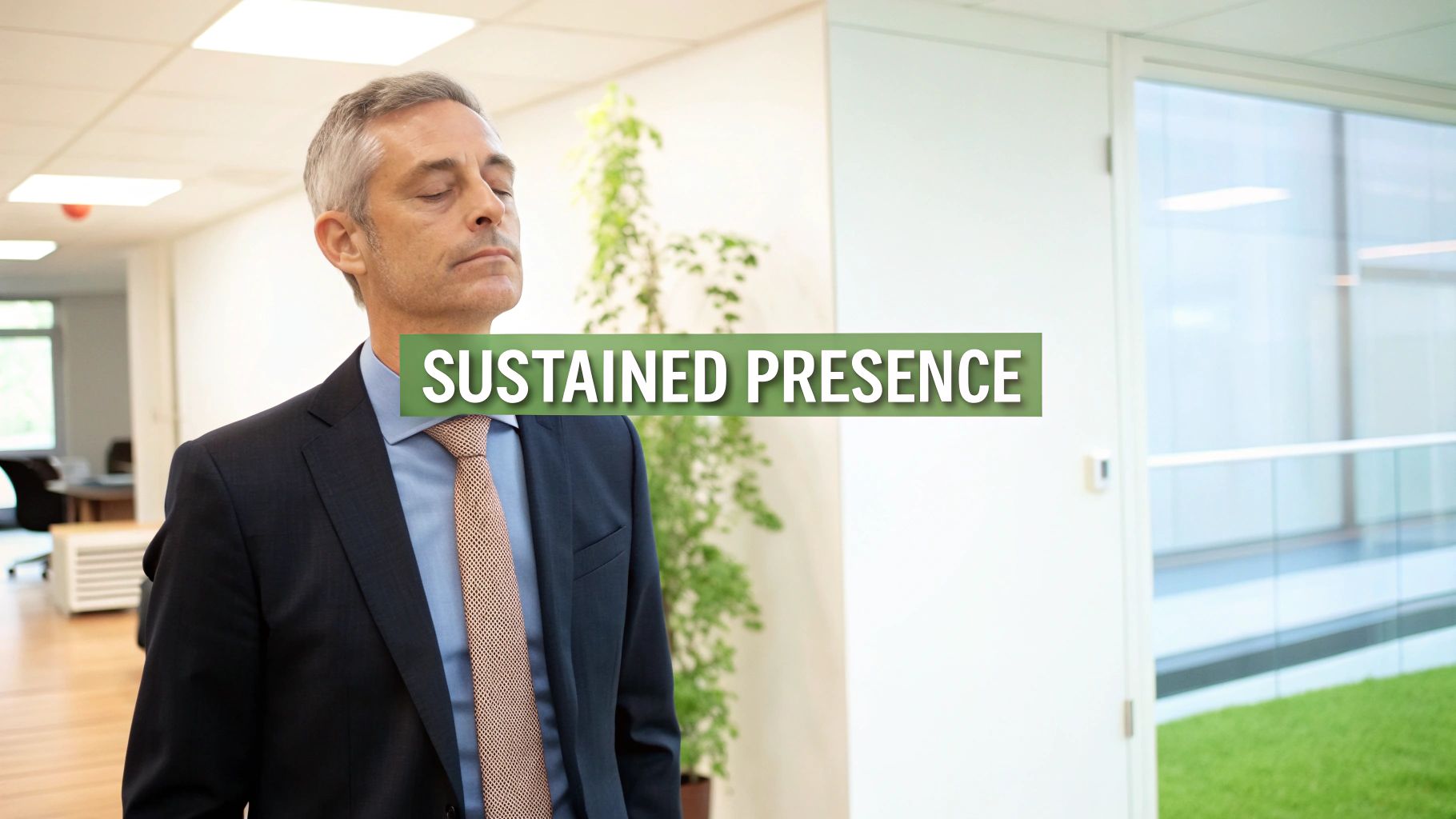
From Validation-Seeking to Self-Sovereignty
The ultimate prize here is achieving nervous-system sovereignty. This is the ability to lead from a place of centered, internal authority, independent of the chaos, opinions, or pressures around you. When you're sovereign, you stop seeking validation because you've become your own source of it.
This is critical in today's workplace. Globally, a staggering 77% of organizations report having a leadership deficit. Even more alarming, trust in managers has plummeted from 46% in 2022 to just 29% in 2024. This trust recession screams for the kind of authentic, grounded leadership this work cultivates. You can read the full research about these leadership statistics to see just how big the problem is.
The True ROI of Embodied Presence
When you can sustain this presence, you finally step off the hamster wheel of burnout. That endless cycle of over-preparing and over-delivering just to prove you're worthy? It ends. Your performance becomes a natural byproduct of your well-regulated state.
This is the real return on your investment:
Sustained Performance: You'll achieve more with less effort because your energy isn't wasted on managing internal anxiety.
Genuine Connection: Your team feels your stability and trusts your guidance, which builds loyalty and psychological safety.
Authentic Influence: You inspire action not through force, but through the quiet, undeniable power of your centered presence.
This whole path is about returning to yourself. It's about shedding the layers of conditioning that told you to be smaller, quieter, or different. The most powerful executive presence is the one that is uniquely, authentically, and unapologetically yours. If you're feeling trapped in that performance cycle, our guide on overcoming burnout at work might be exactly what you need. Your greatest asset as a leader is your own regulated, sovereign self.
Frequently Asked Questions
When you start digging into executive presence, a lot of questions come up. Let's tackle some of the most common ones.
How Long Does It Take to Develop Executive Presence?
This isn't a race with a finish line; executive presence is a lifelong practice. That said, you will see tangible results quickly. Most leaders I work with notice significant shifts in how they feel and how others respond to them within 4-6 weeks of consistent practice. The deeper, embodied rebuild—where this new way of being becomes your default setting—generally takes root over 3-6 months. Lasting presence is built from the inside out, by regulating your internal state, not by faking a power pose.
Can an Introvert Develop Strong Executive Presence?
Absolutely. Some of the most powerful leaders I’ve ever worked with are introverts. There's a massive misconception that presence requires a loud, "larger-than-life" personality. It's not true. Presence is about authority and connection, not volume. Introverts often leverage superpowers like deep listening, thoughtful communication, and a calm demeanor. The goal is never to force an introverted leader into an extroverted mask. Instead, we amplify your innate strengths to build a quiet, unshakable authority that draws people in.
Is Executive Presence Just About How You Look?
No. Appearance is maybe 10% of the equation, and it's the least important part. Of course, presenting yourself professionally matters—it’s a sign of self-respect. But it's table stakes. A sharp outfit can't cover up a shaky internal state.
True executive presence is an 'inside-out' quality. It’s rooted in your mindset, your composure, and your ability to regulate your nervous system under pressure. It's about what’s happening internally, not just what’s visible externally.
You can walk in wearing the most expensive suit, but if you’re internally consumed by anxiety and self-doubt, that's the signal you're broadcasting. We focus on the 90% that actually creates lasting change.
The path to sovereign leadership is about returning to your most powerful, authentic self. If you're ready to stop performing and start leading from a place of genuine authority, the work we do at Baz Porter is designed for you. Discover how the RAMS Method can help you build a sustainable presence that doesn't lead to burnout. Explore our executive rebuild work.
Where to go next
If any of this reads like your own reflection, the Silent Collapse Diagnostic™ is a quiet place to start. And if you want the deeper why beneath the work, read the Sovereign Manifesto.