How to Advance Your Career Without Sacrificing Yourself
You’ve done everything right—collected the promotions, nailed the targets, and proven your relentless drive. But underneath it all, a constant, low hum of exhaustion is growing louder. Your external success is so bright it completely masks your internal depletion. This is the Silent Collapse, and it’s the high price of your high achievement.
Does this internal monologue sound familiar? “If I stop performing at 110%, I will disappear.” This fear becomes the engine compelling you to say yes to one more project, to just push through the fatigue. It’s the silent deal you’ve made with your career: that your value is measured solely by your output.
Key Takeaways
Performance is Not Enough: Exceptional work is just the price of admission. Career advancement hinges on shifting from doing great work to communicating its strategic value and demonstrating leadership potential.
The Golden Cage is Real: Many high-achievers become trapped by their own success, feeling unable to admit exhaustion because it feels like a betrayal of the competent image they've built.
Upgrade Your Operating System: The "hustle harder" mindset leads to burnout. The RAMS Method (Results, Attitude, Mastery, Systems) offers a sustainable framework to build influence and advance without sacrificing your wellbeing.
Sovereignty is the Goal: True career advancement isn't about a bigger title; it's about returning to yourself and leading from a place of calm authority and internal validation, not anxious over-functioning.
The High Price of High Achievement
The strategies that rocketed you to this point are the very ones that are now becoming unsustainable. The constant craving for external validation has built you a career that’s beautiful, yes, but also a confining cage. It’s a state where your ambition has outpaced your nervous system’s capacity to keep up.
To truly advance your career, you must move beyond just working harder. It requires a strategic shift from pure hustle to intelligent impact, from a pleaser mindset to a sovereign one, and from burnout to sustainable systems. It’s about building influence and clearly communicating your value, all while keeping your own well-being front and center.

The Golden Cage of Success
I call this phenomenon the "Golden Cage." Your career looks so impressive from the outside that admitting you’re profoundly exhausted feels like a betrayal of your own success. You're not trapped by a lack of options, but by the sheer weight of your own achievements. The praise starts to feel hollow because it’s for a version of you that is perpetually “on.”
This isn't a personal failing; it's a systemic symptom I see in high-achievers everywhere. The pressure to maintain an image of effortless competence forces you to disconnect from your own body, treating it like a machine that absolutely must not fail.
Let’s be honest: this high-stakes performance is taking a toll. It’s the root of that subtle but persistent burnout that dims your passion and makes even your biggest wins feel a bit empty. You can learn more about how to spot and start overcoming burnout at work to begin reclaiming your energy.
This feeling of being trapped is a clear signal. It’s time for a different approach—one that doesn’t demand you sacrifice your well-being for your ambition. The way forward isn’t about abandoning your goals, but about completely redefining the terms of your success. It all starts by acknowledging the true cost of your current strategy and giving yourself permission to build a new one.
Why High Performance Isn't Getting You Promoted
You’re the go-to person on your team. You nail every target, unravel the gnarliest problems, and your work is consistently top-tier. So when the promotion announcements come out, and your name isn’t on the list, it’s not just frustrating—it’s baffling. What are you missing?

Here's a hard truth most companies won't tell you: exceptional work is just the price of admission. It’s what keeps you in the game, but it's not the thing that gets you to the next level.
The "if I just work harder, they'll have to notice me" mindset is a trap. It keeps you spinning on a hamster wheel of doing more, not becoming more in the eyes of leadership.
The reality is, the system isn't a pure meritocracy. Promotions often hinge less on your current performance and more on your perceived potential for future leadership. And that’s where the disconnect happens for so many high-achievers.
The Broken Rung Phenomenon
There’s a systemic bottleneck that trips up careers before they even get going, and it disproportionately impacts women. It's called the "broken rung"—that crucial first step up from individual contributor to manager.
According to a landmark McKinsey report, for every 100 men promoted to their first manager role, only 81 women are. This isn't just a small gap; it's a chasm that widens over time. It means fewer women get the early leadership reps needed to climb to senior roles. The result? Women’s representation plummets from 48% at the entry-level to a mere 29% in the C-suite. You can dig into the full story in the Women in the Workplace report.
This has nothing to do with competence. It’s about opportunity and visibility. The broken rung creates a pipeline problem that makes it statistically impossible for women to catch up, no matter how hard they work.
From Performance to Perceived Value
As you move up, the currency changes. It shifts from performance (what you do) to perceived value (how your impact is seen by decision-makers). This is a game-changer that most top performers miss because they’re too busy perfecting their deliverables.
So, what does that pivot look like in the real world?
Doing vs. Delegating: You stop being the hero who executes every task and start becoming the leader who builds and trusts a team.
Solving vs. Strategizing: You shift from putting out today's fires to anticipating and shaping tomorrow's opportunities.
Executing vs. Influencing: Your focus turns from just getting the work done to getting stakeholders on board and aligning teams toward a shared vision.
This transition demands a whole new playbook—one filled with skills like strategic communication and political savvy that aren't always taught in an individual contributor role. Our guide on negotiating for a promotion dives deep into the practical steps for making this shift.
The most common trap for high-performers is believing that their results speak for themselves. In reality, results need a translator. You must be that translator, consistently connecting your actions to broader business outcomes.
To get ahead, you have to fundamentally change how you operate. It's not about working harder within a flawed system; it's about learning to navigate that system with a smarter strategy. The goal is to evolve from being the best player on the field to being the one who can coach the whole team to victory. That's leadership. And that’s what gets you promoted.
The RAMS Method: Your New Career Operating System
If you’re caught in the cycle of over-performing and still feeling under-recognized, it's not a personal failure. It’s a system failure. You're running on outdated software. The conventional "work harder" approach is a depleting operating system that always, inevitably, leads to burnout. To actually get ahead on your own terms, you need a full-scale upgrade.
This is exactly where the RAMS Method comes in. It’s not just another to-do list to cram into your already packed schedule. Think of it as a completely new operating system designed for sovereign leadership—a framework for building a successful career that doesn't demand you sacrifice your wellbeing to get there.
RAMS stands for Results, Attitude, Mastery, and Systems. Each pillar is designed to systematically pull apart the patterns keeping you stuck and replace them with structures that broadcast your unique value. It’s the critical shift from being the most valuable doer to becoming the most indispensable leader.
R Is for Results: Redefining Your Impact
In most corporate settings, "busy" is constantly confused with "valuable." The RAMS Method starts by cutting that cord for good. The Results pillar is about getting ruthless with your focus, directing your energy toward outcomes that actually matter to the business, not just activities that fill your calendar.
This means changing how you talk and what you focus on. Instead of saying, "I worked 60 hours on the project launch," you learn to say, "My strategy for the project launch drove a 12% market share increase in Q1." The first statement is about effort; the second is about impact. One might get you sympathy, but the other gets you respect—and promotions.
Ready to start? Conduct a quick "Impact Audit" of your work from the last month.
Categorize your tasks: Sort everything you did into three buckets: High-Impact (directly moves key business goals forward), Low-Impact (necessary but doesn't move the needle), and No-Impact (can be delegated or just stopped).
Quantify your wins: For every single High-Impact task, find a metric. Did it save money? Increase revenue? Make the team more efficient?
Communicate with data: Start weaving these numbers into your weekly updates, performance reviews, and every conversation you have with leadership.
This isn't just semantics; it's a strategic repositioning. You stop being a reliable cog in the machine and start becoming the architect of its success.
A Is for Attitude: Cultivating Sovereign Leadership
Your internal state dictates your external influence. The Attitude pillar is all about making the mindset shifts needed to lead from a place of calm authority, not anxious over-functioning. It's about trading the "people-pleaser" identity for a sovereign one.
Sovereign leadership is something you embody. It’s the ability to hold your ground in a chaotic meeting, to deliver a firm "no" without a shred of guilt, and to communicate your vision with a conviction that needs no apology. This isn't arrogance. It's a deep, internal alignment that projects undeniable confidence.
One of my clients, a senior VP in finance, was constantly praised for being a "team player," which was corporate code for "the person who absorbs all the extra work." By shifting her Attitude, she learned to pause before automatically agreeing to new requests. Instead of a quick "yes," she started saying, "Let me check how that aligns with our top Q3 priorities and I'll get back to you."
That simple script did two powerful things: it gave her back control of her time and it signaled to everyone that her energy was a high-value, strategic resource. Her perceived value shot through the roof because she finally started treating her own capacity as a critical asset.
M Is for Mastery: Honing Your Unique Genius
The well-worn path to advancement tells you to collect a broad but shallow set of skills to look versatile. The Mastery pillar completely flips that script. It’s about zeroing in on your "zone of genius"—that specific intersection of your innate talents and deepest passions—and going deep.
True mastery isn't about being good at everything. It’s about becoming so exceptionally good at your core contribution that you become irreplaceable. This means having the courage to strategically say "no" to opportunities that dilute your focus, even if they look like good "career moves" on the surface.
This is more critical now than ever. Recent data shows that board gains for women have cratered, with only 47 net seats gained in the Russell 3000, a massive drop from 258 the prior year. As economic pressures rise, companies are pulling back on development and sponsorship programs. This makes it urgent for women to define and amplify their own undeniable value. You can explore the full analysis of women's stalling career progress on Fortune.com to see the trends for yourself.
To cultivate your Mastery:
Identify your 10x activities: What are the things you do where your input creates ten times the value of anyone else's?
Protect your deep work time: Block out non-negotiable time in your calendar dedicated solely to honing this craft.
Seek feedback from masters: Find the people who are the absolute best at what you want to do and learn from their process, not just their results.
Mastery builds the kind of authority that doesn't have to be loud. Your expertise ends up doing the talking for you.
S Is for Systems: Creating Levers for Your Energy
Your energy, not your time, is your most precious professional asset. The Systems pillar is about building personal and professional structures that protect and amplify that energy, letting you achieve far more with less effort. Burnout, at its core, is simply the absence of effective systems.
Systems are the guardrails that prevent decision fatigue and save your cognitive bandwidth for the high-stakes thinking that truly matters. They can be simple or complex, but their purpose is always the same: to automate, delegate, or eliminate the low-value drains on your energy.
A few powerful systems you can implement immediately:
A "User Manual for Me": A simple doc you share with your team outlining your communication preferences, work style, and boundaries.
Themed Days: Dedicate certain days to specific kinds of work (e.g., Mondays for big-picture strategy, Tuesdays for team meetings, Wednesdays for deep, uninterrupted work).
A Personal "Board of Directors": A small, trusted group of mentors and peers you can turn to for different challenges, which systemizes how you get advice.
These systems create leverage. They are the force multipliers that let you scale your impact without scaling your stress. You can explore this more in our full breakdown of the revolutionary RAMS Method leadership framework.
From Burnout to Sovereignty: The RAMS Transformation
Making the shift from the conventional, burnout-inducing approach to the RAMS methodology is fundamental. It's the difference between powering your career with adrenaline and powering it with intention. The table below lays out just how deep this transformation goes.
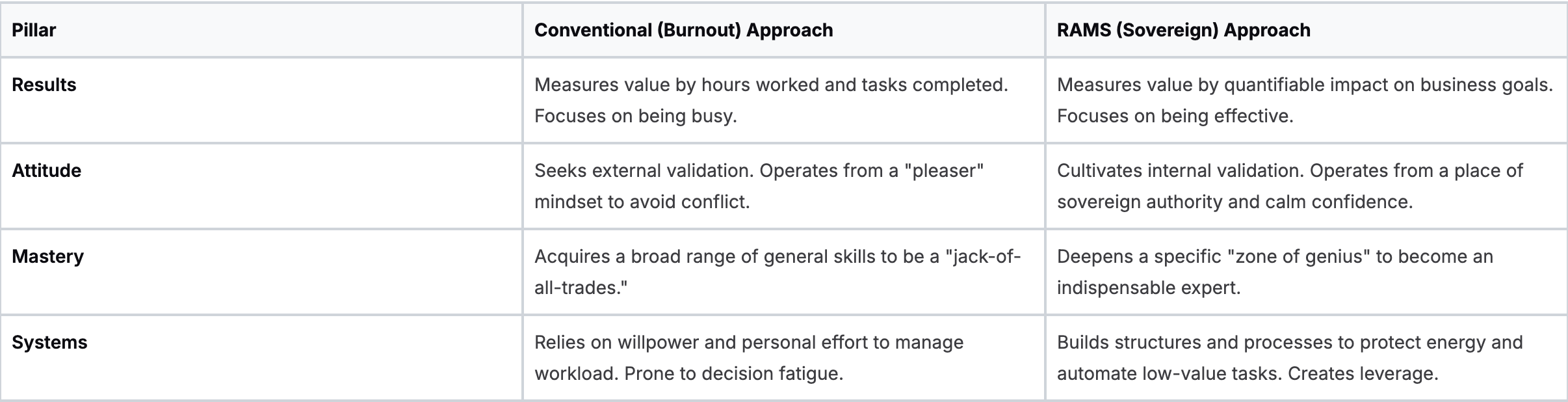
Implementing the RAMS Method is really a journey back to yourself. It gives you the structure to advance your career not in spite of who you are, but because of who you are. This is how you build a career that is not only wildly successful but also deeply, truly sustainable.
Your 90-Day Plan for Implementing RAMS
Let's be clear: theory without action is just entertainment. The RAMS Method isn’t some abstract concept to admire from a distance; it's a practical framework you need to put into practice. This 90-day plan is your bridge from simply understanding the model to actually living it, designed to build real momentum and create tangible shifts in your career.
And no, we’re not just piling more onto your already-full plate. We are strategically redesigning the plate itself.
The RAMS Method isn't just a list of steps; it's an interconnected flow where each element strengthens the others. This is about creating a sustainable system for career advancement that feels authentic.

When you establish effective systems, you create the space to cultivate a sovereign attitude, deepen your mastery, and—most importantly—deliver results that get you noticed for the right reasons.
Month 1: The Systems Overhaul
The first 30 days are all about plugging the energy leaks. You can't pour from an empty cup, and right now, your energy is likely being siphoned off by dozens of low-value tasks and chaotic processes. We start with Systems because they lay the foundation for everything that follows.
Your Primary Objective: Reclaim a minimum of five hours per week by systemizing your biggest energy drains.
Here’s how you’ll do it:
Run a Nervous System Audit: For one week, track your energy. Keep a simple log and note the specific tasks, meetings, or people that leave you feeling drained versus energized. By the end of the week, you'll have a clear hit list of your top three energy vampires. These are your first targets.
Implement One "Hard Stop" System: Pick one of your top drains and build a system to contain it. If constant Slack pings are derailing your focus, implement a rule for yourself: you only check and respond at 10 AM and 3 PM. Let your team know you're doing this to improve focus on high-priority work. This isn't about being unavailable; it's about being effective.
Automate or Delegate One Recurring Task: Find one repetitive, low-impact task you do every single week—compiling a report, scheduling standard meetings, filtering junk email. Use a tool to automate it or hand it off to a junior team member or virtual assistant. This one move will free up more mental bandwidth than you realize.
This first month isn’t about some massive, life-altering change. It’s about proving to yourself that you are in control of your time and energy. By plugging just one significant leak, you start shifting from being reactive to powerfully proactive.
Month 2: Attitude and Mastery Deep Dive
With the new energy you’ve reclaimed, Month 2 is about upgrading your internal operating system and sharpening your unique value. This is where you master the art of the strategic "no" and reinvest that newfound time into activities that amplify your expertise.
Your Primary Objective: Decline one non-essential request each week and reinvest that time into deep work that hones your core genius.
Here are your action items:
Practice the "Sovereign No": Every week, identify one request that falls outside your zone of genius or key priorities. Decline it gracefully but firmly. You could say, "Thank you for thinking of me. My focus is entirely on [High-Impact Project] to ensure we hit our Q3 targets, so I won't be able to take this on." Learning how to set boundaries at work is a critical leadership skill, not a sign of being unhelpful.
Schedule "Mastery Blocks": Carve out two 90-minute, non-negotiable slots in your calendar each week. This is your time for deep work—no emails, no meetings, no exceptions. Use this time to move the needle on a strategic project, learn a high-leverage skill, or write that thought leadership piece you've been putting off.
Seek High-Caliber Feedback: Identify one person in your field whose expertise you truly respect. Ask them for specific, critical feedback on a recent piece of your work. The goal isn't validation; it's precision. Ask, "What is the one thing that would have made this 10% better?"
Month 3: Results and Strategic Visibility
In the final 30 days, we cash in on your internal shifts and make them externally visible. This month is about fundamentally changing the narrative around your contributions. You'll stop being seen as just a hard worker and start being recognized as a strategic driver of business outcomes.
Your Primary Objective: Reframe one of your major Key Performance Indicators (KPIs) from a metric of effort to one of undeniable impact, and present it to leadership.
Here's your final push:
Perform a KPI Translation: Take one of your main responsibilities and reframe its success metric. If your KPI is "manage 15 client accounts," translate it into the language of impact: "achieved a 95% client retention rate, protecting $3M in annual revenue." Always connect your actions to the bottom line.
Lead with Your Impact: In your next one-on-one with your manager or in a team meeting, lead with your translated KPI. Start the conversation with the outcome, not the activity. For example, "I have an update on our client retention strategy—we’ve successfully protected $3M in revenue this quarter." This is how you change the conversation.
Create Your 90-Day Impact Summary: Pull together all your progress from this plan into a concise, one-page summary. Note the systems you built, the time you reclaimed, the mastery you developed, and the results you drove. This document is now your blueprint for every future performance review and promotion discussion.
This 90-day cycle isn't a one-and-done fix. It's the installation of a new operating system—a repeatable process for continuous growth that ensures you advance your career on your own terms, with your sovereignty fully intact.
The Return: Reclaiming Your Sovereignty
The real work of advancing your career has almost nothing to do with climbing some broken, external ladder. It’s about building a new foundation inside yourself—one grounded in personal sovereignty and an unshakable, calm authority.
This is a fundamental shift from the hustle culture mantra of “doing more” to the powerful reality of being more.
We're moving beyond the empty empowerment clichés that litter corporate wellness slides. We're talking about the embodied feeling of leading from a place of integrated strength, not from a reservoir of adrenaline you can no longer afford to tap.
The RAMS Method isn’t just a set of tactics; it’s the operating system that makes this new foundation possible. It connects your strategic actions—the Systems you build, the Mastery you cultivate—directly to your deepest desire: to achieve remarkable success without losing the core of who you are.
Building Your Leadership Legacy
Authentic leadership isn't a title someone gives you; it's an internal state you cultivate. It’s that quiet confidence that allows you to hold your ground, speak your truth, and make decisions that honor both your ambition and your wellbeing.
When you operate from this place, you stop chasing approval and start commanding respect. You can dive deeper into what defines this powerful presence in our guide on what authentic leadership truly is.
For those looking to supercharge their growth, exploring various leadership development programs can be a valuable step. These structured environments often provide new perspectives and tools that complement the internal work you’re doing here.
The ultimate career advancement is not a bigger title or a higher salary. It is the return to yourself—the integration of your power, wisdom, and ambition into a whole and sovereign leader.
This isn't the end of the journey. Think of it as the beginning of a whole new way of operating in the world. The next logical step is to move from understanding to diagnosis. You need a clear map of your own unique patterns and strengths to apply these principles where they'll make the biggest impact.
Common Questions & Straight Answers
Let's get right to it. When you're in the trenches, trying to build a career that doesn't burn you out, practical questions come up. Here are the most common ones I hear from leaders and the no-nonsense answers you need.
How Do I Set Boundaries Without Looking Like I'm Not a Team Player?
This is a huge one, and the reframe is simple but powerful: Frame your boundaries around impact, not inability.
You’re not saying "I can't." You're strategically protecting the quality of your most important work. It’s a shift from being perceived as uncooperative to being seen as deeply strategic.
Instead of a flat "no," try language that shows you’re still focused on the collective win. For example: "To knock Project X out of the park, my focus has to be 100% on it for the next week."
This isn't about refusal; it's about prioritization. You're communicating a dedication to excellence, and that earns respect, not resentment.
My Company Culture Glorifies Overworking. How Can This Method Possibly Work for Me?
When you’re swimming in a sea of burnout, you can't just decide to work less. The key is to outperform, not outwork.
This is where the 'Systems' and 'Results' pillars of the RAMS method become your secret weapon. The goal is to become so effective that you redefine what "valuable work" even looks like on your team.
You start by systemizing the low-value, repetitive tasks. Automate what you can. This carves out the space you need for deep, high-impact work—the kind of work that produces visibly superior outcomes in less time.
Your quantifiable impact becomes the evidence. You become the living case study for a smarter, more sustainable way to achieve incredible results.
I'm Already Burned Out. The Thought of a "New System" Is Exhausting. What's the Very First Step?
I get it. When your tank is empty, even a simple new initiative can feel like climbing a mountain.
The single most powerful—and least demanding—first step is what I call a "Nervous System Audit." This isn't about action; it's about observation.
For one week, just notice. That’s it.
Write down the top three things that consistently drain your energy the most, both at work and at home. Don't try to fix them. Don't build a plan. The simple act of identifying the biggest energy leaks is the crucial first step. Awareness alone is enough to start building momentum.
Are you ready to stop running on an operating system that leads to burnout? Baz Porter provides a proven framework to help you transition from exhaustion-driven performance to embodied, sovereign leadership. Discover your unique path forward.