How to Talk to the Boss: Women Leaders' Guide to Power
You are not preparing for a difficult meeting. You are preparing for an internal mutiny.
You keep telling yourself the problem is communication. It is not. The problem is that the voice running your decisions still believes exhaustion proves worth. So when you need to talk to the boss, the first boss in the room is the one in your own head. She is relentless, productive, polished, and dangerous.
You look composed. You deliver. You carry the room. Then you close the laptop and feel nothing. You say, “If I slow down, everything falls apart.” You say, “I have everything I wanted. Why do I feel nothing?” That is not tiredness. That is Silent Collapse™.
Table of Contents
Key takeaways
If you need to talk to the boss, start with the internal boss first. External language fails when your inner command structure is hostile.
High performance can intensify self-attack. Success does not neutralize collapse. It sharpens it.
The conversation must be strategic, not confessional. You are not asking to be rescued. You are establishing terms.
Sovereign Leadership™ begins in the nervous system. If your body reads truth as threat, you will betray yourself on cue.
The Conversation You Are Avoiding Is With Yourself
You have rehearsed the meeting ten times. None of the rehearsals were with your boss.
They were with the tribunal inside you. The one that calls restraint laziness. The one that calls exhaustion normal. The one that says any need is weakness, any pause is risk, and any honest sentence might expose that you are no longer willing to be consumed by the machine you built.

I have often seen this pattern. A woman leads a company, division, or team with precision. She is respected. She is depended on. She is privately bargaining with herself at midnight. “Push through this quarter.” “Get through this launch.” “Handle this one more personnel issue.” Then the body starts speaking in symptoms the mind keeps overruling.
You do not need more confidence content. You need a cleaner diagnosis. Without that, every attempt to be more self-aware becomes observation without intervention.
Dread is simple. You know the current standard is unsustainable. You also know you trained people to expect it.
The Boss in Your Brain and The Neuroscience of Dread
The direct answer
If you want to talk to the boss, talk to the internal boss first. Name the demand structure driving your fear, strip emotion from the facts, and enter the external conversation from authority instead of depletion.
If you skip that step, you will either overexplain, apologize, or ask for less than you need. That is not communication failure. That is collapse management.
The internal boardroom
I call it the Internal Boardroom. You sit at the head of the table, but the loudest voice in the room still acts like a wartime commander. It values output over signal, endurance over truth, and image over recovery.
That voice did not appear by accident. High achievers build it because it works. It gets results. It earns praise. It helps scale companies, teams, and reputations. Then one day the tool becomes command.
Now every hard conversation triggers the same split.
One part of you knows the current arrangement is damaging your leadership.
Another part says, “Keep smiling. Absorb the load. Do not disrupt the system.”
That split is not a character flaw. It is not. It is a pattern I diagnose as Silent Collapse™. Outward performance remains intact while inner authority erodes.
The most dangerous boss is the one using your own voice.
Many women leaders get trapped here. They prepare to negotiate with a superior, board, client, or investor while still submitting to an internal regime that punishes any move toward self-protection.
The result is predictable. The language becomes hesitant. The ask gets softened. The truth gets wrapped in enough caveats to become ignorable.
Why your body treats honesty like danger
A hard conversation does not just activate thought. It activates threat response.
Your nervous system tracks history, not just context. If you learned that performance created safety, then reducing access, changing terms, pushing back, or stating a limit can register as danger even when the move is strategically correct.
That is why dread appears before a calendar invite. The body reads the coming conversation as exposure.
“A 2025 McKinsey report notes 42% of female executives report a ‘self-sabotaging inner monologue’ that intensifies with success, directly linking high achievement to internal collapse.” https://www.mckinsey.com/featured-insights/women-in-the-workplace
That finding matters because it cuts through the usual lie. More success does not automatically quiet self-attack. In many women leaders, success raises the stakes and often sharpens the internal monologue.
The internal boardroom becomes hostile because the identity was built around indispensable performance. So when reality demands a reset, the body hears, “You are about to become less valuable.”
That is why some women can command a room and still freeze before one honest request. Their intellect is not the issue. Their conditioning is.
I write more about this architecture at nervous system architecture. The short version is blunt. If your body links worth with overfunctioning, then healthy leadership will feel wrong before it feels right.
The metaphor I use is military because the pattern is military in nature. Your internal command structure has stayed on combat footing long after the battlefield changed. You are operating like a fortress under siege while sitting in a boardroom with polished floors and a strategy deck.
That mismatch creates dread. The mission changed. Your system did not.
The Sovereign Protocol Using the RAMS Framework
Most advice on how to talk to the boss is weak. It tells you to be calm, be clear, and advocate for yourself. That is surface language. It ignores the command failure underneath.
I do not use encouragement here. I use protocol. The RAMS Framework™ creates structure where collapse used to improvise.

One technical note matters before the steps. Reframing your self-talk is not cosmetic. It changes leadership behavior.
“Data from Harvard Business Review (2025) indicates that self-talk reframing via military-derived methods boosts Sovereign Leadership attributes by 35% in clinical trials with veteran coaches.” https://hbr.org/
That aligns with what I have seen in practice. The sentence before the conversation determines the quality of the conversation. If the sentence is self-betrayal, the meeting is already compromised.
For deeper context on the framework itself, review the RAMS Method by Baz Porter, a leadership framework explained.
Reach
Reach is the first correction. Most women in collapse enter the conversation trying to reduce tension. Wrong objective.
Your job is to establish the conversation's purpose. Not emotional relief. Not permission. Not approval. Strategic realignment.
If you start with relief-seeking, you will overshare. If you start with strategic alignment, you will lead.
Use this sequence:
Define the primary audience. The first audience is your own nervous system. The second is the external boss. If the first audience is unconvinced, the second will feel your instability.
State the operational issue. Write one sentence with no emotion words. Example. “The current decision load and response expectations are reducing leadership quality and creating preventable drag.”
Name the cost of silence. Silence preserves image and damages function. Say that plainly to yourself.
Choose the frame before the meeting. The frame is not “I need help.” The frame is “I am correcting conditions that reduce strategic performance.”
Here is the test. If your opening could be mistaken for an apology, your Reach is weak.
Acquire
Acquire is about the ask. Most collapsed leaders ask for too much context and too little change. They arrive with a detailed history and no clean request.
That is amateur work. The boss does not need your diary. The boss needs a precise adjustment.
Your ask must be singular, visible, and enforceable. Examples include decision rights, staffing shifts, reporting boundaries, meeting cadence changes, role clarity, or timeline resets. Keep it to one primary move.
Build it this way:
Identify the one point of pressure causing the distortion. Not every irritation qualifies. Find the issue that keeps forcing self-betrayal.
Separate preference from necessity. A preference is nice. A necessity protects leadership function.
Convert the need into a business-relevant request. Replace “I need less chaos” with “I need decision authority over X and removal from Y.”
Remove all emotional padding. “I know this may sound selfish” is banned. So is “I hate to ask.” So is “I might be overreacting.”
A weak ask invites negotiation against your own interests before the other person even speaks.
Many founders fail here when they talk to the boss and the boss is the board, the investor group, or their own internalized standard. They think the conversation is about proving loyalty. It is not. Loyalty without structure becomes self-erasure.
Monetize
Monetize means connect the request to value. Not your pain. Value.
Collapsed leaders often present the issue as a personal strain. That invites concern, maybe sympathy, and often no structural change. You need the request tied to performance integrity, not personal endurance.
Use three categories only:
Decision quality
Execution quality
Leadership continuity
If your request improves one or more of those, say so directly.
For example:
Decision quality “When approvals route through three people, strategic response slows and accountability blurrs.”
Execution quality “Constant after-hours responsiveness reduces next-day judgment and creates avoidable rework.”
Leadership continuity “Sustaining this model keeps output visible but makes long-term leadership unreliable.”
This is not manipulation. It is accurate translation. Your boss may not care about your exhaustion until they understand its operational effect. That is not cruelty. That is leadership reality.
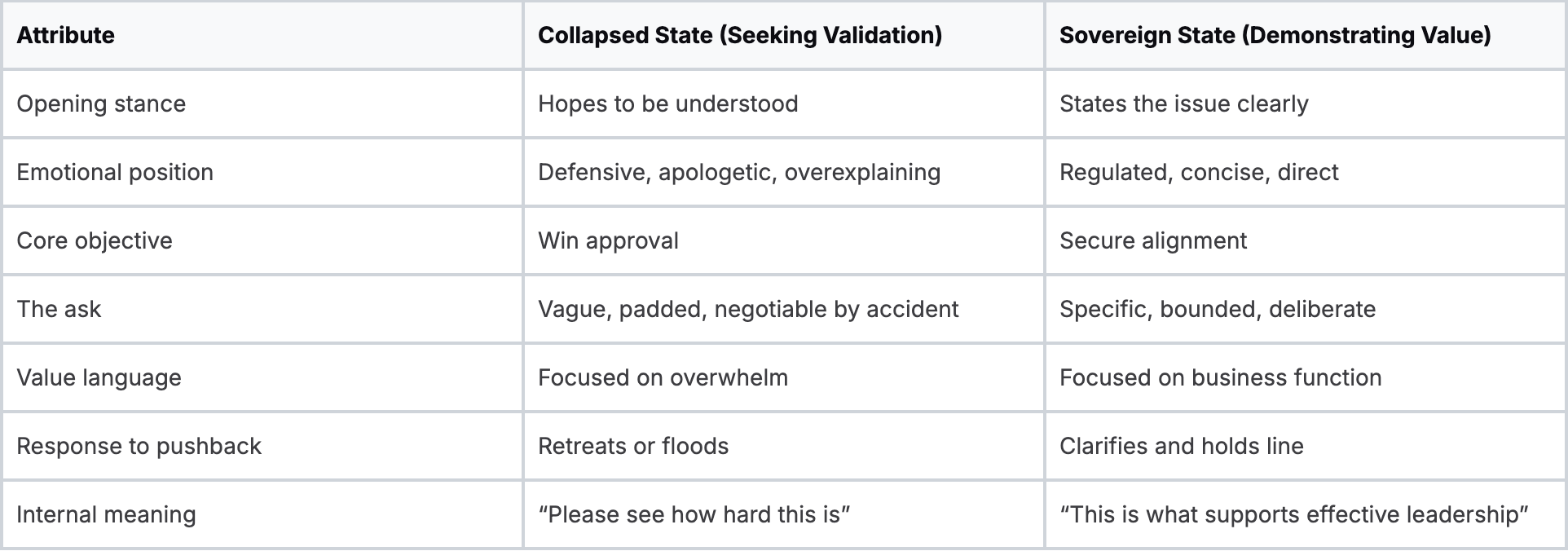
Use this comparison before you enter the room.
Conversation Approach Collapsed State vs Sovereign State
A woman I worked with had built a reputation on constant availability. Senior role. Excellent operator. Privately depleted. Every time she considered changing the pattern, her mind framed it as letting people down.
We did not spend our time polishing confidence. We stripped the distortion. She stopped describing the problem as fatigue. She described it as a degraded leadership model built on unmanaged access. Her conversation changed the week after. The external response mattered less than the internal shift. She no longer negotiated against herself before entering the room.
That is the point.
Scale
Scale is where the identity changes. The goal is not one successful conversation. The goal is a new leadership standard that does not require collapse to maintain authority.
Most women do the opposite. They survive one hard meeting and then drift back into overfunctioning because the old identity still feels safer.
Scale prevents relapse.
Use this sequence after the meeting:
Record what was agreed. Do not trust memory. Write the terms.
Name what you will no longer compensate for. If the structure changes but you keep rescuing the system, nothing changed.
Set one visible behavioral standard. Example. No instant responses outside agreed windows. No re-entry into meetings that should be delegated. No decision ownership without authority.
Observe your body, not just the outcome. If you feel guilt, panic, or the urge to overdeliver after setting a clean boundary, do not treat that as evidence you were wrong. Treat it as withdrawal from an old pattern.
Repeat until the new standard becomes normal. Sovereignty is built through repetition, not insight alone.
The first sign of Sovereign Leadership™ is not confidence. It is the refusal to abandon yourself for short-term harmony.
When this part is done correctly, your leadership becomes less dramatic and more durable. You stop using crisis energy as proof of relevance. You stop performing indispensability. You lead from command, not survival.
The Silent Collapse Diagnostic will name exactly where you are in the collapse cycle. It takes five minutes.
Executing the Conversation with Clinical Precision
The room does not reward the most emotional person. It rewards the clearest one.

Timing is Key to Influence
Do not schedule the meeting at the moment of maximum resentment. Schedule it when you can hold frame.
Use these filters:
Choose proximity to real work. After a visible project milestone or strategic review works better than after a personal breaking point.
Avoid ambush conditions. Hallway disclosures and end-of-day emotional dumps degrade authority.
Protect your regulation before the meeting. No reactive email chains. No rehearsing disaster.
If you need support building your delivery, study executive communication skills training.
Scripts that hold frame
You do not need a long opening. You need one that is clean.
“I want to address a structural issue that is affecting leadership quality and execution. I have identified a specific change that will improve how I operate and what the business gets from me.”
If you are asking for reduced access, say it plainly.
“The current response pattern keeps me active but reduces decision quality. I am changing that pattern so I can lead at the level this role requires.”
If you are asking for role clarity, use this.
“I am carrying responsibility across areas where authority is blurred. That creates drag. I want to reset ownership so outcomes and decision rights match.”
If they push back with “Can’t you just manage this for now?” use this response.
“I can manage almost anything temporarily. That is not the standard I am discussing. I am addressing what produces sustainable leadership quality.”
If they say, “This is a demanding season,” answer without flinching.
“Agreed. That is why I am addressing the operating model now, not after it distorts performance further.”
Keep your tone low. Keep your pace controlled. Do not defend your humanity. State the correction.
The follow-up
Send the follow-up within the same day.
Use three short parts:
Restate the issue discussed.
Document the agreed change or next decision point.
Confirm the leadership outcome the change supports.
Example structure:
We discussed the current operating pattern and its effect on decision quality.
We agreed to shift ownership of X, reduce involvement in Y, and review impact after implementation.
This supports clearer execution and stronger leadership capacity.
No emotion. No post-meeting apology. No hidden plea to be liked.
The Outcome Is Irrelevant Your Sovereignty Is Not
A yes can still leave you collapsed. A no can still leave you sovereign.
That is the part often overlooked. The true win was never external approval. The true win was ending the reflex to betray yourself in order to preserve an image.
I have worked with a founder who looked powerful from a distance and hollow up close. She had revenue, reputation, and team dependence. She also had a private rule. Never disappoint anyone if you can absorb the cost yourself. That rule was destroying her.
She did not need a more polished script. She needed to stop treating self-erasure as leadership. Once she did, the room changed because she changed first. Her body stopped negotiating panic as duty. Her words got shorter. Her standards got clearer. Her leadership became cleaner.
That is Sovereign Leadership™. Not motivation. Not performance theater. Nervous-system command.
If this lands hard, read it as a signal, not an insult. There is more on this shift in embodied sovereignty.
Frequently Asked Questions
Why do I feel empty even though I am successful?
Because achievement and self-possession are not the same thing. You may have built external success on internal overrule.
What if talking to the boss makes me look weak?
Weakness is not honest structural correction. Weakness is needing collapse to keep your leadership identity intact.
What if I am the boss?
Then the first negotiation is with the part of you that still worships unsustainable performance. Founders need the protocol more than employees.
What if the answer is no?
Then you gained clean data. You now know the environment, the limit, and the cost of staying. Clarity is stronger than prolonged self-deception.
How do I know this is Silent Collapse™ and not just stress?
Stress responds to recovery. Silent Collapse™ resists it. You rest and still feel flat, hostile to your own needs, or unable to stop performing.
If your results confirm what you already suspect, the next step is an application, not a sales call. I do not work with everyone. I work with women ready to stop managing their collapse and start ending it. Apply to Work With Baz
British military veteran. Two-time international bestselling author. Founder, The Prestige Architect™. Host, Rise From The Ashes podcast on the C-Suite Network.