The Unspoken Price of Silence: Your Script for Salary Negotiation
It’s the quiet moment after a project launch, during a review, or late at night when the feeling hits. You see the sheer weight of your responsibilities, your real impact on the bottom line, and a cold realization dawns: your paycheck doesn’t reflect any of it.
This is the Silent Collapse—that gut-wrenching moment when years of exceptional performance feel utterly disconnected from your compensation. The internal dialogue is relentless: “If I stop performing, I will disappear.” The thought of asking for more feels like a direct threat to your survival in the system you've worked so hard to master. You're not just afraid of hearing "no"; you're terrified of being seen as ungrateful, demanding, or difficult.
Key Takeaways
The RAMS Framework: Learn a proven system to quantify your value by focusing on Results, Attitude, Mastery, and Systems, turning an emotional plea into a powerful business case.
Neuroscience of Negotiation: Understand how salary talks trigger your brain's threat response (the amygdala) and how to use a script to keep your logical mind (prefrontal cortex) in control.
Word-for-Word Scripts: Get the exact language to open the conversation, state your request, and confidently handle common objections like "the budget is tight" without folding.
Follow-Up System: Master the art of the confirmation email to solidify your agreement and prevent your hard-won raise from dissolving into ambiguity.

Why Avoiding the Salary Talk Costs You More Than Money
An effective script for salary negotiation is your tool to bridge the gap between your proven value and your compensation. It provides a data-driven structure that allows you to advocate for yourself with unshakeable clarity, moving from emotional reactivity to empowered, evidence-based communication. Without it, you remain trapped in a cycle of over-performance and under-compensation.
The data shows why this skill is critical. While skilled negotiators can secure an average pay raise of 18.83%, a stark gender disparity exists. Research published in the Harvard Business Review highlights that while women ask for raises as often as men, they are less likely to get them. This gap screams one thing loud and clear: simply doing great work isn’t enough. Strategic advocacy is essential.
You are not asking for a favor. You are aligning your compensation with the immense value you already deliver. This conversation is the bridge between the leader you are and the recognition you have already earned.
The real cost of avoiding this conversation isn't just financial. It’s the slow, painful erosion of confidence that comes from knowing you’ve settled for less. It’s the dissonant feeling of leading a multi-million dollar division while hesitating to claim your own worth.
When you're thinking about your next career move, like negotiating a promotion, having a solid script isn't just a nice-to-have; it's non-negotiable. This guide will give you the tools to close that gap—for good.
The Hidden Pattern: The Neuroscience Behind Negotiation Anxiety
That heart-pounding, stomach-knotting feeling you get when you think about asking for what you're worth? That isn't a character flaw. It’s pure biology.
Your brain's primary job is survival, and for countless high-achieving women, a salary negotiation registers as a legitimate social threat. It’s a paradox I see constantly in my work with female executives. You can command a boardroom and navigate multi-million dollar projects with ice in your veins, yet you freeze solid when it comes to your own compensation.
This isn't a contradiction; it’s a conditioned response. Years of being subtly rewarded for collaboration and quietly penalized for direct self-advocacy have wired your nervous system to flag this specific conversation as a major risk. Your body is treating the negotiation table like a battlefield.
Your Brain's Internal Threat Assessment
The moment you prepare to use a script for salary negotiation, your brain fires off a rapid, unconscious threat assessment. This primitive survival instinct doesn't know the difference between a predator and a manager who might say "no."
This show is run by the amygdala, your brain’s emotional command center. As documented in studies on social-evaluative threat, when it senses a risk—like potential rejection or being labeled "difficult"—it triggers the fight-or-flight response.
This biological cascade is directly responsible for:
The physical storm: A racing heart, sweaty palms, and that classic knot in your stomach.
The cognitive fog: Your prefrontal cortex, the part of your brain for logic and strategy, gets sidelined.
The emotional flood: Fear and anxiety swamp your system, making it nearly impossible to think clearly.
The anxiety you feel isn't a reflection of your competence. It's a predictable neurological reaction to a perceived social threat. Naming it is the first step to taming it.
This reaction pushes you into familiar avoidance patterns. You might cave and accept the first offer just to make the discomfort stop. You might downplay your massive wins. Or you might talk yourself out of scheduling the meeting in the first place.
The Vicious Cycle of Avoidance and Under-Valuation
This neurological ambush creates a nasty feedback loop. The intense anxiety makes you sidestep the negotiation, which directly leads to you being under-compensated. This growing financial gap then fuels feelings of being undervalued, which can trigger the exact same imposter syndrome patterns that make the next negotiation feel even more terrifying.
The internal monologue is always the same: "What if they think I'm greedy?" or "What if asking for more costs me the job?" This isn’t just a simple fear of hearing "no." It's a deeply ingrained fear of being judged for stepping outside the expected team-player role. You can dig deeper into how to overcome the fear of rejection to understand these powerful triggers.
A well-researched, data-driven business case and a prepared script act as an anchor for your prefrontal cortex. It gives your logical mind a clear path to follow when your emotional brain is trying to pull the emergency brake. It's not about being fearless; it’s about being so prepared that you can act in spite of the fear.
The RAMS Reframe: Building Your Unshakable Business Case
To sidestep that primal threat response, you need a system. You need a clear, logical structure that anchors you in fact, not fear. This is why I developed the RAMS framework. It’s a method designed to turn negotiation from an emotional minefield into a strategic business conversation.
RAMS stands for Results, Attitude, Mastery, and Systems. This isn’t about trying to conjure courage out of thin air; it’s about building it, piece by piece, on a foundation of undeniable proof.
Let's break down exactly how this framework helps you build an ironclad script for salary negotiation.

When you see negotiation as a threat, your instinct is to avoid it. A structured strategy like RAMS redirects that nervous energy into powerful, productive preparation, breaking the cycle.
R - Results That Build Your Business Case
The first and most critical pillar is Results. You must stop talking about your job duties and start quantifying your impact. This is about building a business case so compelling that your request feels like the only logical next step.
Your goal is to gather an arsenal of undeniable evidence.
Quantify Everything: Comb through your last 12-18 months of work. Find every metric. Did you increase revenue? By what percentage? Did you cut costs? How much?
Focus on Impact: Connect every action to a bottom-line outcome. Don't say "I managed the project." Say "I led the Q3 product launch, which drove $1.2M in new revenue and beat projections by 15%."
Gather Your "Receipts": Collect concrete proof—performance reviews, laudatory emails from senior leaders, project reports, and data dashboards.
Your accomplishments are not a list of tasks. They are data points proving your ROI to the company. When you frame them that way, the negotiation becomes a discussion about investment, not a plea for more money.
This isn’t about bragging. It’s about reporting. You’re presenting the facts of your performance with the same objectivity you’d apply to any other business analysis.
A - Attitude of a Sovereign Leader
With your results documented, the next step is cultivating the internal state to deliver your message. Attitude isn't about faking confidence; it's about grounding yourself in the truth of your value.
Here’s how to deliberately shift your attitude:
Reframe the Narrative: Stop seeing this as "asking for more." You are "aligning your compensation with the market value of your delivered results." This small language shift moves you from a subordinate position to a collaborative one.
Embody Your Value: Before the meeting, review your "receipts." Read the praise. Look at the numbers. Let the reality of your impact sink in. This practice helps regulate your nervous system.
Set Your Numbers: Determine your walk-away number (your BATNA), your target number, and your ideal number. Knowing your boundaries beforehand prevents you from making emotional decisions.
Your body language and tone will follow your internal state. When you are grounded in your worth, you project calm authority. You can learn more about finding your center and achieving peace in the midst of chaos.
M - Mastery Through Rehearsal
Mastery is where your script meets reality. You'd never walk into a board presentation without practicing, so why would you walk into a salary negotiation unprepared? Rehearsal is what closes the gap between knowing what to say and actually saying it with conviction.
Record Yourself: Use your phone to record yourself delivering your key talking points. Listen back. Does your voice waver? Adjust and repeat until your tone is calm and firm.
Role-Play Objections: Enlist a trusted friend to role-play the conversation. Have them throw common objections at you. Practice your responses until they feel natural.
Master the Pause: Strategic silence is one of the most powerful tools. After you state your target salary, stop talking. Let the number land. The discomfort you feel is the pressure building on them to respond.
Confidence is a rehearsed skill. Each time you practice, you're creating new neural pathways, making it easier for your brain to access this confident state under pressure.
S - Systems for Flawless Execution
Finally, Systems provide the structure to pull it all together. This includes your script, your timing, and your follow-up process. A system removes the guesswork and minimizes the chance of emotional derailment.
The table below shows the stark contrast between the reactive, apologetic approach and the structured, powerful approach of the RAMS framework.
Negotiation Approach Comparison: Traditional vs. RAMS Framework
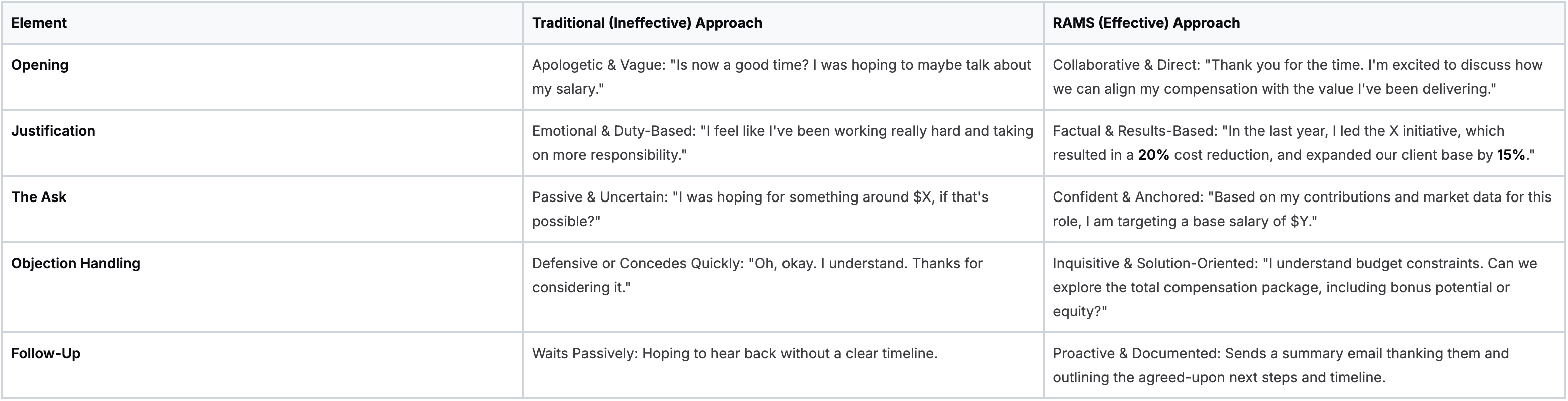
This systematic approach transforms your script for salary negotiation from a list of words into an executable strategy. This is how you stop reacting and start leading.
Mastering Your Dialogue With Proven Scripts and Responses
You’ve built your business case. You've grounded your mindset. Now, it's time to turn preparation into a powerful conversation.
A script for salary negotiation isn’t a rigid monologue. Think of it as a playbook—a collection of strategic phrases to open the conversation, state your case, and handle pushback with total poise. The goal is to have proven language on deck so your brain doesn't default to apologetic patterns when the pressure is on.
Setting a Collaborative Tone
How you begin sets the stage. Steer clear of weak, apologetic openings. Lead with confident, collaborative language that frames this as a partnership.
Here's a powerful way to start:
"Thank you for taking the time to meet. I'm really excited about where the team is headed. In that spirit, I'd like to discuss how we can make sure my compensation is aligned with the value I'm contributing and the current market rate for my role."
This opening is a strategic triple-threat. It starts with shared goals, immediately connects your pay to value and market data, and establishes a professional, business-first tone. You’ve just transformed an awkward request into a logical business discussion.
The Art of the Strategic Pause
One of the most potent—and underused—tools in negotiation is silence. After you state your request and target number, every instinct will scream at you to fill the quiet.
Don't.
State your number clearly. Then stop talking.
Picture this dialogue:
You: "Based on my contributions over the last year—specifically leading the project that increased client retention by 18%—and my research on market rates for a Director with this scope, I am targeting a base salary of $185,000."
You: [PAUSE. Do not say another word.]
This strategic silence projects unshakable confidence and transfers the pressure to the other person. They are now compelled to respond. Mastering this pause is a key element of speaking confidently at work and is crucial for maintaining your authority.
Responding to Common Objections
Hearing "no" or "not right now" is a standard part of the process, not a personal rejection. Anticipating these objections and having a calm, prepared response is what separates a successful negotiation from a stalled one.
Objection 1: "We don't have the budget for that right now."
This is the classic, go-to objection. Don't fold. Stay collaborative and pivot toward creative solutions.
Your Response: "I understand that budgets can be tight. Could we explore the timeline for the next compensation review cycle? Alternatively, I'm open to discussing the total compensation package, including a performance-based bonus or additional equity."
Objection 2: "You're already at the top of the salary band for your role."
This is an attempt to frame the conversation around internal policies. Your job is to re-anchor the discussion back to your specific impact.
Your Response: "I appreciate you sharing that context. My request is based on the significant expansion of my responsibilities and the direct impact my work has had on key business metrics, which now exceed the original scope of this role. Could we discuss re-leveling the position to better reflect these increased contributions?"
Your prep work extends to confidently answering tough questions. You can find strategies for handling difficult questions at interviews that will build your confidence.
These scripts are tools that give your logical mind a track to run on when your nervous system is flashing warning signs. By mastering this dialogue, you take control.
Finalizing Your New Salary: How to Follow Up and Get It in Writing
The conversation might feel like the finish line, but it’s not. The moments that follow are where you either lock in your win or risk letting the agreement dissolve into ambiguity. A verbal "yes" is a great start, but you haven't finished until the new terms are documented.
Think of your follow-up as a non-negotiable final step. It’s a mark of professionalism that prevents misunderstandings and ensures everyone is on the same page.

The Confirmation Email Script
As soon as you can after the verbal agreement, send a confirmation email. This simple act creates a professional paper trail. Your tone should be positive, collaborative, and appreciative.
Example Email Script: Summarizing the Agreement
Subject: Following Up on Our Conversation
Hi [Manager's Name],
Thank you again for your time today. I truly appreciate our productive discussion about my role and compensation.
Just to summarize, I'm excited to move forward with the agreed-upon base salary of [$New Salary] and the performance bonus structure of [Details of Bonus], effective [Start Date].
I look forward to receiving the updated offer letter. Please let me know if you need anything further from my end.
Best,
[Your Name]
This script is short, professional, and leaves zero room for confusion. If you're navigating written communication, our guide on how to negotiate salary by email offers more in-depth strategies.
The Gentle Nudge Script
What happens if a week or more goes by without the promised offer letter? A strategic follow-up can get things moving again without making you seem pushy. A polite inquiry is all you need.
Example Script: When a Decision is Delayed
Subject: Checking In: Following Up
Hi [Manager's Name],
I hope you're having a productive week.
I'm just gently following up on our conversation from last [Day of the week]. I'm very much looking forward to finalizing the details we discussed.
Is there an updated timeline for when I might expect the revised offer letter?
Thanks so much,
[Your Name]
This follow-up is helpful, not demanding. It frames you as a proactive partner eager to finalize the process.
The Return: From Asking to Aligning
Even with the best preparation, negotiation can feel like walking a tightrope. Specific moments can throw you off balance. Let's walk through the most common curveballs and how to handle them with confidence.
What if They Just Say "No"?
First, a “no” is not a failure. Don't let it shut you down. A flat “no” is often where the real conversation begins. A hard stop on base salary is your cue to pivot. Stay calm. Get curious.
Your Response: "Thank you for being transparent. I understand there might be constraints on the base salary. Given that, I’m excited to explore the other parts of the offer to make sure the total package aligns with the value we've talked about. Would you be open to discussing a higher performance bonus or additional equity?"
This move keeps the dialogue open. It shows you’re a creative partner looking for a win-win solution, moving from a single point of failure to a landscape of possibilities.
How Do I Negotiate Benefits and Equity?
Benefits and equity aren’t just “perks.” They are powerful components of your total compensation. Frame them as such.
Additional PTO: "An extra week of vacation is really important for me to ensure I can recharge and consistently perform at the high level this role requires. That's worth about $X,XXX to me."
Equity/Stock Options: "I am genuinely invested in the company's long-term success. Could we look at adjusting the equity portion of this offer to reflect the senior-level impact I plan to deliver?"
Professional Development: "A $5,000 annual budget for professional development would be a game-changer, allowing me to bring the latest strategies back to the team."
When Is the Right Time to Talk About Salary?
Timing is everything. Do not bring up salary in the first interview. The initial stages are your time to demonstrate your value and make them decide they have to have you.
The perfect time to pull out your script for salary negotiation is after you have a formal, written offer in hand. This is your point of maximum leverage. They've invested hours and emotionally committed to you as their top choice.
What if a recruiter pushes you for a number early in the process? Deflect gracefully.
"Based on my research, roles with this level of responsibility in our market typically have a compensation range between $X and $Y. I'm confident that once we've both confirmed this is a great fit, we'll be able to agree on a number in that range that works for everyone."
This gives them a number to work with but doesn't anchor you too low before you have all the facts.
Navigating these conversations is about more than just words; it's about regulating your nervous system and staying anchored in your worth. This is the return to yourself—moving from a state of performance driven by exhaustion to one of embodied, sovereign leadership. If you’re ready to align your career with your true value and lead with unshakeable confidence, learn more about how we can help you.