You’re Not Underpaid, You’re Under-Negotiated: A Guide to Securing Your Promotion
You log the extra hours. Your results are consistently stellar. Every project is on time, under budget, and executed flawlessly. Yet, you're stuck in the same role, watching others get the opportunities you know you deserve. You're hitting an invisible ceiling, and the internal voice is spinning: 'What am I missing?' 'Maybe I'm not good enough.' 'Do they even see what I’m contributing here?' This is a silent collapse, where your hard work paradoxically keeps you in place. The frustration isn't a sign of failure; it's a signal that your current strategy has hit its limit. It’s time for a new one.
Key Takeaways
Understand the Hidden Pattern: Learn why being indispensable in your current role creates a "Corporate Gravitational Pull" that actively prevents your advancement.
Build an Undeniable Business Case: Master the RAMS framework (Results, Attitude, Mastery, Systems) to frame your value in the language of ROI, making your promotion a logical business decision, not a personal request.
Master the Conversation: Get practical scripts and strategies to confidently lead the negotiation, handle common objections like "it's not in the budget," and map out a clear path forward, whether the answer is yes or no.
Define Your Path: Discover how to turn any outcome, 'yes,' 'no,' or 'not now', into a strategic advantage that puts you in control of your career trajectory.
Why Your Hard Work Is Not Earning You a Promotion
You're a top performer, but you feel overlooked. It’s an incredibly frustrating and isolating place to be, like you're slamming against an invisible wall that no amount of sheer effort can seem to crack.

This feeling is a classic "Silent Collapse" moment for high-achieving women. That internal voice starts spinning out of control:
'Am I not strategic enough?' 'Do I need another certification?' 'If I stop performing at 110%, I’ll disappear.' This isn't just about a job title; it's about your nervous system being in a constant state of fight-or-flight, trying to prove a worth that should already be self-evident.
The Performance-Strategy Gap
Here's the raw truth: promotions are almost never a reward for past effort alone. They are investments in future value. The most common trap for high-achievers is a frustrating pattern I call Performance Punishment, where your exceptional competence in your current role makes you too valuable to move. From your manager's perspective, promoting you creates a massive headache. They lose their most reliable team member and now have to find and train a replacement, a risky and time-consuming process.
This dynamic creates a powerful, unseen force that holds you in place. I call this the Corporate Gravitational Pull. Your consistent success and deep institutional knowledge create a strong pull that keeps you locked in your current orbit. The more value you provide right where you are, the stronger that gravity becomes.
Breaking free requires a different strategy. You must build a case that proves the ROI of you in a new position far outweighs the short-term pain of backfilling your old one. It’s not about working harder. It’s about working smarter and, crucially, making your work visible in the right way. You have to shift from being an excellent employee to presenting yourself as an undeniable business case.
This cycle of over-performing without advancement is a classic trigger for self-doubt. Learning how to overcome imposter syndrome at work is a critical first step in reclaiming your power before you even think about negotiating.
The RAMS Framework: Building Your Undeniable Business Case
The frustration of being overlooked for a promotion you know you deserve ends now. The answer isn't working harder. That's a trap, it just strengthens the Corporate Gravitational Pull keeping you stuck.
The real solution is to change the conversation entirely. You need to shift from a plea based on effort to a powerful business case built on undeniable, quantifiable value. This is where you stop hoping to be noticed and start building an argument that is impossible for leadership to ignore.
To get there, we use the RAMS framework. Think of it as your blueprint for articulating your worth in the language decision-makers understand. RAMS stands for Results, Attitude, Mastery, and Systems.
R is for Results: Quantify Your Impact
Results are where we move beyond listing responsibilities and start detailing tangible impact. Vague statements like "I managed the team well" are invisible to the C-suite. They need hard numbers. Your goal is to translate every action into their language: revenue generated, costs saved, or efficiency gained.
Instead of saying, "I improved the marketing campaign," you reframe it with data: "I led the Q3 marketing campaign overhaul, which drove a 15% increase in lead conversion and contributed $250,000 to the sales pipeline."
This simple shift from describing duties to quantifying outcomes is the foundation of your entire case. It proves you don’t just do the work; you drive measurable business growth.
A is for Attitude: Embody the Next Level
Attitude isn't about forced positivity. It’s about embodying the leadership presence and strategic mindset of the role you're asking for, right now. You need to demonstrate that you already operate at that next level, which makes promoting you feel like a natural, low-risk decision.
How do you show this?
Proactive Problem-Solving: Don't just flag problems. Arrive with well-researched potential solutions already mapped out.
Strategic Communication: Frame your contributions in the context of departmental and company-wide goals. Connect the dots for them.
Executive Presence: Carry yourself with calm confidence in high-stakes meetings. Speak with clarity and conviction.
This isn’t about "faking it." It's a deliberate demonstration of your readiness. You're showing them you don't need the title to start thinking and acting like the leader they need.
Failing to frame your value this way is exactly how high-achievers get stuck. They fall into a predictable cycle that moves from feeling stuck to complete burnout and, ultimately, powerlessness.
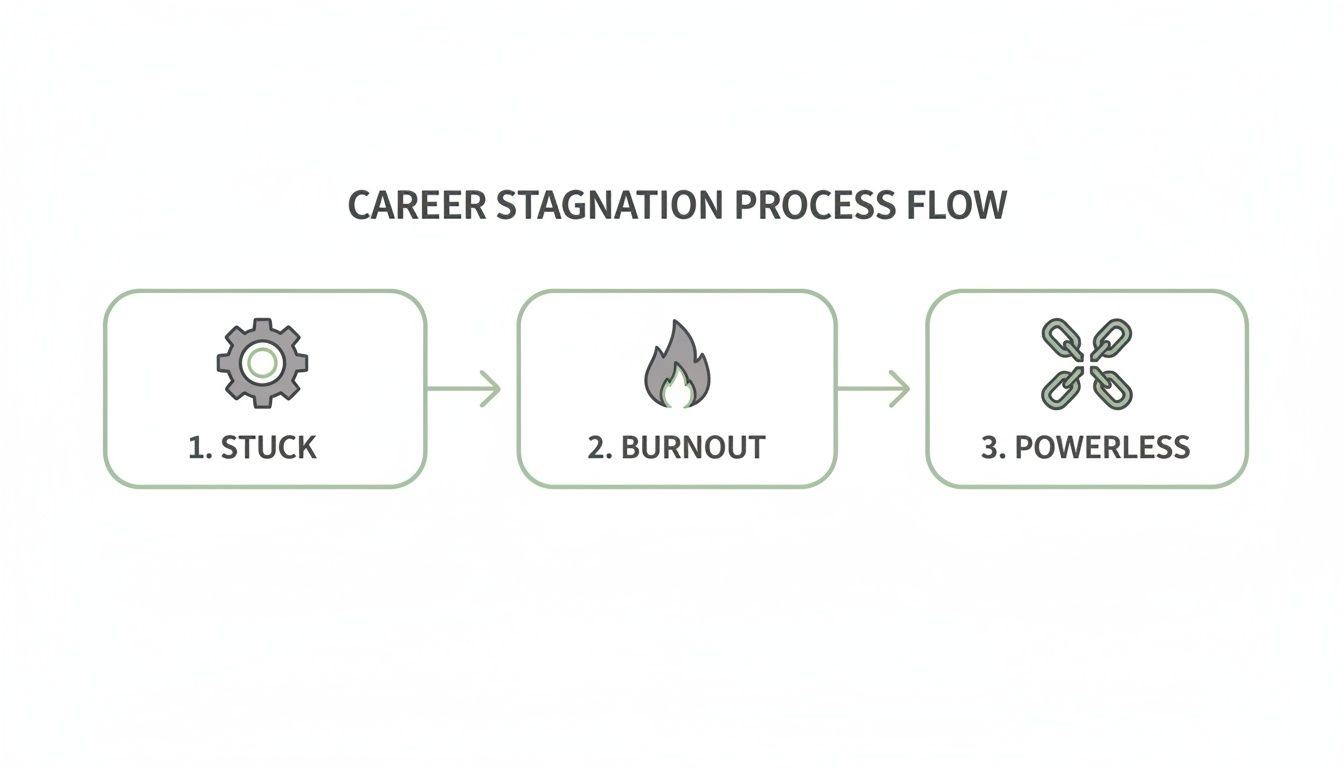
This visual shows the very trap the RAMS framework is designed to break, pulling you out of a reactive state and into a proactive, strategic one.
M is for Mastery: Showcase Your Deep Expertise
While Attitude is about your presence, Mastery is about your substance. This is where you prove your deep expertise and, more importantly, articulate a vision for how that expertise can drive the company forward. This goes beyond just being good at your job.
Demonstrate your Mastery by:
Developing a Point of View: Share insights on industry trends and explain how they could impact your team.
Mentoring Others: Actively coach junior team members. This showcases your ability to elevate the entire group's performance.
Identifying Future Opportunities: Propose new initiatives that align with the company's long-term strategy. Show you're thinking three steps ahead.
When you ask for a promotion, you are selling your future vision. Mastery proves that your vision is built on a rock-solid foundation of expertise. Resources on Mastering Personal Branding for Executives can be incredibly valuable here.
S is for Systems: Build Scalable Value
The final pillar, Systems, separates a high-performer from a strategic leader. A true leader builds processes that allow results to be replicated and scaled, even without their direct involvement. This is how you directly counter the "Performance Punishment" trap. You create a legacy that functions without you, freeing you up to take on bigger challenges.
What does system-building look like?
Creating an onboarding process that cuts ramp-up time for new hires by 30%.
Developing a project management template that slashes errors.
Documenting a key workflow that was previously just "tribal knowledge."
When you show you can build scalable systems, you prove you're not just a doer; you're an architect. To dive deeper into this concept, exploring our full guide on the RAMS method can show you how this coaching framework leaves traditional models behind.
Promotion Pitch Comparison: RAMS™ vs. Traditional
The difference between a weak, effort-based ask and a strong, RAMS-based business case is night and day. One is a request; the other is an investment opportunity.

The strong pitch is undeniable. It's not about what you feel you deserve; it’s about the value you have proven you can create. This is how you negotiate from a position of power.
How to Navigate the Promotion Conversation
You’ve built your business case. Now comes the moment of truth: the conversation itself. This isn't a confrontation; it’s a strategic meeting where you walk in with calm, grounded confidence.

Strategic Timing
Timing is everything. Broaching the subject at the right moment can dramatically increase your odds.
The ideal moments are:
Immediately After a Major Win: Capitalize on the momentum right after you’ve delivered a high-visibility project.
During Annual Reviews or Budget Planning: Leadership is already thinking about resource allocation and future growth.
Following Strong Company Results You Drove: Connect your contributions directly to that success.
Rehearsable Scripts for Opening the Conversation
How you kick off the meeting sets the tone. Practice these opening lines until they feel completely natural.
Script 1 (Direct Approach):
"Thanks for making the time. Based on my contributions to [key project] and the value I've delivered, I'd like to formally discuss a promotion to [Target Role]. I've prepared a brief overview of my impact and my vision for the position."
Script 2 (Collaborative Approach):
"I’m deeply invested in our team's future. I’ve focused on expanding my impact, as you saw with [system you built]. I’d like to discuss how we can formalize that expanded responsibility and align my role with the value I’m now creating, specifically by moving into the [Target Role] position."
Both scripts anchor the conversation in your value and future potential. True confidence here comes from practice. Our guide on how to be assertive at work offers deeper strategies for owning your voice.
Handling Common Objections with Poise
Objections aren't rejections. They're requests for more information. Your RAMS case has already prepared you to handle them.
Objection 1: "It's just not in the budget right now."
This is the classic go-to. Shift their thinking from cost to investment.
Your Rebuttal: "I understand budget constraints. Could we look at the ROI of my work on [Project X], which saved the company [$Y]? I'm confident the return on this promotion will far exceed the investment. Can we explore a timeline for this when the next budget cycle opens?"
Objection 2: "We need you where you are. You're too valuable in your current role."
This is "Performance Punishment." Showcase the systems you’ve built that make your transition seamless.
Your Rebuttal: "I appreciate that, which is why I developed [system or process] to ensure a smooth handover. This system guarantees my current responsibilities will continue running effectively, freeing me up to drive even greater value in the [Target Role]."
Data from a 2025 analysis found that 54% of women negotiated their salary offers compared to just 44% of men, flipping old stereotypes. Assertiveness is the new norm, making these skills more critical than ever. You can explore more trends and their impact on global salary budgets in this detailed report.
Defining Your Path: The Return to Yourself
The meeting is over. Regardless of the outcome, the real win already happened, you advocated for yourself. This was never just about winning or losing; it was about reclaiming your power and returning to yourself. It’s time to detach your self-worth from their decision and focus on your own professional sovereignty.
When the Answer Is Yes
First, celebrate. You built a case, navigated a tough conversation, and succeeded. Now, transition from advocate to architect.
Get it in Writing: Immediately send a follow-up email summarizing the new title, salary, responsibilities, and start date.
Architect the Transition: Proactively suggest a plan for handing off your current duties. This reinforces your strategic thinking.
Set Your 90-Day Goals: Work with your manager to define what success looks like. You're already focused on delivering next-level value.
Getting a 'yes' isn't the finish line. It's the starting pistol.
When the Answer Is No or Not Now
Hearing ‘no’ can feel like a gut punch. Feel the disappointment for a moment, but do not let it define you. Their answer isn't about your worth; it's a reflection of their priorities. Your job is to turn their vague response into a concrete action plan.
This is the critical pivot point. You shift from asking for permission to creating a clear, non-negotiable path forward.
Request a follow-up to establish a formal development plan. Ask direct questions:
"What specific skill gaps do I need to close or results do I need to deliver to be ready for this promotion?"
"Can we create a written plan with measurable milestones for the next 90 days?"
"If I successfully meet every goal, can we agree to revisit this on [Specific Date]?"
If they hesitate or refuse to commit to a tangible plan, you have your real answer. A fuzzy "just keep up the good work" is a signal that there is no real path for you here. This isn’t failure; it’s redirection. It's the data you need to build your exit strategy. Understanding how to navigate office politics is essential here.
Ultimately, this process was about coming back to your nervous system. You are the CEO of your career. You now have the information you need to make your next powerful decision—whether inside this company or with one that sees your value without question.
At Baz Porter, we know that real leadership isn't about asking for permission. It's about building such an undeniable case for your value that the right opportunities become inevitable. If you're done waiting to be recognized and are ready to architect your career with sovereign confidence, it's time to return to yourself.
Discover how we help high-achieving women master these dynamics and build careers that truly align with their power. The first step isn't a sale; it's a diagnostic to uncover what's really holding you back. Learn more at https://bazporter.com.