How to Negotiate Salary When a Range Is Posted (And Why You Must)
You see the job posting. It's the role you’ve been working toward. But then you see it: the salary range. A knot tightens in your stomach. Your mind starts racing, caught between two fears: asking for too much and being seen as demanding, or asking for too little and confirming a deep-seated fear that you’re not worth the top number. This isn't just about money. It's a moment that puts your professional value on trial, and your nervous system is on high alert.
Key Takeaways
Your Real Worth vs. The Posted Range: A posted salary range is not the final word; it's the start of a conversation. Companies often build in flexibility, and the top of the range is rarely the absolute maximum for an exceptional candidate.
The RAMS™ Framework for Justification: To negotiate effectively, you need a business case. The RAMS™ Framework (Results, Attitude, Mastery, Systems) provides a structured way to prove your value beyond the job description, justifying a salary at or above the high end of the range.
Beyond Base Salary: A "no" on your base salary request is not the end. Pivot the negotiation to other valuable forms of compensation like sign-on bonuses, guaranteed performance bonuses, equity, or an accelerated 6-month performance review.
The Cost of "Playing It Safe": The impulse to accept a mid-range offer is often a conditioned survival response. This "agreeableness" can cost women leaders between $500,000 to $1 million over a lifetime due to the compounding effect of lower starting salaries.
Why Settling for the Middle Is a Trap
That familiar knot of anxiety tightens. You see the numbers—a range that feels both promising and strangely limiting. A quiet voice inside whispers, “Just be happy with the offer. Don’t be difficult.” This is the silent collapse, the internal battlefield where high-achieving women lose ground. It’s the constant tug-of-war between the pressure to be agreeable and the gut feeling that your track record, your expertise, and your sheer grit demand more.
Negotiating when a salary range is posted is not just about getting more money; it's about aligning your compensation with the undeniable value you have already proven. It requires shifting from an anxious "ask" to a grounded, strategic discussion based on your impact.

This moment is about so much more than just the money. It's a critical juncture where your nervous system is reacting to years of subtle, societal conditioning. The impulse to accept a mid-range offer isn’t a sign of weakness; it’s a deeply ingrained survival response. For women navigating demanding fields, we’re often taught that being "easy to work with" is a form of professional currency.
But this instinct comes at a steep, often hidden, price.
The Long-Term Cost of Playing It Safe
Playing it safe doesn't just affect your next paycheck; it creates a ripple effect that compounds over your entire career. Women face a significant negotiation raise gap, securing an average of 15% increases compared to men's 19.7%. This disparity, often fueled by the pressure to accept initial offers, can snowball into a lifetime earnings loss of $500,000 to $1 million.
This negotiation isn't just about a number. It's about breaking a lifelong pattern of undervaluing your contribution and reclaiming the power you've already earned. It's an act of aligning your compensation with your true impact.
The internal dialogue is often the biggest hurdle we face:
"What if they think I'm greedy?"
"The top of the range must be for a unicorn candidate."
"I don't want to lose the offer by asking for too much."
These thoughts are the real trap, not the salary range itself. They keep you stuck in a cycle of constantly proving your worth instead of simply assuming it. The stark statistics on women in leadership roles reveal just how systemic these challenges are.
This guide is designed to help you dismantle that internal barrier. We'll reframe this moment not as a confrontation, but as a strategic alignment of value. Your goal isn't to "win" a negotiation—it's to secure compensation that accurately reflects the powerhouse leader you are.
How To Decode The Posted Salary Range

When you see a posted salary range, it’s tempting to see it as a rigid box. That’s a mistake. A salary range isn't a final decree; it's the opening move in a strategic conversation about your value.
The numbers you see rarely tell the whole story. So many high-achievers I've coached fall into the trap of assuming the top of the range is an absolute maximum—a figure reserved for some mythical, perfect candidate. This single misconception can cost you tens of thousands of dollars.
Your negotiating power begins the moment you understand that a company's posted range is often just a peek into their actual budget.
Reading Between The Numbers
Even with pay transparency laws, a posted salary range might not reflect the full picture. Savvy negotiators know there's almost always room to push higher based on the unique value they bring to the table.
This gap exists for a few key reasons. Companies build in flexibility to attract exceptional talent, manage internal equity, and, most importantly, leave room for negotiation—a dance they fully expect, especially for leadership roles.
The numbers themselves are sending signals. A very wide range (say, $150K - $250K) suggests the role is flexible or they're open to molding it around the right person. A narrow one (like $180K - $200K) points to a more structured, data-driven compensation system. It doesn't eliminate negotiation, but it does change your approach.
The midpoint of the range is not your target. It's the company's baseline for a candidate who just checks the boxes. Your job is to prove you're not just checking boxes—you're rewriting them.
Understanding these nuances is everything. To go deeper on this, you might find our guide on the core principles of negotiating a powerful resource.
What The Range Reveals About The Company
Each type of salary range tells a different story about a company’s maturity and flexibility. Your ability to interpret these signals allows you to tailor your entire negotiation strategy before you even pick up the phone.
The table below breaks down what these different ranges signal and how you should adjust your game plan accordingly.
Interpreting Salary Range Signals
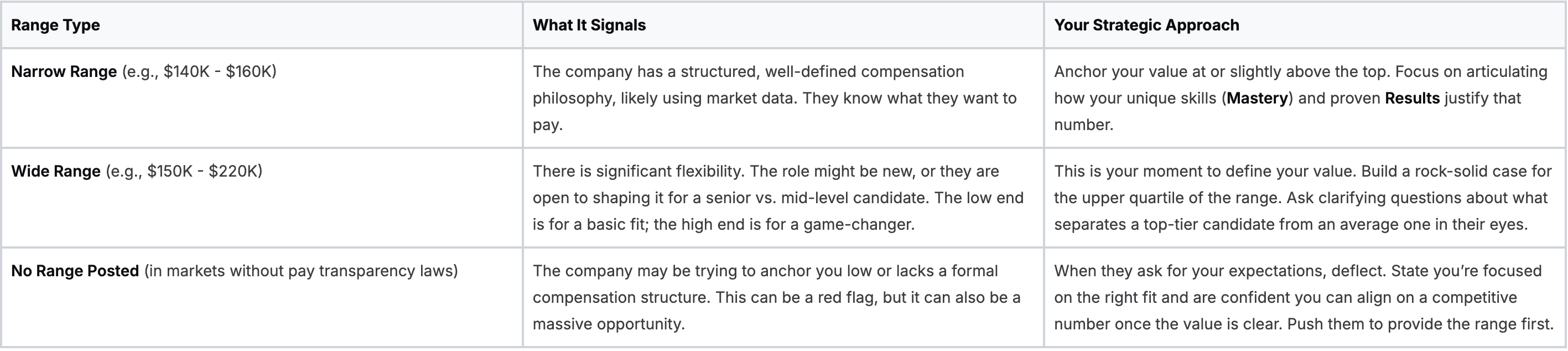
Once you start recognizing these patterns, you shift from a reactive candidate to a proactive, strategic partner. You're no longer just applying for a job; you are evaluating a business opportunity on your terms. This mindset shift is the key to successfully negotiating your worth, with or without a posted range.
Building Your Case With The RAMS™ Framework
The moment you stop asking for more money and start aligning your compensation with the value you’ve proven, the entire negotiation changes. You're no longer a candidate hoping for a "yes." You are a strategic partner, and you’re here to demonstrate an undeniable return on investment.
This is exactly where the RAMS™ framework becomes your weapon. It’s a simple, powerful structure for building an unshakeable business case for your target salary. It moves the conversation away from their budget constraints and squarely into the realm of your impact.
The framework stands on four pillars: Results, Attitude, Mastery, and Systems.
R is for Results
This is the absolute foundation of your argument. It’s where you trade vague claims for cold, hard, quantifiable achievements. Your past performance is the single most reliable predictor of your future success, and your job is to paint a crystal-clear picture of what that success looks like.
Don't say, "I have experience leading teams."
Instead, say, "I led a cross-functional team of 12 to launch a new product line, which captured a 7% market share and drove $2.4M in revenue in its first year." See the difference?
Financial Impact: Did you increase revenue, slash costs, or boost profit margins? Use percentages and dollar amounts.
Efficiency Gains: Did you streamline a process that saved time or resources? Quantify it. Talk about hours saved per week or a percentage jump in output.
Growth Metrics: Did you expand a client base, increase user engagement, or improve customer retention rates? Use the numbers.
This isn't bragging; it's providing evidence. Every single leader I coach who successfully negotiates above the posted range does so by leading with undeniable, quantified results.
A is for Attitude
In a leadership context, "attitude" isn't about being nice. It’s about your executive presence, your problem-solving mindset, and your ability to handle intense pressure with grounded confidence. It's the intangible quality that makes people want to work with you and for you.
You demonstrate this quality in how you navigate the interview process itself.
Are you flustered by tough questions, or do you see them as an opportunity to showcase your strategic thinking? Your calm, assertive demeanor during the negotiation is a live demonstration of the leadership attitude you'll bring to the role.
This is also where your assertiveness muscle comes into play. Communicating your value clearly and confidently—without apology or aggression—is a skill. For leaders looking to strengthen this, learning how to be more assertive at work can be a total game-changer. It reframes self-advocacy as a core leadership competency.
M is for Mastery
Mastery is all about your unique, differentiated skills. What do you know, or what can you do, that is rare and in high demand? This could be technical expertise in a booming field like AI, or a deep, nuanced understanding of a specific market niche.
You have to think beyond the job description. The company might be hiring a "Director of Marketing," but it's your specific mastery in performance marketing analytics for B2B SaaS companies that makes you an invaluable asset, not just another qualified candidate.
Experiential Proof: A client of mine, a leader in the tech space, was interviewing for a VP role with a posted range of $220K-$250K. Her specific mastery was turning around underperforming sales teams. She didn’t just talk about her experience. She presented a mini-analysis of the company's publicly available sales data and outlined a 90-day plan to attack a key weakness she’d already identified. She anchored her ask at $285K and got it. Why? Because she didn't just claim mastery—she demonstrated it.
S is for Systems
This is the element that truly separates senior leaders from individual contributors. It’s not just about what you can do personally; it's about your ability to create scalable processes that deliver lasting value long after you've moved on to the next project.
Systems-thinking proves you are a force multiplier.
Do you have a methodology for building high-performance teams? A framework for entering new markets? A repeatable process for innovation? These are the systems a company is really investing in when they hire you. When you can articulate how you build these systems, you justify a top-of-the-market salary. You're not just one hire—you're an engine for organizational growth.
Even with pay transparency laws, 78% of new hires who negotiate still secure better offers. Recruiters are even reporting a 75% surge in candidates initiating these crucial talks. You can find more insights in the latest salary negotiation statistics. The data is clear: even with posted ranges, building a powerful case with a framework like RAMS™ is what makes all the difference.
Your Actionable Negotiation Playbook
Real confidence isn't about blind courage; it’s built through meticulous preparation. This is your playbook for navigating a salary negotiation when the company has already posted a range. It’s packed with specific scripts and email templates to guide you through every critical moment.
We’re going to get practical. You’ll learn how to handle that initial recruiter screen with poise, when and how to state your expectations to anchor the conversation high, and what to do when they hit you with the classic, "the budget is fixed." This is about giving you the exact language to articulate your immense value.
Scripting Your Initial Recruiter Conversation
That first call is everything. Your goal isn't to agree on a number. It's to build rapport and frame your value before the numbers even hit the table. When the recruiter inevitably asks about your salary expectations, know that it's a test.
Here’s how you ace it.
The strategy is simple: Acknowledge their question, but gently pivot away from giving your number first. Instead, you’ll re-center the conversation on your value and prompt them to share the company's approved budget.
Example Script:
Recruiter: "So, what are your salary expectations for this role?"
You: "That's a great question. From what I’ve learned so far, this role seems like a fantastic fit for my background in [mention a key skill from your Mastery]. Right now, my main focus is making sure this is the right opportunity for both of us. To help with that, could you share the approved compensation range for this position?"
This isn’t combative; it's collaborative. It positions you as a strategic thinker who ties pay to performance and value, immediately elevating your standing in their eyes.
Anchoring Your Value At The Top
Once they share the range, your next move is to anchor your position at the top. This means establishing the high end of their range as your starting point, not your goal. This isn't just wishful thinking; it's a proven strategy.
Proactively anchoring at the top of a posted range, backed by solid market data, has led to an average raise of 18.83% for negotiators. This tactic turns their stated range into your launchpad. You can see more on how this proactive approach completely changes the outcome in recent salary negotiation data.
Example Script for Anchoring High:
"Thank you for sharing that. The range of $180,000 to $200,000 is helpful. Based on my proven track record of delivering [mention a key Result] and my deep Mastery in [mention a specific skill], I’m targeting the top of that range and slightly above, depending on the full scope of the role and the total compensation package."
This statement does three things perfectly:
It validates their numbers.
It immediately justifies your position using your unique value (the RAMS™ framework in action).
It signals that you're thinking about the entire package, not just base salary.
Countering The "Budget Is Fixed" Pushback
It’s almost inevitable. Sooner or later, you'll hear it: "Our budget is firm," or "The top of the range is the absolute maximum we can offer."
Do not mistake this for the end of the conversation. It's actually an invitation to get creative and reinforce your business case. This is where you pivot from talking about your needs to talking about their problems and exactly how you solve them.
Email Template for Countering a Firm Offer:
Subject: Re: Offer for [Job Title]
Dear [Hiring Manager Name],
Thank you so much for the formal offer. I am incredibly excited about the prospect of joining the team and contributing to [Company Goal].
Regarding the compensation, I genuinely appreciate the offer of $200,000. As we discussed, my unique background in [mention a System you've built] will allow me to directly impact [mention a key business problem] from day one. Because of the specific, high-impact value I’m prepared to deliver, I was confidently targeting a base salary of $215,000.
I am confident that we can find a path forward that reflects this value. Would you be open to a brief conversation to explore how we can bridge this gap?
Best regards,
[Your Name]
Notice the tone here. It's collaborative, framing it as a mutual problem to solve. For a deeper dive into crafting these critical communications, check out our complete guide on how to negotiate salary by email.
Expanding The Negotiation Beyond Salary
What if the company truly cannot move on base salary? Don't panic. Pivot.
This is your opportunity to demonstrate your sophisticated understanding of executive compensation. Total compensation is a package, not a single number. Shift the conversation to other valuable levers.
This is where the RAMS™ framework becomes your guide for articulating your value and justifying a higher overall package.

The flow from your past Results to the Systems you build shows a clear progression from what you've done to how you create lasting value—a powerful justification for a more creative compensation structure.
Consider these non-salary items to negotiate:
Sign-On Bonus: A one-time payment is often the easiest way for a company to bridge a first-year compensation gap without breaking salary bands.
Performance Bonus: Negotiate for a higher target percentage or, even better, a guaranteed payout for your first year.
Equity or RSUs: For high-growth companies, this can be far more valuable than cash in the long run. Don't be afraid to ask for a larger grant.
Professional Development Budget: Secure funding for certifications, coaching, or executive education that enhances your Mastery and, in turn, your value to them.
Early Performance Review: Ask for a 6-month review for a potential salary increase, rather than waiting a full year. This puts an accelerated path to your target number on the table.
When you prepare with these scripts, strategies, and a crystal-clear understanding of your RAMS™-based value, you transform the negotiation. It ceases to be a source of anxiety and becomes an opportunity to demonstrate the very leadership qualities they want to hire.
Aligning Your Compensation With Your True Value
Let's be clear: the real win in a salary negotiation isn't just about the final number. It’s about something much deeper. It’s about achieving nervous-system sovereignty—that grounded confidence you feel when your compensation finally aligns with your true professional contribution and personal worth.
This whole process is more than a transaction. It’s a powerful, tangible act of self-advocacy.
Far too many high-achieving women are stuck in a state of adrenalized performance. They're constantly proving their value, delivering incredible results, and simultaneously battling crippling burnout. Negotiating from a place of grounded certainty is the antidote. It flips the script from an anxious "Am I asking for too much?" to a calm, convicted "This is what my impact is worth."
This is the moment all your preparation—the market research, the RAMS™ framework, the scripted conversations—comes together. You’re no longer fighting for scraps. You’re leading a collaborative discussion to ensure your compensation accurately reflects the powerhouse leader you are.
Beyond the Paycheck: The Sovereignty Win
When your salary mirrors your contribution, you create a powerful buffer against the resentment and exhaustion that inevitably build when you feel under-compensated. True value alignment frees you to focus on what you do best: leading, innovating, and driving results. This isn't just about feeling good; it's a strategic move for long-term career sustainability and impact.
The ultimate goal is to build a career that is not only successful but deeply fulfilling. This negotiation is a critical step toward embodying the kind of authentic power that makes that possible.
When you advocate for your full value, you send a clear message to yourself and your new employer: your worth is non-negotiable.
The Full Picture of Your Worth
Remember, your worth isn’t just your base salary. A major mistake I see leaders make is hyper-focusing on that one number. When you’re assessing your value and preparing to negotiate, you have to look at the complete picture.
This means considering the full scope of your total employee compensation. Think about:
Performance bonuses
Equity or stock options
Health and wellness benefits
Professional development opportunities and budget
Retirement contributions
Adopting this holistic view empowers you to structure a package that truly serves your long-term personal and financial goals.
This negotiation is a microcosm of the leadership you will bring to the role. It’s a live demonstration of your strategic thinking, your confidence, and your ability to create win-win outcomes. It reinforces your personal brand as a leader who operates from a place of strength and integrity.
By mastering this skill, you're not just securing a better offer. You're taking a definitive step toward building a career on your own terms, free from the silent drain of feeling undervalued. It's a return to yourself—a leader who is both powerful and whole.
And if you're also eyeing an internal move, the strategies in our guide on negotiating for a promotion offer complementary insights.
Your Burning Questions, Answered
Even with a solid playbook, the heat of the moment can bring up questions that test your confidence. Negotiating against a posted salary range has its own unique minefield. Let’s tackle the most common tripwires so you can navigate these conversations with absolute clarity and poise.
What If The Recruiter Asks For My Number Before They’ve Shown Theirs?
Ah, the classic opener. This is a deliberate tactic designed to get you to anchor yourself low. Don't fall for it. Your job here is to gracefully sidestep the question while keeping the tone collaborative. You want to pivot the conversation back to mutual fit and make them reveal the range first.
Your response needs to be both confident and strategic.
"Right now, my main focus is on making sure this is a fantastic mutual fit for both of us. From what I’ve seen, a [Job Title] role with this level of responsibility in [Industry/Location] has a certain market value, and I’m confident we can land on a competitive number if we agree it’s the right move. Could you share the approved compensation range for this position?"
This script is your power move. It does three things perfectly:
It protects your leverage by not throwing out the first number.
It frames the eventual salary discussion around objective market value and responsibility, not just what you personally want.
It politely but firmly puts the ball back in their court, tasking the recruiter with providing the budget they already have.
Is It Ever a Bad Idea to Negotiate a Posted Range?
Almost never. In today's professional world, especially for leadership roles, negotiation isn’t just accepted—it's expected. Choosing not to negotiate can be misinterpreted. It can signal a lack of confidence or an unawareness of your own market value.
The only real exception is for highly structured, non-negotiable roles, like certain government jobs or union positions with rigid pay scales. But for nearly any corporate leadership role, a posted range is an explicit invitation to a conversation. In fact, recruiters have seen a 75% surge in candidates opening up these discussions, and they see it as a mark of a confident professional.
How Do I Handle a Final Offer That’s Still Below My Target?
Getting an offer that doesn't hit your mark is disappointing, but it's not the end of the road. This is a critical moment. Your reaction is a powerful demonstration of your leadership presence.
First, always start with gratitude. Then, calmly and confidently restate the value you bring, connecting it directly to your target number.
You could say something like this:
"Thank you so much for extending this offer. I am genuinely excited about the opportunity to contribute to [mention a specific company goal or project]. Based on the unique value I’ll deliver, particularly my experience in [mention a key skill or result from your RAMS framework], I was targeting a base of [Your Target Number]. Is there any flexibility to get closer to that figure?"
If they hold firm on the base salary, it’s time to pivot. Shift the conversation to other levers of compensation. Ask about a sign-on bonus, a higher performance bonus target, or even an early six-month review for a salary adjustment.
If the overall gap is still too wide, you must be prepared to walk away. This isn’t a failure. It is the ultimate act of sovereign leadership—valuing yourself and honoring your worth.
At Baz Porter, we believe that aligning your compensation with your contribution is a foundational act of sovereign leadership. If you're ready to stop feeling undervalued and start leading from a place of grounded, authentic power, we invite you to take the first step. Take our diagnostic to identify your leadership burnout archetype and begin your return to yourself. Explore more at https://bazporter.com.