
How to Be Assertive at Work (Without Being Aggressive)
Have you ever walked out of a meeting and immediately thought of the brilliant idea you never shared? Or maybe you’ve said “yes” to yet another weekend project, feeling that all-too-familiar pit of resentment forming in your stomach as you realize your own priorities just got pushed aside. Again. If I stop performing, if I stop being agreeable, I’ll disappear. This is the silent collapse so many high-achieving leaders experience, a slow, quiet erosion of confidence and career momentum that comes from not speaking up.
Key Takeaways
Your Brain is Wired to Please: Understand that your hesitation to be assertive isn't a character flaw. It's the brain's ancient "freeze or fawn" threat response, a survival mechanism that mistakes workplace conflict for a genuine danger.
Assertiveness is a Learnable Skill: You'll see that assertiveness isn't a personality trait you're born with. It's a skill that can be systematically learned and practiced through a clear framework.
The RAMS Framework is Your Blueprint: Discover the five pillars, Results, Attitude, Authenticity, Mastery, and Systems (RAMS), that provide a repeatable method for setting boundaries, handling pushback, and communicating with authentic impact.
Word-for-Word Scripts Build Confidence: Get access to practical, real-world scripts for navigating tough conversations like declining work, voicing dissent, and giving feedback with grace and authority.
Being assertive at work is the skill of communicating your needs, boundaries, and ideas with clarity and respect. It's about shifting from passive agreement to proactive leadership, allowing you to showcase your true value without compromising your integrity or relationships.
The Hidden Pattern—Why Your Brain Defaults to People-Pleasing
If you've ever felt that tight knot in your stomach right before saying "no," or heard yourself rambling to soften a direct request, you're not alone. That physical reaction isn't a character flaw or a sign of weakness.
It’s your brain’s ancient survival wiring kicking into gear. It’s like trying to drive a high-performance race car using a map from the Stone Age. Getting a handle on this hidden pattern is the first real step toward reclaiming your authority at work.
Deep inside your brain, a tiny, almond-shaped structure called the amygdala acts as your 24/7 threat detector. Its one and only job is to keep you safe by scanning for danger and hitting the alarm bell.
For our ancestors, this system was a lifesaver, firing up when a predator was lurking. The problem is, in the modern workplace, your amygdala often mistakes social and psychological stress for a genuine life-or-death situation.
The Modern Threat Is Social Rejection
Think about it. An unexpected project lands on your desk at 4:55 PM on a Friday. Your manager gives you some vague, critical feedback that leaves you guessing. You’re in a high-stakes meeting and you know you need to disagree with a senior leader.
Your amygdala doesn't know the difference between these moments and a tiger in the grass. It just screams DANGER.
This perceived threat unleashes a flood of physiological reactions designed for one thing: survival.
The Freeze Response: This is when you go completely blank in a meeting, can’t find the right words, or just stay silent even when you have something brilliant to add. Your system is paralyzed by the perceived social risk.
The Fawn Response: This is the heart of people-pleasing. It’s an instinctual attempt to appease the "threat" by becoming overly agreeable, helpful, and accommodating. You say yes to work you don’t have time for. You apologize for things that aren’t your fault. You put everyone else’s comfort ahead of your own needs.
"The nice person lives an 'unlived' life. They don’t call their own plays. Their course in life is chosen by other people. They 'go along' with the crowd."
At its core, this is a subconscious strategy to avoid social rejection. Your brain interprets being disliked or causing conflict as a threat to your standing within the "tribe" your team, your company. Your nervous system is choosing short-term safety (keeping the peace) over your long-term advancement (being assertive).
How This Becomes a Conditioned Response
This freeze-or-fawn cycle gets stronger over time. Each time you default to silence or say "yes" when you mean "no," you successfully avoid immediate conflict. Your brain registers this as a win: that behavior kept me safe.
This creates a powerful feedback loop that reinforces passive behavior, making the cycle harder and harder to break.
The inner monologue starts to sound painfully familiar:
"If I push back, they'll think I'm difficult."
"It's just easier to do it myself than to start something."
"If I say no, I’ll get shut out of the next big opportunity."
Constantly negotiating with your own survival instincts is exhausting. It also puts a hard ceiling on your professional growth.
Recognizing that you’re up against a biological impulse, not a personal failing, is the game-changing first step. It shifts the question from, "What's wrong with me?" to "How can I work with my nervous system?" If you want to go deeper on this, you can learn more about how to overcome the fear of being disliked and see how much it's really holding you back.
By understanding the "why" behind your people-pleasing habits, you can finally start to consciously choose a different response. The goal isn’t to kill the fear. It's to learn how to act with clarity and conviction even when it shows up.
The RAMS Reframe—Mastering the Four Pillars of Assertive Communication
Okay, so we've looked at the biology behind why we slip into people-pleasing. Now, let's get into the practical, rubber-meets-the-road stuff: how to actually become more assertive.
Real assertiveness isn't about a single killer comeback or one power pose. It’s an entire operating system. It’s about knowing what you want, getting your head in the right space, using the right tools, and having a playbook for when things get tough.
This is exactly what the RAMS framework is built for. It’s a practical, four-pillar model I’ve developed to help you build authentic assertiveness from the ground up, making it a natural part of who you are.
Pillar 1: Results — Define Your Outcome First
The very first move in assertive communication has nothing to do with what you say. It’s all about what you want to achieve. Before you even think about opening your mouth, you need absolute clarity on your desired outcome.
Think about it. Passive communicators walk into conversations just hoping to keep the peace. Aggressive communicators barrel in trying to win at all costs. But an assertive leader? She walks in with a clear, specific result in mind.
This simple shift from focusing on the interaction to focusing on the outcome, is a complete game-changer. It anchors you. When the conversation gets tense or you feel those old people-pleasing patterns creeping in, your desired result becomes your North Star, pulling you forward.
Before your next big conversation, grab a pen and answer these questions:
What is the single most important thing I need to get across?
What does the ideal resolution look like from my perspective?
What is the non-negotiable boundary I absolutely must establish here?
Having these answers grounds you in purpose. It makes it so much easier to choose your words with intention instead of just reacting out of fear.
Pillar 2: Attitude — Shift Your Internal Narrative
Your internal dialogue dictates everything. The second pillar, Attitude, is all about consciously rewriting the story you tell yourself about what it means to be assertive.
So many of us high-achieving leaders have been conditioned to believe that setting a boundary or stating a direct opinion makes us "difficult," "demanding," or "not a team player." This is the toxic internal narrative that fuels the fawn response we talked about.
An assertive attitude reframes this completely.
You are not being difficult; you are creating clarity. You are not being demanding; you are defining reality. You are not being uncollaborative; you are contributing to a better outcome for everyone.
You have to start seeing your assertiveness as an act of service, to your team, your projects, and your own professional integrity. It cuts through the fog, prevents misunderstandings, and gets everyone operating from the same set of facts.
To truly master this, you have to build up the inner strength to manage your reactions and stay composed under pressure. It's crucial to learn how to build mental resilience and thrive through adversity. This inner work is the foundation for your new, powerful attitude.
Pillar 3: Mastery — Wield the Tangible Tools
Once you know your desired result and you’ve reframed your attitude, it's time to get into the mechanics. Mastery is about the "how" the specific verbal and non-verbal tools you use to deliver your message with quiet conviction.
This pillar is where you learn to embody your assertiveness. It’s not just what you say; it’s how your entire presence backs it up.
The key components here are:
Vocal Tone: Speaking from your diaphragm with a steady pace. You want to avoid "uptalk," where your sentences end on a high note like a question. A calm, even tone signals confidence.
Body Language: Maintaining an open posture and steady eye contact. Use deliberate hand gestures, but avoid fidgeting or shrinking, which telegraphs uncertainty.
Precise Language: Get comfortable with clear, direct "I" statements ("I need," "I believe," "My perspective is..."). At the same time, you need to ruthlessly eliminate weak, apologetic filler words like "just," "sorry, but," or "does that make sense?"
These are skills, and like any skill, they require practice. To go deeper on the nuances of powerful communication cues, our guide on executive communication skills training offers more advanced techniques.
Pillar 4: Systems — Create Repeatable Processes
The final pillar, Systems, is what makes assertiveness stick for the long haul. This is all about building repeatable processes for common challenges so you aren't reinventing the wheel every time you face a tough conversation.
A system is just a pre-designed response or framework you can pull out when you're under pressure. It removes the guesswork and the emotional labor from setting boundaries and dealing with pushback.
Here are a few systems that work like a charm:
The "Yes, and..." System for Declining Work: "Yes, I can absolutely see the value in that project, and my current top priority is delivering X by Friday. To take this on, which of my current tasks should we de-prioritize?"
The "Validate and Reiterate" System for Pushback: "I understand you're in a tough spot with this deadline (validate). My capacity for this week is fully committed to the Miller account (reiterate boundary)."
The "Time Buffer" System: Instead of giving an immediate "yes," make your default response, "Let me check my priorities and get back to you by the end of the day." This gives you space to respond thoughtfully instead of reactively.
These systems are your personal scaffolding. They support you while you build your assertive muscle, making sure you can show up with consistency and grace, even when you feel the pressure mounting.
Diagnosing Your Current Communication Style
Before you can effectively implement the RAMS framework, you need an honest look at your starting line. Most communication at work falls into one of three buckets: passive, aggressive, or assertive. Pinpointing your default pattern is the first real step toward consciously choosing a more effective one.
When we're stressed, our brain's threat response can kick in, often pushing us into a passive freeze-or-fawn reaction without us even realizing it.
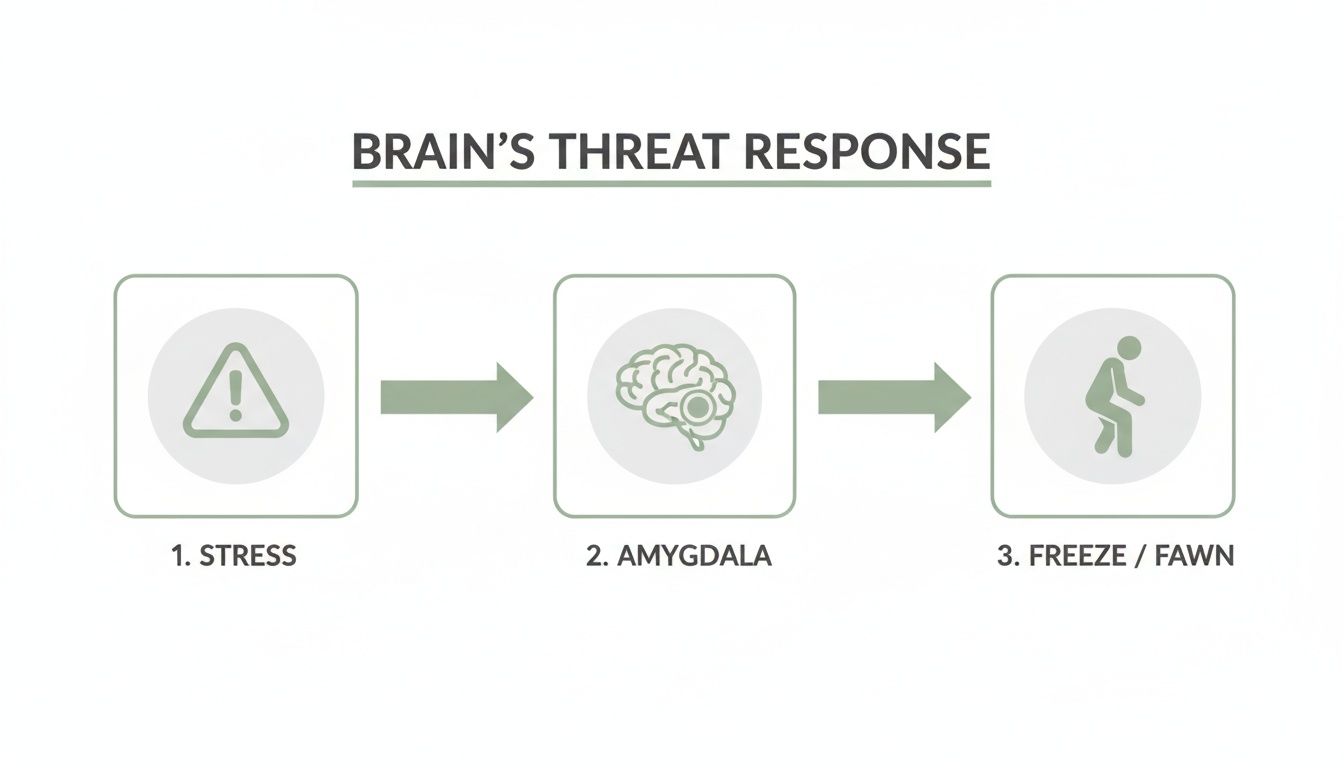
Understanding this neurological shortcut is key. It allows you to catch that impulse and consciously choose an assertive response instead.
So, where do you fall on the spectrum? This table breaks down the core differences. As you read it, be honest with yourself—which column feels a little too familiar?
Passive vs Aggressive vs Assertive Communication

A global survey from the Niagara Institute revealed that 75.3% of professionals naturally lean into an assertive communication style. Even more telling, this approach is directly linked to better outcomes, with 54% of them actively seeking win-win solutions during conflicts.
This data is powerful. It proves that assertiveness isn't some aggressive, outlier behavior. It's the dominant and most effective style used by successful leaders.
Real-World Scripts for Difficult Conversations
Knowing what you should say is one thing. Actually saying it when your heart is pounding and your palms are sweating? That’s a whole different ballgame.
The secret to staying grounded in those high-stakes moments isn't about having a perfect, memorized line. It's about having a framework a go-to structure that anchors you to your goal so you don't get derailed by emotion.
Think of the scripts below as starting points. They’re designed for those conversations you’d rather avoid, giving you a solid foundation you can tweak to fit your own voice and the specific situation you're facing. Each one is designed to move you from a place of internal panic to one of professional, grounded clarity.
Declining a New Project
This is where the people-pleasing instinct goes into overdrive. We’re terrified that saying "no" will make us look like we're not a team player or, worse, that we can't handle the work. The assertive approach flips this script entirely. It positions your "no" as a powerful "yes" to quality and your existing commitments.
The Fear Dialogue: “If I turn this down, they’ll think I’m slacking. I’ll get passed over for the next big thing. I’ll just have to suck it up and work all weekend… again.”
The Assertive Script: "Thank you for thinking of me for this. The project sounds important. Right now, my focus is dedicated to delivering [Project X] by its Friday deadline to ensure it meets our quality standards. To take this on, which of my current priorities should we reschedule?"
See what this does? It validates the new request, reaffirms your commitment to your current work (which your boss loves to see), and shifts the conversation from a simple yes/no into a strategic one about priorities. You're not a roadblock; you're a partner in finding the solution.
Voicing a Dissenting Opinion in a Meeting
Challenging an idea especially one from a senior leader, can feel like walking on a tightrope. Your brain is screaming "Danger!" But great ideas are forged in the fire of constructive debate. Healthy teams need people brave enough to offer a different perspective.
The key is to disagree with the idea, not the person, and to frame your point collaboratively.
The Fear Dialogue: “Everyone else is nodding along. If I say something now, I’ll look like a naysayer. They’ll think I’m not on board. It’s just safer to stay quiet.”
The Assertive Script: "I appreciate the perspective on [the topic]. I'm looking at this from a different angle. My concern is around [mention specific risk, e.g., resource allocation or timeline feasibility]. Could we explore an alternative approach that addresses that?"
This simple script is incredibly effective. You start by validating their point before introducing yours. Using "my concern is" makes it about your perspective, not an attack. And ending with a question reopens the floor for collaboration instead of shutting it down.
Being assertive isn’t about winning the argument. It's about ensuring the best idea wins by making it safe for all perspectives to be heard and considered.
Delivering Constructive Feedback
This might be one of the toughest leadership tasks out there. You’re worried you’ll demotivate your team member, damage your relationship, or spark a defensive reaction. An assertive approach cuts through the awkwardness by being specific, focusing on observable behavior (not personality), and opening the door for a two-way conversation.
This skill is crucial in all high-stakes communication, and it's something you can learn, just like you can learn how to answer difficult interview questions like a pro.
The Fear Dialogue: “Ugh, this is going to be so awkward. They’re going to get defensive and think I’m a jerk. Maybe I’ll just soften the message so it doesn’t sting so much.”
The Assertive Script: "I'd like to talk about the client presentation this morning. While your research was excellent, I noticed the final slides weren't formatted to the company template. This affects the professional image we present. What challenges did you run into with the template?"
This script hits all the right notes. It's direct, specific, and non-judgmental. It separates the person from the behavior ("your research" vs. "the slides") and clearly states the impact of the issue. Most importantly, that final question turns a potential critique into a coaching opportunity.
The Return—How to Handle Pushback Like a Leader
When you start communicating more assertively and drawing clear lines, don't expect a parade. Some colleagues, and even leaders, are so accustomed to your old, accommodating ways that your newfound clarity can feel… jarring.
This pushback isn't a sign you’re doing something wrong. It's often the opposite. It’s a sign you are successfully recalibrating what others can expect from you.
Remember, assertiveness isn't about winning every argument or always getting your way. It’s about holding onto your self-respect and professional composure, no matter what the outcome is. This is nervous-system sovereignty in action.
Strategies for Navigating Disagreement
When you’re met with resistance, your nervous system might scream "Danger!" and tempt you to retreat into old people-pleasing habits. This is where having a plan becomes your anchor. Instead of reacting emotionally, you can respond with intention.
Here are two battle-tested techniques for managing pushback with grace and strength:
The Broken Record Method: This is about calmly and firmly repeating your point without getting sucked into arguments or long justifications. If a colleague keeps trying to push a task on you that you’ve already declined, you simply repeat your core message: "As I mentioned, my priority is completing the Q3 report. I don't have the capacity for that right now." The key is a neutral tone and a consistent message.
Empathetic Validation: This technique is incredibly powerful for de-escalating tension. You start by acknowledging the other person’s reality before restating your own. For example: "I understand you're in a tight spot with this deadline, and I appreciate you thinking of me. My capacity, however, remains focused on the Miller account this week." You show them they’ve been heard, but your boundary stands firm.
The goal isn't to make the other person comfortable with your boundary. The goal is to make yourself comfortable holding it, even when they aren't.
Building Your Assertive Muscle
This is a skill. And like any skill, it takes practice. You wouldn't walk into a gym for the first time and try to deadlift 300 pounds. The same logic applies here.
Start small, in low-stakes situations. Practice stating your preference for a lunch spot. Offer a brief, alternative viewpoint in a casual team meeting. These small wins build your "assertive muscle" and your confidence.
As you get stronger, you can start applying these skills to bigger challenges, like learning how to navigate office politics without losing your integrity.
Ultimately, the goal is to detach your self-worth from how others react. Their surprise, their frustration, even their annoyance that's their emotional reality to manage. It is not a reflection of your value. Holding that line is the true hallmark of a leader.
Returning to Yourself: Becoming an Assertive Leader
Learning to be truly assertive at work isn't just about memorizing a few scripts or tactics. It's much deeper than that. It’s about fundamentally aligning your daily actions with your core values and your professional worth. In many ways, this entire process is a path back to yourself.
The shift you can expect is profound. It’s a deliberate move from feeling overlooked to becoming truly influential, from being overwhelmed to feeling in sovereign control of your career. My goal is to give you a sustainable blueprint where your contributions are consistently seen and your boundaries are deeply respected.
The key now is to keep building on this foundation. This is how these new skills stop being something you do and start becoming an unshakable part of who you are as a leader.
Assertiveness doesn't exist in a vacuum; it’s a critical piece of a much larger puzzle. To see how it integrates with your professional image and authority, our guide on developing executive presence is the perfect next step. True leadership is an embodied state, and genuine assertiveness is one of its most powerful expressions.
Real Questions from Leaders Finding Their Voice
Stepping into your power can bring up a lot of questions. It's totally normal. Navigating the line between passive and powerful is a skill, and like any skill, it takes practice. Here are some of the most common questions that come up for high-achieving leaders as they learn to own their voice.
How Do I Sound Assertive, Not Aggressive?
This is the big one, isn't it? The fear of being labeled "aggressive" or "difficult" is real, and it holds so many brilliant leaders back.
The shift happens when you move your focus from confrontation to collaboration. It’s not about winning a battle; it’s about creating a better outcome for everyone involved. Instead of making demands, you state needs and connect them to shared goals.
Think of it this way:
Aggressive: "You can't just drop last-minute work on my desk. It's unacceptable." (This is accusatory and puts the other person on the defensive.)
Assertive: "To deliver the quality of work we both expect, I need at least a 48-hour heads-up for new tasks. That way, I can give it the focus it deserves." (This is clear, respectful, and framed around a shared value: quality work.)
Use "I" statements to own your perspective—"I see this differently," or "My concern is..." and stick to the objective facts. It’s about being clear, direct, and respectful, not demanding or emotional.
I'm Used to Being Passive. What's a Safe First Step?
If you've spent years being the agreeable one, jumping straight into a high-stakes negotiation feels terrifying. The key is to start small and build your "assertiveness muscle" in low-risk situations.
Confidence is built through evidence. You need to give your brain proof that you can speak up and the world won't end.
Here are a few places to start:
In a low-pressure meeting: Offer a simple, constructive thought. "That's a great point, and I think we could build on it by..."
With your team: State a clear preference for something minor, like where to order lunch from.
Practice in writing: This is a fantastic training ground. Go through your emails and strip out the passive language. Cut the "Sorry to bother yous" and the "Just checking ins." Replace them with direct, confident phrasing like, "Following up on our conversation about X."
Each small win rewires your brain, making the next, bigger step feel that much more possible.
Where to go next. If the quiet erosion of your voice sounds like your own story, the Silent Collapse Diagnostic™ is a quiet place to start — an honest look at what is really holding your voice back. And if you want the deeper why beneath the work, read the Sovereign Manifesto.