How to Negotiate Job Offer Salary Like A Sovereign Leader
You’ve done it. You landed the offer.
But after that first rush of excitement, a familiar, unwelcome inner voice starts whispering doubts. The thrill of the win fades. The thought of the next step—negotiation—feels heavy, confrontational, and fraught with risk.
This is the moment I call the “Silent Collapse.” It’s that gut-wrenching pause between receiving an offer and responding. For so many high-achieving women, this is where a business conversation feels like a personal confrontation. Your mind races with questions that undermine your power: Am I being greedy? What if they pull the offer? Shouldn’t I just be grateful? That hesitation is your nervous system screaming “RISK!”—a primal response cranked up to 11 by conditioning that teaches even powerful women to quiet their own voices.
Key Takeaways
Understand the Neuroscience of Fear: Negotiation triggers a primal "fight, flight, or freeze" response in your amygdala. This biological reaction, not a lack of ambition, is what causes you to hesitate or accept a low offer.
Arm Yourself with Data, Not Emotion: Your power comes from preparation. Benchmark your market rate using multiple sources, quantify your past achievements into a business case, and define your walk-away number (BATNA).
Adopt the RAMS Framework: Shift from a fear-based approach to a value-based one using Results, Attitude, Mastery, and Systems (RAMS). This redefines the conversation from asking for more to articulating your worth as a strategic partner.
Negotiate the Total Package: If you hit a wall on base salary, pivot to the entire compensation package. A signing bonus, equity, professional development funds, and flexible work arrangements are all valuable, negotiable assets.
The Silence Before The Ask
Learning to negotiate your salary isn't about memorizing slick lines or power poses. It's about shifting from a place of seeking permission to a place of demonstrating value, ensuring your compensation reflects the true impact you’re about to make. The key is to manage your own nervous system and approach the conversation as a collaborative discussion about mutual worth, not a conflict.
This isn't a lack of ambition. It's a deeply ingrained, physiological reaction. Your mind starts racing with questions that undermine your power before you’ve even spoken a word:
Am I being greedy?
What if they think I’m difficult and just pull the offer?
Shouldn’t I just be grateful to have this?

That hesitation is your nervous system screaming “RISK!”—a primal response often cranked up to 11 by societal conditioning that has taught even the most powerful women to quiet their own voices.
Learning how to speak confidently at work is a critical skill, but truly mastering negotiation goes deeper. It’s not about memorizing slick lines or power poses. The real work is in understanding why your voice gets quiet right when you need it to be heard the most.
Successfully negotiating your compensation isn’t about being combative or demanding. It’s a fundamental shift in perspective: you move from a place of seeking permission to a place of demonstrating value. It’s a critical act of leadership that ensures your pay reflects the true impact you’re about to make.

Here's something many leaders forget in the moment: negotiation is not a conflict. It’s a collaborative discussion about mutual value. The company has already invested serious time and resources to get you to this point. They’ve decided they want you.
Your job now is simply to help them understand why investing in you at your target level is a savvy move for their bottom line.
From Fear-Based to Value-Based Negotiation
The first move is always a mental one. You have to pivot from a mindset of scarcity and fear ("What if they rescind the offer? What if they think I’m greedy?") to one of grounded confidence ("This is the value I deliver, and this is the compensation that reflects it.").
This isn't just a pep talk; it’s an operational change in how you approach the conversation. A huge piece of this preparation, especially for executive roles, is owning and articulating your value, which is the heart of effective personal branding for executives.
Let's look at the two paths this conversation can take.
The table below shows the stark difference between approaching this conversation from a place of fear versus a place of value. One is reactive and supplicating; the other is proactive and partnership-oriented.
Fear-Based vs Value-Based Negotiation Approaches
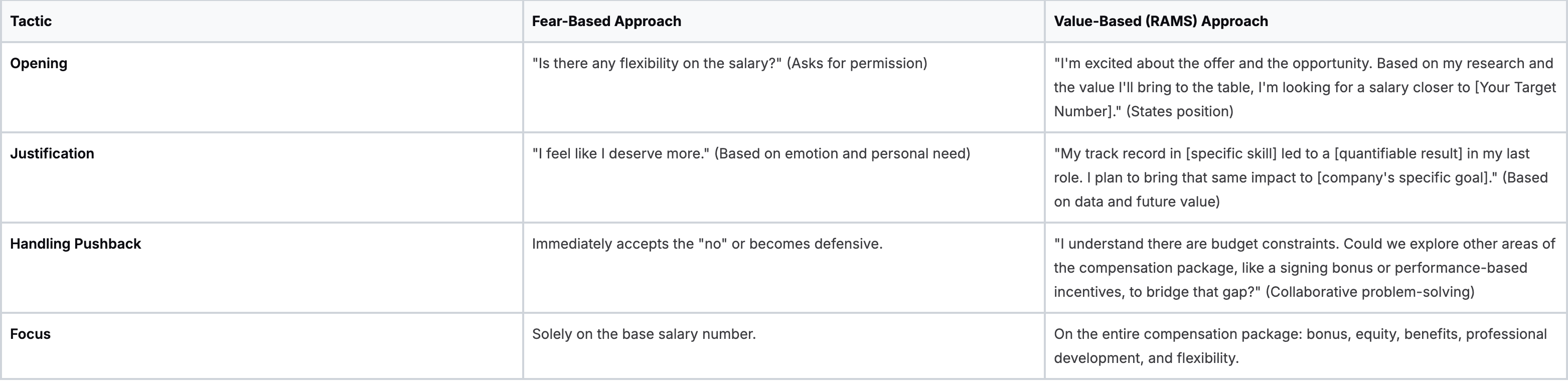
See the difference? One approach is reactive, anxious, and small. The other is proactive, confident, and anchored in the unshakeable knowledge of your worth and what you bring to the table. This is the distinction that makes all the difference.
Arming Yourself with Data and a Plan
Real confidence in a negotiation doesn’t just appear out of nowhere. It's built on a bedrock of solid preparation. Before you even think about picking up the phone, you must have your numbers and your narrative locked down. This part is non-negotiable.
Here’s your pre-negotiation homework:
Benchmark Your Market Rate: Get your data from multiple sources. Use sites like Glassdoor and Levels.fyi (especially for tech roles), but don't stop there. Tap into your network. Talk to trusted mentors and recruiters to get real-world data points for your specific role, experience, and location.
Define Your "Walk-Away" Number: This is your Best Alternative to a Negotiated Agreement (BATNA). It is the absolute floor—the lowest offer you would accept before you politely decline and walk away. Knowing this number with crystal clarity strips emotion and desperation out of the equation.
Quantify Your Value Proposition: This is crucial. Don't just list skills on a resume. Connect your abilities to tangible business outcomes. How have you increased revenue, saved money, improved efficiency, or scaled a team? Put a number on it whenever you possibly can.
The data is overwhelmingly on your side. A 2018 study by Robert Half found that 54% of workers attempted to negotiate their salary, and of those, 70% received a pay increase. That's not just a salary bump; it's a launchpad for your entire career trajectory.
When you’ve done this work, the entire dynamic shifts. You are no longer just a candidate asking for more money. You are a strategic partner presenting a compelling business case for why your proposed compensation is fair, logical, and ultimately, a wise investment for the company.
To go even deeper into the strategy of these conversations, you should also explore the core principles of negotiating from a leadership mindset. This is never about being aggressive. It’s about being clear, prepared, and grounded in the incredible value you are ready to deliver.
The Neuroscience of The Negotiation Table
Ever wonder why simply thinking about asking for more money can make your heart pound and your palms sweat? It’s not just in your head—it’s a deeply wired biological reality. When you step up to negotiate your salary, you're not just having a business chat. You're walking into a scenario your brain is designed to flag as a major social risk, firing up ancient survival circuits.
This whole process kicks off in the amygdala, your brain’s built-in threat detector. The tricky part? It doesn’t know the difference between a real physical threat (like a tiger in the bushes) and a social one (like the fear of rejection). To your amygdala, the risk of being labeled "greedy," "difficult," or even having the offer pulled feels like a life-or-death situation.
This triggers the classic fight, flight, or freeze response. A cocktail of cortisol and adrenaline floods your system, your heart rate spikes, and your ability to think rationally takes a nosedive. The most sophisticated part of your brain—the prefrontal cortex, which handles strategic planning and clear communication—effectively goes offline. This is the precise moment you might freeze up, stumble over your words, or accept a lowball offer just to make the crushing discomfort stop.
The Executive Echo Chamber
For many accomplished women, this biological reaction gets amplified by a psychological pattern I call the "Executive Echo Chamber."
Think of it as an internal feedback loop where every past experience of being undervalued, dismissed, or penalized for being assertive comes roaring back. Every time you were told you were “too aggressive,” every time you saw a male colleague praised for the exact behavior you were criticized for—another layer was added to this chamber.
So when you face a new negotiation, those old voices and painful memories start to reverberate, creating a powerful narrative of self-doubt:
"You know what happened last time you pushed back."
"They’re going to think you’re ungrateful."
"Just take the offer. Don’t ruin this."
This echo chamber is what keeps you playing small. It tries to convince you that your safety is in silence, in accepting what you’re given—even when your research, your experience, and your sheer value scream for more. Breaking free isn’t about pretending the fear doesn’t exist. It’s about learning to manage the nervous system response that gives that fear its power.
Rewiring Your Response Through Sovereignty
The key to overriding this automatic, primal reaction is to cultivate what I call nervous-system sovereignty. This is your ability to stay grounded, centered, and resourceful even when your internal alarm bells are blaring. It’s about consciously shifting yourself from a state of pure reaction to one of empowered response.
Instead of letting the amygdala hijack the conversation, you can learn to intentionally activate your parasympathetic nervous system—your body’s “rest and digest” mode, where clear thinking and executive function are possible. To truly win the psychological game of negotiation, understanding what emotional intelligence in leadership is becomes a non-negotiable asset for reading the room and, more importantly, mastering your own internal state.
This isn't about being fearless. Fear is just a signal. This is about learning to act with fear, without letting it grab the steering wheel. You can acknowledge the racing heart and the anxious thoughts, but you don't have to obey them.
By practicing simple but powerful techniques of nervous system regulation, you can learn to bring your prefrontal cortex back online, even in the middle of a high-stakes conversation. This is what allows you to stay connected to your data, to articulate your value with calm conviction, and to steer the discussion toward the collaborative, problem-solving dialogue that all successful negotiations become.
When you achieve this state of embodied leadership, you silence the Executive Echo Chamber for good. You're no longer negotiating with the ghosts of past meetings. You are present, powerful, and fully capable of advocating for the compensation you’ve earned.
The RAMS Reframe for Salary Negotiation
Knowing the neuroscience of fear is the first step. The second is to actively override it with a structured, sovereign approach. This is where we shift from understanding the problem to taking decisive action, using the RAMS framework—Results, Attitude, Mastery, and Systems—to completely reframe the negotiation.
This isn't about memorizing a few slick lines or pretending to be someone you're not. It's about grounding your request in authentic, undeniable value. You stop asking for what you want and start articulating what you are worth.
Results: The Foundation of Your Business Case
The most powerful negotiating position is one built on a solid foundation of your measurable achievements. "Results" is the first pillar of RAMS, and it’s your arsenal of proof. It moves the conversation away from your personal needs and puts the focus squarely on the company's gains.
Before you even think about picking up the phone, you must do this groundwork:
Quantify Everything: Go back through your past projects with a fine-tooth comb. Where did you increase revenue, cut costs, boost efficiency, or grow a team? Find the numbers. "Managed a team" is weak. "Led a team of 8, increasing departmental output by 15% in six months" is a power statement.
Build Your Impact Portfolio: Create a private document listing 3-5 of your most significant wins. For each one, detail the Situation you faced, the Action you took, and the quantifiable Result. This document isn't for them; it's for you. It’s the bedrock of your confidence.
Connect Past Success to Their Future: This is critical. You must explicitly connect your past victories to the specific challenges and goals of the new company. Frame your value in their language. For example, "In my previous role, I cut customer churn by 10% by launching a new feedback system. I'm confident I can bring a similar approach to your goal of improving client retention."
Going through this process transforms a vague feeling of "I deserve more" into a concrete, undeniable business case. You are no longer just a candidate; you're a high-return investment with a proven ROI.
Attitude: The Collaborative Mindset
Your attitude dictates the entire energy of the negotiation. When you walk in with a fear-based mindset, you immediately create an adversarial dynamic. A RAMS-driven attitude, however, fosters collaboration and positions you as a strategic partner from the start.
It's all about adopting a problem-solving stance. You and the hiring manager aren't on opposite sides. You're on the same side of the table, working together to finalize the terms of a mutually beneficial partnership.
This is the typical neurological process that triggers a fear response, a cycle we can consciously interrupt with the right attitude.

Understanding this "trigger-threat-freeze" sequence is your key to choosing a collaborative mindset instead of letting your biology take over. When you feel that trigger—that jolt of anxiety—see it as a signal to engage your strategic mind, not your survival instincts.
The Script Shift:
Instead of: "Is the salary negotiable?" (This puts them on the defensive.)
Try: "Thank you so much for the offer. I'm very excited about the possibility of joining the team. Based on the market data and the value I expect to bring to [specific company goal], I was anticipating a compensation package closer to [Your Target Range]. I'd love to explore how we can bridge that gap."
This language is confident, non-confrontational, and opens a discussion, not a battle. It frames the entire negotiation as a joint effort to find a win-win solution.
Mastery: Demonstrating Deep Knowledge
Mastery is about knowing your worth within the specific context you're operating in. It’s the irrefutable data that backs up your Results and supports your collaborative Attitude. This requires more than a quick peek at Glassdoor.
It means achieving a granular, undeniable understanding of your market value.
Industry Benchmarking: What are other professionals with your specific skills, level of experience, and in your geographic area being paid for truly similar roles?
Company Context: What are this company's known compensation bands? How is their financial health? What are their most urgent strategic priorities right now?
Role-Specific Value: How critical is this specific role to the company's immediate success? A role directly tied to revenue generation will almost always have more salary flexibility than a role seen as a cost center.
When you have true Mastery, you can counter a lowball offer with calm authority. If they say, "This is the top of our budget for this role," your response isn't emotional. It's factual: "I appreciate you sharing that. My research for senior-level roles that blend product strategy with team leadership in the SaaS space indicates a range of [X to Y]. Given my track record of [mention a key Result], I believe my value aligns with the upper end of that market range."
Systems: Creating Your Repeatable Process
Finally, Systems bring it all together. This is your personal, repeatable process for preparing for and executing any high-stakes negotiation. A solid system ensures you never walk into the conversation unprepared or let your emotions hijack the outcome.
Think of your System as your personal operational blueprint for success. It includes:
The Pre-Negotiation Checklist: A document you complete for every single offer. It must cover your BATNA (Best Alternative to a Negotiated Agreement), target salary, walk-away number, market data, and your quantified Results portfolio.
Communication Protocol: Deciding in advance how you will communicate. A phone call is almost always better than email for conveying tone, building rapport, and reacting in real-time.
Scenario Planning: Rehearsing your responses to common pushbacks out loud. What will you say if they deliver a hard "no"? What's your move if they offer a smaller increase than you hoped for?
By building this System, you automate your preparation and dramatically reduce decision fatigue when you're under pressure. You are no longer improvising; you are executing a well-honed plan. For a deeper look into the principles behind this, you can explore the full RAMS Method framework and see how it applies to all areas of sovereign leadership.
The RAMS reframe isn't just a tactic; it’s an entire operating system. It ensures that when you negotiate your compensation, you do so from a place of unshakeable power, grounded in data, and centered in your true value.
Navigating Bias and Expanding The Ask
For female leaders, negotiating a job offer is about more than just data and tactics. It's about skillfully managing the subtle—and sometimes not-so-subtle—biases that often crop up in these conversations. You’ve presented a powerful case based on your value, but now comes the pushback. This is a critical moment. Your ability to stay grounded and reframe the discussion will define your success.
Countering Common Pushback with Poise
When a hiring manager says something like, "This is the top of the band for this role," your nervous system might instantly register it as a hard 'no.' But often, it’s just the opening move in the real negotiation. The key is to remain collaborative and curious, not confrontational.
Here’s how to handle those all-too-common objections without losing your footing:
When they say: "This is the top of the band for this role."
Your Response: "Thanks for sharing that context. Could you help me understand how the bands are structured? Based on my research and the responsibilities we’ve discussed—like [mention a high-value responsibility]—I saw this role aligning more with a range of [Your Target Range]." This shifts the focus from their supposed limit to the role's actual scope and value.
When they say: "We really value collaboration here, and our compensation reflects a team-based approach."
Your Response: "I completely agree that collaboration is the engine for success, and I'm eager to contribute to that environment. A competitive package ensures I can focus entirely on driving those collective results without distraction. My goal is simply to align my compensation with the significant value I plan to bring to our shared goals."
The trick is to never make it adversarial. You're not challenging their statement; you're seeking more information and gently guiding the conversation back to your value. For more strategies on holding your ground in these talks, check out our guide for women in male-dominated industries.
Expanding the Negotiation Beyond Base Salary
A hallmark of a strategic leader is understanding that base salary is just one piece of the puzzle. If you hit a wall on the base number, the conversation isn’t over. It’s an invitation to broaden the discussion to the Total Rewards Package. This move shows you’re a sophisticated thinker who understands the bigger business picture.
Remember: The company has a budget, but that budget has many different pockets. Money that’s fixed for salary might be flexible for a one-time bonus.
Pivot the conversation gracefully. Try saying, "I understand the base salary may have limited flexibility. With that in mind, can we explore the other components of the offer to make sure the total package reflects the market value for this position?"
This opens the door to negotiating a whole host of other valuable assets.
Elements of the Total Rewards Package
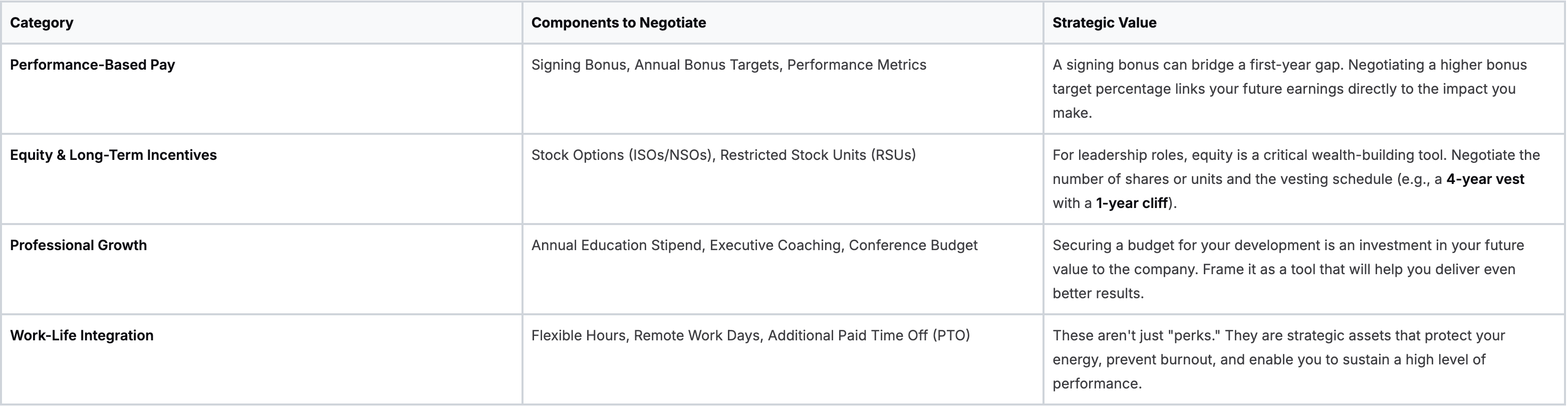
By expanding your 'ask,' you create multiple paths to a win. It proves you're a creative problem-solver focused on a mutually beneficial partnership, solidifying your position as the exact type of leader they want on their team.
Navigating the Tricky Questions in Salary Negotiation
Even with a rock-solid game plan and an unshakeable mindset, you’re going to hit a few curveballs. The moment you decide to negotiate your salary, theory smacks right into reality. This is where the real test begins.
Having sharp, practiced answers for these moments is what keeps you in the driver’s seat. It keeps you grounded in your value and stops common roadblocks from derailing your entire strategy. Think of this as your field guide for the most common negotiation tripwires.
What If They Ask for My Salary History or Expectations Too Soon?
This is a classic gatekeeping move. It’s a tactic designed to anchor you low, right from the start, before you even have a chance to prove your worth. Your mission is to deflect this conversation until they’ve already decided they must have you.
If they ask about your current salary, sidestep with grace and firmness.
A powerful response is: “I’d really prefer to focus on the value I can bring to this specific role and learn more about the responsibilities before we talk numbers. I’m completely confident we can land on a figure that’s fair and competitive for the impact I’ll deliver.”
If they keep pushing for your salary expectations, don't get cornered. You can respond with: “Based on my initial research, roles with this level of responsibility in our industry and geography are typically in the range of [Provide a well-researched, broad range, with your ideal number near the bottom]. That said, my main focus right now is on finding the right fit and truly understanding the full scope of this opportunity.”
This response does two things beautifully: It proves you’ve done your homework, but it immediately pivots the conversation back to your future value, not your past paychecks.
How Do I Handle an Exploding Offer?
An "exploding offer" is a high-pressure tactic where you're given an unreasonably short deadline, often just 24-48 hours, to make a decision. Let’s be clear: this is a major red flag about the company's culture. It’s designed to rush you, to stop you from exploring competing offers, and to force your hand.
But if you’re still interested in the role, you don’t have to fold. You can push back gracefully.
First, always express genuine enthusiasm and thank them for the offer. Then, make a reasonable request for more time.
Example Script: "Thank you so much for this offer! I am genuinely excited about the possibility of joining your team. This is a big decision, and to give it the thorough consideration it deserves, I would be grateful if I could have until [Suggest a reasonable date, like 'the end of this week'] to respond. This will allow me to review everything carefully and come to a confident decision."
If they flat-out refuse to extend the deadline, that tells you everything you need to know about their respect for their people. You have to ask yourself: is that an environment where I can truly lead and thrive?
What If They Pull the Offer After I Negotiate?
This is the number one fear that paralyzes high-achievers and stops them from asking for what they’re worth. So let’s get this straight: any reasonable, healthy company will not rescind an offer just because you opened a polite, professional negotiation.
They’ve already invested a massive amount of time and resources—multiple interviews, internal strategy meetings, background checks—to get to you.
They want you.
If a company does pull an offer after a respectful counter, you haven’t lost a job; you’ve dodged a bullet. A company that punishes a candidate for professionally advocating for their market value is showing you its true, toxic colors. You would have faced that same resistance when asking for a promotion, a raise, or resources for your team. Consider it a gift—a clear sign of an unhealthy power dynamic you are much better off avoiding.
Should I Mention a Competing Offer?
Yes. But only if it's 100% real and you are genuinely prepared to accept it. A legitimate competing offer is the single most powerful piece of leverage you can have. It’s undeniable, real-world proof of your market value.
When you bring it up, the key is to frame it as a collaborative point of data, not an ultimatum.
How to Use a Competing Offer Effectively

When used correctly, a real competing offer transforms your negotiation from a simple request into a clear, data-driven business decision for the employer.
What If I Get a Verbal Offer but Nothing in Writing?
Let me be blunt: never, ever resign from your current job or halt your search based on a verbal conversation. A verbal offer is a great indicator of intent, but it is absolutely not binding. Until you have a formal, signed offer letter in your hands that details every single component of your compensation package, nothing is final.
Your response to a verbal offer should be positive but firm.
“That’s fantastic news, and I’m thrilled to hear it. I am very much looking forward to reviewing the formal offer in writing.”
That simple sentence accomplishes everything. It signals your excitement while professionally nudging the process forward to a concrete, documented agreement. It protects you and ensures every term you negotiated is spelled out, leaving zero room for "misunderstandings" or backtracking down the line.
This entire negotiation process—from digging up your data to navigating these final questions—is an act of sovereign leadership. It’s about reclaiming your power and refusing to let old fears dictate your future value. If you're ready to stop playing small and build a career where your income finally matches your impact, Baz Porter provides the framework. Explore how the RAMS Method can fundamentally change your approach to leadership and life.