Managing Competing Priorities: A Guide for High-Achieving Leaders
The calendar is overflowing. The to-do list is a fantasy. You're in constant motion—putting out fires, answering urgent requests—but that deep feeling of making real progress never arrives. This is the "Silent Collapse," the slow, creeping realization that despite frantic effort, you're not moving forward. You're just… moving. For high-achieving women, this is treacherous. The internal monologue is relentless: “If I drop this ball, everything falls apart. If I stop performing, I’ll disappear.” This isn't just about managing a task list; it's a fight for relevance, where your worth feels tethered to your output.
Key Takeaways for Regaining Control
The Neuroscience of Overwhelm: Understand why a flood of priorities hijacks your brain’s threat response, locking you in a cycle of reactivity and decision fatigue.
The RAMS Method: Discover a powerful framework (Results, Attitude, Mastery, Systems) designed to shift you from reactive task-management to sovereign, legacy-driven leadership.
Actionable Tools: Get practical strategies you can use immediately, from an energy-based priority matrix to communication scripts for setting firm, professional boundaries.
Nervous System Sovereignty: Learn why regulating your internal state is the most critical and overlooked tool for navigating external chaos with clarity and precision.
The Definitive Answer to Managing Competing Priorities
Effectively managing competing priorities is not about working harder or finding a better productivity app. It's about shifting from reactive task-chasing to a proactive, legacy-driven strategy by clearly defining your desired outcomes, weighing tasks by their strategic impact—not just their urgency—and building systems to protect your focus and energy. This is how you reclaim your executive function and prevent burnout.
The Hidden Pattern of Executive Overwhelm
That feeling of being pulled in a dozen different directions isn’t a personal failing. It’s a biological reality. Your brain is fine-tuned to detect and respond to threats. But in the modern workplace, that ancient survival hardware gets hijacked. The constant flood of emails, pings, and meetings triggers your nervous system into a low-grade, chronic state of alert.
This is neurologically exhausting. The part of your brain in charge of clear, strategic thought—the prefrontal cortex—gets systematically sidelined. Instead, the amygdala, your brain’s alarm center, takes over. You become biologically wired to react, not to strategize. This is the root of executive overwhelm.

The CEO of a Failing Startup Metaphor
Imagine your executive brain function as the CEO of a startup on the verge of collapse. Every department is on fire. Finance needs an immediate budget approval. Marketing has a PR crisis. Your top engineer threatens to walk. You’re forced to make critical decisions with scraps of data, just trying to survive the next hour. This is exactly what's happening inside your brain when you’re drowning in competing priorities. Your mind becomes a crisis-management room, leading to profound decision fatigue and burnout.
You are neurologically programmed to prioritize immediate threats over long-term opportunities. This isn't a flaw in your character; it's a feature of your survival hardware that is now working against you in the boardroom.
This state kicks off a vicious cycle. The more out of control you feel, the more your brain desperately craves control. You start micromanaging. You refuse to delegate. This only intensifies the overwhelm, which diminishes your actual control.
For women in leadership, this is amplified by external pressures. The expectation to be decisive and nurturing adds another crushing layer. Burnout from juggling relentless demands is a silent epidemic. One McKinsey report reveals soaring exhaustion for women leaders, made worse by a declining corporate commitment to their advancement. The chaos isn't just on your calendar; it's being encoded into your nervous system architecture.
The RAMS Reframe for Leadership Sovereignty
The endless cycle of firefighting isn’t broken by working harder. It's broken by installing a new operating system for your leadership. The antidote to neurological chaos is the RAMS Method, a framework for managing your energy and intention. It’s designed to pull you out of the frantic daily grind and anchor you in the work that defines your legacy.
The RAMS Method is a four-part system:
Results
Attitude
Mastery
Systems
This isn't about adding more to your plate. It’s about radically changing what you allow on your plate in the first place.
The First Pillar: Results
The Results pillar challenges the belief that being busy equals being effective. It forces a pivot from focusing on activity to focusing on legacy. An overwhelmed leader asks, "What do I need to do today?" A sovereign leader asks, "What outcome am I creating this quarter?"
Are you building your daily schedule around your strategic initiatives, or are you letting your strategic initiatives get the leftover scraps of time from your schedule? This single question separates the reactive manager from the visionary leader.
When you anchor every decision in your desired long-term results, you create a powerful filter. A request that doesn’t align with your core outcomes becomes far easier to decline or delegate. Explore the core principles of the RAMS Method to learn more.
The Second Pillar: Attitude
The Attitude pillar is about cultivating nervous-system sovereignty and detaching your self-worth from your daily output. Your value lies in your wisdom and vision, not the hours you work. This requires a conscious practice of regulating your internal state before you try to regulate your external world. It means recognizing the physiological signs of a threat response—shallow breathing, a clenched jaw—and having the tools to return to calm, centered clarity.
The Third Pillar: Mastery
Mastery is the ruthless discernment of the "vital few" from the "trivial many." High-performers are often good at everything. Mastery isn't about doing more; it’s about choosing to be exceptional at the specific activities that produce disproportionate results.
It requires an honest audit:
What are the 1-3 activities that only you can do that create the most value?
What tasks are you clinging to out of habit, ego, or a false sense of obligation?
Where are you the bottleneck because you haven't empowered your team?
Mastery is the discipline of focusing your power where it matters most.
The Fourth Pillar: Systems
Systems provide the structure to protect your time, energy, and focus. They are your personal scaffolding for success, turning intentions into reliable habits. Systems might include:
A non-negotiable weekly "CEO Time" block for strategic thinking for leaders.
A clear delegation framework outlining what gets passed on, to whom, and with what autonomy.
A communication protocol that trains your team to bring you solutions, not just problems.
These systems are the guardrails that keep you from getting pulled back into the vortex of reactivity.
Reactive Firefighting vs. Sovereign Prioritization
The shift from a reactive approach to the proactive RAMS framework is stark. It’s a move from managing time to leading with intention.

Making this transition is essential for any leader who wants longevity and impact.
The Priority Matrix 2.0
The old Eisenhower Matrix of "urgent vs. important" is broken. It misses the most critical resource for a modern leader: energy. An "important" task could be a quick email or a soul-crushing three-hour report. The Priority Matrix 2.0 reframes the game by looking at tasks through two axes: Legacy Impact and Energy Drain.
This creates four quadrants:
High Impact, Low Drain (Mastery): Your zone of genius. Live here as much as possible.
High Impact, High Drain (Strategic Effort): Critical but taxing tasks. Schedule them carefully and build in recovery time.
Low Impact, Low Drain (Systematize): Routine administrative tasks. Prime territory for delegation and automation.
Low Impact, High Drain (Eliminate): Silent assassins of productivity. Cut them ruthlessly.
The Delegation Litmus Test
Effective delegation is one of the most powerful levers for managing competing priorities. This simple decision tree cuts through the inertia of perfectionism or lack of trust.
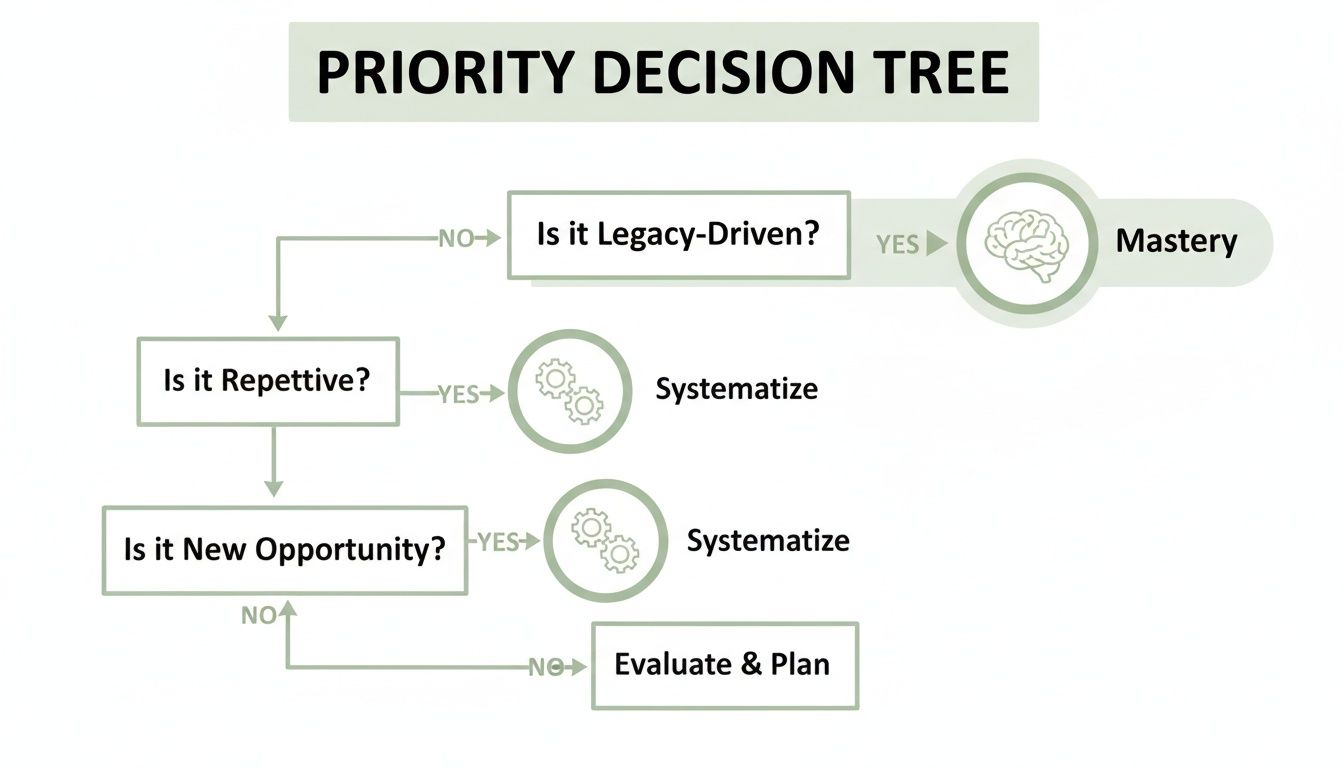
This visual is a constant reminder: your direct involvement should be saved for your Mastery quadrant. Understanding how to delegate effectively is not just about freeing up your time, but developing your team. When facing mental logjams in strategic work, even insights on overcoming writer's block can offer valuable parallels. Similarly, having a grasp on how to prioritize tasks effectively is a foundational skill.
The Return to Sovereignty
We’ve been sold a lie: that mastering our calendars and optimizing our to-do lists is the path to success. That hamster wheel leads to exhaustion, disconnection, and overwhelm. The real goal isn't to get more done. It's to ensure your precious energy is invested in what actually matters. It’s about building a legacy, not just clearing a checklist.
The Path to Nervous System Sovereignty
This shift starts with nervous-system sovereignty—the ability to command your internal world, no matter the external chaos. It’s the capacity to hold a calm, centered presence during a crisis. When you operate from this state, your decisions are no longer hijacked by the reactive parts of your brain. They flow from deep clarity. You stop being a function of your circumstances and become the architect of them.
Your most powerful leadership tool isn't your calendar. It is your own regulated nervous system. From this state of internal stability, you can navigate any external storm with grace and precision.
Step out of the frantic present. Go forward five years and look back. What impact have you made? What have you built that will last? Now, look at your current "priorities." Which of them directly create that five-year future?
This question is a ruthless filter. It slices through the noise of urgency and illuminates the path of legacy. Most urgent tasks will be forgotten in five years. But legacy-driven priorities—mentoring a leader, launching a game-changing initiative—are the ones that compound. A study from DDI World highlights that only 12% of organizations feel they have a strong leadership bench, underscoring the critical need for leaders to focus on legacy-building activities.
This stops being about what you need to do and becomes about who you are choosing to be. The path forward isn't about finding a better system to handle overwhelm. It’s about returning to yourself. It's about identifying the patterns keeping you stuck and beginning the journey back to embodied, sovereign leadership and crafting your leadership legacy.
Ready to stop being a firefighter and start being the architect of your own legacy? The real work is about coming home to yourself and leading from a place of clarity and embodied power. Baz Porter provides the structure for that transformation.
Discover your specific pattern of overwhelm and start building your legacy today.