Your Leadership Legacy: A Proven Framework for Lasting Impact
Your leadership legacy isn't some historical footnote written after you've left the room. It’s the active, daily creation of your impact. It's what remains from your values and decisions, defining how you're remembered not just for what you did, but for how you made people feel and grow.
Key Takeaways:
The Silent Collapse: High achievers often mistake a successful career for a meaningful legacy, leading to a profound sense of emptiness and burnout.
The Golden Cage: Your own achievements can paradoxically trap you, creating a legacy of endurance rather than authentic vision, a cycle wired into your nervous system.
The RAMS Framework: A lasting legacy is built intentionally by redefining Results, mastering your Attitude, gaining Mastery over your inner world, and creating Systems that sustain your impact.
Legacy is Lived Daily: Your true legacy isn't built in grand gestures, but embedded in small, consistent daily rituals that reflect your deepest values.
Your leadership legacy is the lasting, intentional impact you have on the people, culture, and organization you lead. It's the sum of your values in action, shaping not just business outcomes but the growth and well-being of your team long after your tenure.
Defining Your Impact Before It Defines You
You've built a career that looks incredible on paper. You climbed the ladder, shattered ceilings, and delivered results that command respect.
Yet, in those quiet moments between high-stakes meetings and late-night emails, another feeling creeps in. A question echoes: “Is this the impact I was meant to make?” This is the "Silent Collapse"—the unsettling realization that your legacy is being written by default, shaped by quarterly targets and other people's expectations, not your own intentional design. If I stop performing, it feels like I’ll disappear.

This guide is built to pull you off that hamster wheel. It’s a practical framework to help you define, design, and embed a leadership legacy that finally aligns your professional success with your deepest personal values. We're moving you from accidental impact to an intentional one.
From Accidental Impact To Intentional Design
Most leaders run on a default setting, letting external forces dictate their influence. Consciously designing your legacy demands a fundamental shift. It’s about deciding what you want your impact to be, not just accepting the one you’re given.
This table breaks down the two realities. Which side feels more familiar?

Recognizing where you are is the first step. The real shift happens when you accept that true influence is an inside-out job.
It requires a commitment to understanding not just what you do, but who you are being while you do it. It can be powerful to explore different perspectives on legacy and how it’s constructed over a lifetime. This helps connect your actions today with the story you want told tomorrow.
The goal here is moving from a resume of accomplishments to a legacy of contribution. That transition requires both deep introspection and strategic action. This foundational work is what makes authentic leadership so powerful—it’s where your inner state finally aligns with your outer expression.
The Hidden Pattern: Why Your Success Feels Like a Cage
For many high-achievers, the career you’ve painstakingly built can feel less like a launchpad and more like a cage. It’s a beautiful cage, gilded with titles and security, but a cage nonetheless. I call this the Golden Cage of modern leadership: a structure built from your own achievements that, paradoxically, now confines your true fulfillment.
You followed the rules. You outperformed and over-delivered. But this relentless performance creates an architecture of expectations—from others and yourself—that becomes a prison. Your legacy, by default, becomes a monument to your ability to endure, not a testament to your authentic vision. This isn't a personal failing; it's a systemic pattern reinforced by corporate structures that reward a narrow model of success.
The Broken Rung and the Vanishing Woman
This feeling isn't just in your head; it’s validated by stark data. The path to senior leadership is where women's progress often stalls or reverses. This is the "broken rung" phenomenon, creating a landscape where female representation plummets just as women should be stepping into their most influential roles.
Recent research shows a troubling trend. While progress exists in entry-level positions, the picture darkens dramatically at senior levels. Representation for women at the C-suite level has seen the gap widen from 6 to 15 percentage points. You can read the full research on this workplace trend to grasp the systemic forces at play.
This isn't just about numbers. Each percentage point represents a woman who hit a structural ceiling, faced burnout, or decided the cost of staying in the cage was too high. Your leadership legacy is being shaped within this incredibly challenging context.
The Neuroscience of the Golden Cage
The Golden Cage isn't just a metaphor; it’s wired directly into your nervous system. Decades of operating in high-pressure environments can hardwire the brain for hypervigilance and performance-based validation. The same drive that fueled your success also keeps your nervous system in a constant state of fight-or-flight.
This constant state of alert creates a biological dependency on external validation. Your brain gets a hit of dopamine with every success, reinforcing the belief that your safety and value are contingent on perpetual achievement.
This cycle is exhausting. It disconnects you from your intuition, your body, and the deeper purpose that defines a lasting legacy. The architecture of your nervous system starts to mirror the architecture of the corporate world—rigid, demanding, and unforgiving.
To build an intentional legacy, you must first redesign your internal blueprint. Understanding your nervous system architecture is the first critical step toward dismantling the cage from the inside out. Breaking free means consciously shifting from what you achieve to who you are becoming.
The RAMS Reframe: Designing Your Legacy
If you’re trapped in the Golden Cage, you know working harder isn't the answer. You must work differently. This means replacing old leadership metrics with a framework that connects your inner world with your outer impact.
That’s what the RAMS framework was built for. It's a repeatable system for intentionally designing your leadership legacy.
RAMS stands for Results, Attitude, Mastery, and Systems. It is your blueprint for shifting from reactive achievement to sovereign creation, where you build from a place of deep internal alignment.
Many leaders get stuck in a cycle of achievement leading to confinement, and then straight into burnout.
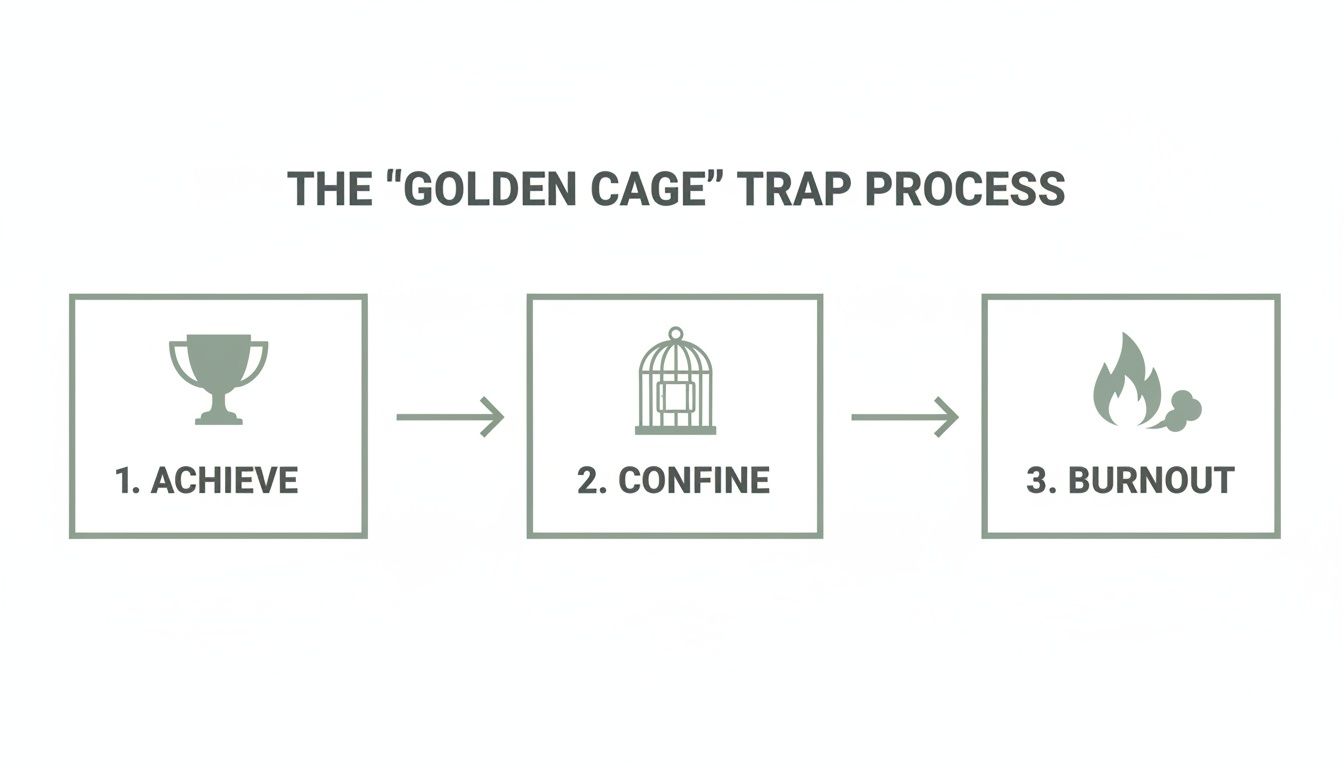
This process shows how success without intention leads to feeling trapped and drained. The RAMS method is the key to breaking this cycle.
R Is For Results Redefined
The first pillar, Results, challenges the very definition of success. You've been taught to measure your worth in KPIs and revenue targets. Those metrics are incomplete. They measure what you did, but not how you did it or the human wake you left behind.
Redefining results means shifting your focus from purely quantitative outcomes to qualitative, human-centric ones.
A legacy isn't built on spreadsheets alone. It's forged in the careers you’ve helped build and the culture you’ve shaped. Your truest results are measured in the growth of your people.
Your legacy is what you leave in people, not just what you leave for them. It’s the difference between inheritance and influence.
Ask yourself these questions:
Beyond financials, what are the three most significant positive impacts my team has experienced this year because of my leadership?
If my team were asked to describe my leadership, what would they really say?
How are my decisions today creating a culture where people feel safe enough to innovate and fail forward?
A Is For Attitude And Embodied Presence
The second pillar, Attitude, is your internal state—the energy you bring into a room before you speak. For many high-achievers, the default is hypervigilance. It’s a constant, low-grade hum of being ready for the next threat.
That state is draining. It cuts you off from your intuition and forces you to operate from fear, not grounded power. The shift is moving to embodied leadership.
Embodied leadership is about being fully present in your own skin, aware of your nervous system, and leading from a place of centered calm. It’s the ability to hold space for a tough conversation without getting swept away.
The difference is clear:

Your attitude is the filter for every action. An embodied presence ensures your impact is intentional, not a byproduct of a dysregulated nervous system.
M Is For Mastery Of Your Inner World
Mastery, in this context, is about achieving sovereignty over your own nervous system. It is the most critical and overlooked skill in modern leadership.
Your ability to regulate your internal state directly dictates your capacity to lead. When you’re regulated, you can think clearly, listen with intent, and respond with wisdom instead of reacting from stress.
This is the deeper work that underpins your leadership legacy. It involves tangible practices that build your capacity to handle pressure.
Somatic Awareness: Learning to recognize the physical signs of stress—shallow breathing, a clenched jaw—and consciously shifting them.
Boundary Setting: Mastering the powerful art of saying "no" to protect your energy. This is a potent act of leadership.
Emotional Differentiation: The ability to feel a strong emotion without becoming it, allowing you to navigate conflict without taking it personally.
Mastery is an inside game. When you master your internal world, you become unshakable. You model a new kind of resilient strength for your team.
S Is For Systems That Sustain Your Legacy
The final pillar, Systems, is about building structures that support this new way of leading. An intentional legacy can't survive on willpower alone. It needs scaffolding.
Personal systems are your non-negotiables: routines that keep you grounded. This could be a 15-minute morning practice, a weekly calendar audit, or a dedicated "thinking day" each month.
Organizational systems embed your values into how your team operates.
Meeting Rhythms: Designing meetings that foster connection, not just status updates.
Feedback Loops: Creating safe channels for honest feedback that flows in all directions.
Mentorship Structures: Formalizing processes to intentionally develop the next generation of leaders.
These systems make your legacy scalable. They ensure your impact is felt even when you're not in the room. You can explore a more detailed breakdown of the RAMS Method™ and its revolutionary approach here. This framework provides the essential architecture for a legacy that lasts.
The Return: Embedding Your Legacy in Daily Rituals
A legacy isn't cemented in a single, grand gesture. It's forged in the quiet consistency of your daily actions. It’s the cumulative effect of thousands of small, aligned choices. The goal is to embed your values so deeply into your routine that they become your default operating system.

The most powerful act of creating your legacy isn't about building something new. It’s about unearthing what’s already there. Your deepest impact flows from a radical return to you—a path back to reclaim the parts of yourself that got quieted in the chase for success. Your true legacy is a direct reflection of your own internal sovereignty. It’s the peace you cultivate within yourself, the values you live, and the centered calm you carry into every room.
Designing Your Signature Leadership Rituals
Leadership rituals are the small, repeatable behaviors that bring your intended impact to life. They are tangible evidence of your values.
How you start meetings: Do you dive into the agenda, or take 60 seconds for a genuine human connection?
How you deliver feedback: Is it a transactional correction, or a developmental conversation aimed at growth?
How you handle crises: Do you react with frantic energy, or respond from a place of grounded calm?
These micro-behaviors are your legacy in action. They shift a team’s culture from burnout to psychological safety.
Here are a few ways leaders translate legacy into powerful rituals:
The Mentorship Mandate: A leader ritualizes "Mentorship Minutes," blocking 10 minutes after every one-on-one to send a follow-up summarizing the mentee's strengths.
The Decision-Making Pause: To build a legacy of thoughtful leadership, a CEO I work with never makes a significant decision in the same meeting it's proposed.
The Morning Anchor: A leader might start each day with a non-negotiable five-minute grounding practice before looking at their phone. Find a powerful structure in our 5-Day Morning Ritual.
Your daily rituals are the most honest expression of your priorities. They are the bridge between the leader you want to be and the leader you are, every single day.
When you lead from a place of genuine authenticity, you’re not just cementing your own legacy. You’re rewriting the script of what leadership looks and feels like for the next generation. This path demands a deeper connection to your own internal signals. Learning how to be more self-aware is the foundational skill that makes everything else possible. Crafting a true legacy means moving beyond work-life balance and toward a more sustainable work-life integration.
This isn't about dimming your ambition. It's about fueling it from a source that is more sustainable and authentic. Your return to self is the crucial step in creating a legacy that not only lasts but also nourishes you along the way.
Your True Legacy Is A Return To Self
Your Questions, Answered
As you define your leadership legacy, questions will arise. Here are the most common ones I hear from the high-achievers I work with.
“How Can I Start Building My Legacy When I’m Already Buried in Work?”
Stop thinking of your legacy as another thing on your to-do list. Think of it as a filter for everything already there. It’s about subtraction, not addition.
Start small. Pick one interaction tomorrow—a team meeting or a call—and decide on one intentional way you’ll show up differently. Maybe you’ll consciously listen more than you speak. Your legacy is forged in these tiny, consistent micro-shifts.
“Isn’t Focusing On My Own Legacy a Bit… Selfish?”
Absolutely not. It's one of the most generous things you can do. A leader driven by burnout and a need for external validation creates a chaotic and draining environment.
When you intentionally design your legacy, you are creating a more stable, inspiring, and psychologically safe environment for your team to thrive in. Your clarity becomes their stability.
Focusing on your impact is an act of service to the people you lead. It ensures you’re giving them the best version of yourself, not just the scraps.
“What If My Authentic Self Clashes With My Corporate Role?”
This friction is the essence of the Golden Cage. The most powerful leaders don't choose between who they are and what they do—they integrate.
This doesn't mean staging a revolution overnight. It means finding small, authentic ways to express your core values within your role. Perhaps it’s in how you mentor, the transparency you bring to tough decisions, or the empathy you show when your team misses a target. Your authentic leadership legacy is built by bridging that gap, not pretending it doesn’t exist.
Where to go next
If any of this reads like your own reflection, the Silent Collapse Diagnostic™ is a quiet place to start. And if you want the deeper why beneath the work, read the Sovereign Manifesto.