
How to Delegate Effectively Without Losing Control
It’s 11 PM. The glow of your laptop is the only light in the room. You're re-writing a report you already assigned, fixing a proposal you thought was handled, trapped in a cycle you built yourself. This isn't just being busy; it’s a silent collapse. It's the moment you realize your greatest strength—your capability—has become the cage that keeps you small. You’ve built an entire career on being the one who gets it done right, and now that identity is costing you your sanity and your team’s potential. The internal dialogue is relentless: "If I stop performing, I'll disappear."
Key Takeaways
The Overachiever's Paradox: Understand why high-performers confuse control with safety, creating a nervous system pattern that leads to burnout and stifles team growth.
The RAMS™ Framework: Learn a proven system (Results, Attitude, Authenticity, Mastery, Systems) to shift from delegating tasks to delegating outcomes, ensuring clarity and true ownership.
From Fear to Sovereignty: Reframe common delegation fears—like fear of failure or of burdening your team—into powerful opportunities for leadership and team development.
Delegate with Intention: Discover how to match work to your team's growth potential, turning your to-do list into a strategic tool for building a resilient, self-sufficient team.
Effective delegation is not about offloading tasks; it's a strategic system for assigning clear outcomes, transferring complete ownership, and building a framework of accountability. This shift moves you from being the team's primary doer to its architect, unlocking scalable growth and reclaiming your own nervous-system sovereignty.
The Overachiever's Paradox—When Your Capability Becomes a Cage
That relentless drive to do it all yourself isn't a time-management problem. It's a nervous system pattern of over-functioning. Think of your nervous system as an internal security guard. For many high-achieving leaders, years of navigating high-stakes environments have trained this guard to believe that absolute control is the only path to safety and success. Letting go of a task feels like willingly unlocking the front door and inviting failure in for dinner.

This pattern comes at a staggering cost. An analysis by Development Dimensions International (DDI) revealed that a shocking 19% of manager candidates showed strong delegation skills. That means four out of five leaders are under-leveraging their teams and overloading themselves, creating a brutal, self-fulfilling prophecy:
You fear your team will fail, so you don't delegate meaningful work.
Your team never gets the chance to develop new skills or take real ownership.
They eventually underperform or become passive, confirming your original fear.
Micromanagement isn't a leadership style; it’s a fear response. It sends a clear message: I don't trust you. This singlehandedly stifles growth, kills initiative, and breeds dependency. Building the inner foundation to break this cycle is critical. You can explore how to build this unshakeable self-belief through confidence coaching for women.
"The paradox of control is that the more you try to hold on to everything, the more you lose command over what truly matters—your vision, your energy, and your own sovereignty."
True delegation is not an abdication of responsibility. It's an act of trust that strengthens others and, most importantly, reclaims your capacity for the strategic, high-impact work you were meant to do.
The RAMS™ Reframe, Shifting From Tasks To Outcomes
Breaking the cycle of over-functioning requires a clear, repeatable system, not just good intentions. This is why I developed the RAMS™ Method. It’s not another framework to clear your to-do list; it’s a system designed to build a self-sufficient, high-performing team that operates with total clarity and real ownership. It’s what finally lets you step back from the tactical ‘how’ and focus your energy on the strategic ‘what’ and ‘why’.
The RAMS™ method gives you a structured way to handle handoffs, making sure nothing gets lost in translation and everyone is locked in on the mission. For a deeper look at the model, check out the revolutionary RAMS leadership framework explained.
R is for Results: Define The Destination First
Ineffective delegation starts with a task. "Can you write this report?" This is a recipe for endless back-and-forth and a final product that misses the mark.
The RAMS™ method flips this. We begin with Results. Before you think about who, you must define the desired outcome with unshakable clarity. What does ‘done’ look like?
Instead of "write this report," a Results-focused approach is: "We need a Q3 performance report that gives the board a clear, data-backed story on our top three growth drivers. The final deck should be no more than ten slides and ready for review by Friday."
You’ve given them the destination but are trusting them to navigate the route.
A is for Attitude: Cultivate Trust and Ownership
Delegation is an act of trust. If you hand over a project but then hover over your team member's shoulder, you've just outsourced your anxiety. The Attitude component of RAMS™ is about cultivating a mindset of genuine ownership.
This requires letting go of the ego-driven belief that you are the only one who can meet the standard. Your role shifts from being the primary ‘doer’ to being the ‘architect’. You must accept that their ‘how’ might look different from yours. As long as their process is ethical and the result meets the standard, their approach is valid. This mental shift is crucial for fostering innovation.
M is for Mastery: Match The Work to The Person
Once you've defined the Result and adopted an Attitude of trust, it’s time for Mastery. This is the art of matching the right responsibility to the right person, based on two key factors:
Existing Strengths: Who already has the skills to knock this out of the park? Playing to someone's strengths builds their confidence and ensures a high-quality outcome.
Growth Potential: Who would benefit most from this challenge? Delegating a task just outside someone's comfort zone is a powerful development tool.
This flow chart shows how to audit your tasks to identify what to keep, delegate for growth, or eliminate.
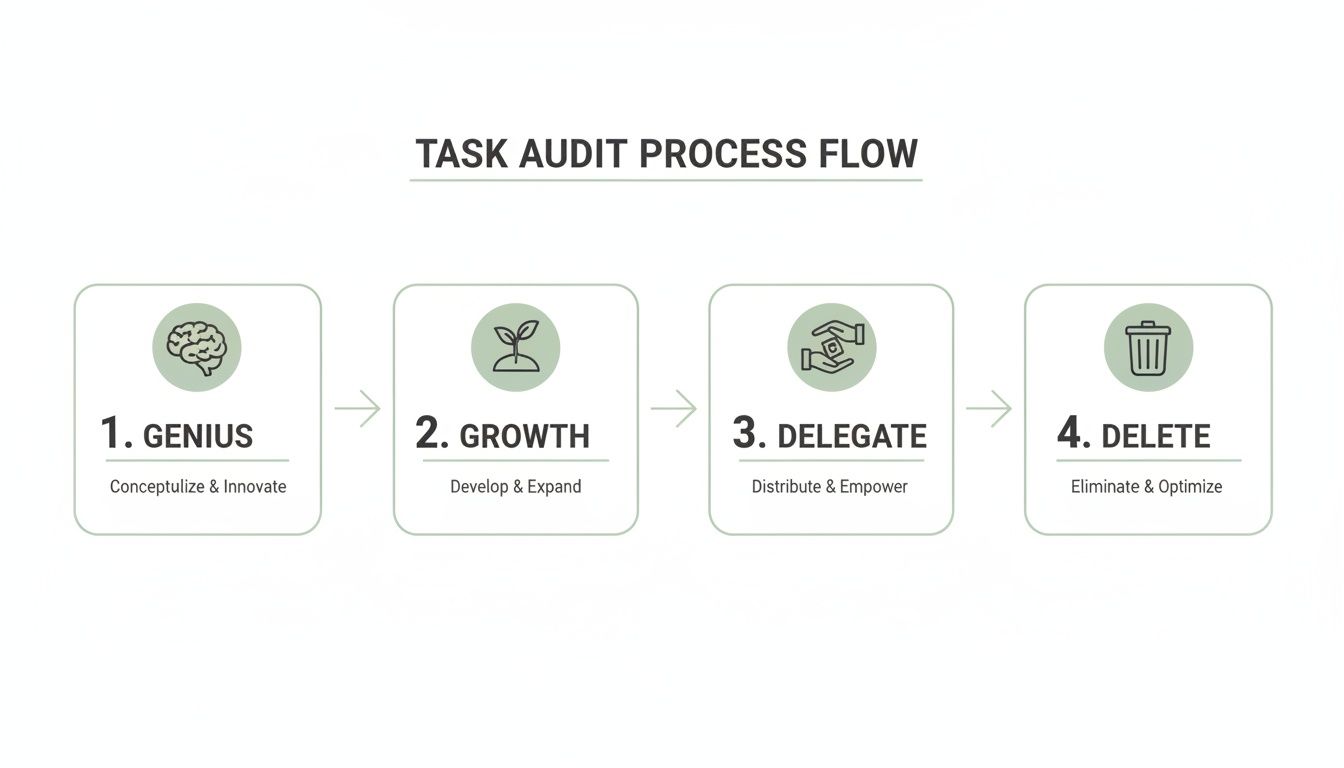
This process turns your to-do list from a source of overwhelm into a strategic tool for team development.
S is for Systems: Create Repeatable Processes for Clarity
Delegation can't survive on hope. It needs Systems. You need repeatable processes for communication, feedback, and accountability. A simple 'Delegation Brief' can be a game-changer. It’s a one-page document or clear email that outlines:
The Desired Result: What is the ultimate goal?
Success Metrics: How will we know, without a doubt, that we've won?
Key Resources: What tools, budget, or information are available?
Timeline & Check-ins: What’s the final deadline, and when will we connect for progress updates?
This brief isn't micromanagement; it's a contract of clarity. The table below contrasts the old model of offloading tasks with the strategic approach of the RAMS™ Method.
Delegation Shift: Micromanagement vs. RAMS™ Ownership

By putting the RAMS™ framework into practice, you stop being the hero. Instead, you become the architect of a system that strengthens everyone to do their best work.
How True Delegation Forges an Accountable and Self-Sufficient Team
Effective delegation isn’t a time-management hack. It’s a powerful tool for developing your people and forging a culture of genuine ownership. When you learn how to delegate effectively, you stop being the chief problem-solver and become the architect of a resilient team.

From Responsibility to True Ownership
There’s a massive psychological gap between giving someone a task and granting them true ownership. A task is a checklist item. Ownership is an outcome. When you hand over a project but dictate every step, you breed compliance, not commitment.
True ownership ignites when you transfer genuine authority. You give your team control over the ‘how,’ trusting them to navigate the path to the agreed-upon ‘what’ and ‘why.’ This signals profound trust. Research confirms this; a study in the International Journal of Environmental Research and Public Health found that when authority is genuinely delegated, employees report higher job satisfaction and performance. See the full research on empowerment and performance.
Architecting Feedback Loops for Confidence
Many leaders accidentally create feedback systems that foster dependency. They become the central checkpoint for every decision, crippling their team's autonomy. An effective feedback loop does the opposite.
Your goal is not to give answers, but to ask questions that guide your team member to their own answer. Instead of "Here's what you should do," try asking, "What options have you considered?" or "What's your recommendation?"
This Socratic approach reinforces that you trust their critical thinking. It trains them to solve problems on their own.
Reframing Mistakes as Data Points
The fear of a team member failing is the biggest barrier to delegation. But a mistake isn’t a catastrophe; it’s just data. When a mistake happens, your response sets the cultural tone. Ditch the blame. Instead, facilitate a blameless post-mortem focused on the process:
What went wrong with the system?
Were the initial instructions unclear?
Were the right resources available?
By treating failures as crucial learning opportunities, you create psychological safety. This encourages smart risk-taking and is essential for building high-performing teams that are engaged and ready for anything.
Overcoming Common Delegation Fears
Knowing the mechanics of delegation is one thing. Actually letting go is another. That resistance you feel is your nervous system, wired for high performance, screaming at you to keep your hands on the wheel. To master delegation, you have to meet these internal roadblocks head-on.
"What If They Do It Wrong?"
This fear is rooted in your high standards. The thought of someone else's mistake reflecting poorly on you is terrifying.
The Reframe: Shift from preventing failure to building resilience. Your job isn’t to build a team that never makes mistakes. It’s to build one that recovers, learns, and comes back stronger.
RAMS™ Action: Use the Systems component. Create a clear Delegation Brief with defined milestones. This lets you course-correct early without hovering. It’s a safety net that lets you trust the process.
"It’s Just Faster If I Do It Myself"
This is a seductive lie. It feels true in the moment, but it’s a long-term trap that guarantees you will always be the bottleneck.
The Reframe: Invest time now to save time later. Think of every delegated task as a training investment. The handoff might feel slow at first, but the payoff is a more capable, autonomous team. This is a crucial step in overcoming perfectionism and thriving.
"I Don't Want to Burden My Team"
For many leaders, this fear is deeply ingrained. You see your team is busy, and the guilt of adding more feels immense. This often stems from a fear of being disliked or being seen as demanding.
The Reframe: Stop seeing delegation as a burden and start seeing it as an opportunity. Meaningful work is energizing.
RAMS™ Action: Apply the Mastery principle. Ask, "Who on my team would be most energized by this challenge?" Then, frame it as a vote of confidence: "I'm giving this to you because I know you're ready to step up."
The Return to Sovereignty
Delegation is not a management tactic; it's a practice of nervous-system sovereignty. It is the disciplined choice to lead from a place of grounded trust, not frantic control. Every task you successfully delegate is an act of reclaiming your own energy, your focus, and your unique genius. You stop being the hero who does everything and become the architect of a system that elevates everyone. This is not about letting go of control. It is about returning to yourself—the visionary leader you were always meant to be.
If you're ready to stop being the bottleneck and start being the visionary your business needs, Baz Porter provides the frameworks to make that shift permanent.
Explore the RAMS™ method and reclaim your leadership at https://bazporter.com.
Frequently Asked Questions
How do I delegate without losing control?
Delegation is not losing control — it is trading frantic control for grounded trust. You define the result with total clarity, hand over the "how," and build a simple system of check-ins so you can course-correct early without hovering. You stop being the doer and become the architect of a team that owns outcomes. That is how you keep command of what matters most.
What if my team does it wrong?
That fear comes from your high standards. Shift your job from preventing failure to building resilience — a team that recovers, learns, and comes back stronger. Use a clear Delegation Brief with defined milestones so you can catch issues early. Treat a mistake as data, not a catastrophe, and run a blameless review of the process. That is what builds the safety that fuels smart risk-taking.
Isn’t it just faster if I do it myself?
It feels true in the moment, but it is the trap that keeps you the permanent bottleneck. Treat every handoff as a training investment. The first pass may feel slow, but the payoff is a more capable, self-sufficient team. Doing it yourself protects today and mortgages every tomorrow.
How do I delegate without burdening my team?
Stop seeing delegation as a burden and start seeing it as an opportunity — meaningful work is energizing. Match the task to the person using the Mastery step: ask who would be most energized by the challenge. Then frame it as a vote of confidence: "I am giving this to you because I know you are ready to step up."
Where to go next
If you recognise the 11 PM cycle of redoing work you already handed off, the Silent Collapse Diagnostic™ is a quiet place to start. And if you want the deeper why beneath the work, read the Sovereign Manifesto.