How to Stop Being Highly Strung and Lead with Calm
You feel it, don’t you? That constant, low-grade hum of tension just beneath your skin. Every notification is a jolt. Every new email, a potential crisis. The internal monologue is relentless. The mental checklists that never, ever end. The gnawing fear that if you drop a single ball, the entire world you’ve so meticulously built will shatter. "If I stop performing," a voice whispers, "I'll disappear."
This isn't just stress; it's a silent collapse, happening right under the surface of your success. True relaxation feels like a distant memory, a luxury you can’t possibly afford. You already know that learning how to stop being highly strung isn’t about just “relaxing more.” It demands you dismantle the entire internal architecture that equates rest with failure and calm with complacency.
Key Takeaways
Acknowledge the Pattern: Being highly strung isn't a personality flaw. It’s a conditioned response from a nervous system wired for constant threat detection in high-stakes environments.
Understand the Neuroscience: Chronic stress locks your sympathetic nervous system ("fight-or-flight") in overdrive. You can learn to consciously activate your parasympathetic system ("rest-and-digest") to regain control.
Adopt a New Framework: The RAMS™ Method (Results, Attitude, Mastery, Systems) provides a strategic blueprint to shift from reactive anxiety to sovereign, embodied leadership.
Return to Yourself: This journey is not about fixing a problem but about returning to your most authentic and powerful state, building a legacy beyond burnout.
The Definitive Path Forward
To stop being highly strung, you must move beyond temporary fixes and address the root cause: a dysregulated nervous system. This means learning to consciously shift from a state of chronic fight-or-flight to one of safety and presence, rewiring the very patterns that keep you perpetually on edge.
This state of constant activation is a common experience for leaders, a phenomenon I call executive dysregulation. It's the direct byproduct of a nervous system that has learned to operate in survival mode as its default setting. You are not broken; your internal alarm system is simply overworked.

That feeling of being “on” 24/7 is a direct symptom of your sympathetic nervous system being locked in overdrive.
You are not imagining it. The pressure is real, and its physiological toll is undeniable. Your body is keeping a score that your mind tries to ignore, leading to burnout that feels both personal and professional.
This experience is profoundly isolating. You look around and see others who seem to manage it all effortlessly, which only fuels the inner critic telling you to work harder, be stronger, and just push through.
But the "push through" mentality is precisely what locks you into this vicious cycle. It reinforces the dangerous belief that your value is tied directly to your output. You can learn more about overcoming this state in our guide on executive dysregulation.
Breaking free begins with the profound admission that this way of living is utterly unsustainable. It's not a sign of weakness—it is the first act of true, sovereign leadership.
The Hidden Pattern: Why Your Internal Alarm Is Misfiring
That constant, low-grade hum of anxiety you feel? That isn't a personality flaw. It’s a physiological reality. For years, your high-pressure career has systematically trained your nervous system to operate as if it's under constant, perpetual threat. It’s as if you’re living inside a fortress you built for safety, but now the walls are closing in, and the constant blare of the alarm is the only sound you can hear.
This has nothing to do with a lack of mental toughness. It's about a biological system doing exactly what it evolved to do—just way, way too often. You are living in a state of chronic sympathetic nervous system activation.
The Science of Being On Edge
Your nervous system has two primary gears:
Sympathetic (Fight-or-Flight): Your body's gas pedal. It floods your system with adrenaline and cortisol, prepping you to handle an immediate threat. Your heart races, muscles clench, and your focus narrows.
Parasympathetic (Rest-and-Digest): This is your brake. It’s the system that slows your heart rate, relaxes your muscles, and allows your body to recover, repair, and conserve energy.
For most high-achieving women, the sympathetic system has become the default setting. Every deadline, every high-stakes meeting, every critical email sends a danger signal to your brain's threat-detection center, the amygdala. This unleashes a cascade of cortisol, the body's primary stress hormone.
In small, acute doses, cortisol is a lifesaver. Chronically, it’s corrosive. It hijacks your executive function, demolishes your sleep quality, and keeps your body locked in a state of high alert, directly causing physical symptoms like a racing heart, shallow breathing, and that persistent tension in your neck and shoulders.
This relentless activation is precisely why you feel so bone-tired yet completely unable to switch off. Your body is physically incapable of standing down because it genuinely believes the threat is constant and real.
Recognizing the biological roots of this state is the first, crucial step toward reclaiming your calm. It shifts the problem from an imaginary character defect to what it actually is: a tangible, physiological system that you can learn to re-regulate. Truly understanding your own nervous system architecture is the foundation for making this life-altering change. When your internal alarm is constantly misfiring, you have to implement strategies for Regulating Stress And Anxiety For Sleep and promoting a state of calm. This isn't just about "feeling better"—it's about restoring the fundamental balance required for sustainable high performance.
The RAMS Reframe: A New Operating System for Leaders
Awareness, on its own, won’t change your reality. To genuinely break free from the highly-strung cycle, you need a new operating system—a repeatable method to tear down reactive patterns and build a foundation of sovereign leadership.
This is what the RAMS™ framework was built for. It’s not about piling more onto your plate; it’s about replacing the plate itself. RAMS stands for Results, Attitude, Mastery, and Systems. It is a strategic blueprint to guide you from reactive anxiety to proactive, embodied calm.
Results Redefined
For most of your career, “results” has meant hitting external metrics. Quarterly targets, project deadlines, revenue growth. Sovereign leadership begins by redefining what a "result" is, expanding the definition to include your own non-negotiable internal outcomes.
Emotional Balance: Is your default state one of calm focus or simmering anxiety? This is now a core KPI.
Physical Vitality: Are you constantly running on fumes or operating from a place of genuine energy? Your physical state is a direct result.
Presence: Can you be fully present in a meeting or with your family without the mental pull of the next task? This is a fundamental metric of success.
When you make your own well-being a primary result, you stop sacrificing yourself for success and start building a version of success that actively sustains you.
Attitude Adjustment: The Worth-Performance Delusion
Your attitude is the internal software running your life. For many highly strung leaders, that software is corrupted by one toxic belief: my worth is directly proportional to my performance.
This delusion keeps you trapped. A great quarter means you feel worthy. A missed target means you feel like a failure. The RAMS method installs a new operating system:
Your worth is inherent and non-negotiable. Your performance is simply an output of your systems and energy. It does not define you.
Detaching your self-worth from your daily output is the most powerful act of rebellion against the highly strung state. It allows you to see challenges as data points, not personal referendums on your value.
Mastery of Your Internal State
You cannot control the external world. You can master your internal response. Mastery, within the RAMS framework, is about developing emotional and physiological self-regulation. It’s about becoming the pilot of your nervous system, not a helpless passenger.
This diagram shows the nervous system's alarm process—how a perceived threat instantly kicks you into a sympathetic "fight-or-flight" response. Mastery is the skill of learning to consciously guide your system back to the parasympathetic state of "rest and digest."

While the alarm is automatic, engaging the "calm" response is a skill you build through practice. This is the essence of nervous system sovereignty.
Mastery isn't abstract; it involves tangible, neurological tools:
Physiological Sighs: A rapid way to signal safety to your brain and downshift from high alert.
Somatic Grounding: Using your senses to pull your awareness back into the present moment.
Emotional Labeling: The practice of "name it to tame it," which significantly reduces an emotion's power.
The full RAMS method is a revolutionary leadership framework that expands on these principles to create deep, lasting change.
Systems for Sustainable Success
Your willpower is a finite resource. Relying on it to "push through" guarantees burnout. The final pillar, Systems, is about architecting your life to prevent the highly strung state in the first place.
A system makes the right thing the easy thing. It builds structures that protect your energy, focus, and well-being by default.
Energy Boundaries: Proactively designing your calendar with non-negotiable blocks for deep work, rest, and recovery.
Communication Protocols: Setting clear expectations with your team about response times to dismantle the "always on" pressure.
A "Shutdown" Ritual: A consistent routine at the end of your workday that signals to your brain and body that it is safe to switch off.
Systems are what make this transformation stick, creating an environment where a calm, regulated state is the natural outcome.
The Highly Strung Leader vs. The Sovereign Leader
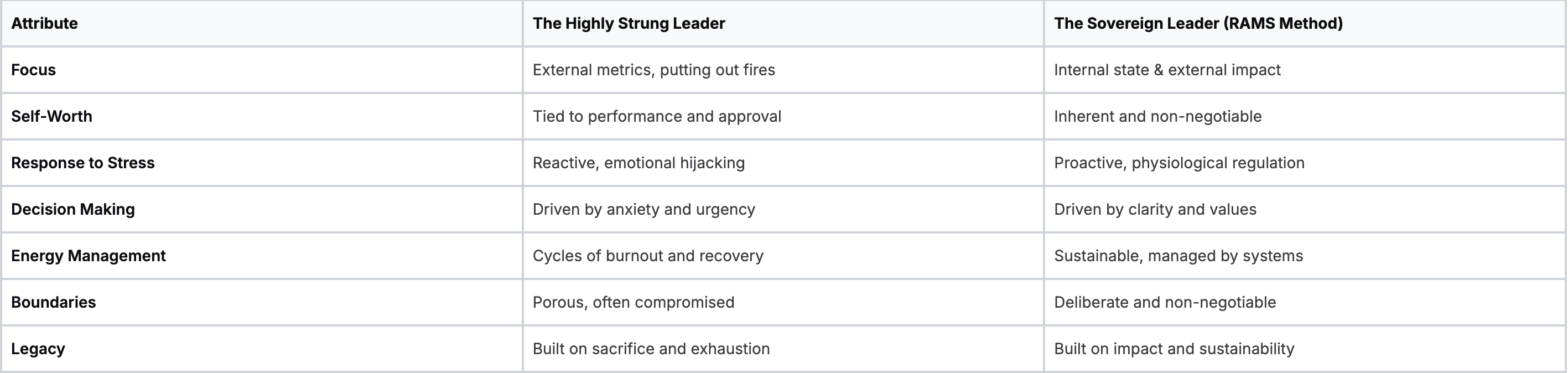
This table is a map. Moving from the left column to the right is the core work of learning how to stop being highly strung. It's a strategic process of reclaiming your power, presence, and peace.
Your In-the-Moment Toolkit for Calming a High-Strung Nervous System
Knowing why your nervous system is on high alert is one thing. Actually stopping an anxiety spiral is another. You need a toolkit of immediate, physical interventions that can pull you out of hyper-arousal. These are physiological circuit breakers designed for high-performers who need to regain control, fast.

Immediate Somatic Resets
When you feel that wave of panic or overwhelm building, your first move must be to interrupt your body's response.
The Physiological Sigh: One of the fastest ways known to science to dump stress. Take a deep inhale through your nose, and at the top, take another quick sip of air. Then, let it all go in a long, slow exhale through your mouth. One to three rounds is all it takes.
Use it: The second you hang up from a tense call. Before a high-stakes meeting. It’s a discreet reset button.
Box Breathing: A staple for Navy SEALs under extreme pressure. Inhale for a count of four, hold for four, exhale for four, and hold out for four. Repeat.
Use it: When thoughts are racing. The counting forces your brain to focus, breaking the anxious loop.
Mastering these techniques is non-negotiable for effective nervous system regulation.
Cognitive Tools for Anxiety Spikes
Once you’ve taken the physical edge off, deal with the mental storm. A highly strung state is fueled by catastrophic thinking.
Your mind will believe whatever story you tell it. If the narrative is one of constant threat, your body will respond as if it’s true. The goal is to consciously introduce a more grounded story.
A powerful strategy is Name It to Tame It. When an emotion rises, label it. Silently say to yourself, "This is anxiety." This simple act engages the rational part of your brain, creating a crucial gap between you and the feeling.
The Non-Negotiable Grounding Practice
To truly stop being highly strung, you must shift from putting out fires to proactive maintenance. Start with a non-negotiable morning grounding practice. Before you touch your phone, anchor yourself. This can be five minutes.
Sit quietly and feel your feet on the floor.
Notice three things you can see, two you can hear, and one you can feel.
Take five deep, conscious breaths.
This practice sets the tone, allowing you to start from presence rather than cortisol. You can explore more ways to calm an overactive nervous system and build a more resilient foundation.
The Return: Building a Legacy Beyond Burnout
The work we’re doing here isn’t about damage control. This is a homecoming. It’s about returning to yourself and building a professional legacy that energizes you, instead of one that drains you dry.
Nervous system sovereignty is the absolute foundation of sustainable, powerful leadership. It's the raw acknowledgment that you can't pour from an empty cup. Your well-being and your professional legacy are two sides of the same coin.
True power isn't found in controlling every last variable. It's found in mastering your own internal state so you can respond with clarity and presence, no matter what the world throws at you.
This mastery is what allows you to build a legacy rooted in sustainable impact, not personal sacrifice. It ensures that your greatest contributions are still ahead of you, not left behind in a haze of exhaustion. You can explore what this really means by digging into your leadership legacy.
The Commitment to Your Future Self
You’re at a crossroads. You can continue down this path of diminishing returns, where every achievement comes at a greater personal cost. Or, you can commit to a new way of leading—and a new way of living.
This isn’t about becoming less of a high-achiever. It's about becoming a more resilient, embodied, and sovereign one. The next move is a commitment to your future self: the leader who is calm, powerful, and deeply fulfilled.
It’s time to stop just surviving your success and start truly inhabiting it.
Your Questions, Answered
As you stand on the brink of dismantling lifelong patterns, it’s natural for questions to surface. Here are the direct answers to the concerns I hear most often from high-performing women.
How Long Until I See Real Results from This?
You'll feel a change from the first exercise. A single physiological sigh can break the immediate stress cycle. Deeper, lasting change—where a calm, centered state becomes your new normal—is a process of consistent practice.
In 1-2 Weeks: You’ll start noticing your triggers with clarity and have the presence of mind to deploy a calming technique.
Within 1-3 Months: The shift becomes undeniable. Your baseline anxiety will be tangibly lower. You'll sleep more deeply.
At 6+ Months: The new neural pathways are established. Calm presence will feel like your natural default state.
Can I Still Be a Top Performer Without Being Driven by Anxiety?
Yes. In fact, you'll become a far more effective one. The highly strung state is fueled by chaotic, inefficient energy. Sovereign leadership is born from nervous system mastery. You will replace frantic, scattered activity with precise, impactful action. Your ambition doesn't go away; it's just fueled by purpose instead of fear.
What If I Genuinely Don’t Have Time for More "Self-Care"?
You don't have time not to do this. Tally up the hours you lose to anxious thought spirals, decision fatigue, and recovering from burnout. That lost time is infinitely more costly than the few moments these techniques require. A physiological sigh takes five seconds. You can practice box breathing for one minute. The goal is to weave micro-doses of regulation into the fabric of the day you already have.
Isn't "Highly Strung" Just Part of My Personality?
No. This is a critical distinction. While you might have a temperament that is naturally more sensitive, being "highly strung" is not a fixed personality trait. It is a conditioned response pattern. Your brain and nervous system have learned that hyper-vigilance is necessary for survival. This work is about teaching your system a new, safer, and more effective way to operate. It's about stripping away the static of anxiety so your true, powerful self can finally take the lead.
Are you ready to stop managing burnout and start building a legacy of sustainable impact? The Baz Porter ecosystem provides the framework for executive women to transition from exhaustion to embodied leadership. Find your path back to yourself.