From Overlooked to Unshakeable: How to Gain Respect at Work
You’re invisible. You’re the first one in, the last to leave. You solve the problems no one else wants, yet in the big meeting, your voice is swallowed whole. When the career-making project lands, you’re passed over. The silent thought echoes: “If I just deliver one more massive win, they’ll finally have to see my value.”
This isn’t a performance problem. It’s a pattern. It's the moment you realize that respect isn't a reward for hard work; it's a currency you don't know how to command. Your nervous system is screaming that if you stop performing, you’ll disappear. This is the Silent Collapse—the internal burnout that happens long before your career stalls, leaving you exhausted, resentful, and unseen.
Key Takeaways: Your Path from Invisible to In Command
The Primal Sting of Disrespect: Learn why being undermined feels like a physical threat and how this triggers a cycle of self-sabotaging reactions.
The RAMS™ Framework: Master a 4-part system (Results, Attitude, Mastery, Systems) to move from an exhaustion-driven approach to one of embodied authority.
Nervous System Sovereignty: Discover why regulating your internal state is the non-negotiable first step to projecting calm, unshakeable confidence.
Commanding Respect in Action: Get tactical, word-for-word scripts to handle being interrupted, having your ideas stolen, and setting firm boundaries without being seen as aggressive.
The Definitive Answer: How to Gain Respect at Work
To gain respect at work, you must shift from chasing validation through sheer performance to commanding it through embodied presence. This involves regulating your nervous system to project calm authority, strategically communicating your impact, and establishing firm, systematic boundaries that demonstrate self-respect.
The Hidden Pattern – Why Disrespect Is a Biological Threat
Have you ever felt that hot, sharp sting when you’re talked over or your idea is dismissed? That’s not you being “too sensitive.” That’s a primal survival alarm ringing in your brain. Neuroscientists have shown that the emotional pain of social rejection lights up the very same neural pathways as physical pain. Your brain literally codes being undermined as an injury.
This is ancient software running on modern hardware. For our ancestors, social rejection meant being cast out of the tribe—a death sentence. Your nervous system doesn’t know the difference between a condescending email and a saber-toothed tiger. A threat is a threat.
Chaos in Your Internal Boardroom
Imagine your mind is a corporate boardroom. When your nervous system is calm, your rational mind—the CEO—is at the head of the table, making clear, strategic decisions.
But the moment that social threat alarm blares, the boardroom descends into chaos. Adrenaline and cortisol flood the system. The rational CEO is shoved aside as your fight-or-flight response hijacks the meeting.
This is the moment you find yourself:
Over-explaining: A desperate scramble to prove your point that reads as defensive.
Getting aggressive: Lashing out with a sharp retort that burns bridges.
Shutting down: Withdrawing completely, signaling that you can be easily steamrolled.
These aren't character flaws. They are the predictable fallout of a dysregulated nervous system. The very reactions you use to regain control are precisely what cause others to respect you less. It's a brutal feedback loop. The only way out is to become the master of your own nervous system.

This isn't just a personal cost. A 2023 Gallup study found that high workplace stress costs the global economy $8.8 trillion. When disrespect is tolerated, it manufactures stress, cripples engagement, and hits the bottom line—hard.
When your internal state is chaos, your external presence will be too. True authority isn't about controlling others; it's about mastering the sovereignty of your own nervous system.
The RAMS™ Reframe – A Framework for Embodied Respect
The cycle of over-performing for validation isn’t broken with more effort. It’s broken with a new operating system. We will now install the RAMS™ Framework—Results, Attitude, Mastery, and Systems. This is our proprietary architecture designed to rebuild your professional presence from the inside out, moving from an exhaustion-driven approach to one of embodied leadership.
Results: From Activity to Impact
The first pillar, Results, isn't about working harder. It’s about articulating your value in a way that is undeniable. High-performers constantly assume their hard work speaks for itself. It doesn’t. You must become the narrator of your own success.
Shift from task-based language ("I completed the quarterly report") to impact-driven statements ("I delivered the quarterly analysis that identified a 15% cost-saving opportunity, which the board is now actioning"). One describes an activity; the other broadcasts a result that commands attention.
Attitude: Nervous System Sovereignty
Attitude is the most misunderstood pillar. It's not about fake positivity. In RAMS™, Attitude is Nervous System Sovereignty—the ability to remain calm and regulated under pressure. It’s the unwavering self-belief that projects quiet confidence, not loud arrogance.
A leader in control of themselves is perceived as being in control of the situation. This internal work is the foundation of a commanding presence and developing true executive presence.
Embodied sovereignty means your self-worth is non-negotiable and not dependent on external validation. You bring your value to the table; you don't wait for others to grant it to you.
Mastery: Competence Multiplied by Visibility
Mastery is a two-part equation: deep competence multiplied by strategic visibility. You’ve nailed the competence part. The missing piece is making that expertise visible to the right people.
Being the best-kept secret in your company is a fast track to being undervalued. You must actively create opportunities to showcase your knowledge.
Volunteer for high-stakes presentations.
Offer to mentor junior colleagues.
Speak up first in meetings with a well-researched opinion.
Visibility isn't bragging. It's generously sharing your expertise to solve problems and position yourself as the go-to authority. As you build this framework, remember that the wider environment also matters. These tips for building a truly respectful workplace offer broader context.
Systems: The Architecture of Boundaries
The final pillar, Systems, makes embodied respect sustainable. Systems are the repeatable processes you build to manage communication, set boundaries, and protect your focus. Without them, your best intentions will collapse under daily pressure.
Examples of effective systems:
A "response delay" script: Instead of saying "yes" on the spot, use: "Let me check my priorities and I'll get back to you by end of day."
A weekly check-in with your manager: A structured meeting where you proactively communicate your results.
Boundary-setting phrases: Pre-prepared scripts for gracefully declining work outside your scope.
Systems slash decision fatigue and ensure your actions consistently reinforce your authority. They are the guardrails that protect your energy.
This diagram shows how disrespect escalates from an internal threat to full-blown burnout when no regulated system is in place.
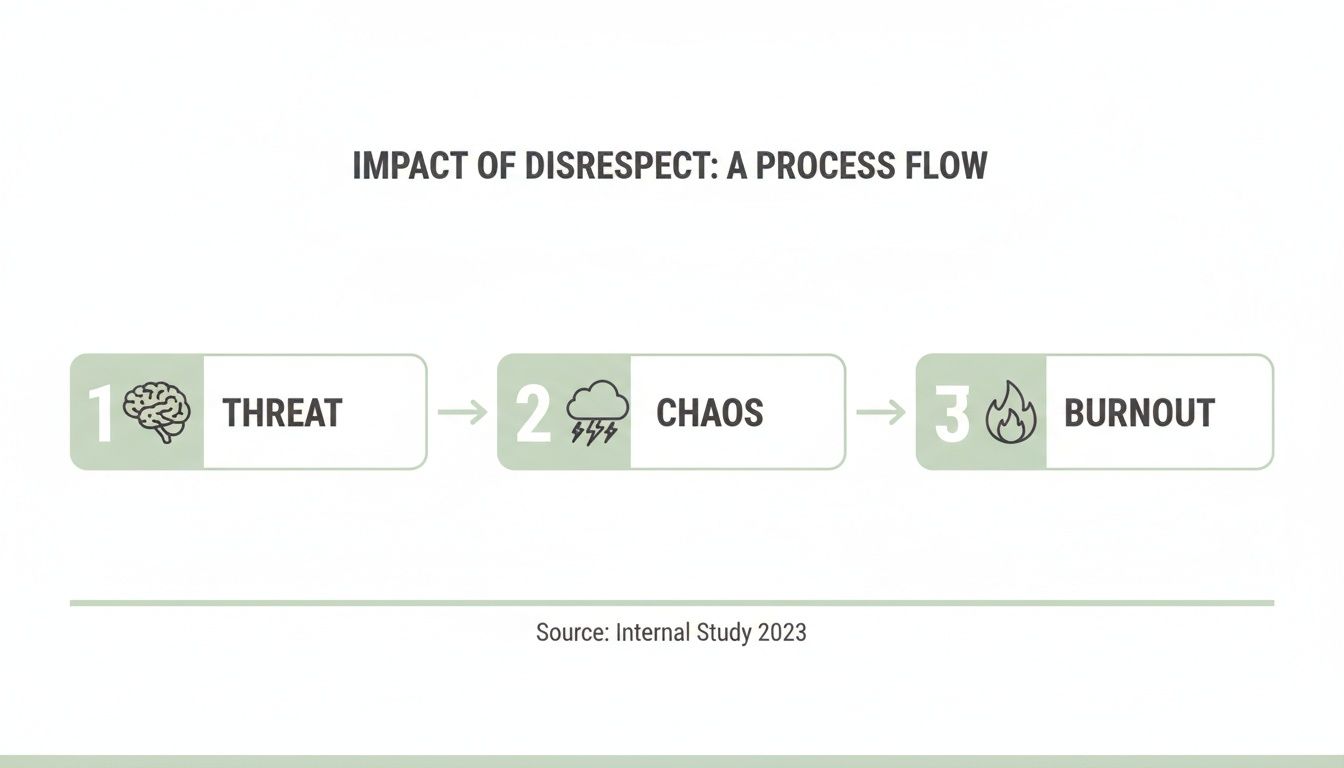
The RAMS™ framework stops this cycle before it starts.
The Critical Shift: From Exhaustion to Embodiment
This table breaks down the crucial differences between the old, unsustainable approach and the new paradigm of RAMS™ Embodied Leadership. This is a diagnostic tool. Be honest—which column describes your current reality?

The path to gaining respect is about deliberately moving, one behavior at a time, from the left column to the right.
How to Command Respect in Difficult Scenarios
Frameworks are essential, but respect is earned in the trenches—in tense meetings and high-stakes conversations. Here are tactical RAMS™ responses for common scenarios.

Scenario One: You Are Interrupted in a Meeting
You're presenting a crucial point, and a colleague cuts you off. The old you might shrink back or lash out. A RAMS™-aligned response is calm, firm, and reclaims control.
RAMS™ Breakdown:
Attitude (Nervous System Sovereignty): Take a slow, silent breath. Hold eye contact with the interrupter.
Systems (Boundary Scripts): Use a clean, non-emotional script.
Mastery (Strategic Visibility): Calmly reassert your expertise.
The Script: "Hold on, [Name]. I want to hear your thought, but let me finish this point first so we have the full context."
Say it, then—without waiting—immediately continue your sentence. Once finished, you can circle back: "Now, [Name], what were you going to add?" This proves you control the flow. For more on this, see our guide on how to be assertive at work without being aggressive.
Scenario Two: Your Idea Is Stolen or Co-opted
You share an idea. A few minutes later, someone else rephrases it as their own, and the room praises them. A RAMS™ response turns this into an opportunity to showcase leadership while reclaiming ownership.
RAMS™ Breakdown:
Attitude (Grounded Self-Belief): Your value isn't diminished. Ditch the scarcity mindset.
Results (Focus on Impact): Your response should be about moving the idea forward.
Mastery (Demonstrate Expertise): Add another layer of detail that proves you're the architect.
The Script: "I'm glad you agree with the concept I raised earlier, [Name]. Building on that, the next logical step would be to analyze [add a specific, expert detail]."
This validates them for agreeing with your idea, re-anchors you as the originator, and shows you’ve already thought three steps ahead.
Scenario Three: You Need to Set a Firm Boundary
It's 4:45 PM on a Friday. You're asked to take on a last-minute project that guarantees a weekend of burnout. The fear-driven response is to say "yes." The RAMS™ approach protects your focus and commands respect for your time.
The Script: "That sounds important. I'm currently focused on delivering [Your Key Priority] by its deadline. I can look at this first thing next week, or if it’s more urgent, we’d need to decide what gets deprioritized."
This response isn't a "no." It's a strategic trade-off. It frames your time as a valuable resource and forces a conscious business decision, demonstrating your commitment to high-impact work.
The Return – Your Path to Sovereign Leadership
The frameworks and scripts are potent. But long-term, unshakeable respect isn't built on tactics. It's the natural result of an identity shift—a move from seeking validation to embodying sovereign leadership. This is about cultivating a well of self-respect so deep that others’ opinions become data points, not verdicts.
Returning to Yourself
This entire process—regulating your nervous system, communicating results, mastering visibility, and building systems—isn't about manufacturing a new you. It’s a path of returning to yourself. It’s about stripping away the layers of burnout to reconnect with the powerful, clear-headed leader you already are.
Respect isn't something you chase. It emerges when your actions, words, and energy align with an unwavering core of self-belief. It's the quiet authority that fills a room before you speak.
The most powerful leaders don't demand respect; they command it through their presence. Their internal state of calm and conviction creates an undeniable external reality.
This is the essence of embodied sovereignty. Part of this path is ensuring your professional image aligns with your authority. You can learn how to build a professional online presence that gets results to make this a core part of your strategy.
Your Next Step Toward Sovereignty
Leaving the exhaustion cycle is a courageous act. It requires a new definition of success, where your fulfillment and professional impact are intertwined. This isn't a sales pitch. It's an invitation to take the next step on your path back to yourself, armed with the right support.
To explore this path, I invite you to learn about Leadership Sovereignty Mastery. This is your chance to move beyond managing your career and start leading your life.
Your Questions on Gaining Respect, Answered
How Can I Earn Respect Without Being Seen as Aggressive?
This is the tightrope so many high-achievers walk. The solution is to shift from emotional reactivity to grounded assertiveness. When you use a RAMS™ framework, your actions are pre-decided. You aren't reacting; you're executing a plan. It’s the difference between a frustrated outburst and calmly saying, "I'd like to finish my point." One is a reaction; the other is a command.
What if I’m an Introvert? Do I Have to Change My Personality?
Absolutely not. Gaining respect has nothing to do with becoming a chest-pounding extrovert. Your power lies in deep preparation (Mastery) and focusing on high-impact, one-on-one conversations. You don’t need to be the loudest voice in the room, just the most thoughtful and impactful one.
How Long Does It Take to See a Change?
You’ll feel the internal shift almost immediately. The first time you use a breathing technique to regulate your nervous system or use a script to shut down an interruption—that's a win. The external world takes longer to catch up. Consistency is key. When your team sees you show up with calm authority again and again, their perception has to shift. Most leaders I work with report a tangible difference in how they're treated within a single business quarter.
Where to go next. If the pattern in this piece reads like your own, the Silent Collapse Diagnostic™ is a quiet place to begin. And if you want the deeper why beneath the work, read the Sovereign Manifesto.