
What Is Self Leadership And How Does It Build Unshakeable Leaders?
The feeling is unmistakable. All the external wins—the promotions, the flawlessly executed projects—have started to feel hollow. It’s that subtle, creeping exhaustion that settles in, overshadowed by the immense internal price you pay to keep that perfect performance going. You're succeeding by every metric that matters, yet you feel a quiet sense of collapse happening just beneath your highly capable surface. This isn't a failure of ambition. It's the predictable outcome of leading everyone but yourself.
Key Takeaways
Self-leadership is not a soft skill; it's a neurological necessity. It is the practice of managing your internal state to prevent the chronic fight-or-flight response that leads directly to executive burnout.
Burnout is a biological state, not a character flaw. A dysregulated nervous system hijacks the brain's prefrontal cortex, impairing decision-making, stifling creativity, and draining your energy.
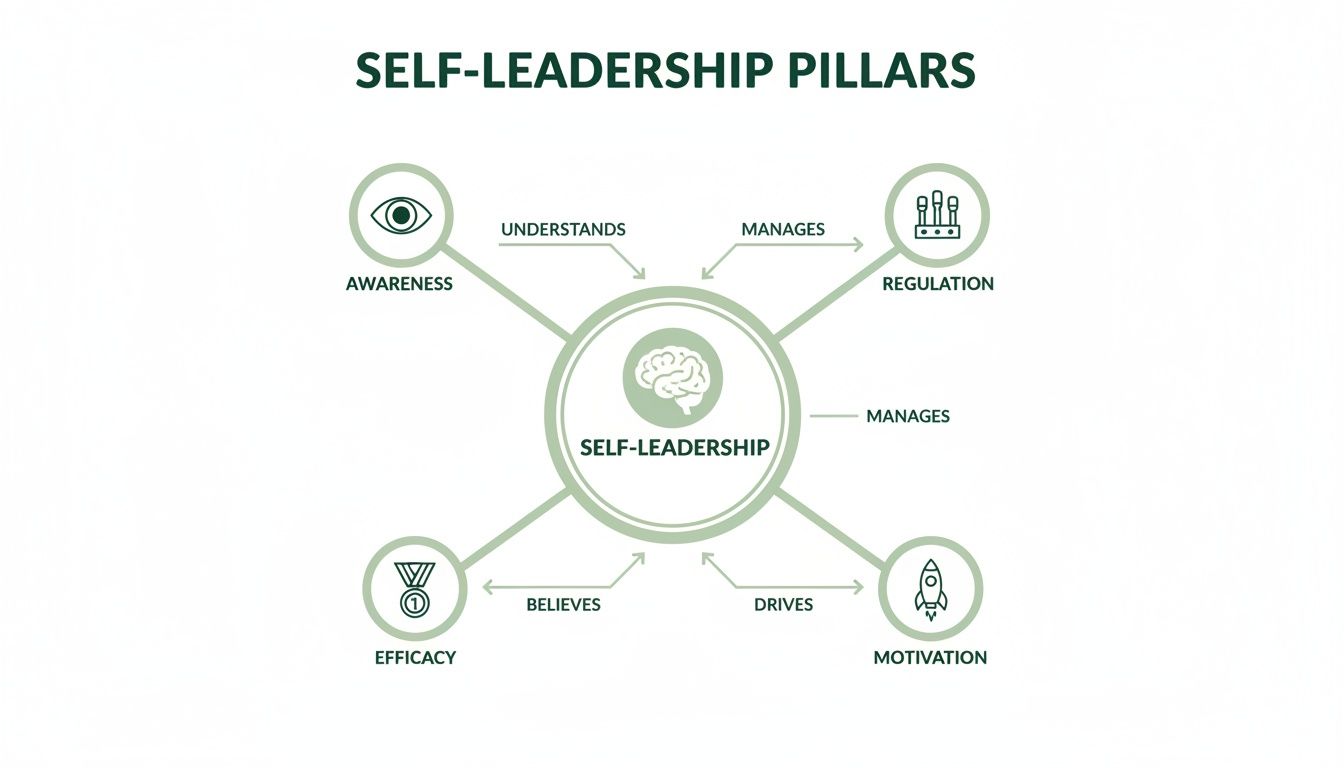
The Four Pillars of Self-Leadership create a framework for sustainable success. Mastering Self-Awareness, Self-Regulation, Self-Efficacy, and Self-Motivation allows you to shift from reactive survival to intentional, sovereign leadership.
The RAMS™ Method is a practical system for implementation. By redefining your Results, mastering your Attitude, pursuing skill Mastery, and building supportive Systems, you can embed self-leadership into your daily reality.
Self-leadership is the conscious practice of influencing your own thoughts, emotions, and behaviors to achieve your goals without sacrificing your well-being. It is the internal operating system that allows high-achievers to swap the crushing weight of external pressure for a grounded sense of purpose, ensuring success is both sustainable and fulfilling.
The High Achiever's Silent Collapse
This is the moment so many high-achieving leaders know intimately but never name. It’s a silent collapse, a quiet erosion of self happening just beneath a highly capable surface.

The symptoms are real, even if you’ve trained yourself to power through them. There’s the constant, low-humming pressure to perform that never really shuts off. You might feel a strange sense of disconnection, like you’re watching your own life from a distance. And underneath it all is a deep, unspoken fear: if I stop performing, I might just disappear.
The Internal Dialogue of Exhaustion
This private reality is fueled by a relentless inner narrative. Your internal monologue probably sounds something like this:
"I have to keep pushing, or I'll lose everything I've built."
"Rest is a luxury I can't afford right now."
"Why does this feel so hard when everyone else seems to be handling it?"
"If I show any weakness, they'll see I don't belong here."
This isn't a sign of failure. It's the predictable result of a system that rewards external validation over internal alignment. Your nervous system gets stuck in a perpetual state of low-grade alert, always scanning for the next demand, the next deadline. Over time, this chronic activation drains your cognitive and emotional batteries, making burnout inevitable.
If this is hitting close to home, our guide on overcoming burnout at work offers a deeper dive into recovery strategies.
The Neuroscience Fueling Executive Burnout
That bone-deep exhaustion isn't a character flaw. It is a predictable, biological consequence of a nervous system stuck in overdrive.
For most high-achievers, the brain has been trained for survival in high-stakes environments. This means your nervous system is perpetually scanning for the next potential failure, hardwired for the external validation that proves you are safe.
The problem? That state was never meant to be your default setting. It's a chronic, low-grade fight-or-flight response. Your body marinates in stress hormones like cortisol and adrenaline, keeping your mind on high alert. You’re living in a state of emergency that never ends.
This constant alarm hijacks your prefrontal cortex (PFC)—the logical part of your brain that handles strategic planning and emotional control. When the primitive, survival-focused parts of your brain are screaming "danger!" all day long, the PFC is starved of cognitive energy. Burnout isn't just feeling tired; it's a state of neurological depletion.
You cannot hustle your way out of a physiological state. The more you push, the more you drain the very cognitive functions you rely on to perform. The only way out is to fundamentally shift how your nervous system operates.
This biological reality is why "powering through" is a losing game. You can learn more about your nervous system architecture and its profound impact on your leadership. Real self-leadership begins right here—by recognizing this pattern and learning the skills to consciously regulate your internal state, reclaiming your brain's full capacity for excellence.
The Reframe—Building the Pillars of Self-Leadership
That constant, buzzing state of neurological threat isn't a life sentence. It’s a pattern that can be consciously unwired. The antidote is a structured, intentional approach to leading yourself back to a place of steadiness and control.
This is what self-leadership looks like in the real world. It’s about systematically building four core capacities, or pillars, that work together. They are the practical framework for taking back your power from the burnout cycle.

Pillar One: Self-Awareness
Self-awareness is the profound act of turning your attention inward. For high-achievers masterful at focusing on external goals, this can feel foreign. It’s learning to recognize what’s happening on your internal dashboard with radical honesty—your triggers, your core values, and the subtle signals your body sends when you’re pushing past a healthy limit. It’s noticing the tightness in your jaw during a tense meeting. Without this awareness, you're flying blind, at the mercy of subconscious stress responses.
Pillar Two: Self-Regulation
Once you see the patterns, self-regulation gives you the power to consciously manage them. This is where you shift from being purely reactive to intentionally responsive. It's the ability to create a pocket of space between a trigger and your reaction—a space where you can make a choice. This pillar directly counters the neurological drain of burnout by calming the fight-or-flight state and bringing your rational brain back online. You must build resilience to master this.
True power isn't the absence of stress, but the ability to return to a calm, centered state right in the middle of it. Self-regulation is the mechanism for that return.
Pillar Three: Self-Efficacy
Burnout erodes your belief in your own capabilities. It whispers that you can’t handle the pressure. Self-efficacy is rebuilding deep, unshakable confidence in your ability to meet challenges. You cultivate it by setting and achieving small, intentional wins that prove your competence to yourself. Each success reinforces a neural pathway that says, "I am capable. I can handle this." This is critical because it shifts your source of validation from external praise to internal proof.
Pillar Four: Self-Motivation
The final pillar is about rewiring your "why." High-achievers often run on external fuel—the fear of failure, the chase for the next promotion. This motivation is potent but depleting. True self-motivation shifts your drive from external pressures to intrinsic, value-aligned goals. It’s about connecting daily actions to a larger sense of purpose that energizes you instead of draining you. This is also a cornerstone of leading others effectively, tying directly into what authentic leadership is.
The RAMS™ Method: A Framework For Self-Leadership in Action
Knowing the pillars is one thing. Living them is another. The RAMS™ Method is a proprietary framework designed for high-achievers to weave the principles of self-leadership into their daily lives. It’s a system for taking abstract concepts and making them real, tangible, and actionable.
It's a strategic architecture for your life, built on four interdependent components: Results, Attitude, Mastery, and Systems.

Results means getting brutally honest about what a successful life feels like to you, separate from anyone else's expectations. It’s about aiming your ambition at a target that nourishes you.
Attitude is where self-regulation gets real. It’s the moment-to-moment practice of consciously managing your internal state. Your internal state dictates your external performance.
Mastery is about identifying the specific skills—both hard and soft—that will close the gap between where you are now and where your redefined "Results" demand you to be. It's a fierce commitment to your own evolution.
Systems are the structures, routines, and boundaries you design to protect your energy and focus. Willpower is finite; well-designed systems are not. They are the essential infrastructure for sustainable peak performance. For a wider organizational strategy, exploring innovative workplace wellness program ideas can complement these individual efforts.
You can learn more by exploring Baz Porter’s RAMS Method and its powerful leadership framework.
The Return to Nervous System Sovereignty
This path into self-leadership isn't about fixing a flaw. It's about a return. It's the process of coming back home to the powerful, centered leader you were always meant to be—before layers of external pressure and chronic stress started calling the shots.

Ultimately, this work is about achieving what I call nervous system sovereignty. This is the state where your biology no longer hijacks you. It’s a profound, grounded control, where the chaos outside no longer automatically creates chaos inside. You operate from a place of choice, not reaction.
The Shift From Reactivity to Sovereignty
For many high-achievers, the nervous system runs on autopilot, stuck in high alert. This constant reactivity is an energy vampire. Nervous system sovereignty means you have the awareness and tools to consciously shift your state. It’s the felt sense of power that comes from knowing you can handle any pressure without losing yourself. You can dive into the practical steps in our guide to nervous system regulation.
Nervous system sovereignty is the ultimate leadership asset. It’s the ability to hold immense responsibility without carrying it as chronic stress in your body, freeing your mind to focus on vision, strategy, and real impact.
This path is the most important work you will do as a leader. It's an invitation to stop managing the symptoms of burnout and start building the foundations of a truly sustainable and fulfilling career. It's about reclaiming your power, your presence, and your peace. This is how you build a leadership legacy that is not only successful but also deeply and authentically yours.
Answering Your Questions About Self-Leadership
As you start to unpack a lifetime of conditioning, questions naturally arise. Let's tackle the most common ones.
Is Self-Leadership Just Another Buzzword For Self-Care?
Not at all. Self-care is often about recovery—replenishing energy you’ve already lost. Self-leadership is the proactive design of your life and career that prevents that depletion in the first place. It's the architecture of a sustainable life, not just the emergency repair crew.
Can I Develop Self-Leadership On My Own?
You can start the path solo. But high-performers accelerate their progress exponentially inside a structured environment. Our deepest blind spots are invisible to us. A skilled coach or community acts as a mirror, providing the accountability and perspective needed to break through plateaus.
Self-leadership is a personal path, but it doesn't have to be a solitary one. Strategic guidance turns years of struggle into months of focused growth.
What’s The Real Business Case For Developing This?
The ROI is massive. Personally, you reclaim your health, creativity, and career longevity. For the organization, the benefits are just as concrete. Research clearly shows strong self-leadership is directly tied to lower employee turnover and greater organizational effectiveness. As work becomes more autonomous, the ability to effectively lead yourself isn't a soft skill—it's a critical competitive advantage. You can dig into some of the research linking self-leadership to organizational success here. Ultimately, self-leadership shifts you from a valuable asset at risk of burnout into a sustainable, sovereign leader who elevates the entire organization.
Where to go next
Sovereign leadership begins with a single, intentional step. If you are ready to move from chronic stress to grounded power and sustainable success, the Silent Collapse Diagnostic™ is a quiet place to begin — a private, 60-minute conversation with Baz that shows you where you stand. And if you want the deeper why beneath the work, read the Sovereign Manifesto.