Sovereign Leadership Training: A Guide to Embodied Leadership
You secured the title. You built the team. From the outside, you are the picture of unwavering success.
But inside, a silent collapse is happening. The relentless pressure to perform has become a crushing weight, fueled by a quiet, persistent hum of anxiety. You feel a constant need to be vigilant, a deep-seated belief that if you stop, even for a moment, everything you've built will disappear. This isn't just being tired; it's a profound sense of disconnection. You're leading others while feeling utterly lost, caught between the roles you play and the person you used to be. The very strategies that got you here, the constant drive, the control, the drive, are now the chains holding you captive.
Key Takeaways
The Problem is Physiological, Not Psychological: The internal struggle of high-achieving leaders is often a dysregulated nervous system stuck in survival mode, not a personal failing or lack of skill.
Traditional Training Fails: Most leadership programs add more intellectual frameworks to a system already overloaded with stress, accelerating burnout instead of solving it.
Sovereign leadership is Embodied: True return moves beyond theory and is built on four pillars: Idealized Influence (being a role model), Inspirational Motivation (casting a vision), Intellectual Stimulation (challenging the status quo), and Individualized Consideration (mentoring your team).
The RAMS Method is the Solution: This proprietary framework rebuilds leadership from the inside out by focusing on Results (redefined), Attitude (nervous system sovereignty), Mastery (embodied skills), and Systems (sustainable performance).
The Hidden Pattern: Why High-Achievers Burn Out

This internal struggle is not a personal flaw. It’s the predictable result of applying outdated leadership models to today’s complex world. The very system that rewards your achievement often sets you up for this exact burnout, leaving you isolated at the top. The internal monologue is exhausting: "I can't show weakness," or "If I'm not perfect, they'll see I'm a fraud."
Sovereign leadership training is a development process designed to rebuild a leader's capacity from the inside out. It moves beyond skills and strategies to regulate the nervous system, enabling leaders to inspire and motivate teams from a place of embodied presence and genuine connection, rather than from a state of chronic stress.
This feeling is a symptom of a larger pattern. Old-school leadership paradigms demand constant output and emotional suppression, forcing you to operate from a state of chronic stress. This is the leadership pendulum: swinging violently between a public persona of perfect control and a private reality of exhaustion and anxiety. It’s an unsustainable dance between performing and collapsing. True leadership isn't about maintaining an unbreakable exterior; it's about cultivating a regulated nervous system that allows for clarity, resilience, and genuine connection.
The Confidence Crisis
This experience is frighteningly common. A global confidence crisis is impacting how ready leaders feel. One survey highlights a troubling trend: 45% of leaders expect to feel unprepared for future challenges, a huge jump from two years prior. This signals an urgent need for preparation focused on internal resilience.
The problem isn't a lack of ambition. It's that the traditional playbook ignores the biological cost of high-stakes leadership. This is where effective sovereign leadership training becomes essential. It gets to the core of the issue: the leader's own internal state.
"The paradox of modern leadership is that the more successful you become, the more isolated you feel. The solution isn't to work harder, but to lead differently—from a place of inner alignment, not external pressure."
The path to overcome this involves shifting from a mindset of control to one of embodied presence. It requires recognizing that being the loneliest leader in the room is a shared crisis, not a unique flaw. This shift is the first step toward reclaiming your energy and leading with purpose.
What Is Sovereign leadership?
So, what is sovereign leadership training? At its heart, this is a development process for leaders who refuse to just manage tasks. Instead, they learn to inspire and motivate their teams to hit goals that once seemed impossible, unlocking potential people didn't know they had. The focus shifts from instruction to strength.
The Gardener vs. The Mechanic
To get it, think of this metaphor. A transactional leader is like a mechanic. They spot a problem, grab the right tool, and fix the immediate issue to get the machine running again. It's efficient and focused on outputs.
A sovereign leader, however, is a gardener. They don't just "fix" a struggling plant. They cultivate the entire environment, the soil, the sunlight, the water, so every plant can thrive on its own. Their work is about creating sustainable, organic growth.
This distinction is everything. The mechanic’s job is done when the problem is solved. The gardener’s work is a continuous act of nurturing a system until it becomes resilient and self-sustaining. That's the real goal.
Moving Beyond Buzzwords to Real Change
This leadership style is a fundamental shift in influence and authority. It’s less about command-and-control and more about building trust, leading with integrity, and creating a shared vision that ignites the organization.
This model operates on a simple truth: a company's success is the sum of its people's efforts. The leader's number one job, then, is to help every single team member recognize and step into their highest potential.
This approach is critical for building a workplace that’s not just resilient but truly innovative. By sparking intellectual curiosity and offering individualized support, these leaders build teams that are more than just productive, they are deeply engaged and fiercely committed. It lays the groundwork for what many call authentic leadership, where your influence flows from who you are, not just the title on your business card.
While this deep, internal work is the core of return, it’s smart to understand the broader landscape. Looking into some of the best leadership development programs can give you context on how different frameworks approach the challenge. But ultimately, the most powerful training grounds leaders in principles that spark change from the inside out, driving both personal growth and explosive collective achievement.
The Four Pillars of Return

To understand what sovereign leadership training is about, we have to look past theory and examine its architecture. The model stands on four foundational pillars. These aren't just abstract ideas; they are actionable behaviors that forge a leadership style that is both powerful and sustainable.
These four pillars work in concert: Idealized Influence, Inspirational Motivation, Intellectual Stimulation, and Individualized Consideration. Each plays a unique role in building a culture rooted in trust, innovation, and genuine commitment. Let's break them down.
Idealized Influence: The Role Model
This is the "walk the talk" pillar. Idealized Influence is about embodying the values and behaviors you want to see in your team. It's earning respect and trust through integrity, not demanding it because of your title. When a leader operates from this place, they become a role model. Their actions align with their words, creating psychological safety. People follow them with confidence because they trust the person, not just the position.
Inspirational Motivation: The Vision Caster
Inspirational Motivation is the art of painting a clear, compelling picture of the future that resonates with the team. It’s connecting daily tasks to a larger, meaningful purpose. This isn’t about motivational speeches full of platitudes. It’s communicating with authentic passion and optimism, uniting everyone around a shared mission. This pillar fuels morale, strengthening people to chase excellence because they believe in where they're going.
Intellectual Stimulation: The Challenger
This pillar nurtures curiosity and challenges the status quo. Sovereign leaders encourage their teams to think critically, question assumptions, and find new ways to solve old problems. They build an environment where innovative ideas are welcomed, not shot down.
By promoting Intellectual Stimulation, leaders strengthen their teams to experiment with new strategies and question outdated practices. This culture of inquiry helps people grow and adapt, turning challenges into real opportunities for innovation.
A leader practicing this doesn't pretend to have all the answers. Instead, they ask powerful questions and trust their team to uncover creative solutions.
Individualized Consideration: The Mentor
At the heart of sovereign leadership is Individualized Consideration. This is the leader's ability to see and respond to the unique needs, strengths, and goals of each person. They act as a mentor and a counsel, offering personalized support and tailored opportunities for development. This approach recognizes that a one-size-fits-all model doesn't work. By understanding individual motivations, leaders provide targeted guidance that accelerates growth, boosts performance, and cultivates a profound sense of belonging.
Transactional vs Sovereign leadership Approaches
The table below contrasts the old way of managing with the new way of leading. It highlights the fundamental shift from commanding and controlling to inspiring and strengthening.

As you can see, the transactional approach is about managing a process, while the sovereign approach is about leading people. One extracts compliance; the other cultivates commitment. For accomplished leaders looking to build resilient, innovative, and deeply engaged teams, the choice is obvious.
Why Traditional Leadership Programs Are Failing You
Let's be direct. Most leadership programs, for all their promises, don't work. They miss the mark because they’re built on a flawed premise: that leadership is just a collection of skills you can memorize. They throw more frameworks and hacks at you, ignoring the human being in the leadership seat. For the high-achieving leader already running on fumes, this approach is harmful. It just adds more to an overflowing plate.
This is like trying to fix a sputtering engine by pumping in higher-octane fuel. It doesn't fix the underlying problem; it just makes the eventual breakdown faster. These programs don't understand the neuroscience of chronic stress or the perfectionism trap. They never touch the real issue: a dysregulated nervous system stuck in high-alert, driving anxiety and exhaustion.
The Myth That More Information Creates Better Leaders
So much of traditional sovereign leadership training is stuck in the head. It's all about information, charts, theories, case studies, as if knowing more makes you a better leader. But you can't think your way out of a physiological state of burnout. All the knowledge in the world is useless when your nervous system is screaming that you aren't safe.
When a leader is in a survival state, their ability to think strategically, connect with their team, or solve complex problems vanishes. More information just becomes more noise.
True leadership isn't about collecting more information. It's about cultivating a state of being from which you can finally access the wisdom you already have.
This is the gaping hole in most leadership programs. They teach you what to do, but never how to be. Any new strategy is a flimsy patch on a crumbling foundation. It’s why understanding strategic leadership development from a place of embodiment is not just important, it's everything.
The Problem with Cookie-Cutter Models
Another reason these programs fail is their generic curriculum. They're designed for an imaginary audience, ignoring the unique pressures, biases, and internal battles that accomplished leaders face. They don't have a clue about the subtle aggressions, the disproportionate emotional labor, or the specific internal critic that shapes a female leader's reality. By pushing sanitized, universal "solutions," they invalidate the real experiences of the leaders in the room.
This disconnect shows up in the numbers. While the leadership training market is growing, overall corporate training spending in the U.S. actually saw a 3.7% drop to $98 billion in 2024. But here's the revealing part: spending on external, specialized counsel services grew by 23%. Leaders are voting with their budgets, seeking real, personalized support. You can dig into more of these trends in the latest report on leadership training statistics.
Any leadership program that doesn’t start with nervous system regulation is built to fail. The only way forward is a path that rebuilds leadership from the inside out.
The RAMS Method: A Framework for Embodied Leadership
Here’s a hard truth: you can’t graft new strategies onto a dysregulated nervous system and expect them to stick. Piling more frameworks onto a foundation of burnout is like painting over a cracked wall—a temporary fix that ignores the structural damage. It’s why a new model is needed for lasting change.
The RAMS Method is that new model. It’s a proprietary framework I developed to rebuild leadership from the inside out, moving beyond abstract theories and into the core human systems that drive performance, presence, and well-being. This is where authentic sovereign leadership training truly begins.
The infographic below shows the common path traditional leadership programs pave—a road where an overload of frameworks leads directly to more stress and, inevitably, burnout.
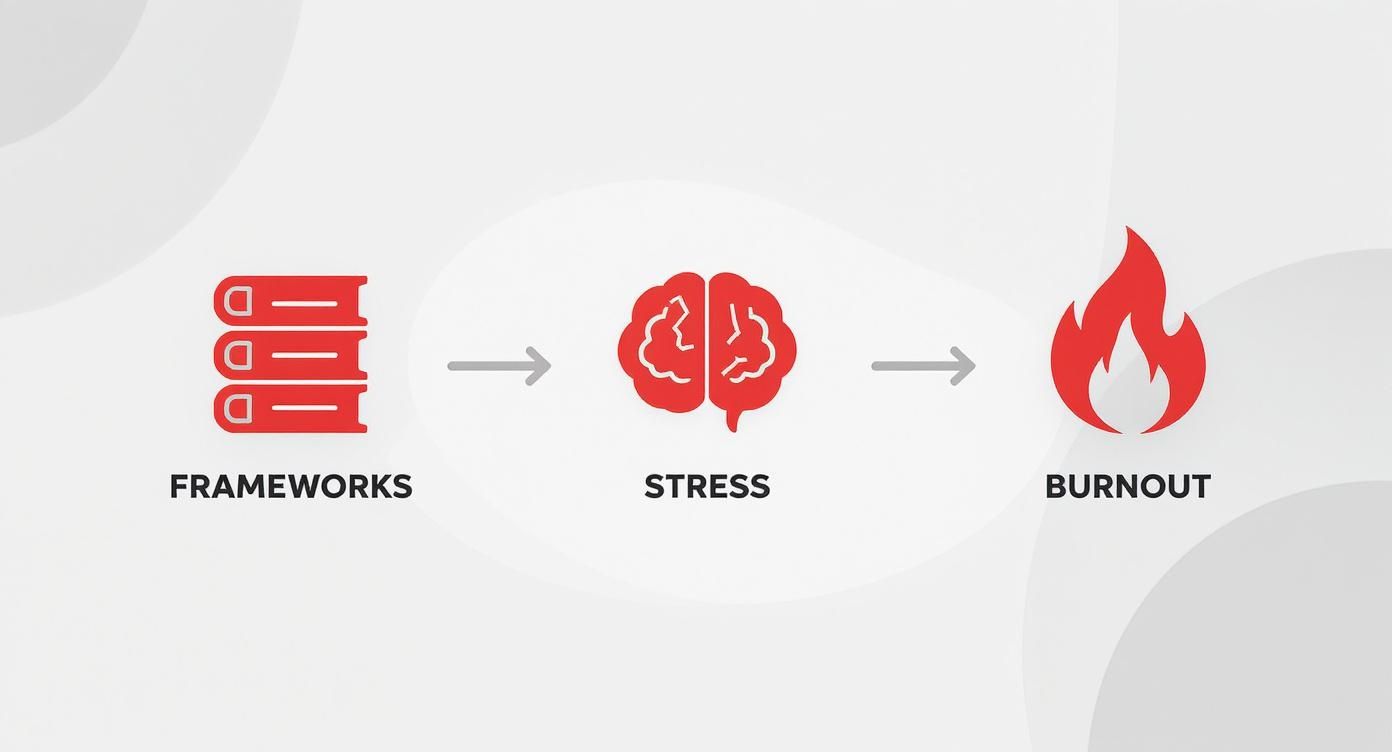
This cycle of intellectual overload leading to physiological exhaustion is precisely what the RAMS Method was built to break.
RAMS stands for the four pillars of embodied leadership: Results, Attitude, Mastery, and Systems. Each pillar is designed to work with the others, creating a powerful internal operating system for leading with sovereignty. You can take a deeper dive into the RAMS Method in this comprehensive guide.
Results Redefined
The first pillar, Results, throws out the old-school definition of success. Conventionally, results are about external metrics: revenue, KPIs, market share. That narrow focus is a direct line to burnout because it separates achievement from personal well-being.
The RAMS Method redefines results as holistic. It’s about weaving professional achievements with your internal state, your health, fulfillment, and presence.
Success is no longer just what you achieve; it's the state of being you cultivate while achieving it. This reframe shifts the goal from a relentless pursuit of more to a sustainable and energizing path.
Attitude as Nervous System Sovereignty
Next is Attitude. This isn't about a fake smile or affirmations. This is about cultivating nervous system sovereignty, the raw ability to stay calm, centered, and clear when pressure is high. We’re talking about practical, physiological tools to regulate your internal state, shifting you from reactive survival mode into a grounded, responsive state of leadership. Your attitude becomes a direct reflection of your regulated biology.
Mastery of Embodied Skills
Mastery is where we develop the tangible, embodied skills of a sovereign leader. This goes beyond intellectual knowledge. It includes skills like holding an unwavering presence in a high-stakes meeting, finding decisive clarity in chaos, and communicating with impact. These aren't "soft skills"; they are physiological capacities. Mastery is honing your ability to listen deeply, hold space for your team, and make powerful decisions from grounded certainty, not anxious reactivity.
Systems for Sustainable Performance
Finally, Systems are the external structures you build to protect your internal return. This means intentionally designing your work, team dynamics, and personal life to guard your energy and sustain high performance without burnout. This could be creating communication protocols that kill urgency culture. It might be delegating with radical trust or scheduling non-negotiable recovery time. These systems become the container that protects your newfound capacity, underlining the importance of embodied self-care that nurtures mind, body, and spirit.
This integrated approach is catching on. A recent Harvard Business Impact study shows how organizations are shifting their training priorities. For instance, 62% of organizations now use employee surveys to measure leadership effectiveness, a clear signal of a move toward more data-driven, human-centered evaluation. Furthermore, 43% use a blend of internal and external programs, actively seeking out specialized expertise to foster genuine growth. This shift aligns perfectly with the RAMS philosophy, which rewires a leader's internal world to create powerful, sustainable external results.
Your Return to Sovereign Leadership
The path of sovereign leadership training boils down to one profound truth.
Real, sustainable leadership isn’t about cramming in another skill set or memorizing a new framework. It’s about stripping away the layers of armor you’ve built to survive. It's about coming home to your authentic, regulated self. This work is about letting go of the relentless pressure to perform. It's about learning to lead from deep internal alignment and presence. This isn’t a destination; it's a new way of being you cultivate, moment by moment.
Reclaiming Your Sovereignty
Here is the core of it: the single most powerful leadership tool you will ever possess is a regulated nervous system. Nothing else comes close. When you're grounded and present, you unlock a level of clarity, resilience, and intuitive wisdom that no external strategy could ever replicate.
This is the essence of sovereign leadership.
It’s the capacity to hold your center when chaos is swirling. It’s making decisions from quiet confidence, not frantic reaction. It’s inspiring your team not through force or constant drive, but through the undeniable power of your own embodied presence. It stops being about what you do and starts being about who you are.
True return is not an addition of something new. It is a returning to the powerful, authentic leader you were before the burnout and pressure began to pile up.
Your Next Step: Return to Yourself
This path isn’t about becoming someone else. It's about remembering and reclaiming the powerful leader already inside you. It's a process of returning to yourself, one intentional step at a time. The work is deep, but the way forward is clear.
If this resonates—if you feel that pull to lead from a place of greater ease, power, and authenticity, then your next step isn’t a sale. It is an invitation to clarity, a logical continuation of the path you're already on. It is a step toward returning to yourself.
To begin this process, I encourage you to explore Leadership Sovereignty Mastery. This is your chance to move from simply understanding these ideas to truly living them, creating a leadership style that isn't just successful, but deeply and sustainably your own.
Frequently Asked Questions
Let's tackle some of the questions that often come up when leaders consider this level of work.
How quickly will I see a difference?
You'll likely feel an internal shift almost immediately. Many leaders report a sense of calm or spaciousness after just the first few sessions, a newfound ability to breathe through a high-pressure situation instead of reacting to it. That's the first sign. Lasting return, however, is a practice. Rebuilding team trust, shifting culture, or healing years of burnout unfolds over time with consistent work.
Is this training only for C-Suite executives?
Not at all. While critical for senior leaders, the principles are powerful for anyone who guides or influences others. We work with team leads, department heads, and rising stars who want to build a different kind of career from the ground up. Equipping a leader with the skills of self-regulation and genuine strength early on is a game-changer. It prevents burnout and builds a pipeline of emotionally intelligent, resilient leaders.
How do you measure the ROI on this kind of training?
Measuring the return goes beyond the P&L, though it shows up there. The real ROI creates a ripple effect, and we track it by looking at both hard data and human impact.
Quantitative Metrics: We see dramatic improvements in employee retention, people stay when they work for a regulated, inspiring leader. Absenteeism drops, and you can measure direct increases in team productivity and engagement scores.
Qualitative Metrics: You can feel these in the office. It’s the palpable shift in team morale, the emergence of a more innovative and psychologically safe culture. It’s watching collaboration improve because friction is gone. Leaders themselves report feeling more confident and less overwhelmed, directly impacting the quality of their strategic decisions.
The ultimate ROI isn't just a number. It's building a sustainable leadership model that drives business growth by nurturing the human beings who make that growth possible. It’s creating an organization that is resilient and thriving from the inside out.
Ready to move beyond theory and begin the real work of embodied leadership? Baz Porter provides a clear path for accomplished leaders to reclaim their sovereignty and lead with renewed power and presence. Discover the next step in your path at https://bazporter.com.
Where to go next
If any of this reads like your own reflection, the Silent Collapse Diagnostic™ is a quiet place to start — a private, one-to-one look at what is really happening beneath the results. And if you want the deeper why beneath the work, read the Sovereign Manifesto.