The End of Hustle: A Guide to Strategic Leadership Development
You’re the one everyone turns to. The one who gets it done, no matter what. Your track record is a testament to your relentless effort and unwavering commitment. But behind that public facade of competence and control, a private battle is raging. You’re running on empty. And not just tired—this is a profound, bone-deep exhaustion that no amount of sleep seems to touch. This is the high-achiever’s paradox: a glittering exterior of success that masks a silent, internal collapse. If you stop performing, even for a moment, you feel like you’ll disappear. This is the price of hustle. It’s not sustainable. And it’s not strategic.
Key Takeaways
Your Biology is Not Your Destiny: Chronic overwhelm isn't a character flaw; it's a physiological state driven by a dysregulated nervous system. True strategic leadership begins with regulating your biology first.
The RAMS Framework is Your New OS: Move from reactive firefighting to intentional impact by implementing a new leadership operating system: Results, Attitude, Mastery, and Systems.
Action Over Abstraction: Lasting change comes from small, embodied practices, not just intellectual understanding. We'll cover tangible actions like a Personal Strategic Audit and real-time nervous system regulation techniques.
Sovereignty is the Goal: The ultimate aim of strategic leadership development is not just better business outcomes, but reclaiming your internal authority and leading from a place of calm, embodied power.
The High-Achiever's Silent Struggle with Burnout
Strategic leadership development is about moving from a state of reactive, frantic control to one of embodied power, where every action is aligned with your internal capacity and a clear, long-term vision. It's the only way to lead without burning yourself to the ground. This guide provides the roadmap to make that shift.
You feel perpetually "on," turning chronic control into your primary survival mechanism. You micromanage every detail, anticipate every risk, and bulldoze through every obstacle because you've come to believe that if you stop performing, you’ll be irrelevant. This constant state of hypervigilance completely disconnects you from your intuition, making true strategic thinking feel like a luxury you simply can't afford.
This isn’t just a personal feeling; it’s a reflection of a massive corporate challenge. Recent global studies have thrown a startling number into the spotlight: only 14% of CEOs feel their organizations have the leadership talent needed to actually execute their business strategies. That staggering gap screams for a new kind of leadership, one that doesn't demand self-sacrifice as the price of admission.

The core problem is simple: how can you lead strategically without sacrificing yourself?
Real strategic leadership development isn't about cramming more skills into your already overflowing toolkit. It's about fundamentally aligning the results you produce with your nervous system’s capacity to produce them. The first step is recognizing the early warning signs. Learning the 10 Key Signs of Emotional Burnout can help you see if these patterns are showing up in your own life.
Our guide on overcoming burnout at work offers some powerful first steps. Ultimately, the goal is to lead from a place of authentic power, not from a place of reactive, desperate control.
Your Strategic Leadership Development Roadmap
This guide is designed to be more than just information; it's a practical roadmap. The table below breaks down the path we're about to take, outlining the core insights you'll gain and the immediate actions you can start taking today.

This roadmap is your guide to moving from a state of constant overwhelm to becoming a leader who drives meaningful, sustainable impact—without sacrificing yourself in the process. Let's begin.
Why High-Performers Are Wired for Overwhelm
The same relentless drive that rockets you to the top isn't just a personality quirk; it's a biological state. For so many of the executives I work with, that feeling of being perpetually "on" comes from a nervous system that’s literally stuck in overdrive. This isn’t a failure of mindset. It’s a physiological pattern.
Think of your sympathetic nervous system as the body's "fight or flight" accelerator. It’s brilliant for short bursts of intense stress, like closing a make-or-break deal. But in the high-stakes, always-on corporate world, it can get jammed in the "on" position.
This creates a constant state of hypervigilance. Your brain is relentlessly scanning for the next threat, the next problem, the next fire to put out. Living like this makes reactive, short-term decision-making your default setting. True strategic leadership becomes almost impossible because your brain is prioritizing immediate survival over any long-term vision. You aren't choosing to micromanage; your biology is compelling you to.
The Guardian at the Gate
I want you to imagine your primal survival instinct as a "Guardian at the Gate." Its only job is to protect you from harm. This Guardian is ancient, powerful, and incredibly effective at its job. It’s what triggers an amygdala hijack, flooding your system with cortisol and adrenaline when a high-stakes project is on the line.
But here’s the problem. When this Guardian is always on duty, it starts to see everything as a threat. A critical email from the board. A team member's mistake. A slight dip in quarterly numbers. All are treated with the same five-alarm-fire level of emergency. This constant activation leads to what’s known as cortisol fatigue, leaving you feeling simultaneously wired and completely exhausted.
This isn't a personal weakness or a sign you can't handle the pressure. It’s the predictable outcome of a biological system pushed far beyond its intended limits. Your struggle is a pattern, not a flaw—and patterns can be rewired.
In its attempt to protect you, this Guardian ends up isolating you. It stands between you and your most valuable leadership assets: your creativity, your intuition, your ability to connect authentically with your people. It keeps you locked in a cycle of control and reaction, making it impossible to access the calm, expansive mindset required for strategic foresight.
If you're finding it harder and harder to connect with your work, it’s a huge red flag that this Guardian has become too dominant. It’s worth exploring the deeper reasons why you might feel unmotivated at work to see just how deep this pattern runs.
This constant state of alert physically rewires your brain to favor short-term, tactical thinking. During a stress response, blood flow is diverted away from the prefrontal cortex—the part of your brain responsible for complex planning and strategic thought. Your brain literally cannot access its most strategic resources when you're chronically overwhelmed.
So, the first real step in developing strategic leadership isn't learning a new tactic or framework. It’s understanding and addressing this underlying biological reality. By learning to regulate your nervous system, you can gently ask the Guardian to stand down. Only then can you access your full cognitive and emotional capacity once again. This is how you move from being managed by your stress to managing your strategy with clarity and power.
The RAMS Framework: Your New Leadership Operating System
You’ve seen how an overworked nervous system keeps incredible leaders stuck in a reactive loop. That constant firefighting isn’t a strategy; it’s a biological survival response. To break that cycle and step into the strategic leadership you’re capable of, you need a new operating system. One that aligns your biology with your ambition.
That’s exactly what the RAMS framework was built for.
This isn’t just another set of tactics to cram onto your already overflowing plate. It’s a methodology designed to re-engineer your entire approach to leadership from the inside out. RAMS stands for Results, Attitude, Mastery, and Systems.
Each piece works together to systematically dismantle the architecture of overwhelm, replacing it with a foundation of embodied power and strategic clarity. Let's dig into how it actually works.
Comparing Reactive Management and Strategic Leadership
Before we break down the framework, it's crucial to see the paradigm shift we're talking about. The old way of managing was built on control and reaction. The new paradigm of strategic, embodied leadership is about intention and influence. This table lays out the fundamental differences.

This isn't just a change in behavior; it's a fundamental shift in your internal state. The RAMS framework is the roadmap to get you from the left column to the right.
Redefining Your Results
For high-achievers, the word "results" is almost always tied to external validation. Hitting KPIs, blowing past revenue targets, landing the next big promotion. This relentless chase is the very thing that fuels the burnout you're desperate to escape.
The RAMS framework flips this on its head right from the start.
True strategic leadership begins when you define results on your terms, anchored in your core values and the unique impact you want to make. This isn’t about lowering your standards; it’s about raising your consciousness.
From: "What numbers do I need to hit this quarter to prove my worth?"
To: "What impact will be most meaningful for the business, my team, and myself over the next year?"
That single shift moves you from being a servant to your metrics to being the architect of your legacy.
Cultivating a Strategic Attitude
Your attitude is the internal filter through which you see every challenge and opportunity. A fear-based attitude, driven by that "Guardian at the Gate," leads directly to micromanagement, risk aversion, and a desperate need for control. It's utterly exhausting.
A strategic attitude, on the other hand, is cultivated from a place of embodied confidence. It's the calm, centered state of a leader who trusts her own judgment and her team's capabilities. This has nothing to do with "thinking positive" and everything to do with achieving a physiological state of regulation.
An embodied attitude allows you to hold complexity without collapsing into overwhelm. You can see the bigger picture because you are no longer consumed by the immediate threat.
This mental and emotional shift is the bedrock of strategic leadership. Without it, everything else is just tactics.
Achieving True Mastery
Mastery, in this context, has nothing to do with perfecting every single skill on your list. It’s about mastering yourself. This pillar zeroes in on two critical areas: strategic foresight and emotional regulation under pressure.
Strategic Foresight: This is the ability to look past the smoke of the immediate quarter and see future trends, opportunities, and disruptions on the horizon. It requires the mental space to think, question, and connect disparate ideas—space that is simply unavailable when you're stuck in reactive mode.
Emotional Regulation: This is your superpower. It's your capacity to remain grounded and clear-headed when the stakes are high and everyone else is panicking. It's the skill of managing your own nervous system so you can lead others through uncertainty with confidence, not anxiety.
This is the progression we're aiming for. It's a path from being driven by external outcomes to being supported by internal systems.
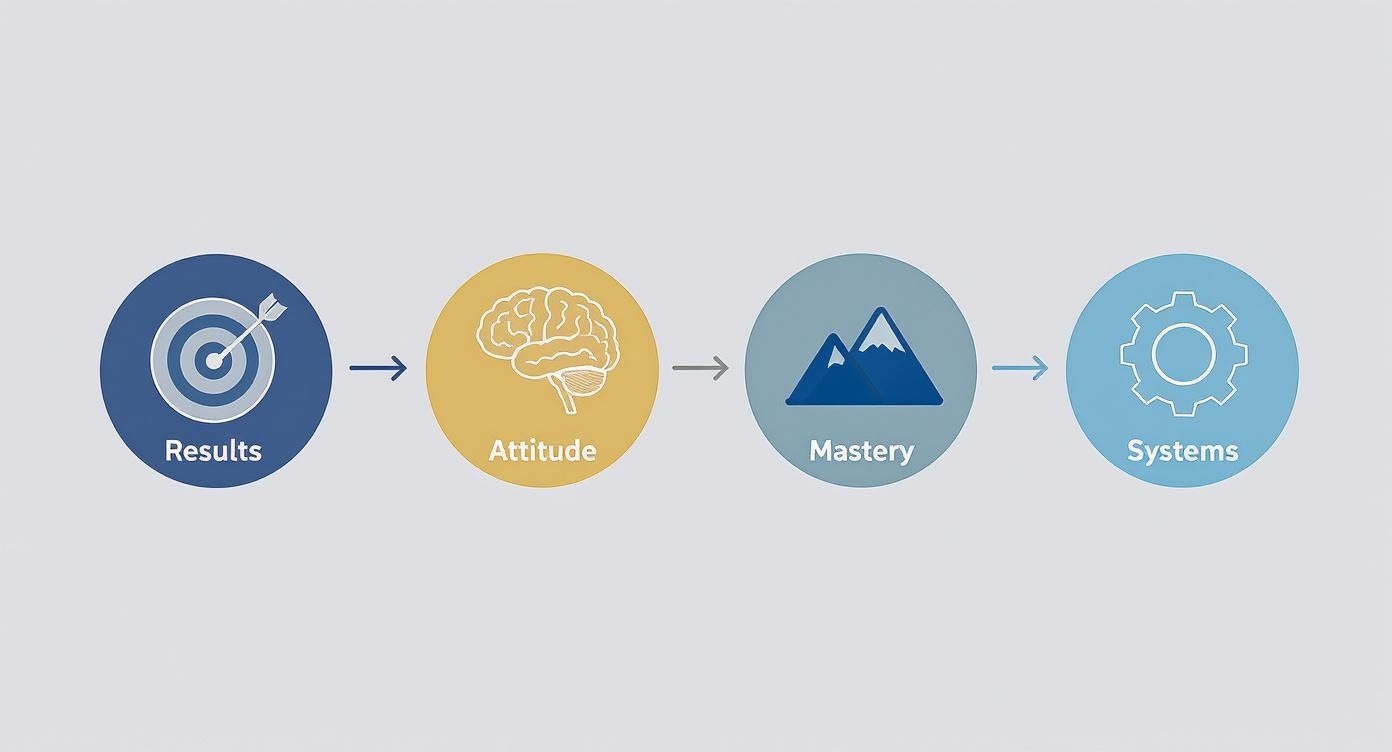
As you can see, each element builds on the last, creating a holistic and sustainable model for leadership that actually works in the real world.
Building Supportive Systems
Let’s be clear: your personal capacity is finite. Believing you can do it all is the fastest route to burnout. The final pillar of RAMS is about creating intelligent systems that fiercely protect your time, energy, and focus, allowing you to operate in your zone of genius.
These aren't bureaucratic processes; they're practical structures that create leverage.
Intentional Delegation: Moving beyond just offloading tasks to strategically strengthening your team with true ownership.
Clear Boundaries: Defining—and defending—the non-negotiable lines that protect your strategic time and personal well-being.
Communication Cadences: Establishing predictable rhythms for meetings and updates that cut through the noise and amplify clarity.
These aren't just administrative afterthoughts; they are the scaffolding that holds your entire strategic focus together. Without robust systems, even the most brilliant strategy will collapse under the weight of daily execution. For a deeper dive, you can learn more about the RAMS method in our detailed article.
For leaders looking to amplify their influence even further, figuring out how to start a business book and monetize your expertise can be a powerful system for scaling your impact.
When you implement the RAMS framework, you create a powerful, self-reinforcing loop. Redefined Results give you a clear North Star. A strategic Attitude provides the internal stability to pursue it. Mastery of yourself gives you the skill to navigate the inevitable challenges. And robust Systems provide the support to make it all sustainable.
Putting Your Strategic Leadership Plan into Action
Knowing the RAMS framework is one thing. Actually living it is a whole different ballgame. A brilliant strategy collecting dust in a binder is just that a document. This is where we get our hands dirty and translate those powerful insights into tangible, daily practices.
We’re moving from intellectual head-nodding to embodied leadership. And it doesn’t start with some grand, sweeping gesture. It starts with a quiet, brutally honest inventory of where your energy is really going.
Forget massive, exhausting overhauls. Sustainable change is built on small, consistent shifts that regulate your system and protect your focus.
Begin with a Personal Strategic Audit
Your very first move is to conduct a Strategic Audit. No, this isn't about business metrics or P&L statements. It’s about you.
For one full week, I want you to ruthlessly track where you are over-functioning. Where are you swooping in to do things that belong to your team? Making decisions that your direct reports should be owning? Solving problems they are paid to tackle?
Get a notebook and be honest.
Where are you the bottleneck in your own organization?
Which specific activities completely drain your battery?
What tasks are you clinging to out of habit, or maybe a little bit of fear of letting go?
This audit is your ground truth. It shines a harsh light on the gap between the strategic leader you want to be and the reactive manager you’ve become. This is the raw data you need to stop operating on autopilot and start making deliberate, conscious choices.
Regulate Your Nervous System in Real Time
Let's be clear: you cannot think strategically from a state of fight-or-flight. It’s physiologically impossible. Your ability to self-regulate your own nervous system during a high-stakes meeting or a tense negotiation isn't a soft skill; it’s a core leadership competency.
Before you walk into your next difficult conversation, try this. It takes less than 30 seconds.
Sit down and plant both feet flat on the floor.
Actually press your feet into the ground. Feel the solid connection.
Take three slow, deep breaths. Make your exhale just a little bit longer than your inhale.
Notice the physical sensation of the chair supporting your body.
That’s it. This simple micro-practice sends a powerful signal to your primal brain that you are safe and grounded, pulling you out of a reactive state and back into your prefrontal cortex—your strategic mind.
"A leader can bring the clarity and support that will enable the team to remain motivated. The leader in this case is like the backbone, providing both a supporting structure and a means of flexibility as new conditions emerge."
Implement Clear Boundaries and Systems
Boundaries aren’t about pushing people away; they are the systems you build to protect your strategic capacity. This means getting incredibly comfortable saying "no," or perhaps more accurately, "not now."
It also means creating the operational structures that free your team to function without you as the central hub. For a deep dive on this, check out our post on scaling impact by creating systems that empower teams.
This isn't just a "nice-to-have." Organizations are waking up to its bottom-line importance. The global leadership development market has exploded to $366 billion, with the U.S. alone accounting for $166 billion. This isn't frivolous spending. It's a response to a critical business reality: companies that fail to invest in these programs risk profit reductions of up to 7%. You can see more of the statistics driving this trend and why it matters.
By putting these small, consistent actions into play, you begin to dismantle the old patterns of over-functioning. You start building the foundation for a sustainable, high-impact leadership presence. This isn't about adding more to your plate; it’s about strategically curating what truly deserves to be there in the first place.
Leading From a Place of Clarity and Calm
Everything we've walked through every framework, every tactic, every mindset shift boils down to something more fundamental than strategy. It’s about reclaiming your nervous system sovereignty.
This isn't just a catchy phrase. It's the non-negotiable capacity to lead with power, decisiveness, and genuine strategic insight from a place of deep internal calm. It's about holding your center, even when chaos is swirling all around you.
You know the pattern because you've lived it: a high-performer whose biology has been wired for overwhelm, pushing you into a relentless cycle of reactive control. The RAMS framework isn't just a map for business; it's the blueprint for rewiring that very system. It’s how you shift from being yanked around by external demands to leading from an unshakable internal locus of control. This is the return to yourself.
Strategic leadership isn’t a title you hold; it's an embodied state you inhabit. It's the quiet confidence that comes from knowing your actions are aligned with your internal capacity, not just external expectations.
The return from frantic management to embodied leadership is profound. You stop just putting out fires and start preventing them entirely. You move from being managed by the tyranny of the urgent to commanding your own vision. This path creates a powerful ripple effect, influencing not only your career but every corner of your life.
This path isn't about adding more to your already overflowing plate. It’s about fundamentally changing how you show up to it. To truly lead with confidence from this new foundation, your first move is to get brutally honest about your unique starting point. The final call-to-action is an invitation to take that next logical step on your path back to embodied leadership a diagnostic tool designed to map out your unique path to sustainable success.
Burning Questions About Embodied Leadership
When leaders start this path from reactive control to embodied, strategic leadership, a few key questions always come up. Let's get right into them, because the answers are critical to navigating this powerful shift.
How Long Until I Actually See a Difference?
Let’s be clear: this isn't a weekend workshop that gives you a temporary high. We're talking about a fundamental rewiring of your internal operating system, and that takes commitment.
That said, you can feel immediate relief from some of the smaller practices, like learning to regulate your nervous system in a high-stakes meeting. Many of the executives I work with report a tangible drop in their stress levels and a new sense of clarity within the first 30-60 days.
The deeper, more profound changes the ones that shift your strategic foresight and strengthen your team on a whole new level start becoming obvious within three to six months. That's when the consistent application of the RAMS framework really starts to compound.
Is This Only for C-Suite Executives?
Absolutely not. While the pressure is definitely turned up to eleven in the C-suite, this approach is for any high-achiever who feels that gnawing gap between their external success and their internal reality.
Whether you're a director steering a critical project, a founder pouring your soul into your company, or a senior manager trying to keep your team from burning out, these principles apply. This is about your pattern of operating, not your title on an org chart.
I'm Not a 'Natural' Leader. Can This Really Be Learned?
Yes. Unequivocally. The old-school idea that leaders are "born, not made" is a myth that has kept countless talented leaders stuck in place. It’s an outdated story we need to stop telling.
Strategic leadership is a potent mix of skills, mindset, and, crucially, physiological regulation and all of it can be developed with intentional practice. This requires moving beyond just consuming more business books and committing to the embodied work of changing your internal state.
"A leader can bring the clarity and support that will enable the team to remain motivated. The leader in this case is like the backbone, providing both a supporting structure and a means of flexibility as new conditions emerge."
The real key is realizing this isn't about piling on more information. It's about unlearning the survival patterns—the perfectionism, the control, the over-functioning that are currently blocking the powerful strategic capacity you already possess.
The path to sovereign, strategic leadership is the single most critical investment you can make in your career, your legacy, and your well-being. If you're ready to trade burnout for building something truly sustainable, the work we do at Baz Porter is designed for you.
Where to go next
If any of this reads like your own reflection, the Silent Collapse Diagnostic™ is a quiet place to start. And if you want the deeper why beneath the work, read the Sovereign Manifesto.