
Discover Your 2026 quiz future life Today!
You open a tab for a quiz future life result because it feels safer than naming what is happening.
You answer questions about dream homes, ideal cities, second acts, and reinvention. Then you stare at the result and feel nothing. Not relief. Not truth. Just the dull insult of being misread again.
Your life doesn’t need prediction. It needs diagnosis.
You are not confused because you lack ambition. You are fragmented because the identity that built your success is now consuming the woman who has to live inside it. You keep thinking, “If I slow down, everything falls apart.” You keep hearing, “You have everything you wanted.” You keep asking, “Why do I feel nothing?”
That split is not moodiness. It is not ingratitude. It is not a branding issue. It is collapse.
Table of Contents
The Futility of the Future Life Quiz
Most quiz future life content is built for amusement, not truth.
That is harmless for someone browsing out of curiosity. It is dangerous for a woman in Silent Collapse™. She doesn’t need fantasy dressed as insight. She needs language for the fracture she is already carrying through boardrooms, launches, investor calls, and family life.

Key takeaways
Generic future quizzes distract from the core issue. They offer prediction when the actual need is diagnosis.
Silent Collapse™ is often hidden by performance. A woman can look powerful and still be internally depleted.
A useful quiz future life tool must assess present-state distortion. It cannot rely on aspiration alone.
The right result should feel clinical, not flattering. Recognition comes before change.
A direct answer, then. If you are a high-achieving woman searching for a quiz future life, the only version worth taking is one that functions as a diagnostic for Silent Collapse™. Anything else is entertainment, and entertainment will not tell you why success now feels emotionally vacant.
The wider culture has not caught up to this. Existing quiz content overwhelmingly misses high-achieving women in this exact condition. A McKinsey Women in the Workplace report notes that 42% of female executives experience this silent crisis, and 68% are unable to envision a fulfilling future self without intervention. That is not a future-planning problem. That is a collapse-of-self problem.
You do not need another flattering profile. You need an instrument that can detect self-betrayal under success.
I’ve seen women mistake physiological and identity-level strain for indecision. They say they feel foggy. Flat. Irritated by everything. They assume they need a sabbatical, a planner, a better morning routine, or a cleaner five-year vision. Sometimes they need medical investigation too, especially when hormonal shifts are involved. That is why practical resources like insights on menopause testing from Lila can matter. Not because menopause explains every collapse, but because real diagnosis beats self-guessing.
If you’ve been asking why people respond strangely to your success, your authority, or your exhaustion, this related reflection helps: why don’t people like me quiz.
What does not work
Prediction-based questions about where you’ll live or what title you’ll hold.
Wish-based prompts that assume desire is still a reliable guide.
Validation-heavy results that soothe the ego while ignoring depletion.
A collapsing woman often knows what she should want. She no longer knows what she can inhabit.
Diagnosing Collapse The Hidden Pattern in Your Results
The hidden pattern is simple. Your inner navigation system keeps routing every answer through survival.
You think you are choosing your future. You are often just describing the shape of your compensation pattern. More control. More proof. More distance from vulnerability. More structures that let you avoid feeling the cost of your own life.

Silent Collapse is not dramatic
Silent Collapse™ does not always look like breakdown. It often looks like competence under strain.
You still deliver. You still solve. You still carry people who should be carrying themselves. But your emotional range narrows. Victories feel like administrative relief. Rest makes you uneasy. Praise lands nowhere. The life you built starts to feel like a polished structure with no oxygen inside it.
That is why ordinary quiz logic fails. It asks what you want. It should ask what your nervous system is defending against.
The purpose data matters here. The Purpose in Life Quiz from UC Berkeley’s Greater Good Science Center found that only 45% of adults report a meaningful long-term goal. For female executives, low purpose correlates with 42% higher cardiovascular risk. It also weakens resilience. In real terms, that means the woman who says, “I should feel grateful,” may be reading her own emptiness as a moral flaw when it is a clinically relevant signal.
Clinical read: When purpose collapses, high performance does not protect you. It often conceals the damage.
Better questions expose the fracture
A real diagnostic asks questions that disturb the persona.
It asks things like:
Does professional success feel more like relief than victory?
Do you fantasize about disappearing, not failing?
Has competence become the mask that prevents anyone seeing your depletion?
When you imagine your future, do you see status clearly but not yourself?
Do you resent the life that depends on your constant regulation?
These questions do not predict your future. They detect distortion in the present.
A good primer on understanding professional burnout can help separate ordinary overwork from a deeper identity rupture. The distinction matters. Burnout says you are tired. Silent Collapse™ says the self performing your life is no longer fully connected to the self living it.
I use a simple metaphor for this. You are trying to find your way with a system that still thinks the emergency route is home. Every reroute takes you back to over-responsibility, over-functioning, and over-control.
If that lands hard, read executive dysregulation. Many women do not need more discipline. They need to see how brilliantly they have organized around distress.
What a useful result should reveal
A useful result should identify where the split is occurring:
Purpose split. You can still achieve, but you cannot feel meaning.
Identity split. Your public role has outrun your private reality.
Capacity split. Your obligations exceed what your body can sustain.
Relational split. Everyone gets your function. No one gets your truth.
If a quiz future life result doesn’t show you one of those fractures, it probably isn’t measuring anything that matters.
How to Interpret Your Answers for Sovereign Leadership
The answer itself is not the insight. The gap is.
High-achieving women usually misread their own results because they read them through duty. They answer truthfully, then interpret untruthfully. They still filter everything through the leader they think they must remain.
The persona problem
Psychometric depth matters because surface preference is often contaminated by adaptation. The career assessment overview describing MAPP’s methodology notes that platforms like this process 71 distinct variables to distinguish aspirational career identity from authentic aptitude-based fit. That distinction is critical for executive women because burnout often comes from a persona they’ve adopted, not from lack of ability.
That is the operating error. You are running software built for a public identity that your actual system can no longer support.
If your answers sound impressive but feel dead, the persona answered first.
Read your answers in three passes
Do not ask, “What does this say about my potential?”
Ask these instead:
What feels heavy in my answers?
Notice where your language is full of obligation, not desire. Words like “should,” “must,” and “need to” are signals.What sounds borrowed?
Some answers are inherited from industry culture, family conditioning, or image maintenance. They are polished, but they are not yours.What requires self-erasure?
Any path that demands chronic suppression is not ambition. It is slow internal abandonment.
Practical interpretation rules
If you choose prestige over peace by reflex, your system may be defending identity, not expressing truth.
If every future image includes more output, you are likely still bargaining with collapse.
If your strongest answers center on proving, then your future is being designed by fear.
If you cannot picture satisfaction without exhaustion, your baseline has been distorted.
In operating terms, this resembles what happens in failing execution systems. Teams set goals that look precise but are built on the wrong assumptions. That is why disciplined planning frameworks matter in business. Resources on mastering OKR implementation are useful because they show how misalignment creates drag even when effort is high. The same applies internally. A woman can be highly capable and still be running a misaligned human system.
If you need language for what aligned power feels like in the body, read embodied sovereignty.
What to trust
Trust the answer that costs your persona something.
Trust the result that names exhaustion hidden under success.
Trust the pattern that explains why your future looks full on paper and unlivable in your body.
That is where Sovereign Leadership starts. Not with ambition. With accurate interpretation.
The RAMS Framework From Diagnosis to Action
She gets the quiz result, nods at the accuracy, saves the page, and goes straight back to the calendar that is eating her alive.
That is the failure point.
Insight without structural change becomes another way high-achieving women perform honesty while protecting the machinery that is draining them. A generic future life quiz often stops at reflection. A diagnostic method has to go further. It has to identify the pattern, locate the operational failure, and force a redesign of how leadership is being carried.
I use the RAMS Framework™ because Silent Collapse is not a mindset issue. It is a systems issue expressed through a woman’s body, schedule, authority, and decision-making.

Burnout changes how a woman leads, sleeps, decides, and recovers. Treating that as a branding problem is delusional. The cost is physical, relational, and strategic. If a future life quiz points to a dream but ignores depletion, it is not forecasting your future. It is helping you avoid the condition you are already in.
Reach
Reach is where many high performers first lose reality.
A woman in collapse increases exposure when her system needs protection. She says yes to one more panel, one more meeting, one more message, one more leadership demand. On paper, it looks like momentum. In practice, she is using visibility to regulate worth.
I see this constantly. The woman is not expanding because the business requires it. She is expanding because being seen temporarily covers the panic that surfaces when she gets still.
Reach work requires three corrections:
Audit where visibility serves strategy and where it serves identity maintenance.
Cut exposure that creates noise without authority.
Rebuild access so leadership is not confused with constant availability.
If every room can reach you, your authority is already leaking.
Acquire
Acquire is the phase where dysfunction gets praised.
The collapsed woman keeps adding. More scope. More proof. More credentials. More complexity. More people depending on her. She calls it ambition because that sounds cleaner than compulsion.
The standard future life quiz fails badly. It interprets hunger as vision. It rewards expansion without asking whether the appetite is clean. It tells her to want more when the underlying issue is that she does not know who she is without pursuit.
The diagnostic question is harder and more useful. What are you acquiring to avoid feeling?
A few questions expose the pattern fast:
What am I still chasing because stopping would force me to face emptiness?
What am I maintaining only because it props up identity?
Which goals create strain without increasing integrity, stability, or actual authority?
Compulsive acquisition produces an impressive life that feels hostile to inhabit.
Monetize
Monetize is about value discipline.
Women in Silent Collapse often extract value from themselves in the most expensive way possible. They over-give, over-explain, over-deliver, and train everyone around them to expect intimate access to premium thinking. Then they resent the dependency they created.
The spreadsheet rarely captures the full loss. This drain shows up in fractured attention, poor pricing, delayed decisions, thinner creativity, and a nervous system that never stands down.
Monetize work usually means:
Stop rewarding urgency with access.
Identify where exhaustion has been built into how you create value.
Restructure offers, roles, and decision rights so leadership gets paid for discernment, not depletion.
I have worked with women whose businesses looked healthy while their internal economy was collapsing. Revenue was coming in. Authority was going out.
Scale
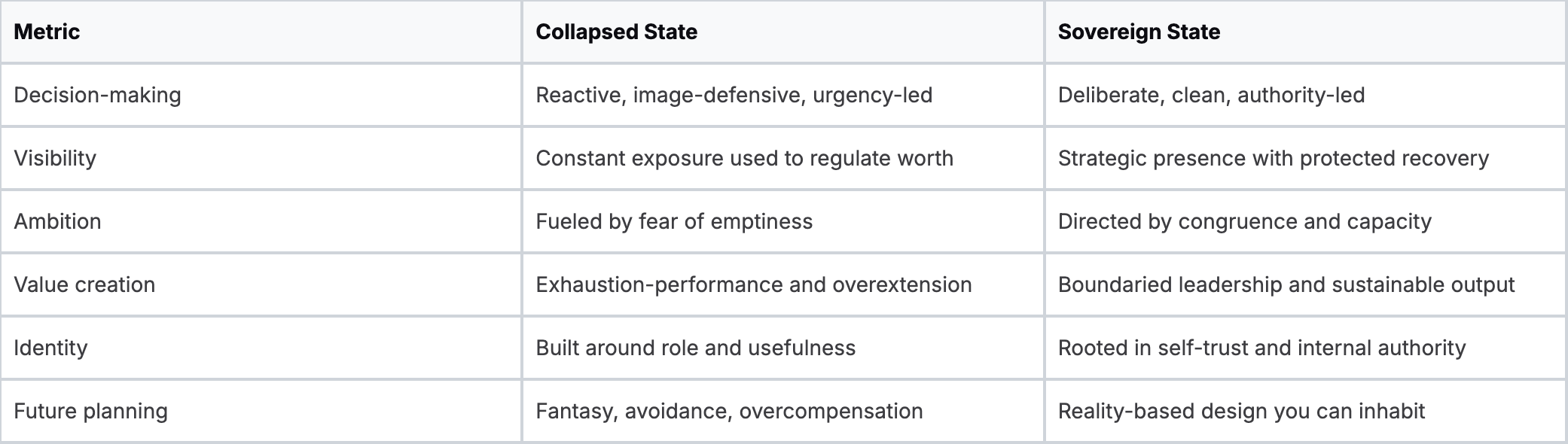
Scale tests whether the woman exists inside the success she is building.
In collapse, scale means a larger container built on a more fragmented self. The business grows. The persona hardens. The body carries the unpaid bill.
In sovereign leadership, scale means expansion without self-erasure. Capacity increases because the structure can hold weight that the woman used to carry alone. Her decisions get cleaner. Her communication loses its edge. She stops wasting energy managing perception and starts using it to lead.
That shift is operational, not cosmetic.
Leadership State Comparison
What implementation actually looks like
RAMS works in sequence.
Recognize the collapse pattern.
Identify where success is covering deterioration, over-functioning, or emotional self-abandonment.Analyze the trigger system.
Track the people, environments, metrics, and identity threats that push you back into compulsive performance.Mobilize structural change.
Change meeting load, response expectations, pricing, delegation, authority lines, and recovery protection.Sustain through nervous-system sovereignty.
Stabilize the system so rest no longer feels dangerous and leadership no longer depends on stress chemistry.
If you want the underlying architecture, read the RAMS method for sovereign leadership.
What works and what fails
What works:
Accurate diagnosis
Pattern interruption at the structural level
Reduced access to your time, energy, and mind
Recovery treated as leadership infrastructure
What fails:
Insight with no behavioral cost
Adding goals to an already collapsed system
Boundary language that does not change identity
Calling endurance a strength when it is adaptation to chronic strain
One client described it plainly. She had built a life she could manage but could not feel present inside. That is the sentence underneath many polished leadership brands. Once we corrected the structure, her authority improved because she stopped spending herself to keep everything running.
The Silent Collapse Diagnostic identifies where you are in the cycle and what has to change first.
The Return Building a Future You Can Inhabit
The return is not dramatic.
It is quiet. Precise. Biological.
You sleep without negotiating with tomorrow. You make a decision without replaying it for hours. You stop using speed to avoid contact with yourself. You no longer need every room to confirm that you matter.

Nervous-system sovereignty is the real future
This is the true meaning for most women when they search for a future life.
They do not mean a prettier vision board. They mean, “Can I live without feeling hunted by my own responsibilities?” They mean, “Can success stop costing me my inner life?” They mean, “Can I still lead without abandoning myself?”
That state is not fantasy. It is built.
A future you can inhabit is one your body does not treat as a threat.
What changes in real terms
A woman in Sovereign Leadership™ does not become passive. She becomes accurate.
She knows when to advance and when to withhold. She stops confusing accessibility with leadership. She can hold authority without chronic tension in the background. Her life becomes less performative and more inhabitable.
That often requires practical redesign. For some women, it means changing how they lead teams. For others, it means changing what they no longer agree to carry. For many, it means admitting the old identity has reached its limit.
If you are still trying to solve this with productivity systems alone, you may be over-planning what is a collapse issue. Tools like a professional growth plan template can help once the diagnosis is accurate. Before that, planning can become another disguise.
The future is not the fantasy result from a quiz. It is the nervous system state from which your real life can finally be led.
Frequently Asked Questions
Why do I feel empty even though I am successful?
Because achievement and inhabitation are not the same thing. You may have built a life that performs well publicly while failing privately. That emptiness is often a signal of disconnection, not weakness.
Is this just burnout or something more?
Sometimes it starts as burnout. Silent Collapse™ is deeper. Burnout says your workload is unsustainable. Silent Collapse™ says the identity managing that workload is fragmenting under the strain.
Can a quiz really tell me my future?
Not in any meaningful way. A useful quiz future life tool does something better. It diagnoses the patterns shaping your current reality so your future is not built on distortion.
Why do rest and success both make me uneasy?
Because your system may have bonded safety to usefulness. Rest removes the proof. Success raises the standard. Both can feel threatening when identity has fused with performance.
What does Sovereign Leadership actually feel like?
Less noise. More clarity. Cleaner decisions. Authority without self-betrayal. You still lead, but you are no longer spending your life force to keep the structure standing.
If your results confirm what you already suspect, the next step is an application, not a sales call. I do not work with everyone. I work with women ready to stop managing their collapse and start ending it. Start with the Silent Collapse Diagnostic, explore the Sovereign Leadership Resource Hub, or Apply to Work With Baz.
British military veteran. Two-time international bestselling author. Founder, The Prestige Architect™. Host, Rise From The Ashes podcast on the C-Suite Network.