Why a "Why Don't People Like Me Quiz" Is a Dangerous Lie
You close the laptop after another flawless day. The board got certainty. Your team got composure. Your family got the version of you that still functions. Then the room goes quiet, and the thought lands again. Something is off. You open a browser and type why don't people like me quiz because naming the fracture feels safer than facing it.
That search is not curiosity. It is a symptom.
You are not looking for entertainment. You are looking for a verdict you can survive. You want the screen to explain why success feels sterile, why conversations feel staged, and why praise no longer reaches you. I’ve seen this pattern before in leaders who are still delivering while privately hollowing out. The search looks small. The condition is not. It often sits beside executive dysregulation, identity strain, and a nervous system that no longer trusts its own readings.

Table of Contents
The Question That Signals Collapse
You don't search for a why don't people like me quiz when life is stable. You search for it when your internal command system is failing.
You have proof that people respect you. They hire you, defer to you, promote you, and ask for your judgment. None of that settles the question. That is the tell. External evidence is present. Internal certainty is absent.
The late-night search usually follows a day of overcontrol. You edited your tone in three meetings. You replayed one sideways glance for hours. You read neutrality as rejection and efficiency as emotional distance. By night, you are no longer asking whether people like you. You are asking whether your whole social presence has become a liability.
That is not vanity. That is collapse logic.
A high-performing woman rarely asks this question from weakness alone. She asks it after prolonged self-suppression. She has spent years converting instinct into performance. She has become readable, polished, and productive while becoming less visible to herself. The quiz appears at the end of that chain. It is a final attempt to turn a private fracture into a score.
Why That Quiz Is a Flawed Diagnostic
A why don't people like me quiz is a bad instrument for a woman in Silent Collapse™. It doesn't measure reality. It measures distortion.
Key takeaways
The quiz confuses feeling with fact. That makes it unstable when your self-perception is already compromised.
The deeper issue is cognitive distortion. Research states that when you feel disliked, your mind often treats assumptions like facts, and this pattern appears in approximately 70% of individuals reporting social rejection in the analysis summarized at Cottonwood Psychology.
The score tells you less than you think. It often reflects performance anxiety, not actual relational capability.
A high achiever needs behavioral evidence, not mood-based self-reporting. That is why generic self-tests fail leaders under chronic strain.
The direct answer is simple. If you are a high-achieving woman asking whether a why don't people like me quiz can tell you the truth, the answer is no. For your profile, the quiz is usually another symptom marker, not a valid diagnostic.
"when you feel disliked, your mind often treats assumptions like facts"
That single mechanism destroys the quiz. The moment your mind starts converting emotional discomfort into certainty, your answers become contaminated at the source. You won’t report what happened. You’ll report what the internal alarm system decided it meant.
That is why I reject these quizzes for leaders in collapse. They reward introspection without calibration. They turn a distorted lens into an authority.
If you want a cleaner distinction between entertainment quizzes and real assessment, read quizzes for life. The difference is not style. The difference is whether the tool can survive contact with a compromised nervous system.
The Likability Lie Your Brain on Silent Collapse
The problem is not likability. The problem is your brain running threat interpretation through a compromised lens. I call that Silent Collapse™.

The compromised lens
A healthy mind separates data from interpretation. A collapsing system fuses them.
Someone gives brief feedback. You log disapproval. A colleague skips warmth because she is overloaded. You register aversion. A room stays neutral. You decide the room has turned on you. The lens is not cracked in an obvious way. It is warped just enough to make bad readings feel precise.
Clinical read: Silent Collapse™ is what happens when external function masks internal threat saturation.
That distortion carries real cost. A 2023 meta-analysis summarized in the SocialSelf review reported that chronic feelings of social rejection correlate with a 29% increased risk of depression onset, and the same source notes Baumeister's "Need to Belong" theory links unmet belongingness with 15-20% higher stress-related cortisol at SocialSelf's analysis of the quiz. Your body does not treat perceived exclusion as a minor social inconvenience. It treats it as a biological threat.
Why high achievers misread themselves
High-performing women are especially exposed because competence can hide deterioration. The outside world sees command. The inside system runs scarcity.
You keep functioning, so nobody calls it collapse. You keep producing, so you call it fatigue. Both labels miss the mechanism. The mechanism is chronic self-monitoring under threat. You are no longer relating. You are scanning.
That is why the search often sits beside feeling empty despite outward success. Emptiness is not random in this pattern. It is what remains after years of substituting controlled performance for unguarded presence.
What the quiz never measures
A generic quiz cannot detect whether your answers come from truth, fear, exhaustion, or role-conditioning. It cannot distinguish poor social skill from over-adaptation. It cannot tell whether you are unlikeable or are over-armored.
That is why I push leaders to study the fear itself, not the fantasy score. If this pattern feels familiar, examine fear of being disliked as a threat response, not a personality flaw. The distinction matters. One invites shame. The other allows diagnosis.
RAMS A Framework for True Assessment
You finish a meeting, replay every sentence, and then reach for a quiz to decide whether the room respected you. That is a bad instrument reading the wrong failure.
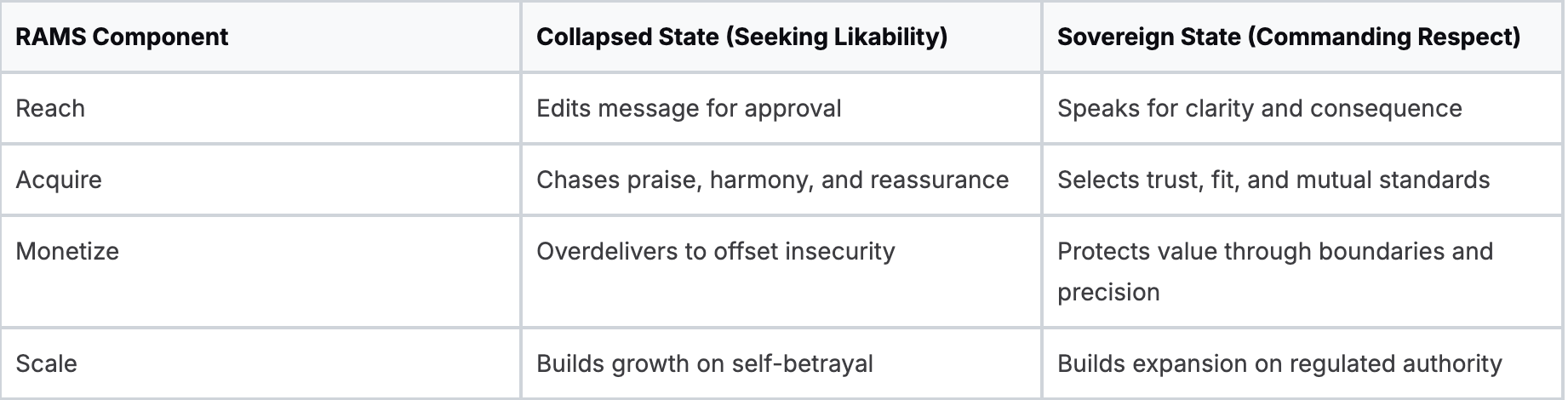
The right question is operational. What pattern is distorting your social self-assessment under pressure? RAMS Framework™ answers that question. It measures where approval-seeking has entered your leadership system and where that distortion is draining authority, clarity, and value.

A likability quiz asks for a feeling score. RAMS examines function under load. It asks four diagnostic questions:
Reach: Where are you diluting truth to control how you are received?
Acquire: What are you pursuing that keeps your identity tied to approval?
Monetize: Where is overfunctioning turning your leadership into a loss center?
Scale: What structure would let you expand without splitting yourself in two?
That difference matters. High-achieving women in silent collapse do not fail because they lack charm. They fail because they keep using social feedback as if it were accurate telemetry. It is not. Under stress, it reads like a faulty gauge.
Leadership State Comparison
Reach
Reach measures signal integrity.
In collapse, your message gets filtered through fear before it reaches anyone else. You soften decisions that need force. You add explanation where authority would be cleaner. You monitor faces while speaking and then edit in real time. The room gets a managed version of you, not a reliable one.
Run this audit.
Track every softened truth. Note where you replaced a clear statement with a safer one.
Measure post-meeting replay. Persistent rumination marks contaminated reach.
Separate clarity from niceness. A precise message protects trust better than an overpadded one.
Leaders do not lose authority in one dramatic failure. They bleed it through repeated self-editing.
Acquire
Acquire measures what your system treats as survival.
A stable leader acquires alignment, standards, and trusted relationships. A collapsing leader acquires relief. Relief comes in the form of praise, quick agreement, inclusion signals, and being seen as easy to work with. That intake never stabilizes identity, so the pursuit intensifies.
Use these corrections.
Stop using praise as proof of value. Praise reflects a moment, not your operating truth.
Define the right target. Seek respect, fit, and clean expectations.
Audit every unnecessary yes. Approval bids often hide inside cooperation.
The pattern is easy to spot. You volunteer early. You absorb friction. You rescue people from consequences they need to face. Then you resent them for needing you in the role you trained them to expect.
That is not kindness. That is self-erasure dressed as usefulness.
Monetize
Monetize measures where collapse becomes expensive.
Approval-seeking always sends an invoice. You pay in attention, recovery time, delayed decisions, weak boundaries, and degraded strategic judgment. The cost stays hidden because the output still looks polished from the outside.
Check three areas.
Overfunctioning: You keep doing work that belongs to other adults.
Perception management: You spend prime mental energy controlling how your competence is interpreted.
Delayed candor: You postpone direct conversations to avoid social discomfort, then pay for the delay in confusion and drag.
Measure impact, not mood. Did the decision get cleaner? Did the room move faster? Did the truth enter the system before the cost of delay increased?
For a fuller explanation of how this diagnostic model corrects coaching drift, read the RAMS Method and the coaching revolution that's leaving traditional models in the dust. The method works because it identifies mechanism, not image.
Scale
Scale measures whether your leadership can expand without internal fracture.
You cannot build a larger role on top of chronic self-suppression. The structure may grow. The operator destabilizes. One part of you leads. One part monitors for rejection. One part performs safety. That split makes scale fragile.
Build scale in order.
Stabilize your internal state. Threat-biased perception corrupts judgment.
Repair identity before expansion. A fractured operator multiplies failure at a higher level.
Lead by context. Stop forcing one acceptable persona into every room.
Use behavior as evidence. Watch patterns, boundaries, and consequences. Stop treating emotional weather as objective fact.
Respect scales. Approval management does not.
RAMS gives you a cleaner first assessment than any "why don't people like me" quiz because it identifies where anxiety has hijacked interpretation. That is the underlying fault line. Once you can see it, you can correct it.
The Return Beyond Likability to Sovereignty
The return begins when you stop asking the wrong question. "Why don't people like me?" keeps attention on approval. Approval cannot regulate a collapsing system.

The better question is harsher and more useful. What internal condition is forcing me to interpret leadership through rejection sensitivity?
That question returns agency. It also removes your favorite escape route. You can no longer blame a vague social deficit for what is chronic internal destabilization. Once you see the pattern, the old quiz loses authority.
What sovereignty actually means
Sovereignty is not a mood. It is capacity.
It is the ability to hold your center when approval rises or falls. It is the ability to hear feedback without collapsing into identity threat. It is the ability to remain warm without becoming porous, and clear without becoming performative.
A cost already exists for refusing that work. The summary of a 2022 Journal of Personality study included in the verified data states that chronic low self-regard predicts a 37% reduction in career advancement over 5 years for women leaders, cited through the source tied to the video reference on self-regard and leadership consequences. Silent Collapse™ is not private in its effects. It eventually shows up in scope, opportunity, and strategic influence.
The decision in front of you
You can keep managing symptoms. Many do. They improve tone, refine image, and collect more evidence that they are acceptable enough to continue. That route preserves function while extending damage.
Or you can rebuild from the level that matters. That means regulation before optics. Identity before expansion. Authority before approval.
If this is the line you’ve reached, study embodied sovereignty. The body always exposes what the brand tries to hide. Recovery starts when leadership is no longer performed against internal panic.
Your Questions on Likability and Leadership
Can I be a strong leader and still be liked
Yes, but "liked" is a weak target. Aim for trusted, clear, and consistent. People often like leaders more when they stop performing likability and start operating with clean standards.
What if my team thinks I’ve become cold
That fear usually appears when you stop overfunctioning. Some people will misread boundaries because they benefited from your excess. That does not mean the boundary is wrong.
Use this check:
If clarity increased, keep the boundary.
If expectations improved, keep the boundary.
If resentment dropped, keep the boundary.
Warmth matters. Self-abandonment does not.
How do I know whether I’m actually unlikeable or just burned out
Look at context. If you feel defective everywhere, your lens may be distorted. If you feel open and natural in safe rooms but tense and performative in hierarchical ones, the issue is likely collapse pressure, not character failure.
That is why broad identity judgments are useless. Context changes expression. If you are also building external authority, this perspective on building authority as a thought leader can help separate reputation from approval-seeking. Authority grows when message and identity align.
Should I keep taking self-assessment quizzes
Not if you are already distrustful of your own readings. A bad instrument worsens confusion. Use tools that force behavioral evidence, context review, and nervous-system assessment. Entertainment quizzes reward mood. Real diagnostics test patterns.
What is the first useful move
Stop asking whether you are liked enough to lead. Start examining whether your system is stable enough to perceive accurately, decide cleanly, and hold a boundary without panic.
If your results confirm what you already suspect, the next step is an application, not a sales call. I do not work with everyone. I work with women ready to stop managing their collapse and start ending it. Start with the Silent Collapse Diagnostic, continue through the Sovereign Leadership Resource Hub, or Apply to Work With Baz.
British military veteran. Two-time international bestselling author. Founder, The Prestige Architect™. Host, Rise From The Ashes podcast on the C-Suite Network.