Passed Up for a Promotion? What It Really Means & What to Do Next
Being passed up for a promotion you deserved is a professional gut punch. It’s a moment that can make you question everything—your value, your performance, and your future with the company. This isn't just about a title or a bigger paycheck. It's a direct hit to your nervous system, triggering a cascade of doubt and disappointment that can leave you feeling utterly worthless and invisible. The email arrives. The meeting concludes. A name is announced, and it isn't yours. This is the "silent collapse"—an internal implosion that happens long before you can formulate a single strategic thought.
Key Takeaways
This setback is not your dead end. It's a turning point. Here’s a summary of how to transform this moment into your next strategic advantage:
Decode the Hidden Dynamics: You will move beyond self-blame to dissect the systemic biases and unwritten rules that often lead to high-performing women being overlooked.
Execute a Strategic Response: Get a clear, step-by-step playbook for the critical 48 hours post-announcement, turning emotional reaction into powerful intelligence gathering.
Implement the RAMS Framework: Learn to apply the Results, Attitude, Mastery, and Systems framework to rebuild your narrative and make your value undeniable.
Chart Your Next Sovereign Move: Understand the three core paths forward—ascend internally, leap externally, or build for yourself—to make a decision rooted in power, not pain.
What to Do When You're Passed Up for a Promotion
When you've been passed up for a promotion, the first step is to master your immediate emotional response by practicing strategic silence for 48 hours. Then, schedule a calm, data-driven feedback meeting with your manager to gather intelligence, not to challenge the decision. Use this information to build a strategic plan using a framework like RAMS (Results, Attitude, Mastery, Systems) to either ascend internally, leverage the experience to find a better external role, or pivot into building your own venture.
The Silent Collapse: Why It Hurts So Much
Your mind races. Wasn't my work good enough? What did I do wrong? Does anyone here even see me?
This internal dialogue isn't weakness. It’s the nervous system’s immediate response to a perceived threat to your professional identity and security. This is the soul-crushing paradox: your high performance and your promotability can be two entirely different things. Your exceptional delivery can trap you in a cycle of being invaluable but not "next-level." You become the reliable engine, not the pilot.
Let's pull back the curtain on the hidden patterns behind this common career injury.

The Comforting Lie of Meritocracy
The idea that the most deserving person always wins is a myth we’re told to keep us working hard. The reality? Promotion decisions are messy, subjective, and riddled with unconscious bias. Decision-makers are often seduced by charisma over proven capability.
This bias hits high-performing women particularly hard. Research from McKinsey & Company consistently shows that women are judged on past performance, while men are promoted based on perceived future potential. Your track record becomes the ceiling, not the launchpad. Sometimes, it’s not that your performance isn't seen—it's that it isn't communicated in the language of leadership. Mastering the art of showcasing your results with metrics is a non-negotiable skill.
Economic Headwinds and Promotion Stagnation
Broader economic forces are also at play. In 2026, we are still seeing the effects of the "promotion stagnation" that began in 2023, where companies tightened budgets and reduced the number of available senior roles. This means the competition for fewer positions is more intense than ever.
A 2026 Gallup study revealed that employees passed over for a promotion are twice as likely to disengage within six months. This is backed by LinkedIn data showing a staggering 41% of mid-career professionals are denied advancement despite stellar performance. You are not alone in this, but your response will set you apart.
Understanding this context is crucial. It helps shift your mindset from "What's wrong with me?" to "How do I strategically navigate this new reality?"
Reactionary vs. Strategic Response
The women who turn this setback into a setup are the ones who reframe their response. The choice is yours.
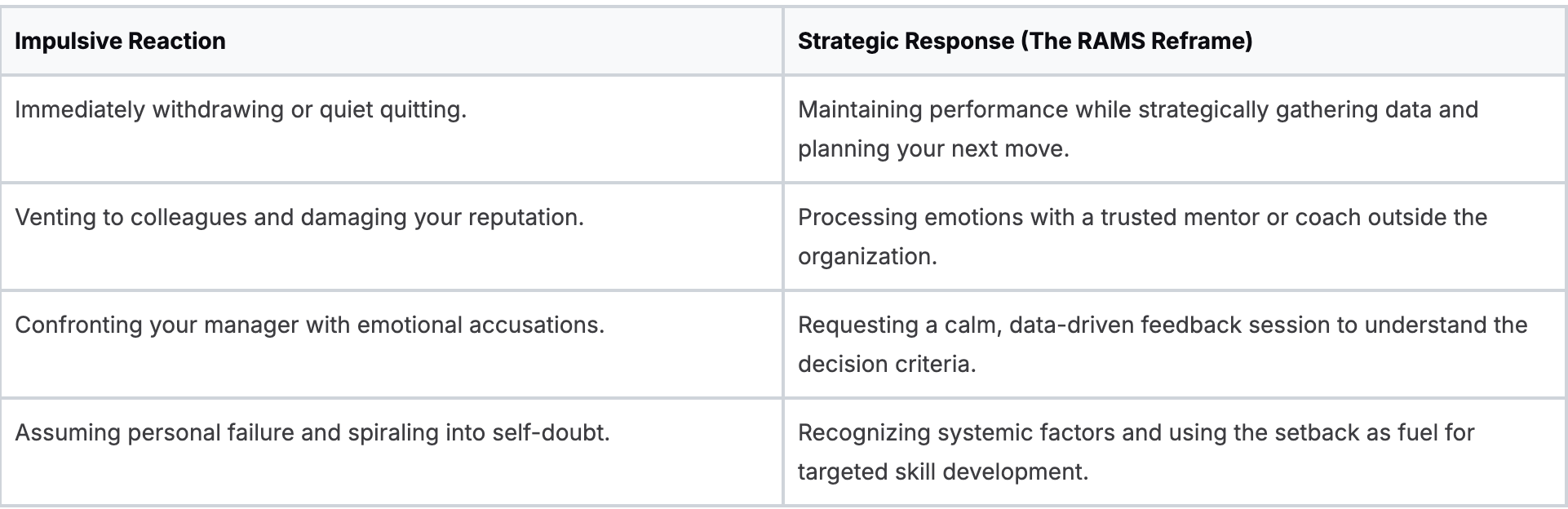
One path leads to bitterness and stagnation. The other leads to empowerment and your next big move.
Your Strategic Comeback: A 3-Step Plan for What's Next
The news hits like a physical blow. Let it. For a moment, feel the sting, the frustration, the white-hot flash of anger. That energy is real, and it’s potent. Now, we’re going to channel it. This is where you stop being the subject of someone else’s decision and start architecting your own.

Step 1: The First 48 Hours: Strategic Silence and Emotional Regulation
That 48-hour window after the announcement is a minefield. Your nervous system is screaming "threat," and the urge to react is immense. Your only job is to breathe, observe, and contain the narrative.
Breathe. Just Breathe. Your body is in fight-or-flight. Use a grounding technique: notice five things you can see, four you can touch, three you can hear. This isn't just mindfulness; it's a neurological circuit breaker that pulls you out of the emotional spiral.
Offer Classy Congratulations. Find the person who got the role. Look them in the eye, and offer a simple, "Congratulations on the new role, [Name]. Well deserved." This act of grace isn't for them; it's for you. It telegraphs unshakeable professionalism.
Shrink Your Circle. Right now, your circle of trust has one person in it: you. Maybe a trusted coach or mentor completely outside your company. You control the story by controlling who hears it.
This isn’t about being fake. It’s about being a strategist.
Step 2: Secure the Feedback Meeting (The Right Way)
Once the initial shock has subsided, it's time to make your move. Send a calm, neutral request to your manager: "I'd like to schedule 30 minutes to discuss my career path and get your feedback on the recent promotion decision so I can focus my development for the future."
This meeting has a single, non-negotiable objective: data collection.
You are not going in to challenge the decision. You're going in as a strategist, a detective. Your mission is to walk out with a crystal-clear understanding of the "why" behind their choice, transforming their rationale into your roadmap.
Leave the emotion at the door. When you walk into that room, you are not a victim; you are an executive gathering intelligence. For more on mastering this, check out our guide on how to be assertive at work in a constructive way.
Step 3: Ask Questions That Unlock Actionable Intelligence
Avoid the trap of "Why not me?" It's accusatory. Instead, ask forward-looking, open-ended questions that force specifics. Take meticulous notes.
"Looking at the person who was selected, what specific skills or experiences really stood out as the deciding factor for this role?"
"From your perspective, what are the top one or two development areas I need to focus on to be seen as the undeniable choice for the next leadership opportunity?"
"Could you share a specific example of a time where my approach could have better aligned with the expectations for this senior role?"
"What specific results or project outcomes would you need to see from me over the next six months to have absolute confidence in my readiness for advancement?"
Document every word. This isn't just for your memory; it's your new performance contract. It’s the baseline for accountability—for you, and for your manager. This proactive recovery is vital, especially when high-profile cases show just how often management decisions seem unfair.
The RAMS Reframe: A Framework for Sovereign Leadership
The initial shock has faded. You’ve gathered the raw data. Now, the real work starts. This isn't about recovering; it's about rebuilding from a position of strategic insight. You need a durable, operational framework for sovereign leadership. That framework is RAMS.
The RAMS Method—Results, Attitude, Mastery, and Systems—is a self-reinforcing loop designed to build career resilience, project undeniable authority, and ensure you are never overlooked again.
R is for Results: The Language of Power
You delivered results, but they weren't heard. The problem isn’t your output; it’s the narrative.
Quantify Everything: "Managed the project" is passive. "Led a cross-functional team of 6 to deliver Project X, increasing departmental efficiency by 18% in Q3 and saving an estimated $250,000 annually" is a statement of power.
Connect to Strategic Goals: Tie every achievement back to the company’s highest-level objectives. Frame your contributions as direct solutions to the problems that keep the C-suite up at night.
This isn’t about bragging. It’s about translating your value into the cold, hard language of leadership.
A is for Attitude: Mastering Your Internal State
Attitude is about mastering your internal state to project calm, unwavering authority. Your nervous system is screaming. The key is to regulate it, not suppress it.
When you can sit in a room, having been passed over, and still command respect through your composure, you become a force to be reckoned with. Your poise becomes more memorable than the promotion decision itself.
This quiet confidence is magnetic and communicates that you see this as a minor data point, not a career-defining catastrophe. This is a core component of developing executive presence.
M is for Mastery: Becoming Undeniable
That feedback from your manager is a treasure map. It shows you the exact gaps to close.
Identify the "Undeniable" Skill: What is the one skill that, if you mastered it, would make you the irrefutable choice next time? Strategic negotiation? Financial modeling? Pinpoint it.
Create a Public Learning Path: Don’t learn in secret. Enroll in a visible certification. Find an expert mentor. Talk openly about what you're learning. This signals ambition and coachability.
You are systematically eliminating their excuses.
S is for Systems: Building Your Support Structure
No leader gets to the top alone. Your current system didn't get you the promotion. It's time for an upgrade.

Your new support system needs two critical elements:
A Personal Board of Directors: A curated group of mentors, sponsors, and peers who will give candid advice and advocate for you in rooms you aren't in.
Nervous System Sovereignty: Your non-negotiable rituals for managing stress and preventing burnout. This is what gives you the energy to play the long game.
The RAMS Method in our revolutionary leadership framework explained is a continuous cycle. This is how you reclaim your power and build a career that is not just successful, but sustainable.
The Return: Charting Your Sovereign Path Forward
Getting passed over wasn't a failure; it was a shot of truth serum. It forced you to see the game board for what it really is. The old game of seeking validation is over. The question isn't "What more can I do for them?" It's "What do I truly want for myself?"
Your next move isn't about proving them wrong. It's about proving yourself right.
The Three Paths Forward: Ascend, Leap, or Build
Your next step will likely fall into one of three trajectories. Pay attention to how each one feels.
Path 1: Redefine and Ascend Internally. You stay, but you change the rules. You use the intel from this setback to apply the RAMS framework and become so influential that your ascent becomes an absolute certainty on your own terms.
Path 2: Leverage and Leap Externally. This "no" just gave you your exact market value inside this company. This path is about taking your proven track record and seeing what it's worth on the open market—running toward a superior opportunity with a culture that rewards your leadership.
Path 3: Pivot and Build for Yourself. For some, this moment reveals a deeper truth: the corporate ladder itself is the limitation. This is the path for the leader who realizes her real calling isn't to climb someone else's structure, but to build her own. This could mean launching a business or starting a consultancy with complete agency.
This decision is deeply personal, especially as the systemic challenges for women in leadership are very real. A landmark Gallup survey found that women are nearly twice as likely as men to feel they've been passed over for a promotion because of their gender—15% of women versus 8% of men.
The Return to You
No matter which path you choose, the ultimate destination is the same: a return to yourself. It's about building a career that doesn't just look good on LinkedIn but feels good in your soul.
The real promotion you just received wasn't a title. It was the promotion to Chief Architect of your own life. The job description is simple: build a career and a life that are authentically, powerfully, and unapologetically yours.
This journey demands a clear strategy. Get more granular by using our guide on creating a professional growth plan template.
Tough Questions, Real Answers
The “no” hits, and then come the questions. Let’s tackle the tough situations that follow a promotion pass-over with actionable strategy.
What If My Boss Is Ghosting Me?
You’ve asked for a follow-up conversation, and you’re getting silence. This is a massive piece of intel. A leader who won't have a hard, constructive conversation with you is not invested in your growth. Period.
Stop chasing them. Send one final, professional email to document your request and create a paper trail. If they still dodge you, you have your answer. Their silence is the loudest feedback you could ever receive about your future under their leadership. It's a clear signal to shift your energy and start using the RAMS framework to find an external role.
How Do I Work With the Person Who Got the Promotion?
This is where your executive presence is forged in fire. Everyone is watching.
Be a Generous Collaborator, Publicly: Find an opportunity to support them where others can see. It's a power move that screams, “I’m a team player focused on organizational wins, not personal slights.”
Draw Professional Lines: Be warm, professional, courteous. You do not need to be their new best friend. Keep conversations focused on work.
Reframe Them as a Data Source: Stop seeing them as your rival and start seeing them as a field report. What skills do they demonstrate? What communication style resonates with leadership? This is strategic intelligence gathering.
Every single interaction you have after being passed over is part of your interview for what’s next. Your composure is your currency.
Should I Reapply for the Same Role if It Opens Up Again?
This is a strategic question, not an emotional one. Reapplying only pays off if the game has fundamentally changed. Ask yourself:
Has the Power Structure Changed? Is there a new hiring manager or C-suite leader?
Have You Annihilated the Gaps? Did you demonstrably get the exact skill or experience they cited as a deficit, with tangible proof?
Has the Role Itself Evolved to perfectly align with your unique genius?
If the answer to any of these is no, then reapplying is a waste of your political capital. It risks making you look stagnant. Channel that energy into a new trajectory—a different internal role or an external opportunity where you won’t be seen as second choice, but as the only choice.
Navigating the aftermath of a career setback isn’t just about finding the next rung on the ladder. It’s about reclaiming your power and strategically designing a career that truly honors the powerhouse leader you are. For many, this setback is a gateway to even greater success, sometimes by learning how to become a career coach to help others, or by finally pursuing their own ventures.
At Baz Porter, we specialize in turning these moments of being overlooked into a woman’s greatest strategic advantage.
Ready to go from being passed over to being undeniable? Discover the leadership blind spots holding you back with our free diagnostic tool.