
Other Words For Pushover: Stop Being Exploited
The Language of Collapse: Why “Pushover” Fails to Diagnose
The word is yes. It leaves your mouth before you've assessed the cost. Another request. Another meeting. Another late night spent rescuing work that should never have landed on you.
You look competent. You look composed. You are still in Silent Collapse™.
“Pushover” is too blunt. It reads like weakness. That misses the mechanism. In many leaders, this pattern is a conditioned stress response. The nervous system chooses compliance before the mind has finished evaluating the threat.
I see this often in executives and founders who carry too much, absorb too much, and explain it away as professionalism. The issue isn't character. It's internal architecture. Merriam-Webster’s thesaurus lists familiar labels, but it doesn't address the leadership double bind or the way people turn the label against themselves in burnout states Merriam-Webster’s pushover entry.
Other words for pushover matter because language shapes diagnosis. Diagnosis shapes correction. Use the wrong word and you keep treating a system failure like a personality defect.
Table of Contents
1. People Pleaser
A people pleaser trades strategic clarity for social approval. That trade always looks harmless at first. Then it starts costing sleep, focus, authority, and self-respect.
This pattern shows up in plain executive behavior. You accept meetings with no decision value. You rework deliverables to protect someone else's feelings. You say yes to “quick asks” that tear holes in the week.
High-achieving leaders often confuse being respected with being liked. Those are not the same thing. If your calendar keeps proving that, read how fear of being disliked distorts leadership decisions.
Approval Over Strategy
The problem isn't kindness. The problem is compulsive accommodation. You stop making decisions from priorities and start making them from anticipated reactions.
Gallup’s 2023 State of the Global Workplace reporting, as cited in the verified data provided for this piece, found that 49% of women leaders in major markets experience chronic burnout linked to doormat behaviors, with 2.6x higher disengagement rates than assertive peers. That pattern is why “people pleaser” belongs on any serious list of other words for pushover. It describes a survival strategy, not a harmless personality quirk.
People pleasing is often compliance dressed as care.
A common scenario. A founder keeps investor calls, team check-ins, and client rescues on the same day because every stakeholder feels urgent. By evening, the founder has protected everyone else's agenda and abandoned their own.
Correction is mechanical.
Set a response delay: Don't answer live unless the issue is time-critical.
Tie every yes to a result: If it doesn't support a real priority, decline it.
Audit your month: Remove recurring commitments that exist to preserve approval.
Name the pattern: Therapy with Ben’s insights on people pleasing offers a plain-language description of how approval-seeking distorts choices.
2. Doormat

A doormat doesn't just say yes. A doormat absorbs impact. Blame lands there. Extra work lands there. Emotional debris lands there.
In leadership, this looks clean from the outside. You're “reliable.” You're “calm under pressure.” In practice, you're carrying failures that belong to other people and calling it maturity.
If that pattern sounds familiar, read how to set boundaries at work without apology. Weak boundaries aren't neutral. They train others how to use you.
Boundary Failure In Plain Sight
This word is harsh. Use it anyway. Harsh language cuts through polished self-deception.
A senior leader takes responsibility for a failed initiative caused by unclear cross-functional ownership. No reset follows. No accountability map changes. The same people keep missing. The same leader keeps absorbing.
That is doormat behavior.
The verified data for this article states that “doormat” is one of the core labels linked to burnout behavior in leaders. I agree with using it clinically. It identifies repetitive boundary surrender under pressure.
Clinical test: If people keep crossing the same line, the issue isn't their confusion. It's your enforcement.
Correct it with visible ownership.
Document decisions: Keep written records of who owns what.
Stop rescuing publicly: Clarify responsibility before accepting more load.
Use low-stakes reps: Practice direct correction in smaller moments first.
Build witness capacity: Trusted peers should reflect when you're taking on what isn't yours.
Doormats rarely fail from lack of effort. They fail from lack of consequence.
3. Soft Touch
A soft touch avoids force where force is required. Not violence. Not aggression. Force in the form of standards, consequence, and clear decision-making.
This leader is often warm, intelligent, and well-intended. They still damage the business. They let underperformance continue because they don't want to feel cruel. They over-explain to soften simple decisions. They negotiate with what should have been set terms.
Kindness Without Consequence
A founder keeps an employee long after trust and output have both eroded. Everyone knows it. Nobody says it. The team reads the actual message. Standards are flexible when emotion gets loud enough.
That is the structure of a soft touch.
The term matters because other words for pushover should reflect how authority leaks in real environments. “Soft touch” captures the ease with which others can influence, delay, or bypass you.
Use lead with confidence in higher-stakes rooms if your tone stays clear until resistance appears, then collapses into apology.
The correction sits in Mastery inside the RAMS Framework™. Skill isn't enough. You need sovereign capability. That means you can hold a standard and remain regulated while someone dislikes it.
A useful distinction:
Kindness: Clear communication with dignity.
Softness: Avoiding necessary friction.
Cruelty: Unnecessary force.
Most soft-touch leaders confuse the first two. Then they avoid the conversation that would protect the team.
Standards without enforcement are only preferences.
State expectations once. Measure them. Follow through. That's not hardness. That's leadership.
4. Yes Person

The meeting ends. You already agreed to three things you did not evaluate. By midnight, your body knows the truth before your calendar does.
A yes person is more than agreeable. A yes person is running Silent Collapse™ in real time. The nervous system hears risk, reads disagreement as threat, and pushes out compliance fast enough to avoid friction. The word yes leaves your mouth before authority has a chance to enter the room.
Agreement Under Stress
A founder approves a partnership call, a new initiative, a speaking request, and an internal exception in the same week. Each one sounds reasonable in isolation. Together, they fracture attention, blur ownership, and train the team to bring more asks because access is easy.
That pattern is not generosity. It is poor command under pressure.
The earlier unsourced growth claim does not belong here. Keep the principle instead. Structured decision rules beat reflex every time.
A yes person needs a gate, not more insight.
Delay the answer: Use a 24-hour hold unless the issue is time-sensitive.
Check three variables: strategic fit, available capacity, clear owner.
Use a process reply: “I need to review priorities before I commit.”
Flag your automatic yes: “Sure” often signals activation, not consent.
I place this inside Results in the RAMS Framework™. If Results are undefined, almost any request can pose as a good opportunity. If Results are specific, dilution becomes obvious.
Fast agreement often looks polite. In practice, it is unregulated authority loss.
Correction starts with timing. Stop answering in the room. Let the system settle. Then decide.
5. Walkover

A walkover is easy to bypass.
The title is there. The role is there. Control is missing. This is what Silent Collapse™ looks like in public. The nervous system reads challenge as danger, then drops force, clarity, and consequence to keep the room calm.
A senior leader presents a clear recommendation. Nobody commits. Two weeks later, the same point comes back through a louder colleague and gets approved without resistance. That leader does not have a communication problem. That leader has an authority problem.
Walkover status develops when your signals stay weak under pressure. You speak late. You soften ownership. You fail to mark violation. People learn the pattern fast. They stop testing whether you mean what you say because they already know the answer.
That erosion is structural. It changes how others assign weight to your judgment, your timing, and your boundaries. If you keep watching your ideas gain traction only after someone else carries them, read this guide on how to gain respect at work. Respect follows visible authority, not hidden competence.
If other people keep getting credit for decisions you initiated, your authority signals are too weak to hold the line.
Use the RAMS™ lens here. Start with Authority. Then tighten the surrounding structure.
Name the recommendation clearly: State what you want approved, rejected, or changed.
Claim authorship in the room: Do not let your position drift into group language.
Attach consequence: If a decision is ignored, say what risk, delay, or cost follows.
Document the call: Send a short written record so your position cannot be repackaged later.
A walkover does not need more confidence rituals. A walkover needs stronger signals, repeated consistently, until the system stops reading them as optional.
6. Appeaser
The meeting turns tense. A bad hire is dragging output down. Everyone knows it. The leader softens the language, delays the call, and asks for more patience. The room gets relief. The problem gets another month.
That is appeasement.
An appeaser trades truth for temporary nervous system relief. This is not a personality flaw. It is a Silent Collapse™ pattern. The body reads conflict as threat, then pushes you toward soothing, delay, and self-betrayal. Other people experience the result as weak leadership.
The cost is structural. Standards slip. Accountability blurs. Resentment goes underground because nobody says the hard thing cleanly and on time.
Self-Protection Disguised as Harmony
A senior leader sees a pattern of underperformance and keeps editing the message to avoid disapproval. The issue spreads. Strong operators stop trusting the room. Weaker operators learn they can survive by draining difficult conversations until the leader backs off.
Appeasement rewards pressure.
That is why this term matters. "Appeaser" names the mechanism better than softer labels do. It points to the actual failure point. You are trying to reduce internal alarm, not solve the external problem.
RAMS™ puts the correction under Attitude. Attitude is the decision posture you bring into tension. If your posture is organized around avoiding rupture, your authority collapses before the conversation starts. If this pattern shows up often, study practical ways to be assertive at work under pressure and apply them before the next conflict, not during it.
Peace without truth becomes deferred conflict with a higher price tag.
Set the boundary before the room heats up. State the problem without apology. Name the consequence if nothing changes. Silent Collapse™ grows when appeasement keeps getting mistaken for maturity.
7. Soft Target
A soft target attracts extraction. Time extraction. Emotional extraction. Decision extraction.
This leader is approachable, responsive, generous, and easy to reach. Good traits. Poorly defended. Without structure, those traits become access points for misuse.
Access Without Guardrails
A founder becomes known as easy to pitch. Every introduction turns into a request. Every request gets time. Strategic work keeps getting displaced by other people's urgency.
That's not openness. That's porous leadership.
Use how to gain respect at work without performing dominance if people like you but keep treating your availability as public property.
The verified data included for this article notes practical adoption of tools and systems that support boundary protection and delegation. I won't turn that into a software recommendation list here. The useful point is structural. Soft targets need systems, not speeches.
Correction belongs in Systems inside the RAMS Framework™.
Control access: Not every request deserves live access to you.
Triage inputs: Filter by strategic value, not sender confidence.
Protect deep work: Open-door leadership without guardrails destroys focus.
Use delegation architecture: Requests should route by role and ownership.
A compassionate leader with no filters becomes a resource pool for everyone except themselves.
8. Non-Assertive Leader
A non-assertive leader withholds force of view. They stay quiet in rooms where silence costs everyone.
This isn't humility. It is often fear dressed in professionalism. The leader doesn't want to sound arrogant, difficult, political, or self-important. So they understate, defer, and disappear.
Silence Creates A Power Vacuum
A senior executive sees a strategic risk in a board discussion and says nothing because the room already feels crowded. The decision moves forward. The damage arrives later. Silence did not keep the peace. Silence financed the mistake.
This belongs on any list of other words for pushover because it names a leadership-specific failure. Not all pushovers are passive in life. Some are highly competent operators who become non-assertive precisely when visibility matters most.
If that is your pattern, study how to be assertive at work without becoming abrasive.
The missing language in most synonym lists is developmental context. The verified gap analysis provided for this piece makes the point clearly. High-achieving leaders often weaponize the pushover label against themselves, even when the underlying issue is a gendered or organizational double bind. I would widen that further. Any leader can internalize old accommodation patterns and mistake them for identity.
Use direct reps.
Keep a wins document: Evidence reduces apologetic speech.
State the recommendation first: Don't hide behind background.
Drop permission language: “I just think” weakens what follows.
Rehearse out loud: Assertiveness is a motor skill, not a slogan.
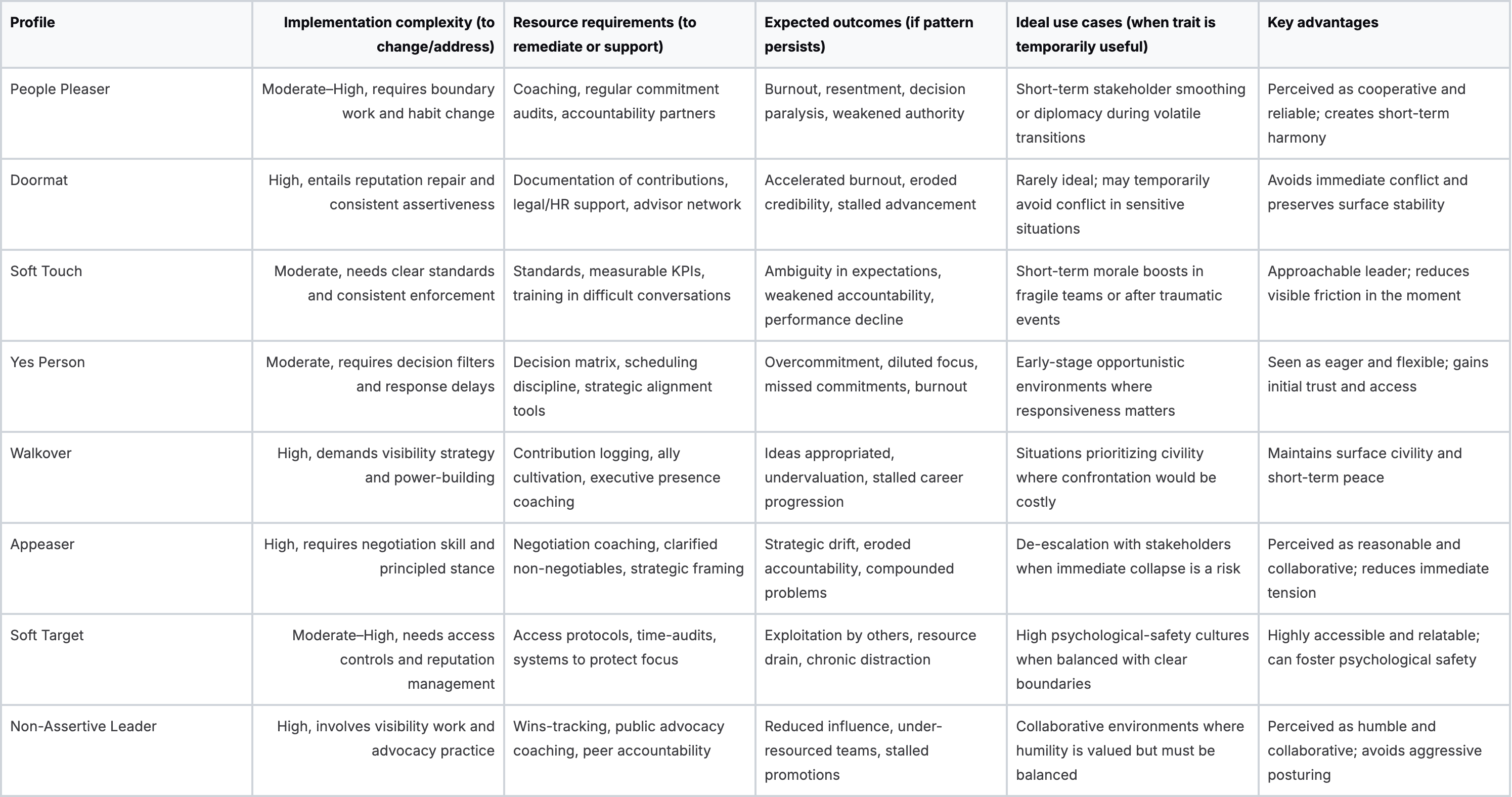
8-Term Comparison: Alternatives to Pushover
The Return From Appeasement to Embodied Authority
The meeting ends. Your calendar is fuller, ownership is still vague, and you already regret what you agreed to.
That pattern is Silent Collapse™. It is a stress response. It gets mislabeled as personality.
People pleaser, doormat, soft touch, yes person, walkover, appeaser, soft target, non-assertive leader. Those terms describe behavior the room can see. They do not explain the mechanism underneath it. Silent Collapse™ does. The body registers tension, risk, or disapproval. Compliance follows before clear judgment has a chance to act.
Embodied Authority fixes that failure pattern. It means staying regulated under pressure, making clean decisions, and holding your position without handing your standards away. Volume does not create authority. Performance does not create authority either. Regulation does.
The RAMS Framework™ gives this pattern a clear diagnosis.
Results expose the first leak. Output stays high while priorities, time, and standards get stripped for parts. You look productive. Control is gone.
Attitude sets the filter. It scans for conflict, urgency, and possible rejection. Then it renames over-accommodation as professionalism. That is how collapse becomes habitual.
Mastery shows up under heat. Skill alone does not protect anyone. Plenty of competent leaders still fold when the room gets tense. Mastery means you can decide, speak plainly, and keep your ground when pressure rises.
Systems make the correction hold. Boundaries based on mood fail fast. You need decision rules, clear ownership, protected access, recovery time, and escalation paths. Without those, the next demand spike puts you back in the same pattern.
Silent Collapse™ starts when public competence exceeds internal capacity.
I have seen leaders with title, revenue, and status surrender basic authority because their pattern rewards overextension and punishes directness. The fix starts with diagnosis. Load. Decision timing. Role clarity. The exact point where automatic compliance begins. Once those failure points are visible, authority stops leaking.
Structural correction works. Repetition makes it stick.
If you need a clear diagnosis first, Take the Silent Collapse Diagnostic. For deeper reading, use the Sovereign Leadership Resource Hub.