
How to Overcome Imposter Syndrome: A Framework for High Achievers
You closed the deal. You led the team to a major win. By every external metric, you are succeeding. And yet, the internal dialogue is relentless: "It was just luck. When will they find out I don't belong here?"This is the high achiever's silent collapse, delivering exceptional results while being haunted by the fear of being exposed as a fraud. It's an exhausting paradox that leads directly to burnout, forcing you to over-prepare, deflect praise, and second-guess decisions you know are right. This isn't just a feeling; it's a pattern, and it's time to break it.
Key Takeaways
Imposter Syndrome as a System: Understand that this is not a feeling to "get over," but a physiological pattern in your nervous system. Quick fixes like "thinking positive" fail because they don't address this root system.
The RAMS Framework: Learn a structured, evidence-based method, Results, Attitude, Mastery, and Systems (RAMS) to dismantle self-doubt and build a foundation of earned confidence based on your actual accomplishments.
Data Over Drama: The most effective way to disarm the inner critic is to confront its vague anxieties with cold, hard data. A daily "Results Log" is your most powerful tool.
Nervous System Sovereignty: The ultimate goal is not just to manage symptoms, but to reclaim command of your internal state, shifting from reactive self-doubt to proactive self-regulation.
To overcome imposter syndrome, you must stop treating it like a personal failing and recognize it as a flawed neurobiological pattern. The solution is a systematic approach, like the RAMS framework, that uses tangible evidence of your results to dismantle the fraud narrative and recalibrate your nervous system for earned confidence.
The Hidden Pattern That Governs High Achievers
That nagging feeling, the one that whispers you're a fraud about to be exposed, isn't a character flaw. It’s a physiological response, a glitch in your brain’s ancient, hardwired threat-detection system. Think of your brain as running on software designed for a world where being cast out from the tribe was a literal death sentence. Its primary job is to keep you safe by scanning for social threats.
When you step up or get a promotion, this system can misfire. It flags your new visibility as a massive risk. An internal alarm starts blaring, flooding you with self-doubt designed to make you retreat to where it feels safer. This isn't logic; it's a primal, nervous-system reaction.

The Science of the Imposter Cycle
At its core, imposter syndrome is driven by the amygdala, your brain's fear center. When facing a high-stakes meeting, the amygdala can hijack your rational mind, pumping stress hormones through your system.
This kicks off a predictable and exhausting cycle:
The Threat: A new opportunity is seen not as a chance to grow, but as a test you could fail, exposing your supposed incompetence.
The Overcompensation: To neutralize this perceived threat, you dive headfirst into perfectionism or over-preparation, working twice as hard to ensure no one can "find you out."
The Burnout: You succeed, but you're too drained to feel satisfaction. You attribute the win to extreme effort or luck, anything but your actual ability. This reinforces the core belief that you aren't good enough, setting the stage for the next round.
This pattern is a direct route to burnout. But once you understand this neurobiological loop, you can stop blaming yourself and start intercepting the pattern. For a deeper look at breaking these old mental habits, check out our guide on resetting your mindset.
You Are Not Alone in This Feeling
If this cycle feels intensely personal, know it's a widely shared experience among high-achievers. Recent research shows just how common this is. For example, a 2025 meta-analysis covering over 11,000 people found that an estimated 62% of health service providers experience imposter syndrome. It often runs alongside anxiety, depression, and burnout, compounding its impact. You can find more details in the full research on imposter syndrome prevalence.
The critical takeaway is this: feeling like an imposter is a common physiological response to pressure, not a verdict on your competence.
Understanding this science is crucial. It shifts the problem from your ability to the faulty alarm in your brain. The solution, then, isn't to work harder, it's to recalibrate that alarm system.
The RAMS Reframe to Regain Control
Knowing the alarm bell in your head is faulty is one thing. Rewiring it is another. It’s time to scrap the old programming of self-doubt and install a new operating system grounded in reality, not fear. That's what the RAMS framework is designed for. This is a practical method for building an undeniable mountain of evidence of your competence and seizing control of your inner narrative.
Here’s what RAMS stands for:
Results: Getting brutally objective about your accomplishments to build a data-driven case against the fraud narrative.
Attitude: Deliberately shifting your internal monologue from a harsh critic to a strategic, no-nonsense coach.
Mastery: Moving your focus from the crushing pressure of perfection to the empowering process of constant learning.
Systems: Building the routines and boundaries that shield your mental energy from the chaos that fuels self-doubt.
Think of this as your blueprint to replace vague, anxious feelings with cold, hard facts.
R is for Results: Your Undeniable Proof
The voice of imposter syndrome loves feelings and dismisses concrete wins as "luck." The fastest way to shut it down? Drown it in indisputable data. Your first mission is to become the chief archivist of your own success. This isn't about ego; it’s about evidence.
Open a document—your "Results Log"—and catalog every win:
Project outcomes: "Led the team that boosted Q3 lead generation by 12%."
Positive feedback: Copy and paste direct quotes from emails, Slack, or performance reviews.
Problems solved: "Designed the new intake process that cut client onboarding time by three days."
This log is now your primary weapon. The next time the feeling of being a fraud starts whispering, you don't argue. You pull out the log and present the evidence, making the feeling look utterly ridiculous.
A is for Attitude: The Internal Reframe
Your internal dialogue is the soundtrack of your career. For most high-achievers, it's a brutal critic. Changing your attitude isn’t about forced positivity. It's about consciously firing your inner critic and hiring an inner coach. A critic points out what's wrong. A coach acknowledges the difficulty and gives clear, constructive feedback for the next attempt.
When you miss a deadline, the old script is, "I can't believe I dropped the ball. I'm such an idiot."
The new, coached-based script sounds like this: "Okay, that deadline was missed. What factors contributed? What can I learn? What specific action will I take to prevent it next time?"
This small shift moves you from being emotionally hijacked to strategically responsive. It's about mastering your internal state, a crucial step in finding peace in the midst of chaos. That inner critic fuels the imposter cycle—a destructive loop where a perceived threat triggers over-preparation, which leads to burnout.
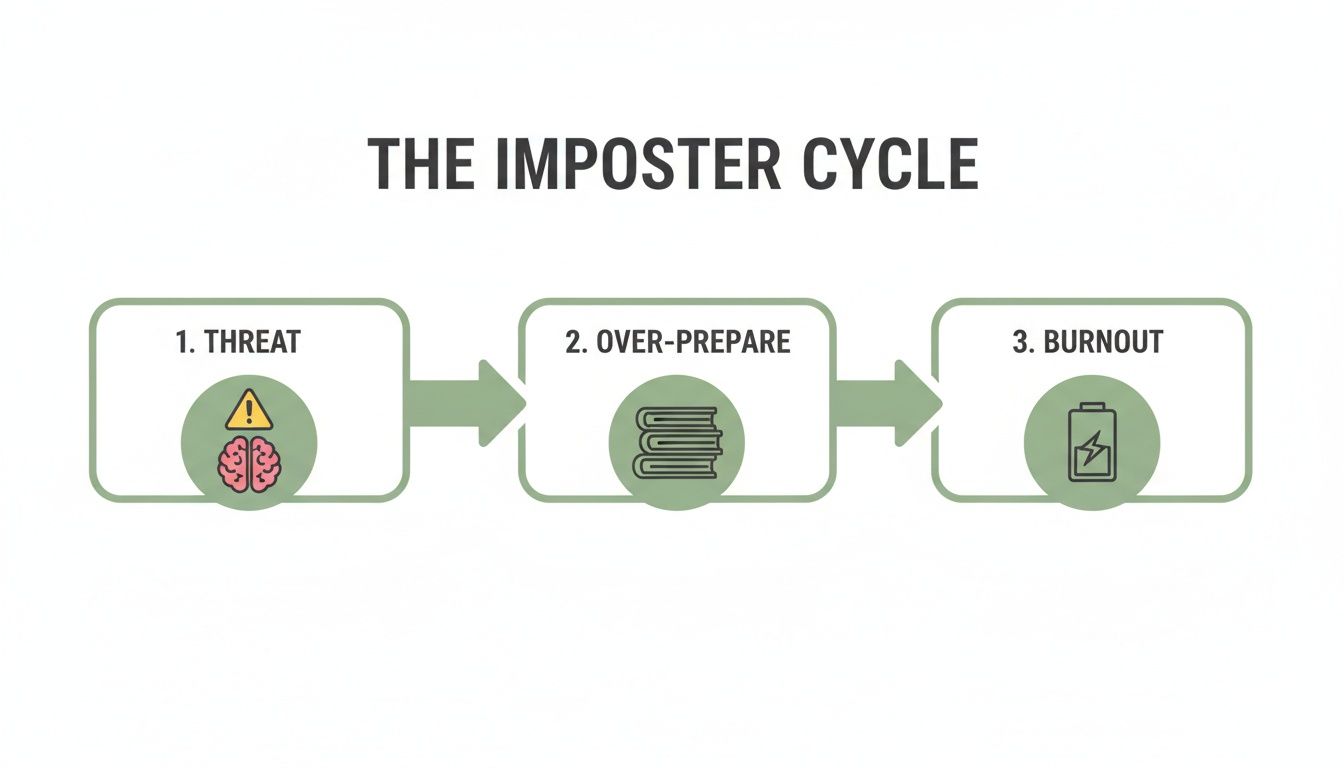
As you can see, this cycle is designed to be self-perpetuating, reinforcing the lie that your success is only possible through unsustainable effort.
M is for Mastery: Embracing the Process
Perfectionism is high-octane fuel for imposter syndrome. It sets an impossible standard where anything less than flawless is a total failure. The antidote is to shift your focus from the goal of perfection to the process of mastery. Mastery isn't about never making a mistake. It’s about a deep commitment to learning, iterating, and getting progressively better.
A perfectionist sees a mistake as proof of incompetence. Someone pursuing mastery sees a mistake as valuable data.
Instead of asking, "Was that perfect?" you start asking, "Did I learn something? Am I moving forward?" This takes the crushing weight off a single outcome and places the value on long-term growth.
With this mindset, new challenges become opportunities to get better, and failure loses its sting.
S is for Systems: Your Protective Structure
Think of your mental energy as a finite battery. Constantly fighting self-doubt drains that battery at an alarming rate, leaving little power for deep work and strategic leadership. Systems are the guardrails you build to protect that battery.
Your systems might look like this:
Time Blocking: Carving out non-negotiable blocks of time for your most important work.
Clear Boundaries: Defining when your workday starts and stops—and sticking to it. Learn more about how to set boundaries at work.
Delegation Protocols: Creating a clear playbook for what you handle personally and what you entrust to your team.
These aren't about being rigid. They're about creating a supportive structure that allows you to lead from calm command, not constant crisis.
Imposter Mindset vs. Sovereign RAMS Mindset
This table illustrates the profound shift from the old pattern to the new framework.
Core AreaImposter Mindset (The Old Pattern) RAMS Mindset (The New Framework)
Success I got lucky. This success is a fluke and I can't repeat it.""My results are documented. I earned this through specific actions.
Feedback Any criticism confirms I'm a fraud. I have to defend myself.""Feedback is just data. How can I use this to get better?
Challenges This is a test I could fail, which will expose me.""This is an opportunity to learn and expand my capabilities.
Self-Talk Don't mess this up. Everyone is watching. You're not good enough.""What's the next strategic step? What have I learned from the last one?
Energy Constantly drained by worry, second-guessing, and over-preparation.Protected and managed by clear boundaries and efficient systems.
By actively putting the RAMS framework into practice, you are methodically building a new operating system for your professional life, one based on evidence and engineered for sustainable success. High-achievers often push themselves into burnout and stress treatment, but proactive systems can prevent this.
The Return to Nervous-System Sovereignty
Overcoming imposter syndrome isn't about "fixing" some deep, fundamental flaw. You are not broken. This entire process is about returning to your natural state of self-trust and authority, a state buried under years of external pressure. It’s about taking command of your own nervous system and reclaiming the power you've unintentionally given away to that nagging voice. The RAMS framework is your operating system for professional sovereignty.
This isn't about becoming someone new. It's about removing the noise so you can finally operate as the leader you already are. It's an act of remembering your own authority.
From this point forward, your primary mission is integration. Every time you log a win, reframe a self-critical thought, or defend a boundary, you are casting a vote for your own competence. Each action is a micro-dose of self-trust that accumulates until the old pattern of feeling like a fraud becomes unrecognizable. This is the real work. As you build these skills, you’ll discover that confidence is no longer a fleeting feeling but a stable, internal resource. To go deeper, find more strategies in our guide to help you lead with confidence.

Your Next Step Toward Sovereignty
The strategies outlined here are potent. But true mastery comes from guided application within a community of peers who understand the unique pressures you face. This is not a sales pitch; it's the next logical step. It's an invitation to stop battling this alone and start integrating these principles with expert guidance. Committing to this deeper work is the ultimate act of leadership, an investment in your long-term success and the legacy you're building.
Frequently Asked Questions
Is there a difference between humility and imposter syndrome?
Yes, and the difference is everything. Humility is a reality-based assessment of your strengths and weaknesses. Imposter syndrome is a distortion of reality, an fraudulent feeling that persists despite evidence of your competence. Humility is an asset; imposter syndrome is an anchor.
What if these strategies feel unnatural at first?
Good. They probably should. If you’ve spent years operating with a relentless inner critic, new thought patterns will feel awkward. Think of it like learning a new language. At first, it's clumsy. With consistent practice, it becomes your natural way of thinking. Trust the process.
Can my leadership style affect imposter syndrome in my team?
Absolutely. A leader's behavior is either a breeding ground for imposter syndrome or an antidote to it. Micromanagement injects inadequacy. In contrast, creating psychological safety—where people feel safe to take risks and admit mistakes, builds confidence and resilience in your entire team.
Are certain groups more at risk for imposter syndrome?
The data is clear: the weight of imposter syndrome falls harder on some. Individuals from ethnic minority groups and first-generation professionals carry a heavier burden, amplified by the daily friction of structural stressors. This isn't a personal failing. Real solutions require systemic support like structured mentorship and inclusive leadership. You can read more on how systemic factors influence these feelings.
At Baz Porter, we help high-achieving women move beyond these patterns to lead from a place of embodied authority and sustainable success. If you're ready to stop managing self-doubt and start building a leadership legacy that reflects your true capabilities, the next step is to explore how we can work together.
Discover the RAMS Method and start your journey today at bazporter.com