How to Prevent Burnout at Work: A Guide for High-Achievers
You’ve done everything right. You climbed the ladder, shattered the ceilings, and built a career that, from the outside, looks like the definition of success. Yet, inside, there’s a quiet, creeping exhaustion. One more "urgent" email, one more late-night strategy session, feels less like a challenge and more like a breaking point. This is the high-achiever’s silent collapse—the moment you realize the relentless pursuit of success has started to cost you yourself.
Key Takeaways
Understand the Performance Paradox: Recognize how the very strengths that fueled your success—like perfectionism and hyper-vigilance—are now the primary drivers of your burnout by keeping your nervous system in a chronic state of "fight or flight."
Redefine Your Metrics for Success: Shift your definition of "results" from purely external achievements (like revenue targets) to include internal sovereignty, such as your well-being and emotional stability, as non-negotiable KPIs.
Master Nervous System Regulation: Learn practical, science-backed tools like strategic breathwork and structured disconnection to actively manage your body's stress response, giving you control over your internal state even amidst external chaos.
Implement the RAMS Method: Adopt a new operating system for your leadership—Results, Attitude, Mastery, and Systems—to build a sustainable career where high performance and personal well-being are not mutually exclusive.
Burnout is the predictable result of deploying unsustainable strategies for too long. To truly prevent it, you must shift from surface-level fixes like productivity hacks to a fundamental redesign of your relationship with work, energy, and leadership itself.
The Hidden Pattern—Why Your Strengths Are Burning You Out
The story is almost always the same. It starts with ambition, a powerful drive that separates you from the pack. But slowly, the lines blur. Long hours become your baseline. You mistake emotional numbness for professional composure, convincing yourself that the growing detachment you feel is simply the price of admission to the C-suite.
This experience is incredibly isolating. You look at your accomplishments and feel a strange emptiness. All the while, the internal dialogue is relentless.
"If I stop performing, I'll disappear."
"I'm too invested to slow down now; everyone is counting on me."
"If I show any weakness, I'll lose everything I've worked for."
This isn't just a bad week; it's a systemic breakdown. It's the consequence of operating at a pace your nervous system was never designed to sustain. This isn't a random lightning strike. For the most capable leaders, it’s a predictable outcome of a painful irony I call the Performance Paradox: the very strengths that got you to the top become the architects of your collapse.

The Neuroscience of the "Always-On" Leader
At the core of this paradox is your autonomic nervous system. More specifically, it’s the constant engagement of your sympathetic nervous system—your body’s “fight or flight” response. For high-achievers, this emergency state becomes the default setting for every looming deadline and overflowing inbox.
Living in this state of hyper-arousal is like running an engine in the red, day after day. Your brain is marinating in cortisol and adrenaline, hormones meant only for short-term survival. Over time, this chemical bath degrades the very functions you rely on to lead.
Cognitive Function: Your prefrontal cortex, the hub for strategic thinking, starts to go offline. This is where brain fog and reactive, short-term thinking come from.
Emotional Regulation: Your ability to manage responses gets shot. You might become more irritable, snapping at your team or swinging between anxiety and detachment.
Physical Health: Chronic activation leads to systemic inflammation, terrible sleep, digestive issues, and a compromised immune system.
For female leaders, this reality is amplified. The unspoken pressure to outperform adds another layer of chronic stress. Understanding your nervous system's architecture is the first, crucial step to taking back control.
When Your Strengths Turn Against You
The Performance Paradox is what happens when your greatest assets are weaponized against you by chronic stress.
Perfectionism: This isn’t just high standards; it’s a deep-seated fear of making a mistake. It locks you into hyper-vigilance, burning incredible energy to control every variable.
Hyper-Vigilance: Your talent for spotting threats is invaluable for strategy. But when it’s stuck “on,” your nervous system treats a minor typo with the same five-alarm fire response as a genuine business risk.
Over-Functioning: You have a massive capacity for work, which often means you absorb the responsibilities of others. You systematically drain your own energy reserves.
This is a full-blown crisis. A recent study found that 59% of women report feeling burned out, compared to 46% of men. This isn't just a personal struggle; it’s a systemic failure with crushing economic costs. Truly understanding this "why" shifts the narrative from "What's wrong with me?" to "What's happening to me, and how do I redesign the system?" The silent collapse from success into burnout almost always stems from an unsustainable lifestyle, which is why a critical strategy is learning how to achieve work-life balance without burning out.
The RAMS Reframe—A Framework for Sovereignty
Here's the hard truth: Burnout isn't a personal failure. It’s a systems failure. You can't solve a systemic problem with more willpower or another productivity app. You need a new operating system.
This is where we stop diagnosing the problem and start architecting the solution. The RAMS Method is a framework I built for sovereignty, designed for sustainability, not just survival.
RAMS stands for Results, Attitude, Mastery, and Systems. It’s a way to rewire your relationship with your work, your energy, and your own internal state. It’s the practical toolkit for shifting from an exhausted performer to an embodied leader.
This concept map shows what we're up against—the core drivers like perfectionism and hyper-vigilance that feed directly into burnout.
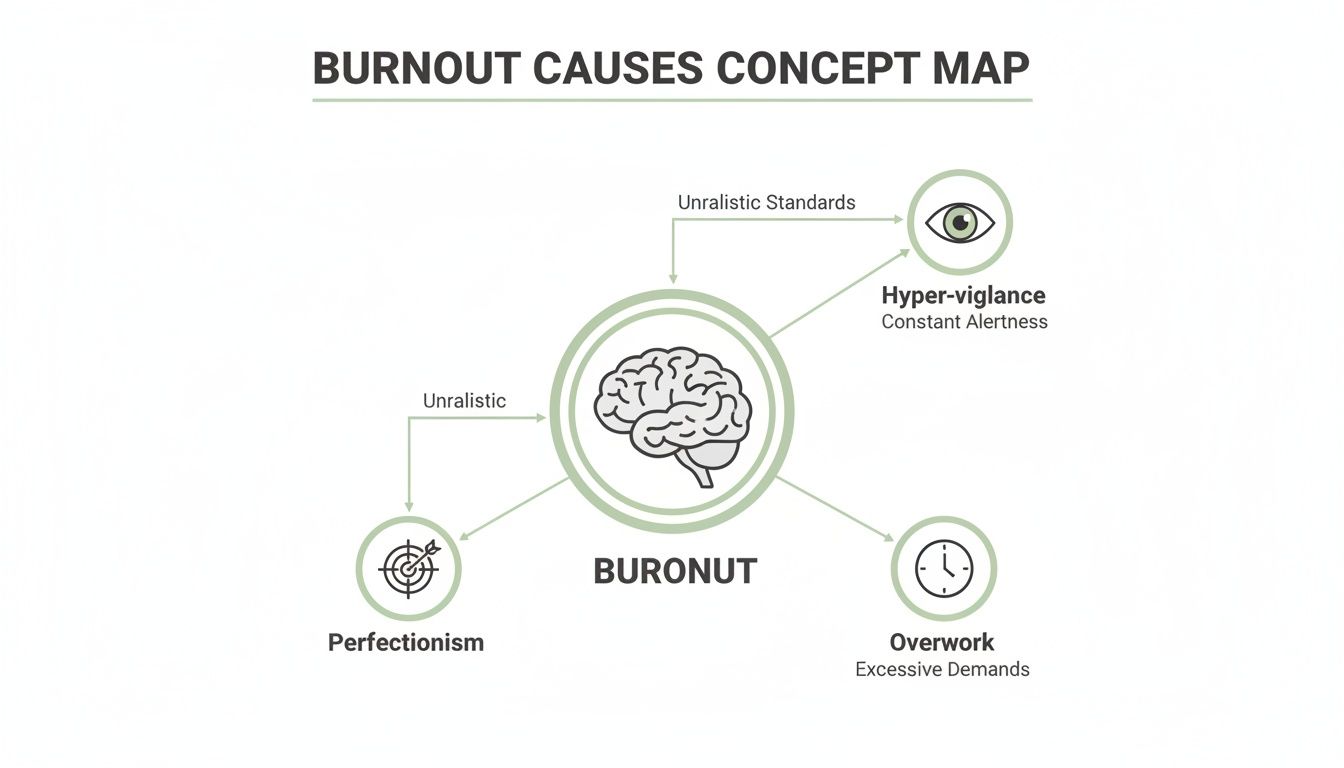
The RAMS Method is designed to dismantle this structure, piece by piece.
R is for Results, Redefined
The first pillar, Results, redefines the very definition of success that drove you to this point. For most high-achievers, "results" means external validation—more revenue, a bigger team. This relentless chase is the primary engine of burnout.
Redefining results means shifting from external metrics to internal sovereignty.
What outcomes truly matter to me, separate from what everyone else expects?
What does a successful day actually feel like in my body?
How can I align my professional goals with my personal need for well-being?
This isn't about lowering your standards. It's about raising them to include your own health and fulfillment as non-negotiable KPIs.
A senior executive I worked with, Sarah, was celebrated for turning around failing departments. Her "result" was always a green P&L sheet. But she was battling chronic migraines. Through RAMS, she redefined her primary result to "achieving departmental growth while improving team well-being scores and taking my weekends completely offline." The department still thrived, but for the first time, so did she.
A is for Attitude, Embodied
The second pillar, Attitude, is the internal shift from a brittle, performative mindset to one of embodied leadership. Burnout forces you into a reactive state. An embodied attitude is grounded, present, and intentional.
This has nothing to do with "thinking positive." It's about cultivating a deep, physical connection to your emotional state. It’s noticing the tension in your shoulders during a board meeting and consciously releasing it. It lets you lead from a place of internal stability, no matter how chaotic things get.
M is for Mastery of Self-Regulation
Mastery is where you learn the practical skills to regulate your physiological state. If your nervous system has been in overdrive for years, you can't just will it to be calm. You have to master the tools to actively manage it.
Breathwork: Simple, structured breathing exercises can instantly shift your physiological state, lowering cortisol and bringing your rational mind back online.
Strategic Disconnection: This is the skill of creating intentional gaps in your day—five minutes between meetings, a walk without your phone—to give your nervous system a chance to downshift.
Boundary Setting: Mastery means communicating and enforcing boundaries not as acts of rejection, but as necessary protocols for sustainable performance.
Mastery gives you agency over your own internal state. Instead of being at the mercy of external triggers, you develop the capacity to choose your response.
S is for Systems, Sustainable
Finally, Systems are what make all of this stick. Your willpower is a finite resource. Instead, you build systems that protect your energy by default. Sustainable systems are the structures and routines that eliminate the need for constant, draining decision-making.
Just look at the difference:

These aren't minor tweaks; they represent a complete redesign of your professional infrastructure. Systems turn good intentions into consistent practice. You can learn more about how to implement the complete RAMS Method in this detailed guide.
The Return—Putting The RAMS Method Into Practice
Knowing the theory is one thing. Living it is where real change happens. The RAMS framework is a set of practical, daily actions designed to rebuild your relationship with your work, your energy, and yourself. This isn’t about cramming more into your schedule. It’s about being surgical—reconfiguring how you operate to protect your most valuable asset: your nervous system.
Tactical Tools for Immediate Implementation
The secret is to weave in small, potent practices that de-escalate stress in the moment. You don’t need a week-long retreat; you can start in the next five minutes.
The 5-Minute Nervous System Reset
Think of this as your emergency brake for stress. Use it between meetings or after a tense conversation.
Find a quiet spot. Sit or stand with a spine that’s straight but not rigid.
Breathe in slowly through your nose for a count of four.
Hold that breath gently for a count of seven.
Exhale completely through your mouth for a count of eight.
Repeat the cycle four or five times. This physiological sigh is a direct message to your brain that you're safe, helping to lower cortisol instantly.
This tiny practice is a powerful way to find some peace in the midst of chaos. It proves you don't need to escape your environment to regulate your internal state.
Architecting Your Week for Sustainable Performance
A C-suite schedule can feel like a relentless assault. The RAMS approach is about designing your week with intention, building fortifications around your focus, and scheduling recovery as seriously as you schedule board meetings.
Monday: Deep Work Blocks. Carve out two 90-minute blocks for strategic thinking. Treat them like non-negotiable appointments.
Tuesday/Thursday: Strategic Connection. Batch your meetings on these days. This creates momentum and frees up cognitive space on other days.
Wednesday: Recovery & Review. Block off the morning for personal recovery—a workout, a walk, or quiet time.
Friday: Delegation & Closing Loops. Focus on strengthening your team and ensuring all critical communication is handled before you sign off.
The Goal is Nervous System Sovereignty
The endgame here is what I call nervous-system sovereignty. This is your ability to lead from a place of grounded presence and clarity, even when chaos is erupting. It's the quiet confidence that comes from knowing you have the tools to regulate your internal world and make decisions that honor both your ambition and your humanity.
Burnout isn't the price of admission for success. It's the bill that comes due when you've been leading from depletion instead of authentic power. The only way to build a career that doesn't cost you your soul is to come back home to yourself.
The data is stark. Women report burnout at 59% compared to 46% for men, according to a 2023 Burnout Report. The antidote starts with redesigning your boundaries and systems. This is how you avoid becoming another statistic.
Your Next Step on the Path Back to You
You've seen the patterns, you understand the science, and you have a new framework. But knowledge without action is just trivia. The next step isn’t a massive overhaul. It’s one small, intentional step. To start building this sustainable power, you can begin by incorporating some of these actionable steps for self-care to combat burnout.
This is your invitation to stop firefighting the symptoms of exhaustion and start laying the foundation for a career built on sovereign leadership.
Not sure how close to the edge you might be? A quick check-in can bring a lot of clarity. You can explore your current burnout risk with our quiz.
Ready to move from exhausted to embodied? Baz Porter provides the framework to build a leadership style that is both powerful and sustainable. Discover the path to sovereign leadership today.
Frequently Asked Questions
What is high-functioning burnout, really?
It is when you keep performing at a high level while running on empty inside. From the outside you look fine. Inside, one more urgent email feels less like a challenge and more like a breaking point. It is your nervous system held in fight-or-flight far too long.
Why would my own strengths burn me out?
The drive, perfectionism, and hyper-vigilance that carried you to the top keep your body in constant alarm. This is the Performance Paradox: the very strengths that built your success slowly become the architects of your collapse.
How do I actually prevent burnout at work?
Not with another productivity hack. You redesign your relationship with work. Redefine what results mean so they include your own well-being, learn to regulate your nervous system, and build sustainable systems into your week so high performance stops costing you yourself.
What is the first step I can take today?
One small, intentional step, not a massive overhaul. Begin with a simple practice like strategic breathwork or a deliberate disconnect, and check how close to the edge you really are before you push any harder.
Where to go next. If any of this reads like your own reflection, the Silent Collapse Diagnostic™ is a quiet place to start — a private read on how close to the edge you really are. And if you want the deeper why beneath the work, read the Sovereign Manifesto.