The Leader's Guide to Making Difficult Decisions Without Burnout
You’re at a crossroads. Every path feels like a gamble. The internal monologue is brutal: 'If I get this wrong, everything I've built could crumble.' This isn't just another business decision; it feels like a defining moment, and the pressure is crushing. You're in what I call a 'Silent Collapse'—a state of high-functioning paralysis where the stakes feel too high to move.
Making a tough call requires more than a pro-con list. The definitive answer to making difficult decisions is to integrate your core values with hard data through a structured framework, all while maintaining a regulated nervous system. This approach transforms paralysis into a powerful act of leadership, allowing you to move forward with conviction, even when the path is foggy.
Your Brain's Resistance is Biological: Indecision isn't a personal failing; it's your brain's threat-response system in overdrive. Understanding this neuroscience is the first step to regaining control.
Pro-Con Lists Fail Under Pressure: High-stakes choices are a clash of competing values, not a simple math problem. You need a deeper framework to find genuine clarity.
The RAMS Method Creates Clarity: The proprietary RAMS (Results, Attitude, Mastery, Systems) framework provides a structured process to move from paralysis to confident action by integrating strategy with nervous system regulation.
Data Fortifies Intuition: The most powerful decisions are made when embodied wisdom is stress-tested with objective evidence, guarding against cognitive biases and emotional reactivity.
The Hidden Pattern - Why Your Brain Fights Hard Choices
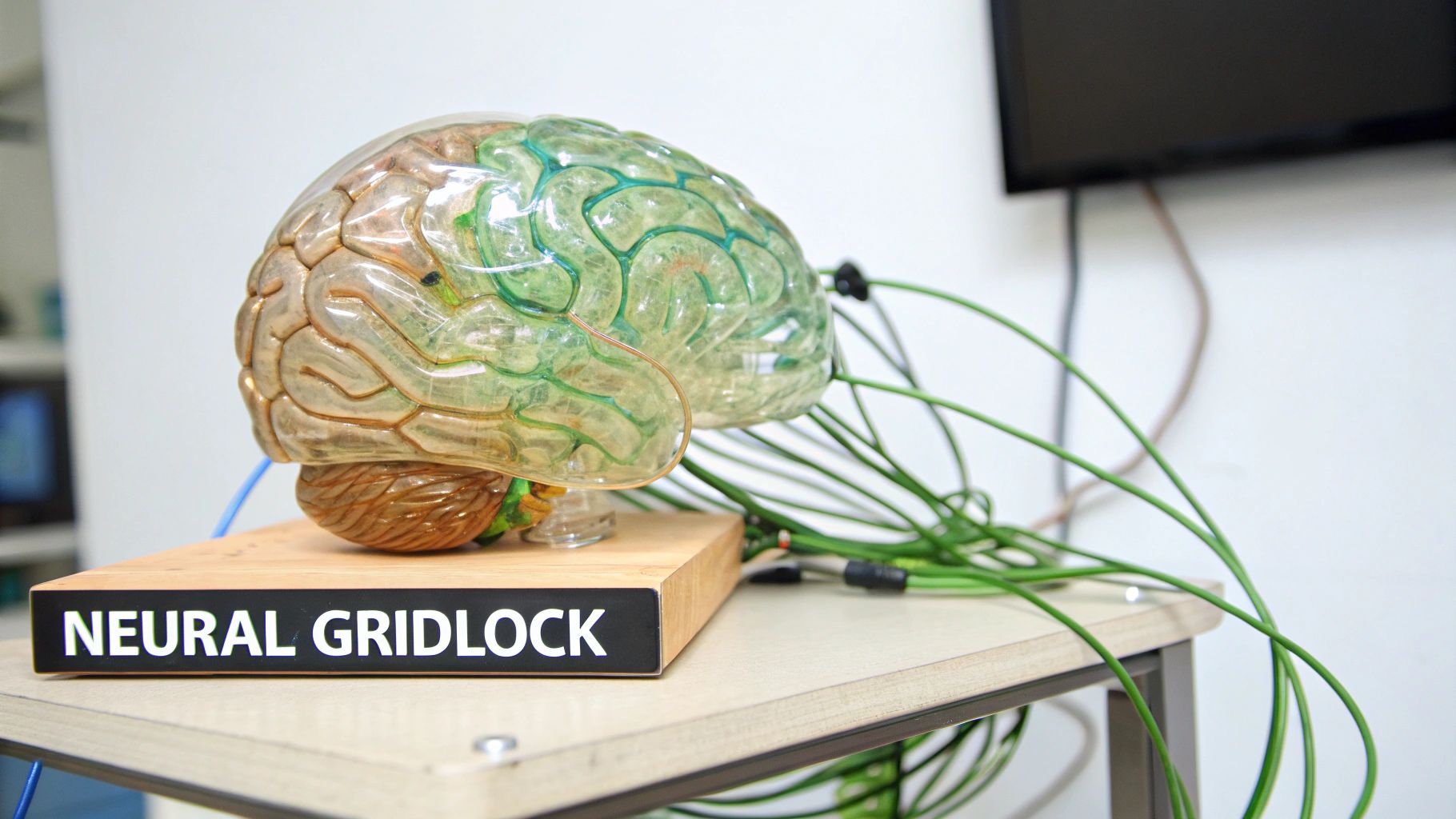
Ever felt completely stuck, like your brain is in ‘Neural Gridlock’ when a major decision looms? That’s not you failing. It’s your biology. High-stakes choices are perceived by your brain not as opportunities, but as threats to your survival.
This triggers the amygdala, your brain’s alarm system, flooding your body with cortisol. Your logical prefrontal cortex—the part you need for strategic thinking—is shoved offline. The result is analysis paralysis: a dizzying cycle of second-guessing and anxiety. This biological hijack is the real root of indecision. You aren't "bad" at making choices; your nervous system is simply trying to shield you from perceived danger.
This response is magnified for high-achievers, especially senior leaders who face immense pressure to be infallible. Making the "wrong" move feels like it could invalidate years of work, creating a feedback loop that leads straight to burnout. You can learn more about this in our guide on overcoming burnout at work.
The Cognitive Traps That Keep You Stuck
On top of the raw survival instinct, your brain relies on mental shortcuts, or cognitive biases. These sabotage your best intentions.
Sunk Cost Fallacy: This is the voice telling you to stick with a project or role because you've already invested so much. You ignore the future cost to your well-being. A client of mine, a COO, nearly burned out trying to save a failing product line she’d championed for two years. Letting go felt like admitting personal failure, but the data showed it was draining resources from three profitable ventures. Recognizing the sunk cost fallacy allowed her to make the strategic cut and reallocate her team's energy, boosting morale and Q4 profits by 18%.
Confirmation Bias: Your brain actively seeks information that confirms what you already believe. If you’re leaning toward a "safe" but unfulfilling choice, you’ll subconsciously filter for data that validates it, creating an echo chamber.
Status Quo Bias: This is an irrational preference for keeping things as they are. Any deviation feels risky, even if the new path is hugely beneficial.
These biases aren't weaknesses; they are predictable bugs in our mental software. Recognizing them is the first step toward overriding their influence. You can explore how this impacts your leadership by understanding your executive nervous system.
The Modern Overload
As if our internal wiring wasn't enough, we face a paradox of choice, where too many options make it harder to decide. This leads to overwhelm, where making no decision feels safer than choosing one and regretting it.
You are not failing at making a decision. Your biological systems are working as designed. The work is not to fight this system, but to regulate it so your higher-level thinking can come back online.
The RAMS Reframe - Moving Beyond Pros and Cons to Real Clarity
The classic pro-con list fails for high-stakes decisions because they aren't math problems. They are clashes between deeply held, competing values. A simple list can't capture the nuance. To find clarity, you must marry your gut feeling with a structured evaluation.
First, Define Your Non-Negotiables
Before weighing options, know your core values. When a decision is agonizing, it’s because two or more of these principles are in conflict.
Consider a promotion with a pay bump (financial security) but more travel (family time). A pro-con list just lays out the conflict; it doesn’t solve it. The real work is deciding which value gets priority in this season of your life.
To get clarity:
Name Your Top 5: What five principles define you? Think about moments you felt most proud or fulfilled. Freedom, integrity, community, growth?
Rank Them, For Now: For this specific decision, force-rank your top five. This hierarchy isn't set in stone for life, but it reveals what matters most right now.
Getting clear on this internal hierarchy ends the mental tug-of-war. For a deeper dive into this internal conflict, our guide on navigating the battle between your head vs. heart is a great place to start.
The RAMS Framework for Confident Action
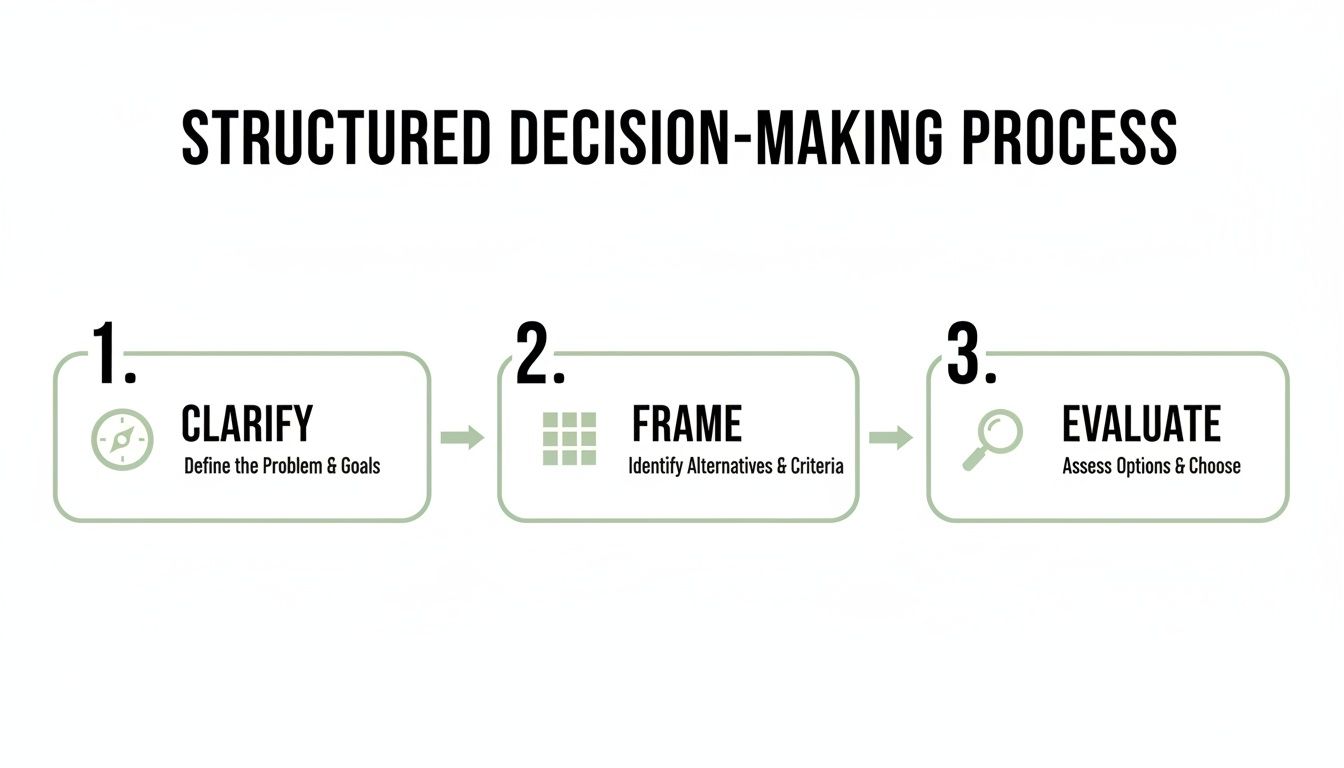
When values clash and you’re stuck in analysis paralysis, you need a new operating system. The RAMS Method (Results, Attitude, Mastery, and Systems) is a dynamic framework designed to pull you out of the chaotic spin cycle and into grounded, confident action.
It's the scaffolding you can lean on to make impossible calls by marrying your internal state with your desired external outcomes.
Comparing Decision-Making Approaches

This structured process, validated by leadership trends, transforms a chaotic decision into a manageable sequence. The 2025 IIBA Global State of Business Analysis Report reveals 26% of professionals now cite systematic analysis as a core strategic driver, up from 21%. Leaders who use frameworks make better choices. You can see the findings on the IIBA's official report page.
Step 1: Results (Define Your True North)
You can't choose a path if you don't know your destination. Get brutally clear on the specific, measurable outcome you need.
What does success for this decision actually look like?
A 15% market share increase by Q4?
Launching a new product with a customer satisfaction score of 90%?
A career transition that cuts travel by 50% without sacrificing impact?
Clarity on the result is your anchor. Any option that doesn't drive that result is a distraction.
Step 2: Attitude (Regulate Your Internal State)
A dysregulated nervous system cannot think strategically. Attitude is your intervention to shift from reactive stress to calm awareness.
Before you look at options, you must regulate.
Somatic Grounding: Take three minutes. Feel your feet on the floor. This anchors you in your body, sending a "safe" signal to your nervous system.
Box Breathing: Inhale for four counts, hold for four, exhale for four, hold for four. This down-regulates the fight-or-flight response, bringing your prefrontal cortex back online.
Only from a place of physiological calm can you assess risks with genuine clarity.
Step 3: Mastery (Close the Execution Gap)
With a clear result and a calm state, ask: What skills or knowledge do I need to pull this off? Mastery is an honest audit of your capabilities.
A brilliant decision is worthless if you can't execute it. Considering a pivot into tech? Identify the specific skills you're missing and build a plan to get them—a certification, a mentor. Mastery isn't about being perfect; it's about being prepared.
Step 4: Systems (Build Your Scaffolding for Success)
No leader succeeds in a vacuum. Systems is about architecting the external support structures that make your choice sustainable.
Who do I need on my team? Who brings the expertise or accountability?
What processes need to change? New communication channels or project management tools?
How will I protect my energy? What new boundaries or routines must I establish?
This holistic approach is a hallmark of top-tier companies. The 2025 HLB Survey of Business Leaders found that the top 25% of performing companies are 1.3 times more likely to have a highly engaged workforce, a direct result of decisive leadership that invests in people-centered systems. The RAMS framework is a fundamental reframe of how to make difficult decisions. Explore it further in our guide to the RAMS Method and its revolutionary leadership framework.
Using Data and AI to Sharpen Your Judgment
Your intuition is a powerful asset. But today, it’s not enough. The most potent decisions are forged at the intersection of embodied wisdom and cold, hard evidence. Data and AI don’t replace your judgment; they make it razor-sharp.
This isn't a future trend. An IBM survey of 400 global leaders revealed 46% of organizations are already scaling AI. A stunning 63% of executives expect a material financial impact from AI within two years.
Think of data as the steel framework supporting your intuitive leaps.
A product launch: Your intuition says the market is ready. You validate it with market trend data, competitor metrics, and customer sentiment scores. The data gives your vision a solid foundation.
A restructuring: Your gut says a merger will unlock efficiencies. You pull internal performance analytics and project completion rates, pinpointing the exact bottlenecks the merger will solve.
The edge comes from translating raw information into actionable insights. Understanding how BI engineering to make decisions transforms messy data into clean insights is crucial. It structures information to answer your most pressing questions. For a deeper dive, see our guide to building a strategic decision-making process.
By integrating technology, you build checks and balances against emotional reactivity and cognitive blind spots. This gives your intuition the clean space it needs to operate at its highest level.
The Return - Committing to Your Choice with Sovereignty
Making the final call is an act of reclaiming your power. It’s the moment you fuse your internal values with external action, turning uncertainty into a declaration of leadership. But the "what ifs" can threaten to unravel your work.
Confidence isn’t being 100% certain you’ve made the “perfect” choice. It’s committing to your chosen path with conviction.
Taming Post-Decision Anxiety
Once the choice is made, your brain’s threat-detection system might still be on high alert. This is normal. Manage this anxiety proactively.
Acknowledge the Ghost Ship: For every decision, there’s a path not taken. See it, honor its possibilities, and then let it sail away. Clinging to what could have been drains the energy you need for the journey you’re on.
Create a Backup Plan: Real confidence grows from security. Establish a small, practical backup plan—a financial runway or a key relationship for support. This isn't planning for failure; it’s creating a psychological safety net so you can commit fully.
Once you make a decision with clarity and integrity, the work isn't to second-guess it. The work is to make it the right decision by committing your energy to its success.
This final step is where you return to yourself. It's not just about how you make difficult decisions; it’s about how you embody them with nervous-system sovereignty. Ready to move from paralysis to power? Take our free Leadership Diagnostic to get personalized insights and reclaim your clarity.
Your Toughest Decision-Making Questions, Answered
What If I Still Make the Wrong Choice?
This is the biggest fear. A powerful framework guarantees a high-quality process, not a perfect outcome. A decision made with clarity, locked into your values and built on solid ground, is never truly “wrong.” It’s feedback. The RAMS method isn't about being right 100% of the time; it’s about building systems that let you adapt and pivot with agility. Outcomes become data points, not failures.
How Do I Handle Conflicting Signals Between Data and Intuition?
When numbers say one thing and your gut screams another, dig deeper. Is the data pointing out a blind spot? Or is your intuition picking up a human element the spreadsheets can't capture, like sinking team morale? Use the data to challenge your Attitude and expose assumptions. Use your intuition to question the data's limits and deepen your Mastery. The most potent decisions are forged at that intersection.
How Quickly Will I See Results from Using RAMS?
You'll feel an immediate difference. The moment you apply a structured process instead of wrestling with chaotic thoughts, anxiety drops. That relief is the first reward. The bigger results—the kind that reshape your business and bring profound fulfillment—build over time. The first tough decision you nail with this newfound clarity is your first major win.
At Baz Porter, we help you move from exhaustion-driven performance to embodied leadership. To identify your unique decision-making style and receive personalized insights, take our free Leadership Diagnostic.
Where to go next
If any of this reads like your own reflection, the Silent Collapse Diagnostic™ is a quiet place to start. And if you want the deeper why beneath the work, read the Sovereign Manifesto.