
Taming the Executive Nervous System: Your Blueprint to End Burnout
You run a global team, yet opening your inbox feels like facing a firing squad. You've hit every target, secured every promotion, but the internal fire is gone, replaced by a quiet, gnawing exhaustion. Your internal monologue is a constant, low-grade hum: "If I stop performing, I'll disappear."
This is the silent collapse—the bizarre paradox of looking successful while your internal world is breaking down. This isn't a failure of ambition. It's a critical warning from your executive nervous system. It's the core of your entire performance capacity, and it's signaling that your current way of operating is utterly unsustainable.
Key Takeaways
The Executive Nervous System Explained: Understand this practical framework connecting your brain's command center (prefrontal cortex) with your body's primal stress responses, explaining why willpower isn't enough to beat burnout.
Identify Your Dysregulation Pattern: Pinpoint whether you operate as a Hyper-Vigilant Achiever (fight/flight), a High-Functioning Freeze (numb autopilot), or a People-Pleasing Pendulum (fawn response).
Master the RAMS Method: Learn the four pillars—Results, Attitude, Mastery, Systems—a strategic blueprint to rebuild your physiological capacity for high performance without sacrificing your well-being.
Immediate Regulation Tools: Discover actionable, science-backed techniques like the Physiological Sigh that can shift you out of a stress state in under a minute, giving you immediate control.
The Hidden Pattern Draining Your Power
For years, you've trained your body to override its own signals—to push through fatigue and ignore the low hum of anxiety. The very qualities that got you here—those unrelenting standards, the hyper-vigilance, that incredible capacity for pressure—are now the architects of your exhaustion.
You’re not losing your edge. Your body is simply presenting the bill for years spent operating in survival mode.
The internal monologue slowly shifts from "I can handle this" to "I can't keep this up," a terrifying admission for anyone whose identity is built on high performance. This internal conflict is a classic symptom of executive dysregulation, a state where your command center is simply overwhelmed. You're learning a hard truth: your nervous system, not your willpower, dictates the true limits of your achievement. The warning signals are no longer possible to ignore.
What Is the Executive Nervous System?
The "executive nervous system" is a practical framework for understanding what happens when your brain’s high-level command center—the prefrontal cortex—collides with your body’s primal stress response under the crushing weight of modern leadership. It’s the wiring that connects your strategic thought to your basic survival instincts.
Imagine your capacity to lead is a high-performance engine. For years, you’ve redlined it to hit deadlines, inspire teams, and drive growth. That engine is your executive nervous system. And right now, it’s not just running hot. It's sputtering, flooded with cortisol after running in the red for far too long. This isn't weakness; it's the predictable physiological outcome of chronic overdrive.
Your Brain on Chronic Stress
Sustained, high-stakes pressure forces your body into a state of nervous system dysregulation. This is the technical term for getting stuck in "fight, flight, or freeze" mode, even when you're just sitting at your desk.
Your brain's smoke detector, the amygdala, becomes hyperactive. It starts screaming "THREAT!" at everything, effectively hijacking the calm, rational, big-picture thinking of your prefrontal cortex.
The fallout shows up directly in your ability to lead:
Decision Fatigue: Simple choices suddenly feel monumental. Your brain is too busy allocating resources to perceived dangers to weigh pros and cons effectively.
Emotional Volatility: You might snap at a trusted colleague over a minor issue or feel a tidal wave of anxiety from a single email. Your emotional shock absorbers are gone.
Loss of Strategic Vision: It’s almost impossible to plan for the next quarter when your entire biology is convinced you won’t survive the next five minutes.
This cycle—where the very drive for success leads to disconnection and exhaustion—is a familiar one for high-achievers.
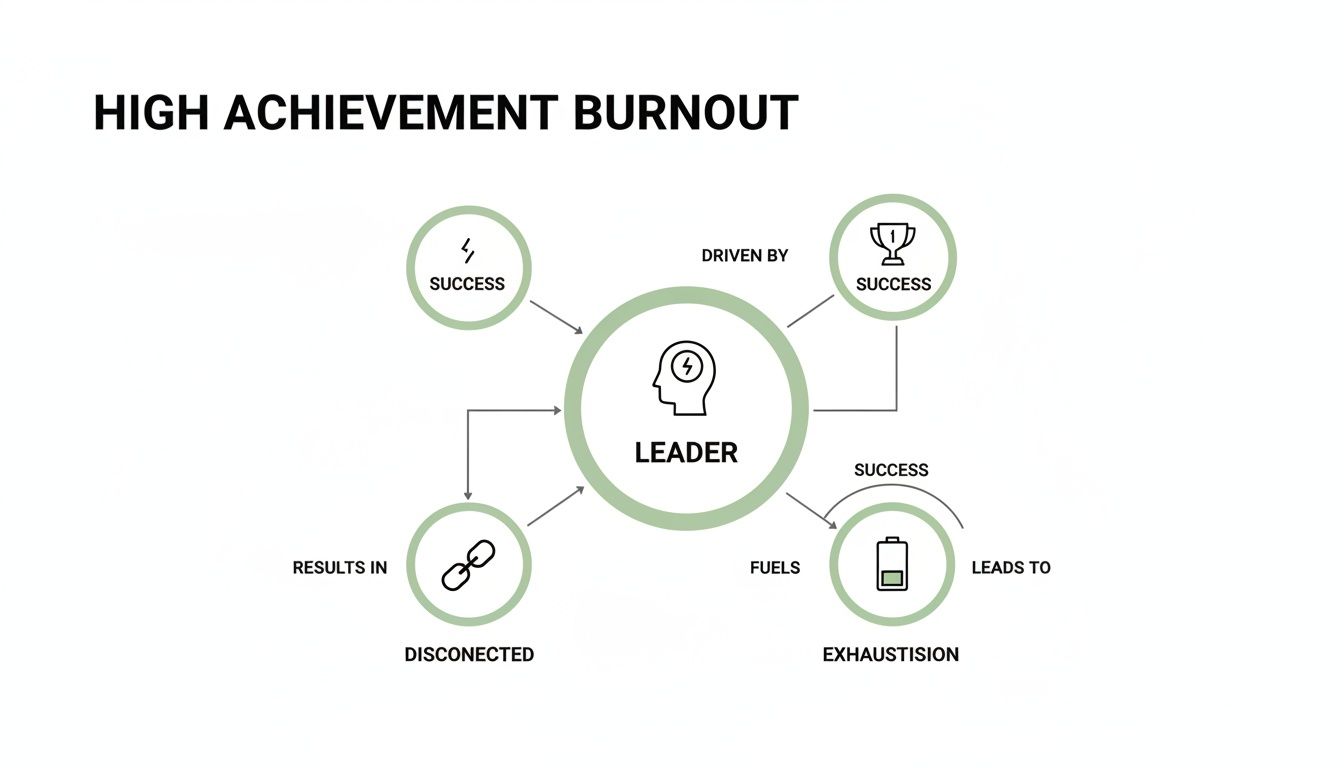
This isn't just a bad week; it's a physiological loop. The ambition that got you here becomes the very thing that burns you out unless you learn to regulate your system.
The Mid-Career Cliff
This experience is incredibly common for women leaders, especially in the middle of their careers. The brain’s executive function system—the mind’s "air traffic control"—is under a relentless siege.
Research from the Center on the Developing Child at Harvard University explains that executive function skills peak in early adulthood. This helps explain why so many incredible leaders aged 35-50 hit a wall just as external demands are at their absolute highest. Studies have even noted potential 20-30% drops in task-switching efficiency under stress in this demographic.
The good news? This state is not a life sentence.
Understanding your own nervous system architecture is the first, most powerful step toward recalibrating it. You can learn to intentionally shift out of survival mode and back into a state of clear-headed, grounded, and powerful leadership. Burnout isn’t your destiny. It’s a data point telling you it’s time for a new approach.
Let's look at what this difference between a dysregulated and a regulated state actually looks like in the day-to-day reality of leadership.
Dysregulated vs Regulated Executive Nervous System
The table below breaks down the stark contrast between leading from a state of chronic stress (Survival Mode) versus leading from a place of grounded presence and clarity (Sovereign Mode). This isn't about personality; it's about physiology.

Seeing these two states side-by-side makes it clear: regulating your nervous system isn't a "soft skill." It is the foundational requirement for sustainable, impactful, and fulfilling leadership. You have the power to rebuild your system and choose which column you lead from.
The RAMS Reframe to Reclaim Your Power
Recognizing your dysregulation pattern is the moment the fog clears. It’s when you stop blaming your willpower and start understanding your wiring. This is where we move from knowing the problem to having a clear, actionable strategy for rebuilding your capacity from the ground up.
The answer isn't to "manage stress" better. That's like putting a band-aid on a broken bone. The only sustainable path is a complete system upgrade. This is why I developed the RAMS Method—a systematic framework designed for high-achievers to regulate their executive nervous system and reclaim sovereign control.
RAMS stands for Results, Attitude, Mastery, and Systems. It’s a blueprint for rewiring your entire approach to performance, fulfillment, and leadership.

Pillar 1: Redefining Your Results
The first pillar, Results, goes straight for the foundational belief that drives leaders into the ground: that your success is measured solely by external metrics. The RAMS Method blows that definition wide open.
True success isn't just hitting a target; it's the capacity to hit that target with your well-being, vitality, and relationships intact.
This means reframing your goals to prioritize your physiological state. What if "success" this quarter also meant reducing your baseline anxiety by 50%? What if a key result was feeling present during dinner with your family four nights a week? This isn't about lowering your standards; it's about raising them to include your own life force.
Pillar 2: Shifting Your Internal Attitude
Attitude confronts the brutal internal dialogue that fuels dysregulation. For years, you've likely used a harsh inner critic as your primary motivational tool, believing it keeps you sharp.
But that relentless self-criticism is pure cortisol. It’s a constant threat signal that keeps your nervous system on high alert, making regulation physiologically impossible.
Shifting your attitude means intentionally cultivating radical self-trust. It involves learning to listen to your body’s signals—the tightness in your chest, the gnawing in your stomach—not as weaknesses to be crushed, but as vital data to be honored. This is the critical move from self-flagellation to self-sovereignty.
"Your internal state dictates your external impact. Leading with a regulated nervous system is not a luxury; it is a non-negotiable requirement for sustainable excellence and inspiring others."
Pillar 3: Achieving Physiological Mastery
This is where the rubber meets the road. Mastery is about learning the practical, physiological tools to actively regulate your nervous system on demand. This goes beyond generic mindfulness apps. We're talking about targeted, evidence-based practices that directly influence your vagus nerve.
Targeted Breathwork: Learning specific breathing protocols, like the physiological sigh, can instantly downshift your nervous system from a sympathetic (fight-or-flight) state to a parasympathetic (rest-and-digest) one.
Somatic Awareness: These are grounding exercises that pull your attention back into your physical body, anchoring you in the present moment and short-circuiting anxious thought loops.
Interoceptive Training: This is the practice of tuning into subtle internal bodily sensations. It builds your capacity to anticipate and address dysregulation before it hijacks your system.
These are the levers that give you direct, conscious control over your internal state. You can learn more about how this complete system works in our deep dive into the revolutionary RAMS leadership framework.
Pillar 4: Building Supportive Systems
Finally, Systems addresses your external environment. No amount of breathwork can overcome a schedule, a team culture, or a set of boundaries that are fundamentally at war with your biology. Your environment must support your regulation, not constantly sabotage it.
This pillar calls for a ruthless audit of your life and leadership:
Time & Energy Boundaries: Implementing non-negotiable blocks for deep work, recovery, and personal time. Learning to say "no" strategically to protect your energy.
Delegation & Trust: Redesigning workflows so you operate within your zone of genius, not as the bottleneck for every decision.
Cultural Regulation: Actively creating a team environment where psychological safety is the bedrock, where rest is encouraged, and where burnout is treated as a systemic failure, not a personal one.
External pressures, even mundane ones, can pour fuel on hidden stressors. Sometimes, relief comes from unexpected places, like achieving greater peace of mind through strategic delegation of transportation needs. The RAMS Method provides a comprehensive strategy to not just recover from burnout, but to build a new foundation for embodied, effective, and deeply fulfilling leadership.
The Return to Nervous System Sovereignty
Knowing the theory is one thing. Taking back control is another. True sovereignty comes from action. The real power of RAMS starts with tiny, immediate shifts you can make right now.
These are micro-practices, most taking less than five minutes, that give you a direct line to your own biology. This is how you start breaking the dysregulation cycle and begin rebuilding your capacity from the inside out.

Immediate Physiological Resets
Your breath is the fastest, most direct lever you have to influence your nervous system. When you feel that familiar spike of stress, you can use a simple technique to send a powerful signal of safety straight to your brain.
The Physiological Sigh: This is one of the quickest, evidence-based ways to dump stress from your body.
Inhale deeply through your nose.
Right at the top of that breath, take in another short, sharp sip of air to fully inflate your lungs.
Now, exhale slowly and completely through your mouth. Make the exhale noticeably longer than the inhales.
Repeat this two or three times.
This simple action physically off-loads carbon dioxide and tells your brainstem to slow your heart rate, instantly downshifting you out of "fight or flight." For a deeper look at rebuilding your capacity after high stress, explore our guide on how to recover from burnout.
Grounding and Centering Practices
When you're stuck in anxious thought loops, your attention is disconnected from your body. A quick somatic centering exercise yanks you back into the present moment.
Somatic Centering Exercise: Use this before a challenging call or any time you feel overwhelmed.
Feel Your Feet: Press both feet firmly into the floor. Notice the sensation of the ground beneath you—solid, stable, and real.
Notice Your Seat: Feel the weight of your body in the chair. Notice the points of contact and the feeling of being supported.
Engage Your Hands: Gently press your fingertips together. Or place your hands flat on your desk and notice the texture and temperature.
This simple act of shifting focus to physical sensation pulls you out of your head and anchors your nervous system in the safety of the here and now. To build long-term resilience, one of the most powerful steps is enhancing your sleep quality. Deep sleep is non-negotiable for physiological repair and cognitive function.
The Long-Term Vision of Embodied Leadership
Regulating your executive nervous system isn't about patching yourself up to survive another quarter. It's the foundation of a more powerful, sustainable, and authentic way of leading: embodied leadership.
Imagine making critical decisions from a place of grounded clarity instead of reactive urgency. Picture inspiring your team through an unshakable calm and authentic presence, rather than a relentless, exhausting drive. This is what it feels like to lead from a regulated state—you hit ambitious goals without sacrificing your well-being.
This path isn't a repair job on a broken machine. It’s a profound return to the powerful, intuitive, and resilient leader you were always meant to be. Our guide to sovereign leadership training dives deeper into this shift.
The invitation here isn't to "fix yourself." You are not broken. The real work is gaining the clarity to finally come home to yourself, fully sovereign and fully alive in your leadership and your life. This is the ultimate return.
Burning Questions Answered
Let's tackle the most common questions leaders have when starting this path.
Is the Executive Nervous System a Real Medical Term?
No, you won't find the "executive nervous system" in a medical textbook. It is a functional metaphor—a powerful framework to help leaders connect the dots between the brain's command center (the prefrontal cortex) and the body's raw, automatic stress responses. It makes the invisible physiological drivers of burnout tangible and manageable.
How Is This Different From 'Stress Management'?
Traditional stress management is a top-down, cognitive approach (time management, reframing thoughts). It often fails because it doesn't address the root cause: a dysregulated nervous system. Our approach is bottom-up. We start with the body's biology first. Instead of trying to think your way calm, you use targeted physiological practices to signal safety directly to your nervous system. This creates the internal foundation for your strategic brain to come back online.
How Long Does It Realistically Take to See Results?
You can feel a change immediately. The very first time you use a tool like the Physiological Sigh, you can experience an instant shift. However, re-patterning a nervous system that has been in overdrive for years is a process. Most leaders notice a significant drop in reactivity and a real increase in clarity within the first few weeks of consistent practice. The goal isn't a quick fix; it's cultivating a new, sustainable way of operating where regulation becomes your natural default state.
Are you ready to stop managing the symptoms of burnout and start building a new foundation for sustainable leadership? The first step is gaining absolute clarity on where your system is most dysregulated.
Take the free diagnostic from Baz Porter today and begin your return to yourself.
Where to go next. If any of this reads like your own reflection, the Silent Collapse Diagnostic™ is a quiet place to start — a clear read on where your nervous system is most dysregulated. And if you want the deeper why beneath the work, read the Sovereign Manifesto.