The Strategic Decision Making Process For Leaders Who Trust Their Gut
You’re standing at a crossroads. The decision feels monumental, and every fiber of your being screams that the “obvious” path is the wrong one. The pressure to act is crushing, but something deep inside is holding you back. This is the silent collapse—that paralyzing moment where years of effort, your reputation, and your legacy hang in the balance.
The fear of one misstep freezes you completely.
Key Takeaways
Failure of Old Models: Traditional decision-making frameworks like SWOT analysis ignore your most valuable asset: your intuition. They force you into a state of analysis paralysis and burnout by treating decisions as purely intellectual problems.
The RAMS™ Method: A truly strategic decision making process must be holistic. The RAMS (Results, Attitude, Mastery, Systems) framework integrates hard data with your intuitive intelligence, values, and nervous system capacity, leading to choices you can execute with conviction.
Data as an Ally: Data isn’t the enemy of intuition; it's the anchor that gives your gut feelings a defensible voice. Learning to ask better questions of your data transforms it from a source of overwhelm into a tool for radical clarity.
Embodied Authority: The ultimate goal is to return to yourself. Your greatest strategic advantage is a regulated nervous system capable of holding complexity and pressure without collapsing, allowing you to lead from a place of sovereignty, not stress.
The Hidden Pattern - Why Your Gut Feeling Is Your Greatest Asset
You’ve crunched the numbers, you’ve analyzed the projections, you’ve listened to all the expert advice. And still, there’s a deep-seated dissonance you can’t shake. This isn't just choosing Option A over Option B; it's a conflict between what everyone else expects and what your own internal compass is telling you.
The internal monologue is relentless: "If I get this wrong, everything I've built could unravel. If I wait too long, the opportunity vanishes. Why can't I just make a choice?"
A truly effective strategic decision making process integrates both analytical rigor and intuitive wisdom, ensuring choices are not only logical but also deeply aligned with your core values and long-term vision. This holistic approach prevents the burnout that comes from constantly overriding your own internal guidance system. Relying solely on external data is like navigating a raging storm by only looking at the map—you're ignoring the crashing waves and the direction the wind is actually blowing.
This is the exhausting reality of high-stakes leadership. The immense weight of responsibility leads directly to decision fatigue and analysis paralysis. It’s not just you. A McKinsey study found a staggering 60% of executives felt that bad decisions were just as frequent as good ones, which shows just how tough it is to navigate complex choices. You end up in a state where the sheer volume of data and opinions creates more noise, not clarity.

Beyond The Data: The Failure of Old Models
Here’s the core problem: conventional models for a strategic decision making process treat choices like purely intellectual exercises. They completely ignore the most critical variables in the equation: your identity, your legacy, and your nervous system's capacity to handle ambiguity and intense pressure. A decision that looks perfect on paper can feel profoundly wrong in your body because it clashes with your core values or your intuitive intelligence.
This is where burnout begins. When you consistently override your gut feelings in favor of external validation or flawed frameworks, you sever the connection to your most powerful leadership tool—your own embodied wisdom.
To break this cycle, learning how to overcome indecision is the first step toward reclaiming your authority and making clear-headed choices.
Traditional decision-making models are failing modern leaders. They were designed for a simpler, more predictable world, and they often encourage you to suppress your intuition and somatic signals—the very "gut feelings" that have guided your success up to this point. This forces you into a state of chronic second-guessing and drains the energy you need to lead with conviction.
The cycle is painfully predictable:
Over-Analysis: You dig for more data, hoping a magic bullet will make the choice for you.
External Seeking: You poll more stakeholders, diluting your own perspective in a sea of conflicting opinions.
Forced Action: You finally make a choice out of sheer exhaustion, not clarity, which almost always leads to suboptimal results and regret.
This article will break that pattern. We’re going to walk through a new framework that honors both data and intuition, empowering you to make strategic choices that are not only effective but deeply aligned.
The RAMS™ Reframe - A New Framework For Sovereign Choices
Most decision-making models try to cram you into a box. They create a false choice between hard data and gut instinct, between cold logic and what your body is telling you.
The RAMS Method isn't just another model; it's a completely different way of operating. It’s an integrated framework designed for making what I call sovereign choices—decisions that are not only strategically sound but are deeply aligned with who you are and the future you're building.
This isn’t just an acronym. Think of it as a leadership operating system built to pull you out of reactive fatigue and into a state of grounded, proactive authority. RAMS stands for Results, Attitude, Mastery, and Systems. Each piece builds on the last, creating a powerful loop that reinforces clarity and conviction at every turn.
Let's break down how it actually works.
Results: Defining Your True North
The whole process kicks off with an unflinchingly honest look at the outcome you want. And honest is the key word here. Too many leaders define results in purely external, metric-driven terms—revenue targets, market share, project deadlines. Those things matter, but they are just byproducts of a much deeper intention.
The RAMS Method forces you to define the embodied result you’re actually chasing. How do you want to feel once this decision is made and implemented? What state of being are you trying to create for yourself and for your team?
A conventional goal sounds like: “Increase Q4 revenue by 15%.”
A RAMS-aligned Result sounds like: “Create a quarter of profitable, expansive growth where the team feels energized and creative, and I end each day feeling fulfilled, not drained.”
See the difference? This shift is profound. It connects a strategic goal directly to your own well-being and nervous system, making sure the path to success doesn't become a fast track to burnout.
Attitude: Regulating Your Internal State
Once that clear vision is in place, the next move is internal. You have to cultivate the state of being required to achieve it. In the RAMS framework, Attitude isn't about slapping on a fake smile or "thinking positive." It’s about nervous system regulation.
You simply cannot make a clear, sovereign choice from a place of fear, agitation, or exhaustion. It's biologically impossible.
High-stakes decisions light up our deepest survival wiring—fight, flight, or freeze. When your nervous system gets dysregulated, your prefrontal cortex (the part of your brain responsible for rational thought) essentially goes offline. You’re left with a primal brain trying to solve a complex, modern problem. That never, ever works.
Grounding Practices: Before a big decision meeting, take five minutes. Literally, feel your feet on the floor. Take a few slow, deep breaths. This simple act sends a powerful safety signal to your nervous system.
Somatic Check-Ins: Pay attention to where you feel the decision in your body. Is there a tightness in your chest? A knot in your stomach? Your body is giving you critical data. Don’t you dare ignore it.
When you make decisions from a place of grounded presence, you get access to your full cognitive and intuitive horsepower. You see more options, you assess risk more accurately, and you connect with a deeper well of wisdom.
Mastery: Aligning With Your Core Genius
Mastery is the filter. It’s about making damn sure your decisions are in perfect alignment with your core values and unique strengths. This is what protects you from chasing those shiny opportunities that look great on paper but are fundamentally wrong for you. A misaligned decision, even if it hits the financial target, will always feel like an internal failure.
This step requires radical self-awareness. It means knowing what you are uniquely brilliant at and where your energy delivers the highest return. It also means having the guts to say no to everything else, no matter how tempting it might seem.
This is about getting to data-informed clarity, where you’re not just looking at numbers but asking the right questions to connect them to your core purpose.
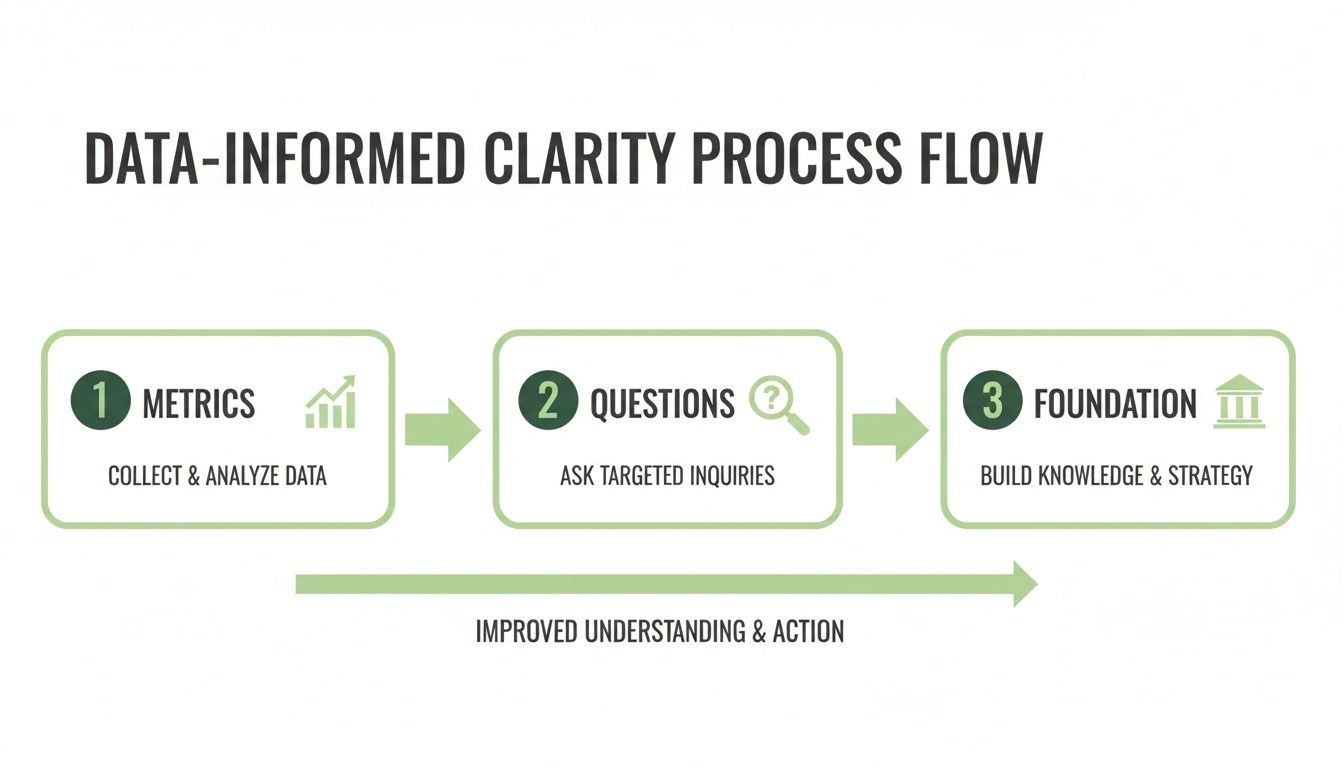
As the diagram shows, you can't build a solid foundation on metrics alone. You have to bridge the gap with insightful questions that get to the heart of your strategy.
To find your alignment, ask yourself:
Values Check: Does this decision honor my top three core values (like integrity, freedom, or creativity)?
Genius Zone: Does this path play to my unique abilities, or does it force me to operate from a place of weakness?
Legacy Impact: Is this a choice I’ll be proud of ten years from now?
When a decision clicks with your Mastery, it feels almost effortless. Action just flows, because it’s coming from the very core of who you are.
Systems: Creating The Scaffolding For Success
A brilliant decision without a structure to support it is nothing more than a good intention. Systems are the practical, real-world scaffolding that makes sure your choice becomes a reality. This is where the rubber meets the road—where strategy meets execution.
This final piece is all about the "how." It's about building the accountability frameworks, communication plans, and feedback loops needed to bring the decision to life and keep the momentum going. Great systems anticipate resistance, manage expectations, and create clear, simple pathways for your team to follow.
When building out your systems, think about:
Accountability: Who owns what? What are the specific, measurable milestones that tell us we're on track?
Communication: How will we roll this out to the team and key stakeholders to create genuine buy-in, not just compliance or resistance?
Feedback Loops: What's our mechanism for gathering data on how this is landing? How will we stay agile and make adjustments as we go?
By deliberately designing these systems, you’re not just hoping for a good outcome—you’re engineering one. You’re creating an environment where your decision is set up to win from the start. The RAMS method gives you the full strategic decision making process, from the internal state of the leader all the way to the external structures of the organization.
Traditional Vs Embodied Decision Making

Looking at this comparison, it’s obvious that clinging to the old way of doing things is no longer a viable strategy. True leadership demands a more integrated and honest strategic decision making process—one that honors every single aspect of your intelligence.
The Return - Leading from a Place of Sovereignty
A decision, no matter how perfectly crafted or data-backed, is just an idea until it’s brought to life. That moment of choosing is a private victory, but the real work—the implementation—is where your leadership becomes a public act of courage. This is the critical handoff where your internal, sovereign choice has to become an external, tangible result.
Let's be honest, this transition from clarity to action is almost never smooth. It's fraught with resistance. You'll get pushback from your team, you'll have to navigate messy corporate politics, and you'll absolutely feel the pressure to second-guess your own conviction. Success here isn’t about forcing your will on people. It's about communicating your decision with an embodied authority that inspires trust and creates unstoppable momentum.

Your ultimate strategic advantage is returning to self.
We’ve walked through frameworks, crunched the data, and mapped out implementation plans. But the honest truth? The most powerful strategic decision making process isn't on a flowchart. It’s not in a spreadsheet.
It’s found in that quiet moment between a trigger and your reaction—the space where you choose to act from your core instead of just responding to outside pressure. Every single choice you make is a vote. It's either a step toward your most authentic self, or a step away from it. The frameworks we've discussed are just tools to help you hear your own inner wisdom more clearly.
The Real Return On Investment
Look, the end goal here isn't just about hitting quarterly targets or boosting efficiency metrics. It’s about a profound return to you. Real transformation happens when your professional decisions stop feeling like you're playing a role and instead become a genuine expression of who you are.
This deep alignment is your single greatest strategic advantage. Nothing else comes close.
A leader who is grounded, clear, and operating from a place of deep authenticity is an unstoppable force. You project a calm confidence that builds trust and creates momentum in a way that no top-down directive ever could. Your own nervous system becomes the most reliable compass you have.
Your most valuable asset isn’t your market share, your technology stack, or your five-year plan. It is a nervous system that has the capacity to hold complexity, ambiguity, and pressure without collapsing into reactivity. From this state of sovereignty, all right action flows.
Making the shift from exhausted executive to embodied leader isn't a quick fix. It’s a fundamental change in how you show up to lead and to live. It's about finally building a legacy that feels as good on the inside as it looks on paper.
The next move isn't to learn another tactic or framework. It’s to deepen this practice of coming back home to yourself. As leaders work through complex choices, financial models are always on the table. For many, adopting Recurring Revenue Business Models becomes a critical strategic move to build predictability and sustainable growth. If you're ready to go beyond conventional strategies and build a foundation of true nervous-system sovereignty, let's have a conversation about what that could look like for you.
Your Questions On Strategic Decision Making Answered
I get asked all the time how this embodied approach to decision-making actually works on the ground, in the messy reality of running a business. Let’s tackle some of the most common questions I hear from leaders.
How Do I Apply This In A Traditional Company Culture?
You don’t need to send out a company-wide memo announcing a revolution. The most powerful changes start small and are led by example.
Try this: In your next team meeting, when you’re defining the goals for a project, don't just talk about KPIs and deadlines. Ask your team how they want to feel when it’s successfully completed. Energized? Proud? That’s the Results component in action. By framing success in both analytical and emotional terms, you’re subtly introducing the power of an embodied outcome. It builds a bridge, showing that gut feeling and hard data aren’t enemies—they’re partners.
I Feel Overwhelmed. What Is The First Small Step I Can Take?
When you’re stuck, the single most potent thing you can do is a somatic check-in. It takes 60 seconds.
Seriously, that's it. Before you jump into that next big decision, just pause. Close your eyes. Take three slow, deep breaths and scan your body. Do you feel a tightness in your chest? A knot in your stomach? That's not noise; it's high-value data from your nervous system. Acknowledging these signals is the first move toward regulating your internal state (the Attitude component). It allows you to make a choice from a place of grounded clarity, not reactive stress.
How Is The RAMS Method Different From SWOT Or The OODA Loop?
Frameworks like SWOT (Strengths, Weaknesses, Opportunities, Threats) or the military's OODA Loop (Observe, Orient, Decide, Act) are brilliant tactical tools. They are designed to help you analyze the external environment and react quickly. They look outward.
The RAMS Method is fundamentally different because it’s an internal-to-external operating system. It always starts with you, the leader. It begins with your internal state—your vision, your values, your regulated nervous system—before you even start analyzing the external data.
While SWOT might tell you what the market will allow, RAMS ensures the path you choose is one you can actually sustain without burning out. It’s the difference between finding a viable path and finding your path.
Are you ready to stop making decisions that drain you and start leading from a place of sovereign alignment? The strategies here are just the beginning. At Baz Porter, we help high-achieving women like you implement these frameworks to build a legacy that is both successful and deeply fulfilling. Discover how the RAMS method can reshape your leadership. Learn more about how we can work together.