Leading Through Change: The High-Achiever’s Guide to Resilient Leadership
The announcement hits your inbox. Another re-org. Another strategic pivot. Your team looks to you for a steady hand, but inside, you’re bracing for impact. The pressure to project absolute certainty while navigating your own exhaustion is the silent crisis of modern leadership. This isn't just a tough quarter; it's the predictable outcome of an outdated leadership model that demands you absorb every shock wave for your team, leaving your own nervous system to pay the price. You're told to be the anchor in the storm, but no one ever taught you how to secure your own footing.
Key Takeaways:
The Shattered Compass: Constant change creates a physiological "threat state" that shatters your internal compass, forcing you into reactive survival mode and making strategic leadership impossible.
The RAMS™ Reframe: To lead effectively, you must first regulate your own nervous system. The RAMS Method (Results, Attitude, Mastery, Systems) provides a framework to move from reactive management to embodied leadership.
ROI of Embodiment: A leader's regulated state directly impacts team trust, retention, and performance. Psychological safety isn't a "soft" metric; it's a direct driver of success during transformation, with high-trust cultures seeing 3x better retention.
Nervous System Sovereignty: Sustainable leadership isn't about surviving the next change; it's about building the internal capacity to remain grounded and intentional, no matter the external chaos.
The Secret Burnout Behind Failed Change Initiatives

Let’s talk about the silent truth that so many high-achieving leaders carry. You're the designated navigator, the one expected to steer the ship through one disruption after another. On the surface, you project absolute control and unwavering capability.
But underneath, a different story is playing out.
You feel the constant, relentless pull of competing priorities. The demand on your energy is never-ending, leaving you stretched impossibly thin. A quiet, creeping exhaustion has settled in, and you find yourself dreading the email announcing the next major organizational shift. Your internal monologue is a constant hum of "I can't drop this ball. If I stop performing, I'll disappear."
That feeling? It's not a personal failure. It’s the predictable, exhausting outcome of an outdated leadership playbook.
The Unspoken Cost of Constant Change
The traditional model demands you absorb all the external chaos while completely suppressing your own internal response. This forces a dangerous disconnect, making you operate from a place of chronic, low-grade stress that inevitably spirals.
This is the fast track to burnout. It's a state where strategic thinking gets shoved aside by pure survival instinct.
You are asked to be the stable anchor in a perpetual storm, but no one ever teaches you how to secure your own footing. The expectation to endlessly perform without acknowledging the physiological toll is the hidden flaw in modern leadership.
This is us holding a mirror up to that struggle. It’s a validation of the immense pressure you're under and the first step toward a more sustainable way to lead.
That pressure doesn't just crush you; it cascades down, poisoning your team's psychological safety and sabotaging the very change initiative you're trying to land. If you want to dive deeper, we've outlined practical strategies for overcoming burnout at work.
Because before you can guide anyone else through uncertainty, you have to lead yourself back to solid ground.
Why Traditional Change Leadership Models Are Failing You
If you feel like you’re trying to lead through a constant storm without a map, you’re not wrong. The relentless pressure of organizational change has your nervous system locked in a perpetual threat state. This isn’t just a feeling; it’s a physiological reality.
The very parts of your brain you rely on for strategic thinking, empathy, and clear-headed decisions—your executive functions—get hijacked by survival instincts. You're stuck in reactive mode, making true, intentional leadership feel all but impossible.
This is exactly why traditional, top-down change models are breaking down around you. They were designed for a different world, one with predictable cycles of upheaval and recovery. Today, there is no recovery. There’s only the next disruption.
The Shattered Compass Metaphor
Imagine trying to guide your team through a dense, unfamiliar forest, but your compass is shattered. The needle just spins wildly, pointing everywhere at once. This is what relentless change does to your internal guidance system.
Your values, your vision, your very sense of purpose—they become fragmented. Instead of navigating from a place of grounded clarity, you're just reacting. You’re putting out the next fire, dealing with the next crisis, fielding the next urgent demand.
Your feeling of ineffectiveness isn't a sign of weakness. It is a predictable neurological response to an environment that has shattered your internal compass, leaving you to navigate a constant storm without a true north.
This internal fracturing is the hidden reason so many change initiatives are doomed before they even begin. It has severe consequences that ripple out across your entire team.
The Neurological Drain of Leading Change
Let's be clear: your cognitive resources are finite. When your brain is constantly scanning for threats—layoffs, restructuring, new technologies—it burns through your mental energy at a completely unsustainable rate.
This neurological drain shows up in very real ways:
Decision Fatigue: Even small choices feel overwhelming because your prefrontal cortex is simply exhausted.
Loss of Empathy: It becomes harder to connect with what your team is going through because your own system is overloaded.
Reactive Communication: You find yourself communicating from a place of stress and reactivity, not strategic intent.
This state isn’t a personal failing. It’s a biological response to an environment that demands constant vigilance. The old models of leadership completely ignore this physiological reality. They treat you like a machine that can process endless change without consequence. You can see more on why standard approaches fall short by exploring the real reason your leadership training isn't working.
The Collapse of Trust and Its Consequences
This internal chaos inevitably destroys the single most critical asset you have for leading through change: trust. When you’re operating from a place of survival, your team feels it. They sense the disconnect between your words and your internal state.
In the whirlwind of today's relentless disruptions—from AI to geopolitical tensions—leading effectively means making trust your number one priority. Research from DDI's comprehensive leadership report paints a stark picture: frontline leaders, especially women in high-stakes roles, are battling burnout at alarming rates. Trust in leadership has eroded, and this correlates directly with failed transformations. In fact, organizations with high-trust cultures see 2.5 times higher employee engagement and 3x better retention during major change.
The data is clear. The failure isn't in your ability to follow a change plan. The failure is in the model itself—a model that disconnects you from your own nervous system and, as a result, from the very people you’re supposed to lead. It creates a domino effect where your internal dysregulation becomes the organization's collective instability.
Until you learn how to recalibrate your own shattered compass, you will continue to feel lost in the storm, no matter how detailed the corporate roadmap is. The first step is to stop blaming yourself and start understanding the deep, systemic reasons why the old way is no longer working.
Recalibrating Your Inner Compass with The RAMS Framework
That feeling of a shattered compass? It’s not just a poetic metaphor. It's the very real, internal chaos that happens when your nervous system gets locked in survival mode. To lead anyone else through change, you first have to stop the frantic spinning inside your own head.
You need a reliable way to find your true north again—a method for recalibrating your internal state so you can guide your team from a place of grounded clarity, not just grit.
This is the critical shift from reacting to the storm to becoming the calm center of it.
The RAMS Framework was built for this exact moment. It’s a systematic approach designed to anchor your leadership in something far more sustainable than sheer willpower. It gives you a blueprint to lead yourself first, so you can show up for your team with an authentic, embodied presence that cuts through any disruption.
Redefining Results Beyond the Balance Sheet
The first pillar, Results, throws a direct challenge to the conventional, burnout-soaked definition of success. When the pressure is on, it’s dangerously easy to equate results with hitting KPIs and revenue targets, often at the direct expense of your own well-being. This narrow focus is a recipe for exhaustion.
An embodied approach to leadership demands a broader definition. True results aren't just about what you achieve, but how you achieve it.
This means looking at success through a more holistic lens:
Sustainable Performance: Is the team’s output coming from a place of energized collaboration or from exhaustion and fear?
Psychological Safety: Do your people feel safe enough to innovate, voice concerns, and take smart risks without fear of reprisal?
Personal Well-being: Are you and your team ending the week depleted, or are you energized by the work you've done?
When you redefine results to include well-being and genuine impact, you fundamentally shift the energetic dynamic of your team. You move from a purely transactional model of performance to a relational one, where people feel valued for more than just their immediate output.
Regulating Your Attitude Through Your Nervous System
The second pillar, Attitude, isn't about slapping on a happy face or forcing "good vibes only." It’s about your physiological state—the literal state of your nervous system. You cannot think your way out of a threat response. When you're stuck in survival mode, your capacity for strategic thought, empathy, and creative problem-solving absolutely plummets.
This is precisely why so much traditional change management fails; it tries to appeal to the logical brain while the nervous system is screaming "DANGER!"
Regulating your attitude means learning to consciously shift your physiological state from threat to safety. This is a learnable, physical skill. It involves simple but powerful techniques to down-regulate your system when you feel the pressure mounting, allowing you to stay present and clear-headed right in the middle of the chaos.
This chart shows exactly what’s happening internally when constant change triggers that threat state, leading directly to that shattered compass feeling so many leaders experience.
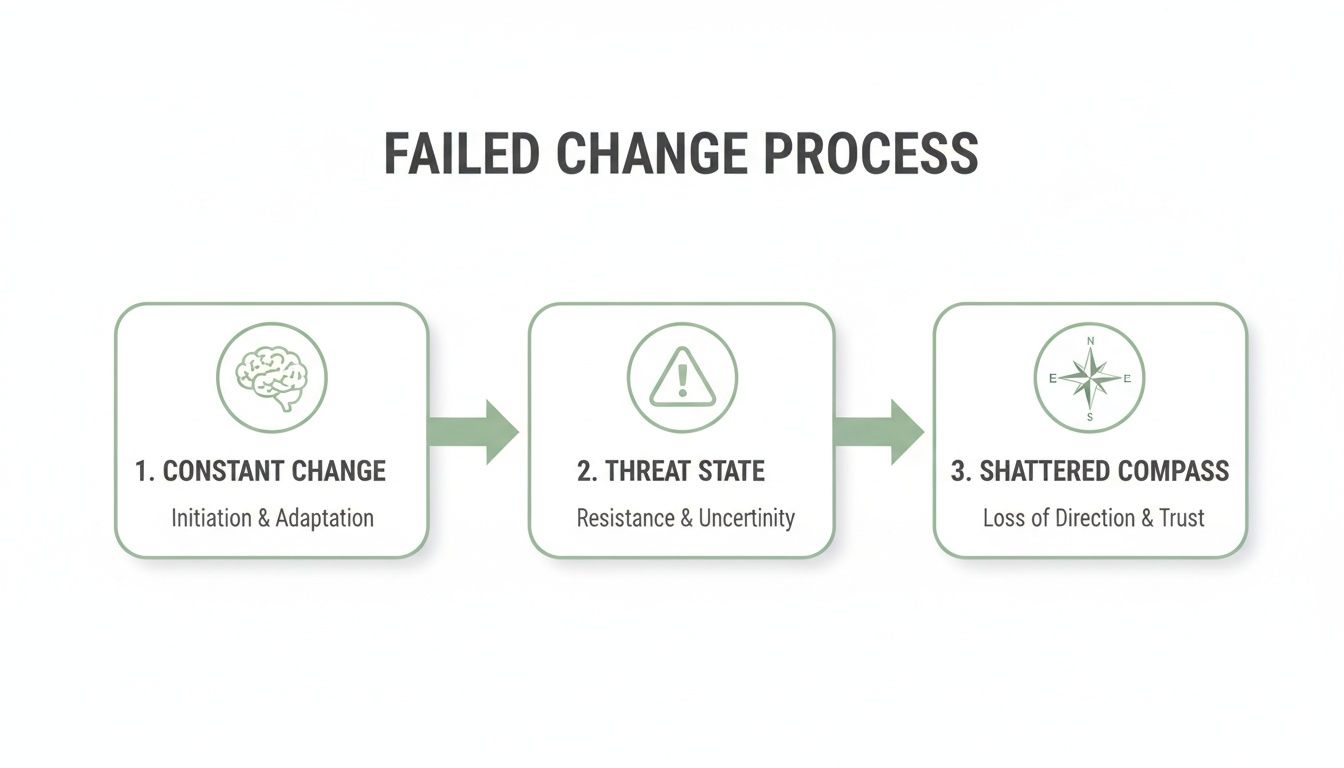
This cycle makes it crystal clear: nervous system regulation isn't a soft skill; it's a non-negotiable leadership competency for navigating modern business.
Achieving Mastery in Communication and Decision-Making
Once your nervous system is regulated and you have a clearer, more sustainable definition of success, you can focus on Mastery. This is about honing the specific leadership skills that build rock-solid trust and confidence during periods of intense uncertainty. When people feel unsafe, their need for clear, consistent, and empathetic communication skyrockets.
Mastery is about developing deep proficiency in:
Clean Communication: Speaking with clarity and conviction, making sure your words, tone, and body language are all aligned. This is how you eliminate the mixed signals that breed anxiety and mistrust.
Decisive Action: Making clear decisions from a grounded place, even when you don't have all the information. This provides a vital sense of stability and direction for your team when everything else feels uncertain.
Holding Space: Creating an environment where your team can actually process the emotional impact of change without judgment. This is how you build deep loyalty and psychological safety.
Mastery isn't about being perfect. It's about showing up with skill and intention, providing the steady hand your team desperately needs to navigate the storm.
Building Resilient Systems for Yourself and Your Team
The final pillar, Systems, provides the structure that makes this entire approach sustainable. Without supportive systems, even the best intentions will crumble under pressure. Systems are what create the container for resilience, both for you and for your team.
This means intentionally designing structures that reinforce psychological safety and well-being.
Systems are the guardrails that keep you and your team from veering off course when fatigue and pressure set in. They are your commitment to a new way of operating, made tangible.
Think about implementing systems like these:
Personal Systems: Your non-negotiables for regulating your own nervous system. This could be a 5-minute breathwork exercise before your first meeting or a sacred, protected block of "deep work" time on your calendar.
Team Systems: The rhythms and rituals that build connection and clarity. Maybe it's a weekly check-in that always starts with a personal "win," or a transparent communication cadence for sharing updates about the change initiative.
By building these kinds of robust systems, you embed an embodied, resilient approach into the very fabric of your team's culture. You can find a deeper explanation of how these pillars work together in our detailed guide on the RAMS Method leadership framework. This is how you move from just managing change to truly leading through it, creating a foundation of resilience that can withstand any disruption.
This table really brings to life the difference between the old, reactive way of managing change and the embodied, nervous-system-aware approach that RAMS offers.
From Reactive Management to Embodied Leadership: A RAMS Comparison

Looking at this side-by-side, it's easy to see how one path leads to burnout and the other to sustainable, high-impact leadership. The choice is about moving from an approach that depletes human capital to one that intentionally cultivates it.
Architecting Resilient Teams in Times of Change

Once you’ve recalibrated your own internal compass, the next move is to translate that grounded, embodied leadership into the very architecture of your team. This is where your inner work starts to create real, external impact.
Leading through change means you have to move beyond just managing your own state. It's time to actively shape an environment where your entire team can navigate uncertainty and come out stronger. This isn’t about just pushing down top-down directives; it’s about co-creating a culture of genuine resilience.
One of the biggest hurdles I see leaders face is getting executive buy-in for this more human-centered approach. The cold language of spreadsheets and bottom lines can easily drown out the critical need for psychological safety. The reality is, the two are completely intertwined.
Making the Business Case for Embodied Leadership
To get the support you absolutely need, you have to connect the dots between your team's well-being and their performance, and you have to do it in a language other leaders can't ignore. This isn’t some "soft" initiative—it's a strategic imperative for any transformation to actually succeed.
Think about it: digital transformation has a bleak 35% global success rate. Why? Because it’s not about the tech; it’s about the people. The data shows that leaders who express genuine confidence in their teams see 2.3 times higher success rates. That confidence is what turns organizational doubt into unstoppable momentum. This is a proven multiplier for successful change.
Use that data. Frame psychological safety as a direct enabler of agility, innovation, and retention—all critical metrics, especially when everything is in flux.
Designing Change Interventions That Actually Build Trust
Once you have that buy-in, your focus shifts to designing the specific interventions that will carry your team through the transition. This is where you get fiercely intentional with your communication, your team structure, and the rituals that hold you all together.
Your communication plan is your number one tool for building trust. It has to be more than a few email updates.
Transparency Over Positivity: Be radically honest about the challenges ahead. Acknowledging uncertainty is far more powerful and reassuring than pretending it doesn't exist.
A Predictable Cadence: Set up a reliable rhythm for updates, like a weekly 15-minute stand-up dedicated only to the change. Predictability is incredibly calming for the nervous system.
Two-Way Channels: You have to create structured, safe ways for your team to give feedback. Think anonymous surveys or dedicated "ask me anything" office hours. This shows their voices truly matter.
A leader's most critical role during change is to be the single most consistent and reliable source of information. When you create clarity, you reduce the cognitive load of anxiety for your entire team. That frees up their energy for adaptation and high-level performance.
Beyond just talking, you need to design team rituals that intentionally foster connection and psychological safety. These are the small, consistent actions that reinforce your team’s social fabric when outside pressures are trying to tear it apart.
Case Study: A Tech Leader’s Gutsy Pivot
Let’s look at a client of mine we’ll call "Sarah," a director at a mid-sized SaaS company. Her firm had to make a sudden, brutal pivot away from its flagship product because of a massive market shift. This meant re-skilling nearly 60% of her engineering team and killing a product they had poured years of their lives into.
The risk of a mass exodus of her top talent was off the charts.
Instead of just dropping the bomb and moving on, Sarah used a RAMS-based approach:
She Redefined Results: Sarah immediately reframed what success looked like. The new goal wasn't just launching a new product; it was retaining 90% of the core team through the transition. This instantly made well-being a primary KPI.
She Regulated the Collective Attitude: She actually held a "funeral" for the old product. It gave the team a chance to openly grieve the loss of their hard work, validating their feelings and creating the space to move forward.
She Focused on Mastery: She invested heavily in re-skilling programs and brought in specialists to help the team adapt. This wasn’t just about the company’s new direction; it was a clear commitment to their growth.
She Built New Systems: A daily "pivot huddle" was born. It was a forum for rapid-fire questions and transparent updates, completely eliminating the information vacuum that fuels anxiety.
The outcome? Sarah's division retained an incredible 95% of its key engineers. They not only launched the new product successfully but came out the other side with a more resilient, adaptable, and fiercely loyal team culture. This is a powerful example of how to lead through change by putting your people first. Successfully architecting this kind of resilience often means mastering cross-departmental collaboration to ensure everyone is pulling in the same direction.
This approach proves that building a resilient team isn't about having all the answers. It’s about creating the right conditions—the communication, the rituals, the psychological safety—for your team to find the answers together. You can dive deeper into the core principles of creating a cohesive and effective team by reading our guide on building high-performing teams.
Sustaining Your Leadership Through Personal Sovereignty
Leading your team through one reorganization is tough. But building a leadership legacy that actually withstands constant disruption? That’s the real work.
The goal isn’t just to survive the next big change. It's to build a career where you thrive because of them. This last, critical piece of the puzzle brings the focus right back where it all started and where it all ends: with you.
We call this practice nervous-system sovereignty. It's your capacity to stay grounded, clear, and authentic, no matter how much chaos is swirling around you. It's the ability to anchor every action in your core values, not just react to the pressure of the moment. Think of it as a continuous practice, not a destination you arrive at.
Your Leadership as a Deliberate Creation
Personal sovereignty is the shift from letting your career happen to you, to deliberately creating it yourself. For leaders to sustain their energy and impact through turbulence, this inner work is non-negotiable.
It involves things like thoughtfully developing your personal brand as a leader so your impact and values are crystal clear to everyone you work with. But mostly, it requires stepping back from the urgent, day-to-day demands to ask yourself the questions that truly matter.
The most powerful leaders don’t just navigate change; they become the steady, clarifying force within it. This comes from a deep, internal alignment that no external pressure can shatter.
Don't treat these questions as a one-time exercise. They are your recurring touchstones, the guideposts for your entire leadership path.
Impact: If you stripped away your job title and all the KPIs, what is the one true impact you want to have on the people you lead?
Energy: What parts of your leadership role leave you feeling energized and totally in your element? And which parts leave you feeling drained and depleted?
Legacy: When your time in this role is done, what’s the one thing you hope your team says they learned from your leadership?
These questions keep you tethered to your own "why." They ensure your professional path is a genuine expression of who you are, not just what you do. You can dive deeper into this core concept in our guide to embodied sovereignty.
This path of self-leadership is ongoing. The work is about returning to yourself, understanding your unique leadership patterns, and building a more embodied, sustainable way forward.
Burning Questions About Leading Through Change
Theory is great, but leading on the ground is where the real work happens. When you're in the thick of it, navigating a major shift, practical questions pop up fast. Let's get straight to the ones I hear most often from leaders shifting to a more embodied, sustainable approach.
How Do You Lead Change in a Resistant Culture?
When you’re up against a culture cemented in "the way we've always done things," trying to introduce a new way of leading can feel like pushing a boulder uphill. The answer isn't to push harder. It's to start smaller and create proof that’s impossible to ignore.
Forget about trying to boil the ocean and overhaul the entire organization at once. Your sphere of influence is your team. Start there. Use the RAMS framework to build a small, powerful pocket of high psychological safety and sustainable, knock-it-out-of-the-park performance.
When your team starts shipping incredible work without burning out, heads will turn. Other leaders will get curious. Your team becomes a living, breathing case study, making the business case for this approach far more powerfully than any slide deck ever could. Success is the most compelling argument against resistance.
What Is the Single Most Critical Skill for Managing Uncertainty?
If you can only master one thing, make it this: nervous-system regulation.
When uncertainty hits—a restructure, a market downturn, a global crisis—the collective anxiety in an organization goes through the roof. As the leader, your team will unconsciously look to you and mirror your internal state. If you’re operating from a place of frantic, reactive stress, that's the energy you'll broadcast.
On the flip side, if you can stay grounded and internally calm amidst the chaos, you become a stabilizing force for everyone. This isn’t about pretending you're not stressed or suppressing emotion. It's about having the tools to process it effectively so you can think clearly and lead from a place of intention, not gut-level fear. This one skill is the foundation for everything else.
How Can You Measure the ROI of This Approach?
Investing in things like psychological safety and well-being can feel a bit fuzzy, but I promise you, its impact shows up in the hard numbers. You just have to know where to look.
Measuring the ROI of embodied leadership means tracking the "costs of doing nothing." It's about quantifying the very real expense of burnout, low engagement, and failed initiatives that the old, unsustainable models produce.
You'll see the needle move in these key areas:
Employee Retention: Look at the voluntary attrition rate on your team and compare it to the company average. Keeping your best people during a massive change is a huge financial win.
Engagement Scores: Use simple pulse surveys to get a baseline for psychological safety and engagement before you start. Measure again after implementing RAMS-based systems and watch the numbers climb.
Project Velocity: Keep an eye on the speed and quality of project completion. Teams that feel safe and supported don't just work harder; they're more innovative and efficient. Problems get solved faster.
Reduced Absenteeism: A drop in sick days and burnout-related leaves of absence is a direct line to a healthier bottom line and, more importantly, a healthier team.
Your path to embodied leadership doesn't have to be a solo one. At Baz Porter, we provide the frameworks and community to help you build a sustainable, high-impact career that feels as good on the inside as it looks on the outside.
Discover your next step here: https://bazporter.com
Where to go next. If any of this reads like your own reflection, the Silent Collapse Diagnostic™ is a quiet place to start — a private read on how close to the edge you really are. And if you want the deeper why beneath the work, read the Sovereign Manifesto.