Executive Self-Governance: The System of Self-Rule
Written by Baz Porter®
You govern a company. You govern a board. You govern everyone but yourself.
That gap is Silent Collapse™. Outside, you run on a system. Inside, you run on willpower and adrenaline. One holds. One does not.
Executive self-governance closes the gap. It is the built system that rules your own energy, standards, and commitments. It is the core discipline of Sovereign Leadership™. It is the line between power that lasts and power that costs you everything. I wrote the Sovereign Leadership manifesto for the leader who is done running on fumes.
On this page
Key takeaways
Executive self-governance is a system, not a mood. It rules your energy, standards, and commitments on purpose.
Willpower is a finite resource. It depletes under load. A system does not.
Self-leadership sets the direction. Self-governance builds the rails that hold you to it.
The five pillars of RAMS™ give self-governance its structure: Results, Attitude, Authenticity, Mastery, Systems.
You do not need more discipline. You need a design that makes the right move the default one.
What executive self-governance actually is
Executive self-governance is the built system by which a leader rules their own energy, standards, and decisions. It is not a personality trait. It is not raw discipline. It is an architecture. It decides in advance what you do when you are tired, pressured, or provoked, so the choice is already made before the moment arrives.
Most leaders govern the enterprise with systems and govern themselves with hope. They install dashboards for the company and instinct for the self. The enterprise holds. The self erodes. Self-governance ends that double standard. It treats you the way you treat the business: as a system worth designing.
The hidden pattern: willpower is not a system
Here is what most high performers get wrong. They believe self-control is a virtue you summon. It is not. It is a resource you spend.
The research is clear. Roy Baumeister and colleagues showed that self-regulation draws on a limited store, and that store depletes with use (Baumeister, Bratslavsky, Muraven, and Tice, Journal of Personality and Social Psychology, 1998). Every hard call in the morning taxes the next one by night. This is why disciplined executives crack at 9pm, not 9am. The tank is empty.
So the leader who relies on willpower is building on sand. The fix is not more effort. The fix is a system that spends less willpower. Self-governance moves the load off your mind and onto your design. Peter Drucker named this decades ago in Harvard Business Review: managing yourself is the real executive skill, and it is built, not born (Drucker, "Managing Oneself," 2005).
Self-leadership vs self-governance
People confuse these two. They are not the same. Self-leadership sets the direction. It asks who you want to be and where you are going. It is vision turned inward. You can read the primer on what self-leadership is and it will point you at intent.
Self-governance is the layer under it. It builds the rails that hold you to the intent when the day fights back. Leadership is the compass. Governance is the guardrail. Vision without governance is a wish. Governance without vision is a cage. You need both, in that order.
The RAMS™ reframe across five pillars
I run every self-governance build through RAMS™: Results, Attitude, Authenticity, Mastery, Systems. Each pillar governs a different failure point.
Results. Govern the scoreboard, not the noise. Define the two numbers that decide the quarter. Ignore the rest. Ungoverned attention chases every metric and moves none.
Attitude. Govern your state before you govern your calendar. Your first hour sets the tone for the other fifteen. Design it. Do not let the inbox design it for you.
Authenticity. Govern the gap between what you say and what you carry. When the public standard and the private practice split, the split becomes the collapse. Close it on purpose.
Mastery. Govern your growth as a schedule, not a hope. Skill compounds when it is dated. Put the reps on the calendar, or they never happen.
Systems. Govern the defaults. Every recurring decision becomes a rule, a checklist, or a boundary. You free your willpower for the calls that are truly new.
Here is the difference the pillars make, side by side.
Collapsed: Runs on willpower. Decides fresh every time. Says yes and pays for it later.
Sovereign: Runs on design. Decides once, in advance. Says no by default and yes on purpose.
Collapsed: Standards drift when tired. The private self and the public self split.
Sovereign: Standards hold when tired, because the rail does the holding, not the mood.
Collapsed: Energy is spent, never renewed. The tank empties and never refills.
Sovereign: Energy is scheduled and protected. Renewal is a rule, not a reward.
Baz Porter does not motivate. He does not inspire. He does not counsel. He architects.
If your standards drift the moment you are tired, that is not a character flaw. It is a design flaw. The Silent Collapse Diagnostic™ is the hour where we find the exact rail that is missing.
A case: the founder who governed everyone but himself
A founder came to me last year. He ran a nine-figure company. Every system in the business was tight. Every system in the man was gone.
He led with executive composure in the room and unraveled in the car. His energy was rationed by crisis. His standards held in public and slipped in private. He was one bad quarter from learned helplessness.
We did not add discipline. We built governance. We fixed his first hour. We turned his repeated decisions into rules. We scheduled renewal like a board meeting. Within a quarter, the panic was gone. Not because he tried harder. Because the system carried the load he used to carry alone.
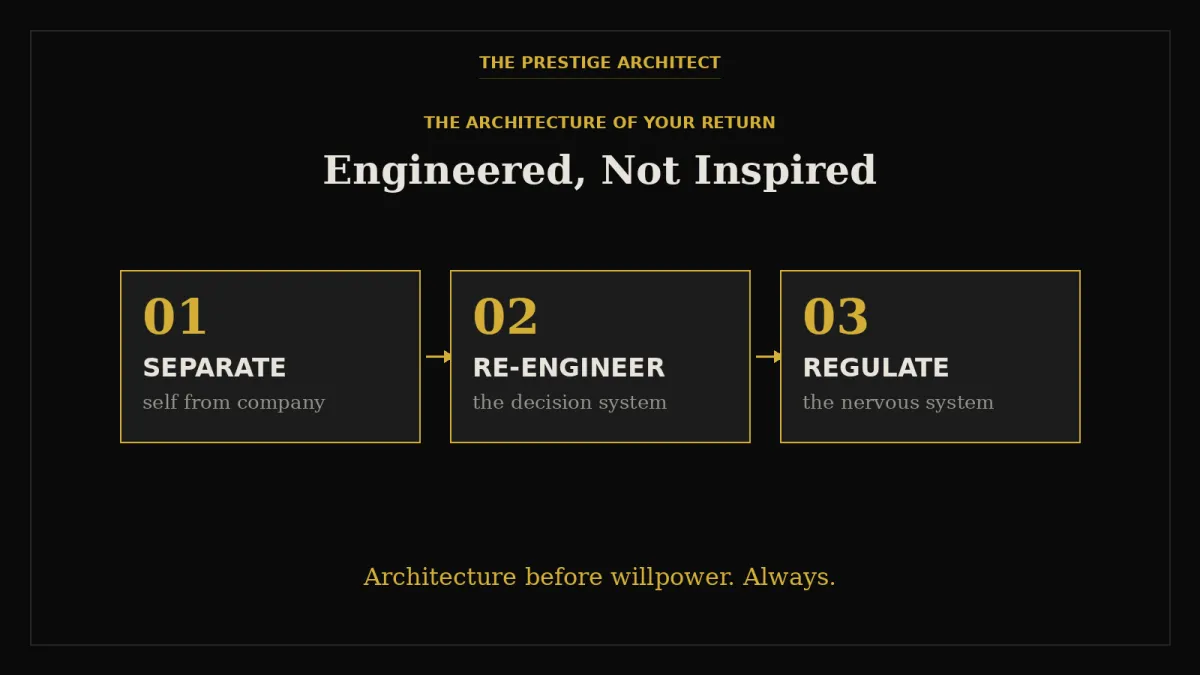
The architecture of your return
Success without self-betrayal is not a slogan. It is an engineering problem. Power without collapse is built, one rail at a time.
You already govern the hard parts of a company. You can govern yourself the same way. The return starts with one honest hour on where your own system is missing. That is what the diagnostic is for.
Apply for the Silent Collapse Diagnostic™. One hour, live with me. We map the rail you need first and the order to build the rest.
Frequently asked questions
What is executive self-governance?
Executive self-governance is the built system a leader uses to rule their own energy, standards, and decisions. It replaces willpower with design. It makes the right move the default, so your standards hold even when you are depleted.
How is self-governance different from self-leadership?
Self-leadership sets the direction and the identity you are moving toward. Self-governance builds the rails that hold you to that direction under pressure. Leadership is the compass. Governance is the guardrail. You need both.
Why does my self-discipline fail at the end of the day?
Self-control draws on a limited store that depletes with use. By evening the tank is low, so willpower gives out. The answer is not more effort. It is a system that spends less willpower by deciding in advance.
How do I start building self-governance as a leader?
Start with one recurring decision that drains you and turn it into a rule. Then design your first hour and protect your renewal on the calendar. Build one rail at a time rather than overhauling everything at once.
Can self-governance prevent executive burnout?
It targets the root cause. Burnout grows when energy is spent and never renewed and when standards run on mood. Self-governance schedules renewal and hands your standards to a system, so collapse has nowhere to take hold.
Baz Porter® is the founder of Baz Porter LLC® and the architect of Sovereign Leadership Architecture™. A British Army veteran and international bestselling author, he guides high-achieving leaders from Silent Collapse™ to Sovereign Leadership™: power without collapse, success without self-betrayal. Begin with the Silent Collapse Diagnostic™.