Learned Helplessness: Why Capable Leaders Stop Trying
Written by Baz Porter®
You have the title. You have the authority. You have the resources most people would envy. And somewhere inside, you have stopped believing any of it will change a thing.
That quiet surrender has a name. Psychologists call it learned helplessness. I call it one of the least visible forms of Silent Collapse™.
It does not look like giving up. You still perform. You still deliver. You have simply concluded, deep down, that your effort is pointless. I mapped this erosion in the manifesto, because it takes the most capable people first.
On this page
Key takeaways
Learned helplessness is the belief that your effort no longer changes the outcome, so you quietly stop trying.
It is not weakness. It is a nervous system that has learned that control is gone.
High achievers are among the most vulnerable, because their drive assumes effort always pays.
The exit is not more force. It is small, structured proof that your action still moves the world.
What learned helplessness really means
Learned helplessness is the state of believing your actions no longer affect your outcomes, so you stop acting on your own behalf. You still function. You still hit deadlines. But the sense that you can change your situation has gone quiet. In leaders it rarely looks like a crash. It looks like a capable person who has privately decided that nothing they do will matter, and has kept working anyway.
The term is not loose language. It comes from decades of research on how living things respond to conditions they cannot control. When effort and outcome stop lining up for long enough, the mind draws a conclusion. It decides the levers are disconnected. Then it stops pulling them, even after the levers start working again.
The hidden pattern beneath the surrender
Learned helplessness is not a character flaw. It is a lesson the nervous system taught itself.
The psychologist Martin Seligman named it in the 1960s. In his studies, subjects exposed to outcomes they could not control later stopped trying to escape, even when escape became easy. They had learned that response and result were unlinked, and the lesson outlasted the conditions that taught it (Seligman, Learned Helplessness, Annual Review of Medicine, 1972).
Capable leaders reach this point through a quieter door. You push on a problem that will not move. The market. The board. The culture you inherited. You apply real effort and get no proportional return, again and again. Your own competence makes it worse. A high achiever with a strong internal drive assumes effort always pays, so the gap between effort and result lands harder.
Over time, the mind protects you the only way it knows. It lowers the effort to match an expected return of zero. This is the surrender beneath the surface. You are not lazy. You have been trained, by repetition, to expect that pulling the lever does nothing.
The danger is that it hides. Learned helplessness in a leader does not announce itself. Psychology Today, writing on learned helplessness at work in 2025, described how it quietly erodes the will to act while performance holds. The American Psychological Association defines it as a failure to act after repeated exposure to uncontrollable events. The output stays. The agency leaves. You keep delivering from muscle memory while the belief that you can change anything drains out of you.
And because you still deliver, no one steps in. You get handed harder problems and more of the same immovable weight. You are promoted deeper into the exact conditions that taught you to give up.
The RAMS™ reframe
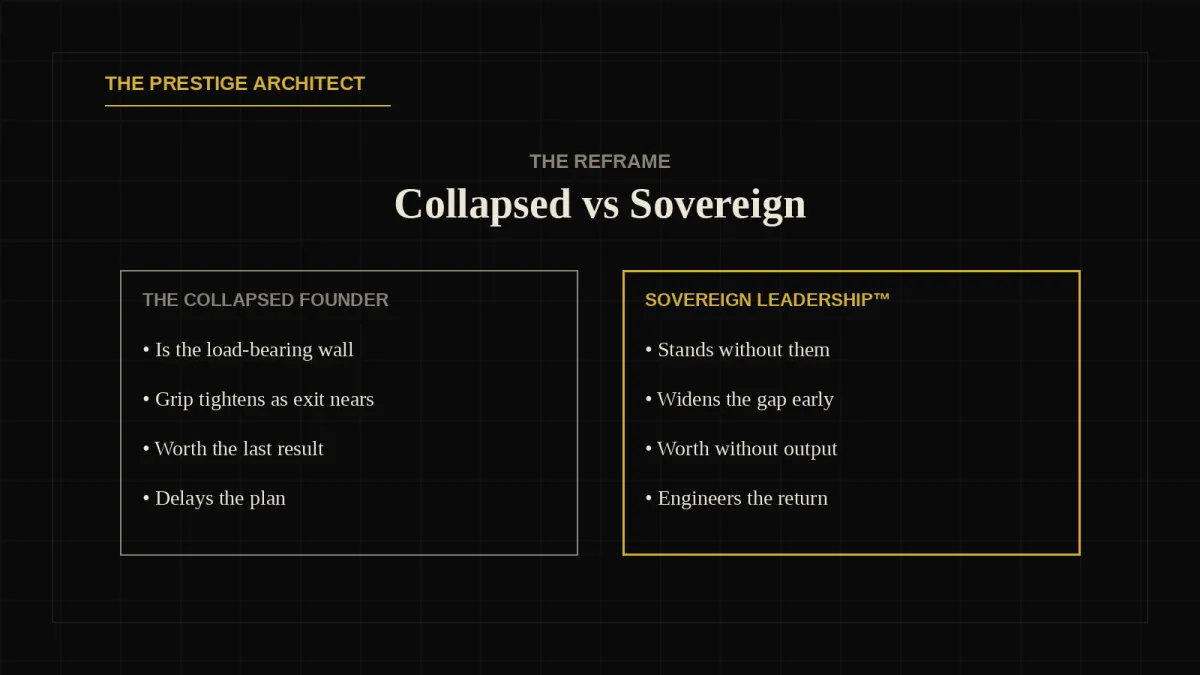
My work runs on RAMS™: Results, Attitude, Authenticity, Mastery, Systems. It reads a leader at the level of the nervous system, not the task list. Here is learned helplessness through each pillar, collapsed on one side and sovereign on the other.
Results. Collapsed: you stop setting goals you believe you can reach. Sovereign: you rebuild proof that your action moves outcomes, one small win at a time.
Attitude. Collapsed: quiet resignation dressed up as realism. Sovereign: earned optimism, grounded in evidence you gathered yourself.
Authenticity. Collapsed: you perform confidence while privately certain nothing will change. Sovereign: you tell the truth about where you feel powerless, and act from there.
Mastery. Collapsed: skill frozen, because why sharpen a tool that changes nothing. Sovereign: deliberate practice that restores your sense of cause and effect.
Systems. Collapsed: routines that confirm your powerlessness. Sovereign: structures that give you fast, visible feedback that you still move the world.
Baz Porter® does not motivate. He architects the conditions under which a leader recovers their own agency.
If you recognize yourself here, name it precisely. The Silent Collapse Diagnostic™ is a sixty-minute session with me. We find exactly where you decided effort was pointless, and what to rebuild first.
A leader I counseled
A founder came to me after four years of fighting the same wall. The company was stable. From outside, nothing was wrong. Inside, he had stopped believing he could change its direction.
He said it flatly. He still ran the meetings. He no longer proposed anything bold, because bold had not worked before. He had shrunk his own reach to the size of what felt safe. He called it maturity. It was surrender.
We did not add ambition. We rebuilt evidence. One small controllable action, taken and tracked, then another. Slowly his nervous system relearned the link between effort and result. The reach came back after the belief did.
The architecture of your return
You do not argue your way out of learned helplessness. The belief is not in your logic. It is in your body, written by repetition. You rewrite it the same way, through repetition you control.
Start small on purpose. Choose one action fully inside your control, take it, and record the result. The point is not the size of the win. The point is the proof that your action produced an effect. Learned helplessness is faulty evidence. You correct it with new evidence.
Then add a weekly review. Once a week, ask one question. Where did I act and see a result this week, and where did I assume the lever was dead without pulling it. Write it down. The pattern shows you where agency is returning and where it still needs rebuilding.
Do this under structure, not mood. Agency returns in repetitions, the way strength does. You do not think your way back to it. You build your way back. This rebuild sits at the center of Sovereign Leadership Architecture™.
When you are ready to do it with counsel, apply for the Silent Collapse Diagnostic™. One hour. One honest map of where you stopped trying, and the first structure to bring your agency back.
Frequently asked questions
What is learned helplessness at work?
Learned helplessness at work is the belief that your effort no longer changes your outcomes, so you quietly stop trying to improve your situation. You keep performing your role. You simply stop pushing for change, certain it will not land. It develops after repeated effort meets no result.
Why are high achievers prone to learned helplessness?
High achievers carry a strong drive and assume effort always pays off. When they hit a problem that will not move despite real effort, the gap lands harder than it would for others. Their own reliability also means they get handed more immovable weight with less support.
Is learned helplessness the same as burnout?
No. Burnout is exhaustion from depletion. Learned helplessness is a belief that action is pointless, which can arrive with energy still in the tank. You can feel capable and rested and still be certain nothing you do will change the outcome.
How do leaders overcome learned helplessness?
Leaders recover by rebuilding evidence that their action produces results. Take one small controllable action, track the outcome, and repeat under structure. Agency returns through proof, not force. A weekly review of where effort met a result speeds the rebuild.
Can learned helplessness lead to Silent Collapse™?
Yes. Left unnamed, learned helplessness is one of the quietest drivers of Silent Collapse™ in accomplished leaders. Performance masks it while the sense of agency drains away. Naming it early is how you interrupt the slide before it becomes the whole life.
About the author
Baz Porter® is a British Army veteran, international bestselling author, and host of the Rise From The Ashes podcast. He is the architect of Sovereign Leadership Architecture™ and the RAMS™ method. He guides accomplished leaders from Silent Collapse™ to Sovereign Leadership™: power without collapse, success without self-betrayal.